Waiting on Glory: Year Seven

Ethan’s Dad: Last week our Bible Study Fellowship Group was studying John 17, which is the prayer of Jesus before he goes to the cross in which He petitions the Father concerning His disciples and then for all believers. John 17:24 says: “Father, I want those you have given me to be with me where I am, and to see my glory, the glory you have given me because you loved me before the creation of the world.”

When our teaching leader got to that verse, he told a story about a nurse friend who worked at a hospital and who was taking care of a man who was having a heart problem. At one point in the middle of the night, the man coded, and the nurse had to pump his chest. For a moment, he did not respond, and the nurse saw a look of complete peace come over the man’s face. The nurse and the code team were able to revive the man. The next morning, the man woke up and was recovering well. The nurse went to him as she was leaving her shift because she wanted to ask him about that moment in which she saw his face seem so peaceful in the midst of the emergency. The man told her that he had seen Jesus and that the sense of security, belonging, and especially joy that he felt was unlike anything he had ever experienced. The man said he wanted to stay with Jesus, but that Jesus had told him it was not his time yet.

Our teaching leader related that story as a way of attempting to convey a taste of what it will feel like for believers in the presence of Jesus — to see His glory and to be with Him in eternity. For most of the people sitting in that chapel listening to the story, I am sure it was a reassuring and inspiring vignette. But it made me sick, almost physically sick, to the point that I wondered if I would need to walk out of the room.

For anyone who has read snippets of our story about Ethan, you might guess why the story produced that effect. Ethan had a heart defect. Ethan coded, on this very day, seven years ago. His amazing Mom tried to revive him while I stood by in helpless disbelief. The EMTs tried to revive him on the way to the hospital. The emergency room doctor and his team did everything they could for 20 minutes. Nothing. There was no revival. There was no peace. There was no happy story to tell. Our baby was gone after two incredibly short, hard months, in an instant. It was separation: cold, stark, and ongoing. I have no words to adequately describe it, and honestly, that is probably a good thing because no one would want to read about such emptiness.

And I started reliving that moment the instant our teaching leader mentioned that man’s heart trouble. I do not blame the teaching leader at all. This happens to us at times, and we never quite know what might set it off. I am sure the fact that it was close to this day had something to do with it, because it does not happen as often as it once did, and sometimes I wonder about that. It is not that time heals the hurt, as some people are all too fond of saying, but that time makes it feel more distant — until there is a trigger. Because when it happens, it feels very real, all too real, being right back there on that March 10th, the day that changed everything.

So, I took some deep breaths; I zoned out from the lecture for a little bit. I felt the deep ache inside. I wondered for the millionth time why Ethan is not here with us. Why does his twin brother not have his sidekick? Why do we not have five children sitting at the table every night? Why does Ethan not get to experience our laughter, our fights, our Friday-night movies, our family road trips? Why do we not get to see his smile, hear his voice, watch him run, feel his hugs? The enormity of what we all have lost because his little heartbeat stopped is incalculable.

There are many entries in this blog filled with musings about that why. This one is not about that. It is, first, just meant as a lament, because I still mourn over losing him. The sadness deserves — demands — to be acknowledged. Time does not heal it; time just spreads out the anguish so that it is not felt as deeply all the time. My heart is still broken, Ethan, and it always will be, as long as I am here. I do not believe that there is anything wrong in admitting that.

But there is another part to the story. After I started to come out of my flashback, I started to think again about what Jesus had said. “Father, I want those you have given me to be with me where I am, and to see my glory, the glory you have given me because you loved me before the creation of the world.” Jesus wants us to be with Him where He is. He wants us to live in His glory. Just as the Father loved Jesus before the creation of the world, Jesus loved us before we were ever created. So, is that what Ethan saw when he closed his eyes that last time? Did he see Jesus in glory, holding out His arms to embrace our frail little boy? Jesus informs his disciples before His prayer that “in my Father’s house are many rooms; if that were not so, would I have told you that I am going to prepare a place for you? And if I go to prepare a place for you, I will come back and take you to be with me that you also may be where I am.” (John 14:2-3). Jesus invited Ethan into His home. He said, “My child, you fought bravely, you gave all you could to stay with your family because you know how much they love you, but it is time now to rest with me. See how much I love you,” holding out His scarred hands, “and feel the glory that surrounds you,” a glory that is, somehow, more wonderful than the warmth he felt in his Mother’s arms.

Even more shortly before His prayer, Jesus tells his disciples: “So it is with you: Now is your time of grief, but I will see you again and you will rejoice, and no one will take away your joy.” (John 16:22). Ethan arrived at our true home before I have, but I will join him one day. And when I do, no one will be able to steal that joy ever again. “He will wipe away every tear from our eyes. There will be no more death, or mourning, or crying, or pain.” (Revelation 21:4). There will just be joy: Joy in being with our Savior, and joy in seeing my son again! Jesus has promised, and it will be.

As Jesus said, though, before that time, there is grief. Jesus acknowledges that. He did not say there is anything wrong with that. For some, that time of grief is longer than it is for others. I do not know why that is because it certainly seems unfair. “God knows we ache, when He asks us to go on. How do we go on?” (Ellie Holcomb, Red Sea Road). He asks us to go on in the knowledge that comes from faith as to what lies ahead in the end. The end is Jesus, the author and finisher of our faith. Jesus was there for Ethan seven years ago on this day. And He will be there with me and Ethan’s Mom on our last days. He is waiting to show us His glory, the glory Ethan already has seen and is surrounded by right now.

I can say that because Jesus is also here, right now, even in this ever-present moment of grief. He is here just as He was on that cross, bearing all shame, pain, anguish, anger, wrath, blood, and broken hearts. Right there Jesus and the Father experienced separation, loneliness, despair, darkness, the emptiness of that loved one not being there — a separation even more painful than ours because they had been together forever. He knows what this grief is to us, even more than we know it ourselves. Then Jesus died and His heart stopped beating.

But three days later “His heart beats, His blood begins to flow, waking up what was dead a moment ago.” (Andrew Peterson, His Heart Beats). His death will end Death, once and for all. He returned to glory so that we can join Him in glory. Jesus is there, in glory, waiting. Ethan is there, in glory, waiting. I am here, for so long as He calls me to care for the precious ones that remain here, waiting. But for those of us in Christ, waiting is hoping because “we celebrate in the hope of the glory of God.” (Romans 5:2).

This I call to mind, and therefore I have hope:

Because of the Lord’s great love we are not consumed, for his compassions never fail.

They are new every morning; great is your faithfulness.

I say to myself, ‘The Lord is my portion; therefore I will wait for him [hope in Him].’

The Lord is good to those whose hope is in him [who wait on Him], to the one who seeks him;

it is good to wait quietly for the salvation of the Lord.
Lamentations 3:21-26

Happy Fourth Birthday, Ethan!

Ethan’s Dad: It is late, but I cannot let the day pass without marking what should be our Little Caboose’s fourth birthday. His twin brother Noah had a good birthday, I think, filled with most of the things such a day should have for a child: special meals, an adventure with Mom, some cool presents, and visits from grandparents (both virtual and in person). Of course, those also are all things Ethan does not get to experience, and we, his family left in the Shadowlands, are so much the poorer for it. The joy we get to see from Noah is matched by the void left by Ethan’s absence.

And once again with these events that mark time we remain astonished in opposing ways that we have arrived at the twins’ fourth birthday because time both flies and crawls in this situation. It flies as we watch Noah, in the same way so many other parents do, grow like a weed throughout his precious childhood. It crawls as we miss Ethan, always yearning for that time when we will see him again. Time is indeed relative when you live with having twins but only one of them is still living with you on this earth.

I am ever thankful that we continue to get to see Noah’s joy. It is impossible to exaggerate the enormity of that blessing, one which I am painfully aware I would not recognize quite so well if it was not for Ethan’s absence. Yet, I am always heartbroken that we do not simultaneously get to see the same joy from Ethan, or the unique joy the boys certainly would have given to each other. Noah is now old enough to express to us — and often does— that he wishes Ethan would come back to us, and the sweetness of that unknowing longing evokes an inner ache that defies description.

My consolation — my hope — is that one day we are going to be able to sit down with Ethan and have a bunch of birthday parties in a row, or one party so stupendous that it somehow dwarfs these lost milestones. What will be his favorite party game, his choice of cake, his big present? I wonder as I wait for that jubilee which exceeds all earthly celebrations.

For now, we mark the time, we cherish Noah, and we cling to the promise that God is able to keep our Ethan, who we have entrusted to Him, until the day Christ returns. (2 Timothy 2:12). Our four-year-old who never reached four or three or two or one was celebrated and mourned this day. And so he will be until Kingdom Come.

Happy Birthday, Ethan

Happy 3rd Birthday, our precious Little Caboose. We can’t put a present at the end of your bed for you to open this morning. We can’t sing Happy Birthday to you and watch your smile. We won’t be wondering where to go for dinner because you and your twin brother picked different places.  We can’t see you try to blow out candles on a cake with Noah and then watch you stuff your face with it. We can’t watch you tear wrapping paper off of presents and then hear you giggle with glee when you see what is inside. We won’t be able to take you with us when we go off to Disney World next week to celebrate as we have done when each of our children has turned 3.

All we can do is continue to love you, remember you, and long for the day when we finally will get to celebrate with you. “For we know in whom we believe, and that He is able to keep you, our Ethan, who we have committed to Him, until the day Jesus returns.” (2 Timothy 1:12).

The day you were born was filled with trauma, and the too few days after that we had with you were hard on you and your little heart. But never, ever doubt, son, that each and every one of those days was a gift we will treasure forever. We miss you terribly every single day, dear Ethan, but especially so on this day which marks our introduction to your contemplative blue eyes and irresistibly adorable face.  We love you always and forever.  Celebrate a little with the Lord today, but be ready for the ultimate party filled with tears and cheers on that day we will be there to hug and hold you again.

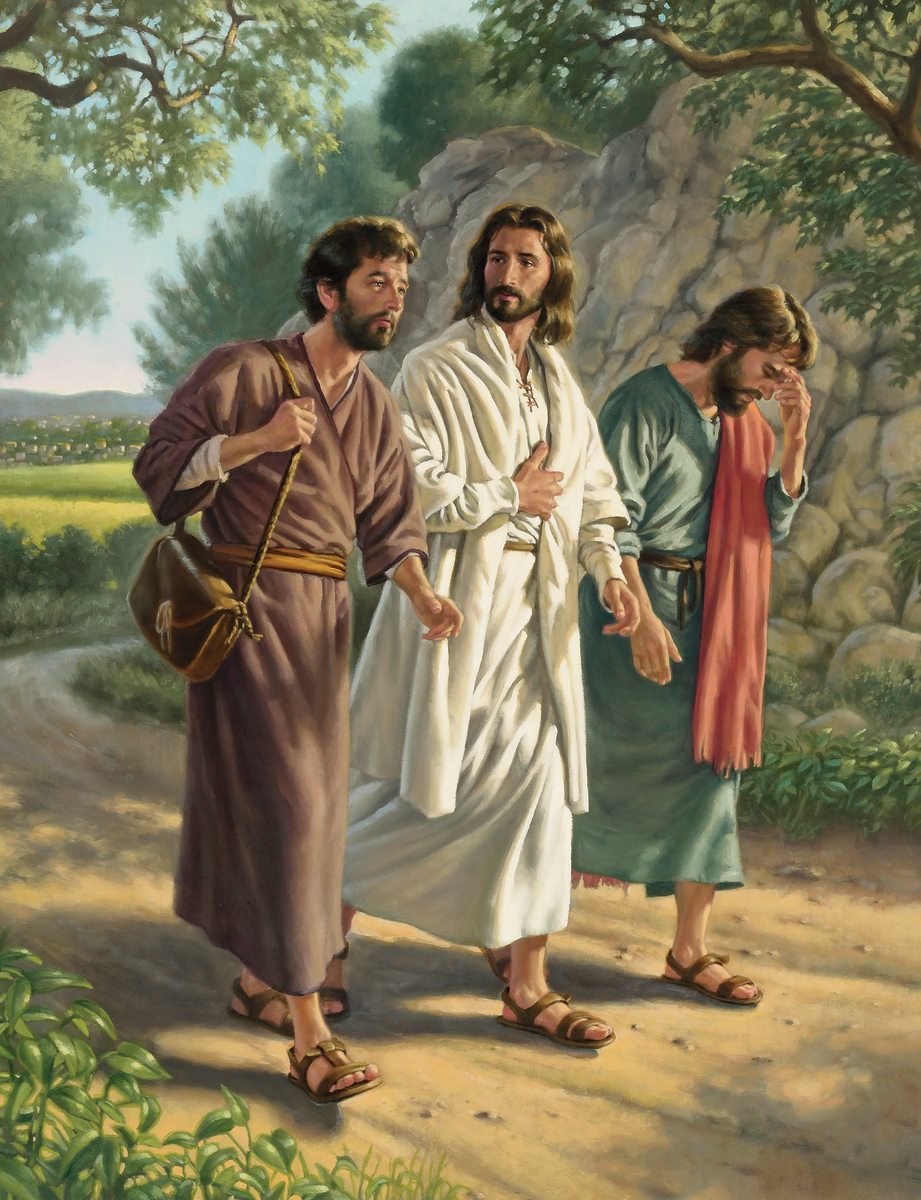
On the Road to Emmaus

Road to Emmaus

Several weeks ago a pastor at our church gave a sermon based on the story of the Road to Emmaus. For anyone who might be unfamiliar with it, the story can be found in Luke 24:13-35, and it is about who two followers of Jesus encountered when they were walking to a village about seven miles from Jerusalem on the day Jesus rose from the dead — before that news had widely spread. There are many fascinating aspects to the story, but this time when I was reading it one particular fact struck me in a way it had not done before. The story begins like this:

“That same day two of Jesus’ followers were walking to the village of Emmaus, seven miles from Jerusalem. As they walked along they were talking about everything that had happened. As they talked and discussed these things, Jesus himself suddenly came and began walking with them. But God kept them from recognizing him.

“Jesus asked them, ‘What are you discussing so intently as you walk along?’

“They stopped short, sadness written across their faces. Then one of them, Cleopas, replied, ‘You must be the only person in Jerusalem who hasn’t heard about all the things that have happened there the last few days.’

“‘What things?’ Jesus asked.

“‘The things that happened to Jesus, the man from Nazareth,’ they said. ‘He was a prophet who did powerful miracles, and he was a mighty teacher in the eyes of God and all the people. But our leading priests and other religious leaders handed him over to be condemned to death, and they crucified him. We had hoped he was the Messiah who had come to rescue Israel. This all happened three days ago.

“‘Then some women from our group of his followers were at his tomb early this morning, and they came back with an amazing report. They said his body was missing, and they had seen angels who told them Jesus is alive! Some of our men ran out to see, and sure enough, his body was gone, just as the women had said.

“Then Jesus said to them, ‘You foolish people! You find it so hard to believe all that the prophets wrote in the Scriptures. Wasn’t it clearly predicted that the Messiah would have to suffer all these things before entering his glory?’ Then Jesus took them through the writings of Moses and all the prophets, explaining from all the Scriptures the things concerning himself.”

What struck me was the line: “But God kept them from recognizing him.” (Luke 24:16). The immediate question that comes to mind is why? Why did God prevent these followers from recognizing Jesus the moment He appeared to them? As the story relates, the men were clearly distraught by the events of the crucifixion. As I attempted to convey in my last post, His followers’ whole worlds were turned upside down when Jesus was killed. These men tell Jesus that they had “hoped he was the Messiah,” and then those hopes were seemingly dashed by Jesus’ sudden and gruesome demise, which they probably witnessed. So, why in the world would God prevent these grieving men from recognizing Jesus standing in the flesh before them?

Of course, you start to get some sense of the answer as the story unfolds. First, the men honestly told Jesus what they believed: they thought Jesus was a great prophet and teacher, but they were unconvinced that He was the Messiah. Jesus then explained the Scriptures (what we today call the Old Testament) to them as they were meant to be understood, with Jesus at their center. His teaching was so powerful that the men literally begged Him to stay with them longer even though they still didn’t actually know who He was.

“By this time they were nearing Emmaus and the end of their journey. Jesus acted as if he were going on, but they begged him, ‘Stay the night with us, since it is getting late.’ So he went home with them. As they sat down to eat, he took the bread and blessed it. Then he broke it and gave it to them. Suddenly, their eyes were opened, and they recognized him. And at that moment he disappeared!

“They said to each other, ‘Didn’t our hearts burn within us as he talked with us on the road and explained the Scriptures to us?’ And within the hour they were on their way back to Jerusalem. There they found the eleven disciples and the others who had gathered with them, who said, ‘The Lord has really risen! He appeared to Peter.'”

After the encounter, the men didn’t sit around or go to bed; they got right back on the road back to Jerusalem to tell the Disciples what had happened to them. They were practically bursting with the news. These men, who had been followers, were now true believers in Jesus as the Savior of the world because now they had to tell people about Him.

Thus, by the end of the story, it becomes clear that God kept the men from initially recognizing Jesus for their own good. Their belief needed the uncertainty, and, dare I say, the pain, that came from not understanding what had happened to Jesus. It needed those prompting questions from a seeming stranger to bring their honest doubts to the surface. The men also clearly needed guidance from Jesus to traverse this spiritual journey from anxiety to exuberance about Jesus, but they did not really know that was their need. In short, in order for the men to experience a progression from factual knowledge about the Bible and Jesus to genuine understanding and faith in who Jesus really is, the men had to be kept in the dark for a little while. Timing was crucial to a correct understanding of the answers they sought.

So, you might be thinking: “That’s all very interesting with regard to how people come to a saving knowledge of Jesus, but why are you writing about it in this blog that is dedicated to Ethan?” And the answer is that I think God can be telling us more than one thing through the stories He has preserved for us in the Bible. I have no doubt that the story of the men on the Road to Emmaus is about a journey toward faith in Jesus. But it also can have something to say about how God raises His children.

No one knows us better than God because He made us. “For you created my inmost being; you knit me together in my mother’s womb.” (Psalm 139:13). He knows what we need, and, just as important, when we need it. So, when this story says, “God kept them from recognizing Jesus,” it suggests that there are times that God purposefully does not reveal to us the answer to a question we ask — even when we desperately want an answer for good an understandable reasons — because the timing is not right for us to receive that answer. For reasons we cannot fathom at the time, we must walk through a period of pain, uncertainty, inquisition, and spiritual guidance from the Lord before we are prepared to fully grasp the import of the answer.

If you think about it, we do the same with our own children. Children ask questions all the time that we know the answers to, but for a variety of reasons we do not provide them with an immediate direct answer. In many cases, we do not reveal the answer because the child is not ready to understand the answer. It is better for the child that the answer waits for a more appropriate time. This can be true for something as simple as a birthday surprise or as profound as how they came to be. In fact, there are even times when we will tell them the true answer because it is unavoidable, but they will not come to grasp the full import of that answer until many years later. I know this last one to be true from telling our other children when we came home from the hospital on March 10, 2017, that Ethan was not coming home. Our other children are still too young to really understand what his absence means.

The question I always ask God is Why? Why would You let our Ethan die so young, before we could see all he was meant to be? Why would You perform this miraculous work of creating so precious a creature inside his mother — together with his brother Noah — and then let that “wonderful work” die in our arms? (Psalm 139:14). Why would You allow this harrowing experience of twins being born in the back of an ambulance in an ice storm, only to then watch one of them expire after being raced to a hospital in another ambulance? Why would You have him be born with a hole in his heart, so that each of his days before a necessary (but supposedly common) surgery were a painful struggle for him, only to have him leave us before he could have that operation? Why? Why? Why?

Aside from the cold reality that evil really does exist in this world, God has not given me an answer. And to be honest, I believe that I am going to live the rest of my life — however long it is — without receiving an answer. I know that sounds depressing. And again, to be honest, there are a lot of times that the silence that surrounds that pleading question is just that: depressing, forlorn, dark — much like I imagine those men on that Road felt two days after Jesus had cried out from the Cross “My God, my God, why have You forsaken me?” before He breathed His last. (Matthew 27:46).

But it is also good to remember that this does not mean there isn’t an answer. The answer to Jesus’ question from the Cross came the moment He took His first breath in that tomb Sunday morning. The answer to those men’s questions was standing right in front of them even though they did not yet know it. It is a mistake to be believe that just because you do not receive an immediate answer to a heartfelt question that no answer exists -– or that you will never receive it. Sometimes the when is just as important as the what.

And I believe that there is a reason I have to wait for the answer to my question. I am well aware in saying this that it means God is purposefully allowing me to travel this road of uncertainty, doubt, and yes, even pain before I receive the answer. That is not an easy thing to accept, but the truth is often not easy; it is, however, necessary. And, by the way, that does not mean it is easy for God to make me wait, just as it is sometimes hard for me to keep an answer from my own children. God knows that I ache, and grieve, and wonder, and I believe that it rends His heart to watch me go through this experience. (Psalm 56:8).  But if sometimes what is best is not what is easiest, then that is as true for God as it is for us. So, in His infinite wisdom, He keeps the knowledge from me even though it pains Him to do so.

But please do not misunderstand: I am not saying that God thought Ethan needed to die in order for me to experience some kind of spiritual progression in my life. Some well-meaning Christians, in a round about way, say things like this to fellow believers who have suffered excruciating losses in an attempt to offer meaning for a senseless event. It isn’t true. What these people do not realize is that what they are really saying is that the loved one the fellow believer lost was just a pawn for God’s work in that believer’s life. That is an insult, not a comfort. How could this be if Ethan, like all of the other precious ones who are tragically lost through no fault of their own, is “fearfully and wonderfully made?” (Psalm 139:14). Pardon me for the bluntness, but this idea that all things occur for your own betterment is an extraordinarily selfish view of life. There is a distinct and important difference between understanding that God can produce good from the ash of tragic circumstances and saying that tragic circumstances are for our good. The former is Biblical truth; the latter is nothing less than the denial of the existence of evil.

What I am saying is that for some reason, I am not ready for the full answer to this question of Why. I think it is likely that at least part of the reason is simply that my finite existence is incapable of understanding it. Regardless, what is important for me to grasp is that sometimes God does not give us an immediate answer, not because it doesn’t exist or because we don’t deserve one, but rather because it is absolutely necessary for us to wait in order for the answer to have the meaning it is intended to have. And so I must wait. But I do not wait as one with no hope:

“It is wrong to say that the Almighty does not listen, to say the Almighty is not concerned. You say you cannot see him, but He will bring justice if you will only wait.” (Job 35:13-14).

One day I will have an answer, but it will be better than just a mystery revealed; it will include setting this wrong aright again.

“Yes, the Sovereign Lord is coming in power. He will rule with a powerful arm…. He will carry His lambs in His arms, holding them close to His heart.” (Isaiah 40:10-11).

I will not just get to see why; like the men on that Road, I will get to see Who is the answer. And I will see Him holding Ethan in His arms . . . waiting for me.

A Perpetual Saturday

Ethan’s Dad: I never really gave much thought to that Saturday. It wasn’t that I was flippant about it or that I purposefully ignored it. It was just that, in the Christian tradition I grew up in (and I think most others), all of the focus is placed on Good Friday and Easter Sunday. In many ways this is perfectly understandable.

Good Friday is the cataclysmic crisis point in which everything comes crashing down, the unthinkable occurs, and abject evil appears to win. For Christians that day is the definition of the ultimate sacrifice by the only One capable of making it for our sins.

In the starkest of contrasts, Easter Sunday is the glorious climax, the triumph, the grandest of all happy endings. It is the impossible of resurrection from the dead occurring, and yet it was simultaneously inevitable if Jesus was who He said He was because death could not hold onto the Author of life. For Christians that day means a new and ultimately eternal life with God.

So it is little wonder that Saturday is overlooked or even forgotten as it bridges these two profound and all-important days. But you don’t traverse a chasm without a bridge, so it is a required part of the journey, and — I have come to realize — it is more precarious than at first it might seem to be.

Can you imagine for a moment what that day must have been like for Mary, the Disciples, and others close to Jesus? Jesus had completely changed their lives: shown them miraculous signs reminiscent of wonders spoken about by ancestors of old, opened the doors of love beyond their previous comprehension, given them a brand-new purpose for life, and offered a hope unlike any they had ever known before. He had promised them an eternity with Him.

And then it all came to a sudden and sickening end in the span of one dark day. It must have been extremely confusing for them to watch Jesus be arrested, let alone witness Him beaten, then offered to the crowds, and then crucified like a common criminal. Everything they had known, believed, and hoped was instantly shattered beyond all recognition the moment Jesus breathed His last on that cross. It had to seem almost surreal, like it had to be a nightmare that they would surely awake from at any minute.

But when Saturday dawned, the darkness was still there, and it was, if anything, more oppressive. The sheer intensity of the trauma from the previous day was replaced by the stark void of the loss. Jesus really was not there. His leadership, assurance, and love were gone. More immediately, His presence was missing. And somehow they had to go on.

Remember that they did not know what would happen on Sunday. Jesus had tried to tell them, of course, but they just couldn’t understand it. Honestly, in a way you can’t blame them. It was all unlike anything that had ever happened before. Granted, as I have said, they had witnessed Jesus precipitate several miraculous events on a smaller scale: feeding thousands with almost no food, calming raging seas and walking on water, raising Lazarus after he had been in a tomb for 4 days. But this time they had watched Him die. And not just any death, but the most gruesome devised by the Roman Empire. It had to feel devastating, bewildering, hopeless. Surely they just wanted to crawl into a shell and never come out.

So they waited . . . and wondered. What was there left to do? How do you hold onto faith when everything you believed is turned upside down? How do you maintain hope when you watch it breathe it’s final breath? How do you continue to love when what illuminates that love is buried in a tomb? The questions are endless and the answers are elusive; they feel out there, yet not accessible. That Saturday they lived in a kind of netherworld — not really dead, but not capable of fully living either.

“So they took His body down
The man who said He was the resurrection and the life
Was lifeless on the ground now
The sky was red His blood along the blade of night

“And as the Sabbath fell they shrouded Him in linen
They dressed Him like a wound
The rich man and the women
They laid Him in the tomb

“….

“So they laid their hopes away
They buried all their dreams
About the Kingdom He proclaimed
And they sealed them in the grave
As a holy silence fell on all Jerusalem”

-Andrew Peterson (God Rested)

If you haven’t already guessed it, the reason for this rumination (other than the fact that it is Easter weekend) is because for my wife and I it feels as if we are living every day in something like that Saturday. You see, on one level, the day of a tragic event is the hardest because the vividness of its devastation haunts you over and over again. But in another sense, the day after is almost harder. At the time, the day of the event seems surreal, like it can’t be happening, like you are watching it from the outside as it unfolds. But the day after the horror, the reality hits you because the frantic energy of the moment is no longer there, and a person you love gone. The stark realization of permanent absence desolates your soul and you can hardly breathe, let alone dare to believe that one day the chasm of that loss will disappear and you will be reunited again.

An irreplaceable presence, our Ethan, is missing from our lives every day. It is an absence we did not ask for or expect. And that absence stretches on, with each new day bringing an ache and unsettledness that never quite subsides. When we say we are “Walking in the Shadowlands,” this is, in large part, what we mean.

An undeniable fact about that Saturday long ago is that God knew what it would be like for those close to Jesus after He was crucified.  God knew about the pain, confusion, and uncertainty, and yet He did not break through the silence to give them reassurance. He let then wait until Sunday to see the answer for themselves. I think it is worth asking: Why did God allow them to endure that Saturday?

The most immediate answer is that He knew everything would be made right again on Sunday. But what if it was more than that? Suppose that the waiting, with all of its attendant anguish, bewilderment, and doubt, was a necessary part of the process for the revelation of the Resurrection.  Would the Disciples have fully grasped the implications of the Resurrection without experiencing what life would be without Jesus’ presence?

Of course, Christians today know how the whole story unfolded, so it is harder to grasp what the loss of Jesus must have felt like on that Saturday.  But we do experience personal losses, sometimes profound ones.  And sometimes, when there is a loss that is wretchingly dear, God asks us to wait the rest of our earthly lives — to trust Him in the midst of the daggers of pain and whirlwinds of questions — until we come to the end of that seemingly perpetual Saturday and see that the loss will be made whole.

For me, then, there is a strange comfort in the fact that dark Saturdays are not alien to Christianity; they are, in fact, apparently somehow integral to it.  It does not lessen Ethan’s loss for me, but it does show me that God knows what I am feeling, and the fact that He has let me experience it is not proof that He is not there, as some would tell you.  Instead, the loss of that precious boy, and the restless unease that accompanies it, imparts a little more understanding of what life would mean without Jesus, without His death, burial, and resurrection.  So, I will keep walking in the shadows and looking forward to dawning of that Sunday when

“the Lord Himself will descend from heaven with a shout, with the voice of the archangel and with the trumpet of God, and the dead in Christ will rise first. Then we who are alive and remain will be caught up together with them in the clouds to meet the Lord in the air, and so we shall always be with the Lord.” (1 Thessalonians 4:16-17).