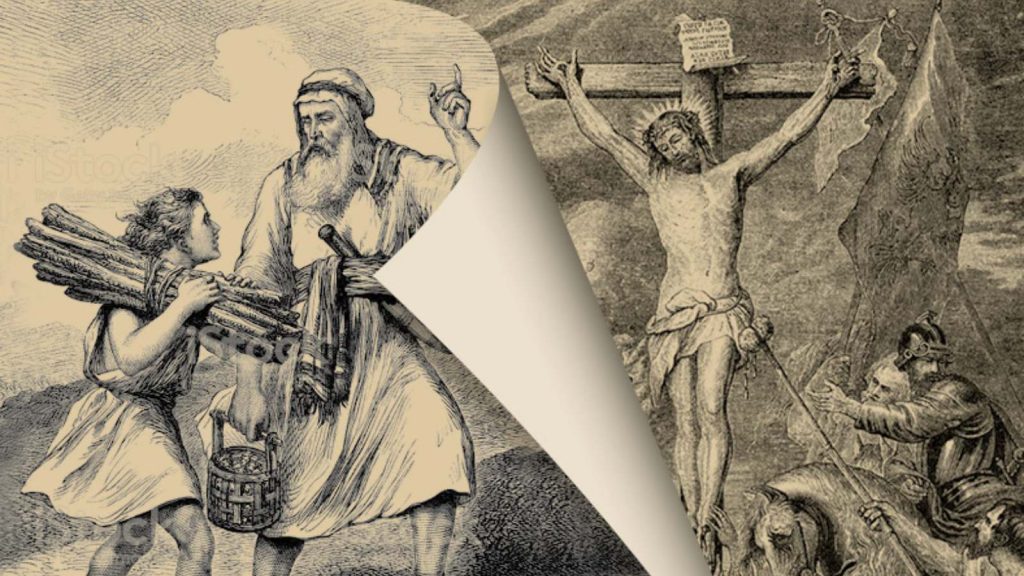
Ethan’s Dad: As my last post noted, we recently celebrated the twins’ fourth birthday. In our Bible Study Fellowship classes, the lesson for Ethan’s Mom and I that week of Ethan’s birthday was Abraham’s sacrifice of his son Isaac (Genesis 22:1-14). People who believe or live as though there is no spiritual aspect to life would ascribe that kind of occurrence to a mere coincidence, but if you believe that God exists, that He loves you, and that He is active in your life, then it is not so easy to dismiss this scheduling alignment.
So why would God have us study that particular story on that particular week? From a certain point of view, it seems cruel to have to ponder a story about God asking Abraham to sacrifice his son on the same week we remember the coming into the world of the the son we lost. And I don’t want what I am going to relate here to obscure the reality that engaging with the lesson was painful. To be sure, there are key differences between Abraham’s experience and ours: God did not ask us to give up Ethan, like He commanded Abraham to sacrifice Isaac, and our son was actually taken, without warning or explanation, while Abraham ultimately received the grace of not having to go through with the horrible deed and thus retained his son. Perhaps most importantly, the Genesis text expressly states that God was testing Abraham (22:1). As I have related in this blog before, I steadfastly believe that Ethan’s death was not a “test” from God: death is evil; it is not part of God’s original plan for us, and ascribing a tragedy like that to some sort of spiritual maturation process co-signs Ethan to being nothing more than a pawn in other people’s lives, which is absolutely wrong.
Even though we can mentally recognize those differences, the story still evokes strong emotions because of our experience. We understand what is being asked of Abraham in a tangible way few others can. Likewise, we have a deeper sense of what it actually meant for God to sacrifice, and be separated from, His Son Jesus on the Cross. (Though no human can adequately grasp the level of that sacrifice because Jesus physically endured an almost unimaginably grotesque death, He spiritually bore the entire sin of the world for all-time, and He and the Father had never before experienced the separation this sacrifice required). But if you asked us, we would say in a heartbeat that this deeper sense of understanding the magnitude of the loss at issue is not worth it. Indeed, there have been numerous times in the wake of that most horrendous of days that we have questioned whether this whole way of setting things up makes sense or was worth it. Why would God create a world where He knew so much pain was going to be inflicted on people He says He loves?
But then you have to remember Genesis 3:15 (“And I will put enmity between you and the woman, and between your offspring and hers; he will crush your head, and you will strike his heel.”) which tells us that God also set up this world in such a way that His Son (and therefore also Himself) was going to hang on a tree by nails in order to save us. So we can’t say that God is ducking any of the pain or that this is some kind of cruel joke or game He is playing because no rational person would set up such a wrenching game. In other words, God could identify with Abraham, and He can identify with us, just as we can with them.
And that truth got me thinking that perhaps the reason God had us do this particular lesson on this particular week was to identify with Abraham all the way through the story — not just in the sense of loss — but in order to affirm to us that Ethan was a precious gift to us, just as Isaac was to Abraham. For just as Isaac’s conception and birth were miracles, it also was a miracle that Ethan was born safely in that ambulance four years ago. As his only child, Abraham undoubtedly had spent a tremendous amount of time with Isaac before God gave this test to Abraham. We spent two priceless, brief months with Ethan, caring for him more intensely than any other baby we have had, up until the very moment he left us. But there is more to the parallel. Abraham was able to obey God’s command because Isaac’s life was a testimony to the facts that God always keeps His promises and that God does impossible things. According to Hebrews 11:19, Abraham in fact was clinging to the belief that Isaac would be raised from the dead, even though he had no concrete experience of such an event. But Abraham did know that God had demonstrated the power to create life from Sarah’s “dead” womb, and so Abraham firmly believed (because otherwise how could he ever have taken even the first step toward that mountain?) that even Isaac’s death could not hinder God from keeping His promises about Isaac and his offspring.
It is true that God endured the sacrifice of His Son while knowing that that Jesus was going to be raised from the dead, while Abraham had to rely on faith in carrying out God’s command to sacrifice Isaac. But that is precisely the point: we must come to understand that faith in God is as certain as actually knowing how it all ends. God commended and blessed Abraham, He preserved Isaac in the flesh, and He saved Abraham for eternity precisely because of Abraham’s indomitable faith in what was true: that God is a promise-keeper who does the impossible, including resurrection. Thus, to God knowing the answer is not as important as having faith in Him that there will be an answer.
Yes, this story of Abraham and Isaac is about how obedience to God may involve great sacrifice — though not more than God already has sacrificed for our salvation. But it is just as much about sustaining faith in God’s power of resurrection. So perhaps God was reassuring us on that particular week that His gift of Ethan to us was not in vain; we, like Abraham, can believe with confidence that we will see Ethan again because God ensured exactly that with none other than His own Son, who lives and is with Ethan at this very moment. Praise the Lord for His comforting truth in the midst of great sorrow!
 Walking in the Shadowlands