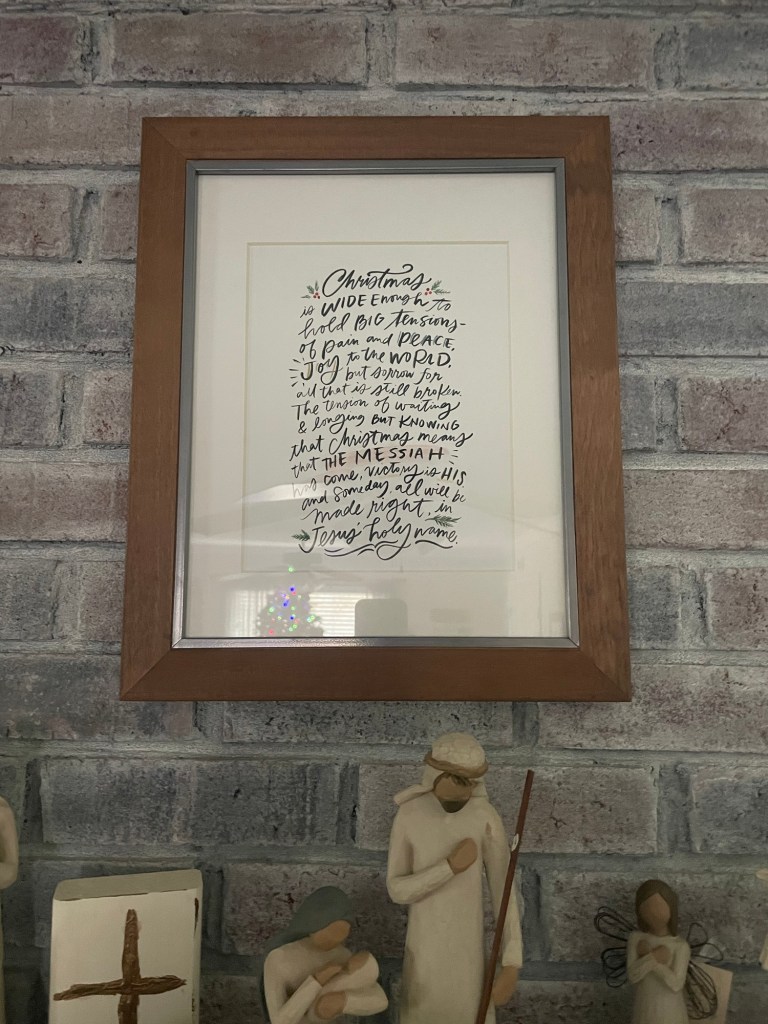
Christmas is Big Enough

Ethan’s Mom: A couple of years ago, I found a hand-lettered print that we now display every Christmas. It reads:

Christmas is wide enough to hold big tensions – of pain and peace, joy to the world but sorrow for all that is still broken. The tension of waiting & longing but knowing that Christmas means that the Messiah has come, victory is His, and someday all will be made right, in Jesus’ holy name.

I need that reminder every year. I remember sitting in a grief counselor’s office in the fall of 2017 asking if I would ever enjoy Christmas again. I used to love Christmas, I said, but I want to skip the whole thing this year. My capacity to hold joy and sorrow has grown significantly over the last six years, but I still struggle to hold all the joy of Christmas with the pain of missing Ethan. Although we have developed traditions which keep his memory alive in our celebrations, we have never spent a Christmas with our entire family. The closest we have been was in 2016 when I was 34 weeks pregnant with the twins.

This year, the words from that print seem especially significant.  The Wednesday after Thanksgiving, a teenager in our church died unexpectedly.  The following Sunday was both the first week of Advent and his memorial service.  I shed many tears between those two days.  I cried for the abrupt end of his life, for his parents and siblings, and for his friends at church and their families.  

I also cried for the abrupt end of Ethan’s life, for my family, and for me.  There are several details that differ between our stories.  For instance, Ethan’s siblings were much younger and grieved in a very different way than teenaged siblings would after sixteen years of life together.  But you don’t have to look too hard for the similarities.  One night, we went to bed without any indication that our sons would not be alive the next morning.  We both had taken last group pictures of our children not knowing we would never have a complete family photo again.  We were both left with a million questions, most of which have no answer.  All of these thoughts swept me back to March 2017 in a way that I had not experienced in a long time.  

Like many people who love this family and wanted to support them in the shocking aftermath of that day, I wanted to do something. It turns out, our immediate role was not to make a casserole or send flowers, it was to light a candle.

Our family had been asked to light the first candle of Advent the day before anyone had any notion that the week would take such a tragic turn. The litugrical calendar specifies a theme for each week of Advent, and the first week is hope. Sometime late in the week, I realized how important it would be to light that particular candle on the very day that held not only the first worship services since this teenager passed away but also his memorial service later that afternoon.

It may not seem like a lot to light a small candle in the face of so much darkness; I confess that I initially thought it might not even matter to anyone except for me.  But then I remembered an exceprt from one of my favorite read aloud series, “The Green Ember.”  The series follows a group of rabbits as they fight for freedom from their birds of prey captors, and the four books are full of examples of true courage and hope.  In book three, after the wizened captain explains to the young hero that his job in the upcoming rebellion is not to fight but to unfurl a banner over the battle raging below, the young rabbit denies his instinct to charge into the battle. 

How could he help them? He knew he could help them most by shifting the battle in any small way…Then he remembered Helmer’s words, ‘Symbols matter, more than you might imagine.’ Picket’s heart was pumping fast, and he wanted badly to join the battle. But he banked and swept over the center of the skirmish…He waved the torn banner back and forth. “For the Mended Wood!” he cried. He heard an answering shout over the din of war and felt inside the fire of the good fight. He knew that all around, from the desperate fighters in the square to the hundreds rushing into First Warren through the west wall breach, the sight of this renowned warrior waving the true king’s banner atop this desecration of a statue was one to set the faintest heart on fire.

Ember Rising by SD Smith

I do not claim to be a “renowned warrior” but I am a veteran fighter in the ongoing battle against the darkness of dispair. After six Christmases of “holding the tension between joy to the world and sorrow for all that is still broken,” I felt that our family was uniquely empowered to light the candle of hope that morning. It felt like a mission. The hope candle is the first candle, lit before the candles of peace, joy, and love can shine. It’s the first flicker of light, breaking the darkness. It paves the way toward the full illumination of the Advent wreath with its Christ candle glowing in the center on Christmas Day.

I pray that tiny flame shifted the battle in any small way for our church family that morning. I have heard from a few people who reached out to say that the meaning was not lost on them. In some mysterious way, that candle also shined a little tiny bit of redemption on our story. If you have read this blog at all, you know this has been the hardest thing Ethan’s dad and I have experienced, individually and together. But we are still here, standing, fighting for the light, holding on to hope through another Christmas season without Ethan.

One week later, we gathered for our church Christmas musical, a wonderful concert with an intergenerational choir, orchestra, and scenes from the nativity. It was a truly joyful time, but not without its own moments of sorrow. The juxtaposition between the two weeks was apparent – one very sad day with a spark of hope and one very joyful day with a bittersweet note in the air. We could gather for both, knowing that Christmas is big enough to hold it all.

On this Christmas night, whether you find yourself holding on fiercely to a small flickering flame of hope or in the warm glow of a joyful celebration or somewhere in between, I pray that you know “that the Messiah has come, victory is His, and someday all will be made right, in Jesus’ holy name.” Amen.

Light of the World

By: We the Kingdom

Light of the world, treasure of Heaven
Brilliant like the stars, in the wintery sky
Joy of the Father, reach through the darkness
Shine across the earth, send the shadows to flight
Light of the world, from the beginning
The tragedies of time, were no match for Your love
From great heights of glory, You saw my story
God, You entered in, and became one of us

Sing hallelujah, sing hallelujah
Sing hallelujah for the things He has done
Come and adore Him, bow down before Him
Sing hallelujah to the light of the world

Light of the world, crown in a manger
Born for the Cross, to suffer, to save
High King of Heaven, death is the poorer
We are the richer, by the price that He paid

Sing hallelujah, sing hallelujah
Sing hallelujah for the things He has done
Come and adore Him, bow down before Him
Sing hallelujah to the light of the world

Light of the world, soon will be coming
With fire in His eyes, He will ransom His own
Through clouds He will lead us, straight into glory
And there He shall reign, forevermore

Sing hallelujah, sing hallelujah
Sing hallelujah for the things He has done
Come and adore Him, bow down before Him
Sing hallelujah to the light of the world
The light of the world

The Futility of Going Back to the Future

Ethan’s Dad: Have you ever noticed how much people are obsessed with time? The common observation is that ours is a fast-food culture, which means we want/demand everything to happen as instantly as possible. But the obsession doesn’t stop there. Countless stories, television shows, and movies revel in imagining that we could manipulate time — whether that entails traveling backward to remedy tragedies and mistakes or jumping forward to discover what awaits us, and they posit questions about the consequences of moving either way on the timeline. We long for this power over time even though there is no realistic indication that we could obtain it.

But that does not stop people from thinking about the possibility of time-travel. In this vein, I recently read a news story about the paradox of time-travel. The paradox of time-travel is that if a person was to travel back in time in order to fix something that went wrong in history — like trying to prevent Adam and Eve from eating the fruit that caused the fall of humanity into sin — fixing that problem would mean that the problem would no longer exist when that person returned to his or her own time, so there would be no motivation to go back in time in the first place. Put another way, things happen the way they happen, and if they unfolded another way than was intended we could never know it because we are creatures of the time we are born in. However, a prolific young scientist in Australia claims to have demonstrated through mathematics that the paradox of time-travel does not exist. The young man says that if you were to go back in time and fix a problem, events would conspire in such a way that the problem would occur anyway. In the example I just referenced, if you stop Adam and Eve from eating the fruit, someone else would still disobey God, and we would still have sin. So, the motivation for going back to fix the problem would still exist for the time-traveler, and thus there is no paradox. Of course, if the Australian mathematician is correct, the lack of a paradox also means that even if humans could go back in time, they could only change a particular variable of time, not what ultimately happens in the timeline. In other words, there is an inevitability to the unfolding of events even though human agency makes deliberate choices about how to do things.

You might think this is a strange topic to explore in this blog. But to me this theory sounds an awful lot like God’s planning of time in this world. We know choice exists because without it love would not be real. However, we also know from the Bible that God has had a plan from before the beginning of time as to how humanity’s arc, and God’s salvation, would unfold. One of the verses I recite every time I visit Ethan’s grave is a paraphrase of Titus 1:1-2: “The faith of those chosen of God and the knowledge of truth are a faith and knowledge that rest in the hope of eternal life which God, who does not lie, promised before the beginning of time.” The prophet Isaiah proclaims: “O Lord, You are my God; I will exalt you and praise your name, for in perfect faithfulness You have done marvelous things, things planned long ago.” (Isaiah 25:1). Ecclesiastes 3:11 (my all-time favorite verse) informs: “[God] has made everything beautiful in its time; He has also set eternity in the hearts of men. Yet they cannot fathom what He has done from beginning to end.” These (and many other) Bible verses point to God setting up time as an unfolding story and yet planning for eternity even before He started the clock of history. People often wonder how these two things can be simultaneously true. But if time operates in such a way that we are able to make deliberate choices and yet the grand sweep of history unfolds only one way, i.e., we cannot manipulate the timeline (because we are not God), then it seems to me that we have at least a partial answer to the mystery. God has designed our timeline in such a way that our billions of variable choices impact us, but they do not affect the destination of history, which culminates with salvation through Christ for all who believe.

Pondering such a model of existence is both mind-boggling and awe-inspiring. The question that often arises from such pondering about time and eternity is: why would God set all of this in motion if He knew about all of the atrocities that would subsequently transpire? Or, as Fyodor Dostoevsky famously asked in “The Grand Inquisitor” chapter of The Brothers Karamazov: How can God say that all of this is worth the suffering of even one starving child? The consequences of the abhorrent evil Adam and Eve brought into this world are enormous, some would say, incalculable.

I think the answer to The Brothers K question lies in coming to appreciate that there is no reason that we should exist at all apart from God’s grace. God was here before all of the creation we see and that we are still discovering: Absolutely nothing required Him to make all of this and all of us in the first place. He never had to say “Let there be light.” He could have left Earth formless and void. Nothing mandated that He create creatures in His image. Yes, there is a whole lot about this world that is evil and dark and relentlessly unforgiving; viruses are part of that, as are the unexplained deaths of infant children, and seemingly a million other cruel things. But before all of that there was God. And by His own choice, first there was light, and then there was the gift of life. And all of that was immeasurably good. Moreover, beyond the irreplaceable gift of existence is the fact that God accounted from the beginning for humanity’s going astray, and His solution to that immense problem entailed sacrificing His own Son. If we stop and think about all of that first, before all else, it should produce a profound sense of gratitude and thankfulness. As the Psalmist said: “It is good to proclaim your unfailing love in the morning, and your faithfulness in the evening.” (Psalm 92:2). Such an attitude of thankfulness as a starting point can change our perspective of what we see before us. It does not erase evil, but it reminds us that the good, that life itself, is not a brutal fact of necessity, but is truly a gift from God.

I always lament (and forever will) that Ethan did not get to live more of this life, but I am thankful that He lived at all, and I should remember that the same is true for me and everyone else. As the Psalmist also reminds us, “For with You is the fountain of life; in Your light we see light.” (Psalm 36:9). The light of life is sparked by thankfulness to the God who gave us everything. Can we honestly say that never existing would have been better than the evil that plagues the world, especially given what God foreshadowed in the Garden of Eden and brought about through Jesus? The Lord declares: “I make known the end from the beginning, from ancient times, what is still to come. I say, ‘My purpose will stand, and I will do all that I please.'” (Isaiah 46:10). That end is this:

“The Lord God will swallow up death forever.
He will wipe away the tears from all faces;
He will remove the disgrace of His people from this whole earth.
For the Lord has spoken.

And in that day it will be said: ‘This is our God;
We have waited for Him and He has saved us.
This is our Lord;
Come let us be glad and rejoice in His salvation.'”

(Isaiah 25:8-9).

The inexpressible hope of this end to time-bound life is why God’s answer to Job in chapters 38-41 of that difficult work is not as heartless as it can seem from our perspective of sympathizing with Job’s immense suffering.

“Then the Lord spoke to Job out of the storm. He said:

“Who is this that obscures my plans
with words without knowledge?
Brace yourself like a man;
I will question you,
and you shall answer me.

“Where were you when I laid the earth’s foundation?
Tell me, if you understand.
Who marked off its dimensions? Surely you know!
Who stretched a measuring line across it?
On what were its footings set,
or who laid its cornerstone—
while the morning stars sang together
and all the angels shouted for joy?

“Who shut up the sea behind doors
when it burst forth from the womb,
when I made the clouds its garment
and wrapped it in thick darkness,
when I fixed limits for it
and set its doors and bars in place,
when I said, ‘This far you may come and no farther;
here is where your proud waves halt’?

“Have you ever given orders to the morning,
or shown the dawn its place,
that it might take the earth by the edges
and shake the wicked out of it?
The earth takes shape like clay under a seal;
its features stand out like those of a garment.
The wicked are denied their light,
and their upraised arm is broken.

“Have you journeyed to the springs of the sea
or walked in the recesses of the deep?
Have the gates of death been shown to you?
Have you seen the gates of the deepest darkness?
Have you comprehended the vast expanses of the earth?
Tell me, if you know all this.

“What is the way to the abode of light?
And where does darkness reside?
Can you take them to their places?
Do you know the paths to their dwellings?
Surely you know, for you were already born!
You have lived so many years!

“….

“Do you known the laws of the heavens?
Can you set up God’s dominion over the earth?

“….

“Who endowed the heart with wisdom
or gave understanding to the mind?

“….

“Would you discredit my justice?
Would you condemn me to justify yourself?

“….

“Then Job replied to the Lord:

“‘I know that you can do all things;
no purpose of yours can be thwarted.
You asked, “Who is this that obscures my plans without knowledge?”
Surely I spoke of things I did not understand,
things too wonderful for me to know.

“‘You said, “Listen now, and I will speak;
I will question you,
and you shall answer me.”
My ears had heard of you
but now my eyes have seen you.
Therefore I despise myself
and repent in dust and ashes.'”

Job 38:1-20, 33, 36; 40:9; 42:1-6.

God was not saying to Job that He did not care about Job’s suffering; after all, He was very careful to curtail Satan’s desire to destroy Job. But God was saying that He has existed from before the beginning of time and that He created this world with His own rules and intentions. For some reason, God did not (fully) reveal the end of history to Job, and, as with Job, He does not reveal all of the reasons for the shattering events of our earthly lives. Yet, for us to question God’s ways without accounting for the entire picture is to approach sophistry. The Lord does not despise heartfelt questions: God did not stop Job from asking his questions over and over again, and the Psalms are full of questions to God for why He allows things to occur the way they do. But God desires that we not assume a position of authority as if we have the knowledge and power only He possesses.

Accepting that we cannot fully comprehend why events unfold as they do, and that we cannot actually alter God’s plan, can bring some peace in the turbulence of life. For one thing, from these truths it follows that just because we cannot fathom a reason for an occurrence does not mean that there is no reason for it (a mistake often made by atheists). For another, it means that no matter how terribly we screw up, we cannot throw God for a loop because events will inevitably culminate with Jesus’s return, God’s victory over sin and death, and eternal life in glory with Him for those who believe. We must always keep this end in mind as we traverse our story in time because there will be life events we desperately wish we could do over.

For instance, it is only natural that I wonder about that March night and morning in 2017: that maybe if I had done just one thing differently Ethan would still be alive. But I cannot go back because, for whatever reason, this is how the story unfolded, and I am a part of this time, not outside of it like God. Moreover, as his mother and I know by now (though a part of each of us will always struggle to admit it), nothing we did caused Ethan to die. For a combination of reasons, unknown to us and to the medical world, his little body could not hold on anymore. He spent one last night and early morning close to us, and then he left and was welcomed into the arms of Jesus. And as painful as Ethan’s absence always will be during the remainder of our time here on earth, we must always remember that this catastrophic event is not the end of story. God, at the end of time, will, in a sense, undo time’s scars.

From His Word, we can see that God’s love overcomes this wretched evil and that the evil ultimately will be wiped away. This means that there is something in this time-bound life that is vital to our lives in eternity. Part of the importance is obviously God’s demonstration of His love for us, which had to physically unfold in order to be truly appreciated.  I have been saying that God is outside of time, but perhaps even more wonderous than that is the fact that God actually chose to enter our time in order to ensure its glorious ending.  God not only set time in motion; He marked its defining moment with His own presence, and then sacrifice.

But I suspect that part of the importance of living this life is the idea Andrew Peterson suggests in his song Don’t You Want to Thank Someone for This

“And when the world is new again
And the children of the King
Are ancient in their youth again
Maybe it’s a better thing
A better thing

“To be more than merely innocent
But to be broken then redeemed by love
Maybe this old world is bent
But it’s waking up
And I’m waking up”

There is some way that experiencing this life, both in its immense joys and wrenching sorrows, heightens our lives in eternity in a way that would not have been true if all of this had not occurred. We cannot know exactly how that is; our charge is to trust that this is true because of what we do know: that God so loves us that He gave His only Son to die for us, that Jesus rose again, and that one day we will spend eternity with Him. Those are the timeless truths for our time-bound lives.

When Love Refrains: What Else the Story of Lazarus Tells us about God

Lazarus 1Ethan’s Dad: My wife has mentioned in this space before that sitting in church can be a trying experience for us. We never know when a song, a prayer, or a statement made in Sunday School banter might open the floodgates of sadness that reside within us from losing Ethan. Of course, this is also true in everyday encounters, but we have found that the likelihood of it occurring is magnified in church because mortality and miracles are topics of discussion in church much more often than in everyday life.

One of those occasions occurred this past Sunday when our pastor was giving a sermon titled “Who is Jesus.” It was part of a series he has been doing in which he has listed three descriptions of Jesus in each sermon and expounded upon them. The first of those descriptions this past Sunday was that Jesus is “the resurrection and the life.” This is a description Jesus gave about himself that is recorded in the book of John, chapter 11, that tells the story of Jesus raising Lazarus from the dead.  In one part of the story, Jesus has a captivating conversation with Martha, the brother of Lazarus.  Just after Martha informed Jesus that Lazarus has died, Jesus said:

“Your brother will rise again.”

“Martha answered, ‘I know he will rise again in the resurrection at the last day.’

“Jesus said to her, ‘I am the resurrection and the life. He would believes in me will live, even though he dies, and whoever lives and believes in me will never die. Do you believe this?’

“‘Yes, Lord,’ she told him, ‘I believe that you are the Christ, the son of God, who was to come into the world.’” (John 11:23-27)

Our pastor was, of course, right that Jesus’s pronouncement about himself in this passage is foundational to the Christian life because it revealed to Martha (and all who would later read those words) who Jesus was in the grandest eternal sense and what they must do to inherit eternal life, which was simply to believe in who He really was. My problem was not with the pastor’s reference to this exchange or to the story of Lazarus in general. My issue was with the pastor’s use of something Martha said right before this part of their conversation.

When Martha first heard that Jesus had arrived in Bethany — the town where she, her sister Mary, and Lazarus had lived — she said to him, “Lord, if only you had been here, my brother would not have died.” (v. 21). To fully understand this comment, you have to know that several days earlier Martha and Mary had sent Jesus a message informing Him that Lazarus was sick, and they no doubt had expected Jesus to come quickly to Lazarus’s aid.  Instead, Jesus arrived in Bethany four days after Lazarus had died.  Jesus’s delay piled confusion on top of the crushing grief Martha was feeling because of her brother’s death.

Our pastor chose to focus on those two little words near the beginning of Martha’s statement: “if only.” The pastor did a riff on how we all have “if only” times in our lives, i.e, times when we believe that things could have been different if only God had acted or if only we had made a different choice. He made some statement about how, in thinking this way, we are often more focused on temporal things while God is concerned with eternal matters. Again, that is a true statement in itself (to a degree). And I believe the pastor’s point was that whatever those “if only” moments might be in our lives, Jesus is the ultimate answer to them because He is the resurrection and the life.

Now, as I have said, I had no theological problem with any of this in the abstract. My issue was that as soon as the pastor started talking about “if only” moments, my mind (and my wife’s) immediately veered to March 10, 2017, and that horrific period when we literally screamed for God to save our precious Ethan. We begged; we pleaded; we cried oceans of tears. . . . And nothing happened.

So, here is the thing about Martha’s statement that the pastor chose to gloss over: she was right. If Jesus had been there before Lazarus had died, He could have saved Lazarus from death. Indeed, in all likelihood Martha had seen Jesus do it before for total strangers. All she was wondering was: why didn’t Jesus come earlier and save His friend Lazarus? And is that really such a bad thing to wonder about?

I don’t think so. For one thing, Jesus did not rebuke Martha in any way for her implied question. In fact, if she had not wondered about it, I think it would mean that Martha did not really believe that Jesus was who He said He was. But we know this isn’t true because Martha gave not one, but two great statements of faith. Right after Martha made her “if only” statement, she said: “But I know that even now God will give you whatever you ask.” (v. 22). And then when Jesus asks her if she believes that He is the resurrection and the life, Martha responds unequivocally: “Yes, Lord, I believe that you are the Christ, the Son of God who was to come into the world.” (v. 27).

As one who has been where Martha was, in the throes somber grief, I have to say that this is a wonderful testimony on her part. The Holy Spirit must have encouraged her, but it is truly admirable that Martha did not let her deep sorrow swallow her faith in Jesus at that moment. The sincerity of Martha’s faith practically explodes off the page because of the palpably desperate moment in which she expresses those statements. It is not unlike that moment when a thief hanging on a cross, in the midst of excruciating agony, expressed his faith in Jesus even as Jesus was on a cross right beside him (Luke 23:40-43), or when Stephen asked the Lord to forgive his executioners as they stone him and he proclaimed that he saw Jesus standing at God’s right hand in heaven. (Acts 7:54-60).  To proclaim Jesus as Lord when doubt has enveloped the heart and darkness is one’s sole companion: those are the testimonies that speak most to me because I know first-hand how difficult it becomes in that lonely place to cling to this truth.

But as commendable as Martha’s faith is, do not lose sight of the fact that, at the same time, she questioned Jesus’s timing. For faith and questions are not incompatible; they are, in a sense, inseparable. We do not continue to learn about who Jesus is if we do not keep wondering about why things must be the way they are. For Jesus is “the author and perfecter of our faith,” (Hebrews 12:2), where “perfect” really means “finish” or “complete.” Our faith must mature, and it only does so when we probe and ask Jesus to show us who He is, just as Martha did. And I think the answer she received stretched beyond her imagination, because how could one really conceive that Jesus was going to call Lazarus forth out of that tomb, and that Lazarus would actually walk out of it as if nothing at all had happened to him?

So as I sat there in the pew now only half listening to the rest of the sermon, I kept poring over this story about Lazarus, a story like the widow of Zarephath, which inevitably causes a believer who loses someone close to him or her to wonder, just as Martha did: Why didn’t you save him, Lord? And I am not afraid to confess that I did not receive an answer. But what I did see was something I had never noticed before in all my years of being told about and then reading this story. It was this: Doing this was really hard for Jesus.

I don’t mean the raising of Lazarus from the dead. Indeed, the remarkable thing is that that was the easy part for Jesus. For Jesus, raising Lazarus was no different than restoring a blind man’s sight or causing a lame man to walk or walking on water. Certainly, it seemed different to everyone else, but for the One “through whom all things were created, things in heaven and on earth, visible and invisible,” resurrection is not difficult. (Colossians 1:16; see also John 1:3).

No, what was really difficult for Jesus was not saving Lazarus before he died. Go back to when Martha and Mary first sent their message to Jesus telling Him that Lazarus was sick. John 11:3 says: “So the sisters sent word to Jesus, ‘Lord, the one you love is sick.’” Martha and Mary knew Jesus would understand that they were talking about Lazarus, which tells us that Jesus and Lazarus must have been extremely close friends. Jesus responded to this message by saying: “This sickness will not end in death. No, it is for God’s glory so that God’s Son may be glorified through it.” (v. 4). This response, though somewhat cryptic at this point in the story, tells us that something bigger was going on than anyone could really understand.

But then John decides to give the reader an interesting side note.

“Jesus loved Martha and her sister and Lazarus. Yet, when He heard that Lazarus was sick, he stayed where He was two more days.” (vv. 5-6).

This note drives home the point that Jesus loved all three of these people very much, and yet He did not do what everyone would think He would do and rush to see Lazarus, Martha, and Mary. No, instead, Jesus essentially decided to kill time with his Disciples while Martha and Mary watched their brother suffer and die. Despite appearances, this isn’t callousness; it is the exact opposite: it is unfathomable love. John is telling us that Jesus really wanted to rush to Lazarus’s side, but that for the sake of something greater, He had to wait.

This point is reinforced again when Jesus said to his Disciples: “Lazarus is dead, and for your sake I am glad I was not there, so that you may believe.” (vv. 14-15). Jesus says He is glad for their sakes, not His own, because if this was just about His personal feelings, He would not have allowed Lazarus to die. Jesus was also acknowledging here that if He had been there, He would have healed Lazarus rather than letting him die. Think about it: where in the Gospels is there a time when Jesus refused an in-person request for healing? He certainly would not have refused to heal if He was standing before his dear friends watching Lazarus suffer. So, Jesus did not go right away because He knew what had to happen — Lazarus dying — and that it would not have happened if He had gone to them sooner.

John decides to make very sure the reader does not miss how difficult this was for Jesus by noting that when Jesus saw Mary and her friends weeping near Lazarus’s tomb, “He was deeply moved in spirit and troubled,” (v. 33). And then he observes that “Jesus wept” when He saw Lazarus’s tomb. (v. 35). The word “troubled” that is used in verse 33 is the same root word Jesus later used in the Garden of Gesthsemane to describe His spirit in its agony before the crucifixion. And yet again, just before Jesus raises Lazarus, John notes that “Jesus, once more deeply moved, came to the tomb.” (v. 38).

John (God, really) is practically begging his readers recognize that Lazarus’s death precipitated intense pain for Jesus. Jesus understood that allowing Lazarus to die had caused great pain and grief for people He loved very much. Jesus weeps for the real anguish that is present even though He is about to remove the reason for it by raising Lazarus from the dead.

In the same way, I believe that God weeps for us in our sorrow for Ethan’s loss. God knows that Ethan is with Him and that He will raise Ethan again for us to see one day, but He also knows that there is real and genuine suffering caused right now by Ethan’s absence. He knows that torment because Jesus lived it. The fact that Jesus is the resurrection and the life gives us incredible hope for eternity, but it does not erase our reality of agonizing loss in the here and now. God does not ask us to ignore or diminish that reality because He has shared it.

So God wants us to know that He truly understands our pain and grief. But in this incarnation story, God tells us more than just that He felt as we feel. He tells us that there are times when, in His love, He refrains from acting to save even though it deeply wounds Him to stay His healing hand. In the immediate sense it is not what He wants: God does not enjoy seeing our suffering, and it hurts Him even beyond what we can imagine because He knows that He can help us. But sometimes God chooses “to stay away from Bethany for a couple of days” even as He hears our cries. I do not pretend to know why He makes this choice at some times while at others He rushes to save one in need.

Certainly the answer comes easier in the Lazarus story, for Jesus delayed coming so that He could demonstrate that His power extends even over death itself. Further, Jesus’s raising of Lazarus started to bring the conspiracy against Jesus to a head because the miracle caused a great many more people to believe in Him, and, in turn, the religious leaders resolved that Jesus must be stopped at all cost. So His raising of Lazarus became a part of the chain of events that led to the crucifixion, which caused His death, which precipitates His resurrection, and leads to our redemption.

God’s choice to refrain from acting in our circumstances does not portend such heady consequences — at least so far as I can see. I believe that at least in part the answer to why He sometimes stays His healing hand lies in the fact that this world is corrupted by evil, and in many cases God must let the consequences of that evil play out; otherwise, love and choice do not exist. And part of the answer lies in how suffering occasions examples like Martha who proclaim their belief in Jesus even as they drown in sorrow, and by so doing they embolden others to believe likewise. But those are only partial answers. Right now we know in part, but there will be a time when we will know in full. (See 1 Corinthians 13:12).

Yet, as much as I wonder about a complete answer to the why question, even a full answer would not bring Ethan back. Consequently, for me what is more important is the knowledge that God’s failure to act does not equate to a failure to care. God can simultaneously allow and yet participate in our suffering. In fact, this also happens when people sin. Sin hurts the sinner and often those around him or her. But it also grieves God to see His children participate in evil. Thus, whether the suffering is caused by the world’s brokenness or by human rebellion, God permits pain knowing that it will cause Him intense pain as well, all because of His greater purposes.

In the story of Lazarus Jesus tells us that greater purpose is “God’s glory,” (v. 4) and our eternal lives (v. 25). The stories of our earthly lives take places within that context, and so ultimately we can take lasting comfort in the assurance that the tragedies which befall us — tragedies seen by a God who hurts with us as we experience them — will one day be made right again. One day He will call Ethan forth and we will see him again because Jesus truly is the resurrection and the life.

Over and Underneath

Ethan’s Mom: This past weekend, I attended the (in)complete Retreat for moms who have experienced stillbirth and infant loss. The weekend consisted of group sessions with a certified counselor and Bible study with a leader who had attended the first of these retreats, held in 2016. My hope in attending was to connect with other women who know the pain of this loss firsthand, and I did, in fact, develop relationships which I think will last many years. But I was surprised to find out what a milestone this retreat would become on my journey.

I really didn’t realize how tired I had become – tired of pretending, tired of avoiding, tired of trying so hard to figure it out. The best picture I can give you of the change in my soul is an overtired child. When I arrived home Sunday, I was putting an overtired, no-nap 20 month old to sleep. This is not pretty, in fact, it is nearly impossible. No amount of rocking or shushing or calm reassurances of my love or his need for sleep made any difference. Eventually, into the bed he went, still wailing at maximum volume. After 30 minutes of throwing down in his crib, I went back in and asked if I could try rocking him again. This time, he did not fight me, and his anxiety lifted as I rocked. He stilled to my voice and seemed to accept that what he needed was to sleep. I didn’t put him in the bed as soon as he stopped gasping for breath between sobs. I held him until he was relaxed and ready to accept going to sleep. My love did not change one bit, and my actions were pretty similar both times I tried to put him to bed. He wasn’t able to accept my love in the same way he typically does at bedtime because his body and mind were so incredibly tired that it was affecting him deeply. Eventually, he hit bottom and looked to the person who had been there trying to help all along.

I have been an overtired toddler in the arms of God for many months now. Perhaps those of you who interact with me are surprised by this, but that is the best description for the angst that has built up inside of me, maybe mostly since the anniversary of Ethan’s death. It has felt like people have moved so far beyond this tragedy that anytime I tried to talk about Ethan or my grief, I felt like people became very uncomfortable. Well, if there is one thing I try to avoid, it is rocking the boat. Taking responsibility for how people reacted to my life and my loss was putting a tremendous strain on me. I was overwhelmed by the darkness — fighting and punching at air, trying to wrestle with what happened to my sweet baby, my family, and my faith — but I didn’t want any help. I didn’t want to invite anyone into the darkness with me.

There were many holy moments throughout the weekend, and some I will ponder in my own heart instead of sharing them on this blog. But I want to share a message I believe I received from God the Father through his Holy Spirit and the wise counsel of the retreat staff.

The Bible study leader and I were cut from the same perfectionistic cloth. Her journey contained battles with many of the things I had been struggling with. She encouraged us that we can stop wrestling with ourselves and start wrestling with God, inviting Him into our darkness. The enemy would have us fighting within ourselves instead of going to God with questions and doubts and turmoil. If he can keep us from bringing Him the negative feelings that are so hard to feel and harder still to express to other people, even the closest of friends or family, He can keep us away from the source of healing.

It sounds easy to bring everything to God, but it isn’t, at least for me. In the first few months after Ethan died, I remember telling Greg that people needed to stop telling me about the loving arms of Jesus. I did not feel surrounded by the loving arms of Jesus. I felt like I was in a choke-hold and that Jesus, if he was even really real, was a million miles away, coolly detached from my misery.

What I didn’t realize until this weekend is that I was stuck there. I have returned to church and Bible study, and I have watched as my husband’s cracked faith seemed to cement back into place. I have a completely new and deep gratefulness and longing for the return of Christ and the redemption of the world, but for the here and now, He seemed so far away. One day He will be my hero, defeat death, and restore me to Ethan, but until then, I’m just on my own down here in this crazy messed up world, fighting all the battles that wage inside of me. Grief has been the loneliest experience of my life.

Maybe it is easy to read that and think, “Oh, how misguided. What weak faith. Of course, God is always with us, He says so.” Beggin’ your pardon, but if you have never buried a child, you have no idea what it takes to choose every moment of every day to keep trusting in a loving God who could have saved your baby in a hundred different ways but did not.

That is the paradox. My really thoughtful and deep husband addressed this in a blog post already. I guess this is my version of coming to terms with this, a little later on.

The Bible study leader encouraged us to lean into the paradox, to wrestle with God, to “pour out your heart like water before the Lord’s presence” (Lamentations 2:19). And throughout the rest of my messy, tearful, heart wrenching prayers during the weekend, I started to lean in. He spoke to my heart in a non-saccharine, non-loving-arms-of-Jesus way that He was here, and even though I couldn’t even see or acknowledge Him, that He has been here all along. He told me that it was time to stop flailing and fighting His love, that it is real and near even though it hasn’t felt like that at all.

And in that revelation, I rested. My soul rested, just like my overtired bundle of sweat and tears fell asleep in my arms as I rocked and sang over him.

I do not mean to imply that I was “fixed” this weekend or that I don’t have sadness and doubt, longing and heartbreak, and all the other emotions that can weigh so heavily on those of us who walk through the valley of the shadow of death. But I do know in a way I didn’t before, that He is with me in the valley. His rod and staff comfort me. I believe He will give me provisional grace for this messy life and have decided to trust it from here on.

I want to share the lyrics to a song that describes what I am trying to express in this post.  Jesus loves you, always, and I am praying that you can rest in this truth today.

I hear You say
“My love is over, it’s underneath
It’s inside, it’s in between
The times you doubt me
When you can’t feel
The times that you question
“Is this for real?”
The times you’re broken
The times that you mend
The times you hate me
And the times that you bend
Well my love is over, it’s underneath
It’s inside, it’s in between
These times that you’re healing
And when your heart breaks
The times that you feel like you’ve fallen from grace
The times you’re hurting
The times that you heal
The times you go hungry and are tempted to steal
In times of confusion
In chaos and pain
I’m there in your sorrow under the weight of your shame
I’m there through your heartache
I’m there in the storm
My love I will keep you by my power alone
I don’t care where you’ve fallen or where you have been
I’ll never forsake you
My love never ends
It never ends.”

Taking the Path of Paradox

Ethan’s Dad: Karl Marx famously said: “Religion is the opiate of the masses.” This remark says more about Marx than it does about religion. That is, it shows that Marx knew very little about true religion and only focused on what he wanted to believe about religion.  Marx told himself that people believed in religion because it provided them with a delusion that masked the truth of their sterile lives. In other words, religion supposedly made the lives of ordinary people easier for them at the expense of facing reality.

Any true practitioner of the major religions can tell you that Marx’s framework is nonsense.  It is anything but easy to take religion seriously.  Most religions, to one degree or other, require a person to do at least one thing that is directly contrary to our basic nature: pay homage to something higher than ourselves.  In this sense, religion is not natural at all.  It is not an easy way to escape reality; it requires a certain transcendence of it.  The easier path does not acknowledge demands outside of ourselves.  The easier path treats survival as its own reward and lives accordingly, sacrificing anyone and anything that gets in the way of the self.

In a sense, Christianity raises the level of natural difficulty to a whole different level than other major religions.  How so?  A pivotal difference between Christianity and other religions is that Christianity says that we cannot save ourselves, only Jesus can do that. Thus, Christianity removes the control over our lives that other religions seek to bestow by making our actions play a consequential role in our ultimate destiny.  Because of this difference, Christians are not supposed to act out of obligation or to earn a reward, but out of love: a love for God and what He has done for us in Jesus, and a love for others that grows from that love for God.

But again, this love does not come naturally or easily.  We are born loving ourselves, first, foremost, and always, and second loving those who help us most. We must be shown by God (through His Spirit) that He does the most and cares the most for us, and that even strangers deserve our love because God loves them just the way He loves us.

The militant atheist Richard Dawkins has said that it would be much better for humanity if people just acknowledged that life is “empty, pointless, futile, a desert of meaninglessness and insignificance.” (Richard Dawkins, The God Delusion, p. 360).  He argues that people create problems for themselves when they seek to attach meaning to a universe of “blind physical forces and genetic replication” where “some people are going to get hurt, other people are going to get lucky, and you won’t find any rhyme or reason in it, nor any justice.”  (Dawkins, A River Out of Eden, pp. 132-33).  This view is nothing more than a post-modern rendition of Marx’s riff about religion. It is this notion that “reality” — by which people like Marx and Dawkins mean their belief that there is no spiritual reality and the only real existence is matter and physical energy (what I will call materialism) — is harder for people to accept than the fantasy of another world beyond this one.

Such contrasting thoughts can provide for an interesting, if esoteric, philosophical debate, but at this point you are probably wondering what any of this has to do with Ethan.  The answer is, actually quite a bit.  This debate takes on an entirely different dimension when you face the unexpected death of your child.  If Marx and Dawkins are right, then that death is just part of life and there is no greater significance or meaning to it.  If Christianity is right, then . . . .

I want you to stop for a second and ask yourself if Christianity is really the easier choice here? If life and death are accidents of nature, then why should another person’s death affect us at all? There is a sense in which the materialist view makes things very easy because then life is what it is and there is nothing to reconcile. There is no higher obligation, let alone a rational reason to love because that implies an attachment beyond the self with accompanying burdens that last after other people are gone forever.  And since you are an accident too, whatever befalls you is not evil or cruel or unfair, but rather it is just the reality of it all and it matters not because you will end permanently as well.

Now, if Christianity is true, it means that God loves us beyond all measure of our comprehension, and yet for some reason He allowed our Ethan to die — through no fault of his or ours — before he got to do (and we were privileged to witness) a thousand things in his life.  God knew Ethan’s death would cause us unfathomable pain, and yet He allowed it to happen.  As a Christian, I cannot say this happened because it caught God by surprise or He was unable to save Ethan, because the Bible tells us that God is all-knowing and all-powerful. (And indeed, why would God, if He is real, be less than that?) As a Christian, I cannot say (the way the Marx/Dawkins adherent can) that this was simply an accident of nature.  No, instead I have to hold onto a paradox: that there is an all-knowing, all-powerful, and ever loving God, and yet somehow there also exists a pervasive natural evil in this world that at times robs us of those we love.  It says God calls us His children and still somehow He allows this evil that inflicts unspeakable harm upon us.

And this is far from the only paradox Christianity asks a believer to accept.  We must believe that God transcends time and yet that He stepped into time.  That He is infinite and yet He became finite. That He is Spirit and yet He became flesh.  That He is eternal and yet that He died. That by His death and resurrection He gave us life everlasting. That we are here, and yet this is not our home.  A real belief in Jesus means all of these things. And yet the likes of Marx and Dawkins want to say this is the easier path in life?

I will grant that there is a segment of Christianity for which it could be said that it is easier than the materialism of Marx and Dawkins. It is the segment that ignores the paradoxes — particularly the first one regarding the existence of evil — by claiming that absolutely everything happens for a particular reason, that God wills everything for His purposes, and so there is no room for questioning or wondering.  Instead, all is as it should be, you just have to have the faith to accept it.  This is not the post for me to explain all the ways I think such a brand of Christianity misunderstands Biblical truth.  It will have to suffice here to observe that such a Christianity leaves no room for actual evil or for authentic faith.  So I leave it aside and ask again: is Christianity the easier path in life?

The answer is “No,” but at bottom that isn’t even really the right question. We should not be surprised that Marx and Dawkins assume that people select religion over materialism because it is easier. They hold this view precisely because they are materialists: to them the material is all that motivates people, and so most people inevitably will select the easier road in life.  Of course, this view is self-contradictory because it fails to explain why there are people like Marx and Dawkins who do not select such a path.  When you drill down, the answer comes down to the fact that they believe that they are just smarter than the rest of us.  In the end, that is their real motivation for such a view: a demonstration of superiority.  And you do not have to read much of Marx or Dawkins for proof of this smugness (a natural trait that, at time, we all display).  I would also argue that a lack of belief in God fits nicely with this claim of superiority because it means that there is no being superior to them.

If you put aside the lens of materialism for a moment, however, and imagine that people sometimes make choices based on something other than comfort, then you might see the real reason why people would select Christianity over materialism. When you watch your baby dying before your eyes, you scream and shout in bitter anguish, and then you collapse in a pool of silent despondency, wondering where God is; you do not have the luxury of a comfortable Christianity.  You feel numb; cold; hopeless; alone.

You are left with this: Is it true? Is there a love that surrounds this? Is there a hope that transcends it? Is there ultimately a triumph of the good despite the harsh reality of such abject evil?

This place of haunting loss is where faith is not a a tingly feeling or a rote creed.  It is a conscious decision to persevere in spite of the deep wound in your heart. It is where, as Andrew Peterson says in one of his many honest songs,

“faith is a burden, it’s a weight to bear
It’s brave and bittersweet
And hope is hard to hold to
Lord I believe, only help my unbelief
Till there’s no more faith and no more hope
I’ll see your face and Lord I’ll know
That only love remains.”

My wife and I (and a host of other Christians that have experienced abominations of evil even worse than our own) do not believe in Christianity because it is easy.  We believe because, while you are drowning in the abyss of evil, you realize there is something else there, something beyond you, something above you — Someone who knows all about this because He suffered the loss of a child, experienced a separation unlike any we could comprehend, endured torture, embraced an ignominious death, and bore the sins of the world — all at the same time.  Does He understand what we endure?  How can He not?

Christianity does not deny the existence — and even the pervasiveness — of darkness in this world.  It simply insists that God ultimately has overcome the darkness.  The materialist views Christianity as delusional because of its insistence on a spiritual reality, but there is a a raw concreteness to Christianity that materialism cannot match because true Christianity not only recognizes suffering for what it is, it endures it, and it promises that God will ultimately overwhelm it because of what Jesus has done.

“Where can I go from your Spirit?
Where can I flee from your presence?
If I go up to the heavens, you are there;
if I make my bed in the depths, you are there.

“If I rise on the wings of the dawn,
if I settle on the far side of the sea,
even there your hand will guide me,
your right hand will hold me fast.

“If I say, ‘Surely the darkness will hide me
and the light become night around me,’
even the darkness will not be dark to you;
the night will shine like the day,
for darkness is as light to you.” (Psalm 139:7-12)

“[B]ecause of the tender mercy of our God, the Sunrise from on high came from heaven to shine on those living in darkness and in the shadow of death, and to guide their feet into the path of peace.” (Luke 1:78-79)

Jesus said: “I have come into the world as a light, so that no one who believes in me should stay in darkness.” (John 12:46)

Thus, by holding onto the paradoxes inherent in the Christian faith we are planted in a reality far more profound than the shallow materialist vision that seeks (and spectacularly fails) to maximize pleasure and avoid pain at all costs because it insists that the here-and-now is all that matters.  Instead, we are renewed by a Spirit that only a lasting hope could bring. “Therefore, though outwardly we are wasting away, inwardly we are being renewed day by day.” (2 Corinthians 4:16).  Another paradox — and thank God for that.