Joy Found in “The Morning”

Earlier this summer, I was invited on a girls trip to the beach.  My daughter, one “old” friend, one “new” friend, and all three moms spent a few days with the sand between our toes.  I love the beach – the sights, the sounds, the smells – so I knew the trip was going to be fun.  An added bonus I did not realize until we were there chatting under the beach umbrella was that all three girls had brothers and only brothers.  So even though the other two moms had older children, we were all in the same boat as far as parenting middle school girls for the first time.  We traded tips on finding appropriate swimwear and navigating big emotions.  It can be so nice to be among people living a shared experience.  “You too? I thought I was the only one…” are usually welcome words that can bring relief and validation.  

This holds true even when the shared experience is one you would never wish for anyone.  Sometimes people describe being a bereaved parent as being a member of a club to which no one wants to belong.  We wish no one else would ever join our ranks, but the reality is that our number will continue to grow until Jesus returns.  Recently, the devastation of flash flooding in Texas took the lives of at least 36 children.  Who knows how many were born still or died in the night or succumbed to cancer during the past 24 hours alone?

Even though I wish this were not the case, it is.  And there are some things that bereaved mothers share that no one else can understand fully.  I cannot tell you how invaluable it has been for me to develop friendships with moms who are at similar places in their grief, as well as those who are further down the road and those who are just beginning.  

Soon after Ethan died, a coworker put me in contact with an old friend of hers that was developing an online ministry for mothers impacted by miscarriage and infant loss.  My first experience with what would become The Morning was a beautiful art print with Ethan’s name on it, which was given to me by this coworker.  I did not know at the time that this print (which still hangs in our playroom) was the beginning of such a meaningful relationship.  

In 2018, The Morning released a podcast, “The Joyful Mourning,” hosted by the ministry’s founder, Ashlee Proffitt.  I listened to every single episode for the first few years, many times while taking #4 on walks in his stroller.  I heard the story of Ashlee’s son, who was six weeks old when he died unexpectedly of SIDS.  It was like walking around the neighborhood with a friend and mentor, receiving much needed encouragement and practical advice.  She shared how grief had changed her relationships, her parenting, and her faith.  She interviewed moms, each of whom shared their own stories.  Sometimes the details were similar to our story, other times not as much.  In other episodes, professionals explained the physical, emotional, and relational effects of grief.  Most episodes offered some very practical advice, and each episode offered something even more valuable — hope.  

The ministry added an online community to facilitate interactions between mothers.  The Morning Community grew into a multifaceted support system — a place where everyone was invited to tell the story of their babies, vent frustrations, and receive encouragement.  The Morning added another “big sister” to act as a mentor in this space.  Meg Walker was exactly what the community needed.  Her writing skills and her ability to connect with people, even virtually, made everyone feel welcomed and valued.  Eventually, they added community moderators to assist in managing the online community.  I served as one for six months and had a much better understanding of the sacrifice Meg willingly gave, even while her own family was growing.  Meg gave us questions to discuss, checked in on us during holidays and hard days, and made everyone feel that their baby mattered.  

To illustrate the kind of support this group provides, consider the universal dilemma of the bereaved mother.  “How many children do you have?” may seem like small talk to most people.  To mothers who have children in heaven, it feels like crossing a minefield, every time.  When I answer 5, the follow up questions will almost always reveal that one has died, and the reactions to that fact are awkward at best, painful at worst.  When I answer 4, I feel that I am being disloyal to Ethan and discrediting my motherhood.  I have five children that I love with my entire being.  Five children that I do my best to support and to celebrate.  Five children that I pray will know the love of their Creator and play their role in His redemptive story.  But that is a lot to try and sort out with a new acquaintance on the ball field or in the band booster club.  

Every so often, a new member of the community would ask how to handle this situation.  The other newer members would agree, “yes!  I never know what to say!”  The older members would encourage the woman to do what she feels most comfortable given the particular circumstance and that it does get more automatic with practice.  And everyone would reaffirm that the child in heaven is no less a part of her family and that she is no less a mother to him/her than if that baby was in her arms right now.  

That’s the kind of sisterhood that grew under Ashlee and Meg’s leadership.  And I haven’t even begun to discuss the other ways The Morning has touched lives — devotionals, workshops, holiday support groups, specialized merchandise, templates for funeral programs, cell phone wallpaper, suggestions for how to remember your baby during each changing season, and very helpful guides for family and friends seeking to love a grieving mother well.   All the resources and websites are beautifully designed with soft colors and meaningful images.  On Ethan’s birthday, I write an entry in his linen bound birthday journal.  Each winter, I wear my “One Day Closer” sweatshirt and drink coffee from a mug received from another community member during a Christmas mug exchange.  They give me a measure of comfort on the long gray days between Ethan’s birthday and the anniversary of his death.  

During this summer, Ashlee and Meg are taking a sabbatical to seek God’s guidance for the future of The Morning.  I have been praying that they will experience much needed rest from their labors of the past few years and hear His voice leading them in the way forward.  Whatever God has in mind for The Morning, I know He will continue to work healing in the lives of grieving mothers.  After all, Jesus’ own mother is “in the club” and he provided for her with one of his final breaths.  For this period of time and for my own life, The Morning has been a conduit of His grace, and I will be eternally thankful for the work his servants have done for me and for countless other mothers who are learning that “joy can be found, even amidst the morning.”

This Thing is Not Going to Break You

By Christa Wells

You could not plan for this, No, there was no silhouette

Up against the pink horizon to warn you of the hit

But you absorbed it all with grace, Like a child you spoke of faith unmoved, That holds onto you

This thing is going to try to break you

But it doesn’t have to, You’re showing us how

This thing is going to bend and shape you, But He won’t let it take you

You know it somehow, This thing is not going to break you

You could take your loss, You could hide away from us

With your grief lassoed around you, But you’re laying it in the sun

And you stare straight into the light, You say you’d rather go blind than look away, What can I say?

This thing is going to try to break you, But it doesn’t have to

You’re showing us how, This thing is going to bend and shape you

But He won’t let it take you, You know it somehow

This thing is not going to break you, this thing is not going to break you,

this thing is not going to break you
The Time Is Soon

Ethan’s Dad: Eight years. It has been eight years since we last saw Ethan — experienced him — alive. Eight years since I heard his cry: he would wail, scream, go on for quite a while, but also sigh. Eight years since I felt his breath. It could be halting and shaky, but it also could be very gentle. Eight years since I fed him those bottles of milk and formula. That was always difficult for me. I felt that I could never get him to drink enough. It was not for lack of effort — he tried very hard — but there was almost always some left. The best part of that was when he was finished and was tired. When he slept peacefully, he was like an angel. Eight years since I saw those eyes open: those dreamy, contemplative eyes that always gave the impression he was thinking about something interesting. I wish I knew those thoughts. Eight years since feeling his warmth. He liked to be held close. It was his love language because he could not yet really speak.

It has been eight years, but the time is relative — it both flies and crawls. It flies because in one sense it feels like an instant since that moment of loss happened; that time is frozen in our hearts. It crawls in the sense that each day without him aches, and we long to see him again. But the reality is that we live in this present time, each next moment, without him. God asks us to go on because our journeys in these earthen vessels are not finished. We have not spiritually matured to the point of being ready to see Him, which means we are not able to see him yet either. No matter how much we may wish it, we cannot change this reality.

It makes me think about the difference between how God experiences time versus how we do. Several of the stories I read to our kids revolve around altering time. Characters are able to jump back and forth — unwind, rewind, or see what is coming ahead. Of course, that is all fiction. God has made us to traverse time in one direction, always moving forward. But God does not experience time that way.

I recently finished reading C.S. Lewis’s Voyage of the Dawn Treader to our smaller kids. In it, there is a scene in which one of the main characters, Lucy Pevensie, interacts with Aslan the lion, who is (for those who may not know) an allegorical stand-in for Jesus in the Chronicles of Narnia series. At the end of the scene, Aslan tells Lucy that he must leave her, and he says:

“Do not look so sad. We shall meet soon again.”
“Please, Aslan,” said Lucy, “what do you call soon?”
“I call all times soon,” said Aslan.

That exchange is a not so veiled reference to Jesus’ words in Revelation 22:12-13 in which He says: “Behold, I am coming soon! My reward is with me, and I will give to everyone according to what he has done. I am the Alpha and the Omega, the First and the Last, the Beginning and the End.”

Soon” takes on an enlarged meaning because of what Jesus says about Himself being before and after all other things. In Revelation 1:8, Jesus similarly says, “I am the Alpha and the Omega, who is, and who was, and who is to come, the Almighty.” In the same chapter, verses 17-18, He says, “Do not be afraid. I am the First and the Last. I am the Living One; I was dead, and behold I am alive forever and ever! And I hold the keys of death and Hades.” Just before Jesus ascends into heaven at the end of His first coming, He gives the disciples the command to go tell everyone about Him, and He adds: “And surely I am with you always, to the very end of the age.” Matthew 28:20.
In the Old Testament, when God speaks to Moses from the burning bush, Moses asks God:

“Suppose I go to the Israelites and say to them, ‘The God of your fathers has sent me to you,’ and they ask me, ‘What is his name?’ Then what shall I tell them?”
“God said to Moses, ‘I AM WHO I AM. This is what you are to say to the Israelites: I AM has sent me to you.'” Exodus 3: 13-14

Unlike us, who experience time as one forward horizon, God is present everywhere, all at once. This is why He knows the future and can speak with certainty about it, and why He can speak to anyone at any time. Lest you think that God has it easy because He is not immersed in time as we are, think for a second about what it means to see everything and to be everywhere. Could you or I handle the immensity of that? I know that I sometimes feel an almost overwhelming sense of dread when I read the news about all the calamities that happen around the world every day. It is too much for us to digest. Even though we only experience remote harms second-hand, the sheer number of them burdens us. Think about if you were there for each and every catastrophe — for all-time, throughout history. In that light, the fact that we live in time and have no choice but to move on to the next moment is a blessing because we do not continually or infinitely live through any moment all the time.

But God also chose to willingly experience time as we do when Jesus was incarnated. In that earthly life, you could practically hear Jesus’ heart breaking when he lamented over Jerusalem: “Jerusalem, Jerusalem, you who kill the prophets and stone those sent to you, how often I have longed to gather your children together, as a hen gathers her chicks under her wings, and you were not willing.” Matthew 23:37. When Jesus came to Lazarus’s tomb, He openly wept — twice. John 11:35 & 38. In the Garden of Gethsemane, Jesus tells His disciples: “My soul is overwhelmed with sorrow to the point of death.” He then prays earnestly: “My Father, if it is possible, may this cup be taken from me. Yet, not as I will, but as you will.” Matthew 26:38,39. Jesus then goes to the Cross and experiences an agonizing and excruciating death that includes separation from God the Father. In all of those moments, Jesus knew the future, but He experienced time as it unfolded, just as we do, and so He felt as we do.

Likewise, when Jesus healed those in need, He made them well for their remaining time on earth; He did not rewind time such that those people never experienced the pain, harm, and loss they had known up until that time. He renewed and redeemed those individuals, as much on the inside as the outside, but they still carried with them what they had lived in their brokenness before they had met Him.

Why am I getting into all of this about time — for God and for us? Because in these past eight years there have been countless times that I have wished I could go back, or I have wished I could have known what was going to happen, so that somehow, some way, Ethan would still be with us. I particularly do this on each March 10th.

But we all do this for certain points in our lives, don’t we? Our fascination with time travel boils down to wanting to fix things, to make right what has gone wrong. We do not want to retrace our steps, but rather to redirect them. But we are not made that way or for that purpose.

In that same exchange between Aslan and Lucy in Voyage of the Dawn Treader, a little before the part I quoted above, Lucy asks Aslan if she has messed something up to the point that it can never be the same again, and whether it would have been different if she had not made the mistake. Aslan answers:

“Child, did I not explain to you once before that no one is ever told what would have happened?”

There is no “what if?” because there is no going back. For us, there is this moment, and the next, and the one after that. And what happens matters, for this earthly life and the heavenly one. This is why Jesus said, “Whatever you did for one of the least of these brothers of mine, you did for me,” which paradoxically connects directly with His command “Do not store up for yourselves treasures on earth …, but store up for yourselves treasures in heaven.” Matthew 25:40; 6:19-20.

I cannot undo our loss of Ethan. I cannot unwind the pain and misery and missed opportunities of all we do not get to experience with Ethan for the rest of our days here. But because each moment in time matters — as do the losses that accumulate with each day that passes — Ethan’s presence here for even that brief two-month time eight years ago also matters. He matters and he cannot be erased because Ethan is a child of God. “How great is the love the Father has lavished on us, that we should be called children of God! And that is what we are!” 1 John 3:1

Yes, the knowledge that God is always present both hurts and helps. It hurts because it means He was there in that moment, and yet He did not stop it. He had the power to halt it or to unwind it, yet, for reasons we cannot know, He did not. But it also helps because it means God was there from the start.

“Where can I go from your Spirit?
Where can I flee from your presence?
“If I go up to the heavens, you are there;
if I make my bed in the depths, you are there.
“If I rise on the wings of the dawn,
if I settle on the far side of the sea,
even there your hand will guide me,
your right hand will hold me fast.
“If I say, ‘Surely the darkness will hide me
and the light become night around me,’
even the darkness will not be dark to you;
the night will shine like the day,
for darkness is as light to you.
“For you created my inmost being;
you knit me together in my mother’s womb.
I praise you because I am fearfully and wonderfully made;
your works are wonderful,
I know that full well.
“My frame was not hidden from you
when I was made in the secret place,
when I was woven together in the depths of the earth.
“Your eyes saw my unformed body;
all the days ordained for me were written in your book
before one of them came to be.”
Psalm 139:7-16

God created Ethan. He created him with a purpose and a destiny. Part of that purpose was to be with us, even as exceedingly short as it was, and for us to love him and him to love us. We do not know what our lives would have been like if he had stayed with us, and we are not meant to know. But we are told where Ethan is and where, one day, we will be.

“Do not let your hearts be troubled. Trust in God, trust also in me. In my Father’s house are many rooms; if it were not so, I would have told you. I am going there to prepare a place for you. And if I go, I will come back and take you to be with me that you may also be where I am.” John 14:1-3

So, when, exactly, is that? “He who testifies to these things says, ‘Yes, I am coming soon.'” Revelation 22:20. Yes, to Jesus all times are “soon.” It is not so with us, but we are meant to live as if that is the case — as if time is both present and imminent — happening soon. With the help of the Spirit, we are to become like Him as much as it is possible in our present, earthly, time-bound existence because then, one day, we will be like Him. “What we will be has not yet been made known. But we know that when [Jesus] appears, we shall be like Him, for we shall see Him as he is.” 1 John 3:2. And we will see our Ethan too, at which point soon will be now. “Amen. Come, Lord Jesus.” Revelation 22:20.

Entering In

Ethan’s Mom: “What is some of the deepest suffering you have experienced, and how did you cope through it?”

Those words have been staring me down this week.  The question is number 4 in this week’s BSF lesson, entitled “Perseverance in Suffering.”  There is about an inch of white space underneath in which to write an answer.  Who among us can describe their suffering and coping strategies in that much room?

After five days of sitting down to work on my lesson only to walk away after a few minutes of staring at it, I have finally come up with an answer:

“See blog.”  

Since the inception of this blog, it has been a safe place to process our thoughts about suffering, grief, and loss.  The loss of Ethan, primarily, but also the myriad of secondary losses we experience as a result.   I don’t know that anyone out there reads this consistently or anticipates hearing from us, but that’s OK.  We have viewed the blog first and foremost as an outlet for us.  It is a blessing, but not necessarily a goal, for others to benefit from our writings.  

All that to say, I’m not sure anyone has been sitting around thinking, “I wonder why Ethan’s parents don’t post as often as they used to?”  But in case you have, it is not because our hearts have healed.  That is one thing I don’t like about the wording of the above question – it is in the past tense.  How did you cope through it?  I cannot be the only one who would rather it use the present participle – how are you coping through it?  

I last held Ethan in my arms in the early hours of March 10, 2017.  If Jesus tarries, as the old Baptist preachers say, I will live the rest of my days longing to hold him again.  There is no earthly end to this suffering.

Of course, daily life does not look the same as it did this time seven years ago, coming up on the first anniversary of March 10th, for many reasons.  Seven years ago, I had to make an intentional effort to enter into joy, and even then it was for brief moments at a time.  Grief was a constant companion, always right in front of my eyes no matter what else I tried to look upon.  But life didn’t stop – specifically, the needs of my four living children continued.  We had help from friends and family, but I needed to care for them as much as they needed to be cared for by their mother.  In many ways, they were my gateway to the moments of joy my soul so desperately needed.  Jumping on the trampoline, making muffins, zoo outings, giving and receiving warm hugs – these were the means of grace that “brought my soul up from Sheol” and “restored me to life” (Psalm 30:3).  

Now, at times, I have to make an intentional effort to enter into sadness.  While the kids still bring me much joy,  we have moved into a season where their schedules dictate my schedule in a new way.  Instead of falling into place around a naptime, my day now centers around school and extracurricular activities.  Taking care of the four living kids seems more urgent than giving myself space to grieve.  Having a “sad day” here and there was a necessity then, but it seems like a luxury now.  Sometimes, it is easier to skirt around the edges as opposed to diving into the deep.   We have written on the blog about how difficult and costly it can be to sit with others in their darkest moments.  In some ways, I feel like it is also costly to sit with myself.  

I just can’t dash off a quick answer to the question in my BSF lesson in a few sentences or write an entire blog post in the carpool line.  Writing these posts requires quiet, time, and space to think – all things at a premium at this stage in the game.  I just counted, and I have 8 unfinished entries on my Google Drive. The phrase, “I should write a blog post about that…” rolls through my consciousness with regularity, but when I looked at the last few entries on the blog, I realized there wasn’t a single post between Ethan’s 7th birthday and his 8th birthday.  That breaks my heart a little.  

Speaking of his birthday, this year it fell on the first day back to school after winter break.  There aren’t many quiet moments for reflection in between making the magic of Christmas happen and cleaning up the aftermath.  Then Saturday before school started, we celebrated #4’s birthday with a party at a local rock climbing gym.  He deserves to celebrate with his friends, and I want to be able to give him that experience.  The only way that happens, though, is if I can compartmentalize my feelings about hosting a birthday party for him where none of the guests know he has a twin brother who should be here as well.  

Although I felt a little bad for thinking this, I was glad that I would have some quiet time while they were at school on the 7th.  I knew I needed to feel my feelings, but when the day arrived, I felt numb.  The temperatures were just above freezing, limiting our visit to his grave.  The house was in need of a thorough cleaning after two and a half weeks of everyone being home full time, and I couldn’t shake the compulsion to scrub all the bathrooms.  Then after school we ate birthday cake before all the regularly scheduled activities.  The day passed in a blur, and I hardly shed a tear.  

At my next monthly session, I related to my counselor how not crying on Ethan’s birthday really bothered me.  She put words to my feelings.  “You haven’t had a chance to enter in,” she said.  I am not used to thinking of grief that way.  For years, it crashed in like a tidal wave.  It still does at times.  A birth announcement, a conversation about the challenges of raising twins, an icy forecast – all of these and many more can bring strong waves of grief that knock me off balance a little, or a lot, depending on the exact circumstances.  The waves still come relentlessly, but not every wave knocks me down.  

I guess the world might look at this and call it healing, or closure.  I don’t think that’s quite it though.  I do need to enter into the darkness at times – if I try to ignore it through staying busy or just waiting until the “right time” comes, things do not go well for me and for those around me.  But I am not at the mercy of the darkness in the same way, either.  A sneaky voice whispers in the back of my mind: “Is this leaning too far into joy?  Am I leaving Ethan in the past?”

Love is eternal; pain is not.  One day, pain will be no more.  That is the real point of this week’s BSF lesson, but I had a hard time seeing that through all the attempts to rationalize and spiritualize our response to suffering.  As we move ever closer to the day when we see Ethan again, it is right to feel the balance tipping in favor of joy.  It is also right to fully enter into the sorrow.  Both are necessary; both are, in their own ways, good.  In the words of A Liturgy for Embracing Both Joy & Sorrow, “For joy that denies sorrow is neither hard-won, nor true, nor eternal.  It is not real joy at all.  And sorrow that refuses to make space for the return of joy and hope, in the end becomes nothing more than a temple for the worship of my own woundedness.”  It goes on to remind us that we have a role model in our practice of holding the tension:

Maybe that is where the confusion lies for some who hear our story.  People assume we are angry at God and need to work through those feelings to arrive at a place where we can continue to believe and to worship Him.  They think that to embrace joy necessitates leaving lament behind.  They presume that finding peace and purpose in our suffering requires that we wholeheartedly accept God’s sovereignty and abandon our unanswered questions.  But it’s both/and, not either/or.  We are at liberty to lament and rejoice. I don’t know if anyone else needed to hear that – I sure did.  

Anywhere
By: The Gray Havens
Eyes wide late night windowsill open
There’s a shadow at my back saying everything’s broken
So I pointed to a star saying that’s where I’m going
Second to the right then straight til’ morning
Praying in the dark please if you’ve got a moment
There’s a shadow in my mind says you’re never gonna notice
That I been dying inside I been trying not to show it
But I never want to feel this way again
So take me anywhere anywhere anywhere but here
Ah take me anywhere anywhere anywhere but here
I don’t care I don’t care I don’t care where
Just take me anywhere
Anywhere but here

I’ve been trying to keep the faith
I’ve been trying to trust the process
But it just feels like pain, doesn’t feel like progress
And it seems like a waste if I’m really being honest
I’ve been trying to fly away but I keep falling
And Neverland keeps calling
So take me anywhere anywhere anywhere but here
Ah take me anywhere anywhere anywhere but here
I don’t care I don’t care I don’t care where
Just take me anywhere
Anywhere but here

I could spend my nights
Staring at the sky
Dream of ways to fly away
Chasing happy thoughts
Or a better plot
While I lose another day
And what a tragedy
To awake and see
That I’ve never learned to stay
So bring me to a place
Where I don’t chase escape
Somewhere I could finally say
Don’t take me anywhere anywhere anywhere but here
Don’t take me anywhere, anywhere
Eyes wide late night windowsill open

A Great and Marvelous Gift

Ethan’s Dad: Our boy would have turned 8 yesterday. Of course, one boy did turn 8 — our Noah — and I certainly do not take that for granted. It is a joy to watch Noah be happy, to watch his face light up when he receives a gift he loves. But it also hurts because there should be a boy right beside him doing the same thing — lighting up our lives with his wonder at receiving new things. Ethan is not here to offer us that joy which comes from giving him presents as a celebration of being part of our lives for another year. It is the eighth year we have celebrated this day without him because he never made it even to the first birthday. I do not know how to quantify such a loss of joy, but the absence is very apparent with each smile or gasp from Noah. I usually do not feel it in that particular moment, which is a small blessing, because then I would miss the joy that is there. But later, in the silence — after the party, the laughter, the cake, and the toys — the absence is there. It is a gnawing deprivation, a robbery worse than the grandest of heists.

It is also at that moment — in the silence, amidst the darkness, surrounded by emptiness — that I am reminded that it could be worse. How? That joy could have not come in the first place. We were not trying to have twins. We were not expecting to have twins. Initially, we were just excited that we would be having another baby at all. And then that sonogram showed two heartbeats rather than one. It was colossal news. I remember Ethan’s mom, for a second, thinking it could not be true. Yet there he was, and everything changed. We already had three children. But five? Yes, five — it turns out we were delighted with that. It required a lot of scrambling, recalculating, reimagining . . . and every bit of it was worth it. (I would give absolutely anything to be living the chaos of five right now).

Even so, it still almost did not happen. There is no need here to retell the whole story in this post, but Ethan was not in the correct position around the time of birth, and then he and Noah decided to pick the rare event (for Alabama) of an ice storm, of all times, to join the world. That precipitated the elegant bravery and unflinching fortitude of their mother to will them into this world, with just a little help from an EMT in an ambulance traveling on an ice-skating rink of a road. Honestly, Ethan beat some long odds just by making it that far.

And there was still more to overcome because, a short time later, we learned of Ethan’s heart defect. Again, this post is not the place to delve into all that was involved there. However, I mention it just to illustrate the point that nothing says we were ever entitled to be graced with his presence. Ethan was a gracious, unmerited gift, a blessing bestowed despite immense obstacles. He and Noah together gave us overwhelming joy. I truly thought I was the most blessed father in the whole world.

And really, I was. That is the reason it hurts so much. To lose the double nature of that precious blessing is excruciating. I cannot hold him, hug him, tickle him, light-saber battle him, shoot hoops with him, laugh with him, correct him, watch him fall asleep, or see the light in his eyes when he opens a birthday gift. Why would such a unique gift be given and then taken away in such a brief time? This blog is full of posts exploring that inscrutable question, and the probing will continue.

But I would not know the immensity of Ethan’s absence if he was never with us in the first place. “God does great things, and unsearchable, marvelous things without number.” (Job 5:9). “Many, oh Lord, are Your wonderful works which You have done; and Your thoughts toward us cannot be recounted to You in order; if I would declare and speak of them, they are more than can be numbered.” (Psalm 40:5).

The Lord did a great and marvelous thing in giving us Ethan (and Noah) eight years ago. He was thinking about Ethan when we were not, and He gave us Ethan without our asking for such joy because the Lord “is able and willing to do more than we ask or imagine.” (Ephesians 3:20). And He continues to think about Ethan. “For I know the thoughts that I think toward you, says the Lord, thoughts of peace and not evil, to give you a future and a hope.” (Jeremiah 29:11). That Scripture passage is usually quoted as if it is some kind of high school graduation slogan. I will save all the reasons I think that is a misreading for another time, but presently I will observe that Lord is not talking about the here and now: He is referring to eternity. As much as Ethan’s absence here and now hurts, Ethan is living in peace with the Lord right now, and we soon will be. In the meantime, the Lord says to both to us and to Ethan that He “is in our midst,” and that “He will rejoice over us with gladness, He will quiet us with His love, and He will exult over us with singing.” (Zephaniah 3:17). Amen. And Happy Birthday, Ethan.

Waiting on Glory: Year Seven

Ethan’s Dad: Last week our Bible Study Fellowship Group was studying John 17, which is the prayer of Jesus before he goes to the cross in which He petitions the Father concerning His disciples and then for all believers. John 17:24 says: “Father, I want those you have given me to be with me where I am, and to see my glory, the glory you have given me because you loved me before the creation of the world.”

When our teaching leader got to that verse, he told a story about a nurse friend who worked at a hospital and who was taking care of a man who was having a heart problem. At one point in the middle of the night, the man coded, and the nurse had to pump his chest. For a moment, he did not respond, and the nurse saw a look of complete peace come over the man’s face. The nurse and the code team were able to revive the man. The next morning, the man woke up and was recovering well. The nurse went to him as she was leaving her shift because she wanted to ask him about that moment in which she saw his face seem so peaceful in the midst of the emergency. The man told her that he had seen Jesus and that the sense of security, belonging, and especially joy that he felt was unlike anything he had ever experienced. The man said he wanted to stay with Jesus, but that Jesus had told him it was not his time yet.

Our teaching leader related that story as a way of attempting to convey a taste of what it will feel like for believers in the presence of Jesus — to see His glory and to be with Him in eternity. For most of the people sitting in that chapel listening to the story, I am sure it was a reassuring and inspiring vignette. But it made me sick, almost physically sick, to the point that I wondered if I would need to walk out of the room.

For anyone who has read snippets of our story about Ethan, you might guess why the story produced that effect. Ethan had a heart defect. Ethan coded, on this very day, seven years ago. His amazing Mom tried to revive him while I stood by in helpless disbelief. The EMTs tried to revive him on the way to the hospital. The emergency room doctor and his team did everything they could for 20 minutes. Nothing. There was no revival. There was no peace. There was no happy story to tell. Our baby was gone after two incredibly short, hard months, in an instant. It was separation: cold, stark, and ongoing. I have no words to adequately describe it, and honestly, that is probably a good thing because no one would want to read about such emptiness.

And I started reliving that moment the instant our teaching leader mentioned that man’s heart trouble. I do not blame the teaching leader at all. This happens to us at times, and we never quite know what might set it off. I am sure the fact that it was close to this day had something to do with it, because it does not happen as often as it once did, and sometimes I wonder about that. It is not that time heals the hurt, as some people are all too fond of saying, but that time makes it feel more distant — until there is a trigger. Because when it happens, it feels very real, all too real, being right back there on that March 10th, the day that changed everything.

So, I took some deep breaths; I zoned out from the lecture for a little bit. I felt the deep ache inside. I wondered for the millionth time why Ethan is not here with us. Why does his twin brother not have his sidekick? Why do we not have five children sitting at the table every night? Why does Ethan not get to experience our laughter, our fights, our Friday-night movies, our family road trips? Why do we not get to see his smile, hear his voice, watch him run, feel his hugs? The enormity of what we all have lost because his little heartbeat stopped is incalculable.

There are many entries in this blog filled with musings about that why. This one is not about that. It is, first, just meant as a lament, because I still mourn over losing him. The sadness deserves — demands — to be acknowledged. Time does not heal it; time just spreads out the anguish so that it is not felt as deeply all the time. My heart is still broken, Ethan, and it always will be, as long as I am here. I do not believe that there is anything wrong in admitting that.

But there is another part to the story. After I started to come out of my flashback, I started to think again about what Jesus had said. “Father, I want those you have given me to be with me where I am, and to see my glory, the glory you have given me because you loved me before the creation of the world.” Jesus wants us to be with Him where He is. He wants us to live in His glory. Just as the Father loved Jesus before the creation of the world, Jesus loved us before we were ever created. So, is that what Ethan saw when he closed his eyes that last time? Did he see Jesus in glory, holding out His arms to embrace our frail little boy? Jesus informs his disciples before His prayer that “in my Father’s house are many rooms; if that were not so, would I have told you that I am going to prepare a place for you? And if I go to prepare a place for you, I will come back and take you to be with me that you also may be where I am.” (John 14:2-3). Jesus invited Ethan into His home. He said, “My child, you fought bravely, you gave all you could to stay with your family because you know how much they love you, but it is time now to rest with me. See how much I love you,” holding out His scarred hands, “and feel the glory that surrounds you,” a glory that is, somehow, more wonderful than the warmth he felt in his Mother’s arms.

Even more shortly before His prayer, Jesus tells his disciples: “So it is with you: Now is your time of grief, but I will see you again and you will rejoice, and no one will take away your joy.” (John 16:22). Ethan arrived at our true home before I have, but I will join him one day. And when I do, no one will be able to steal that joy ever again. “He will wipe away every tear from our eyes. There will be no more death, or mourning, or crying, or pain.” (Revelation 21:4). There will just be joy: Joy in being with our Savior, and joy in seeing my son again! Jesus has promised, and it will be.

As Jesus said, though, before that time, there is grief. Jesus acknowledges that. He did not say there is anything wrong with that. For some, that time of grief is longer than it is for others. I do not know why that is because it certainly seems unfair. “God knows we ache, when He asks us to go on. How do we go on?” (Ellie Holcomb, Red Sea Road). He asks us to go on in the knowledge that comes from faith as to what lies ahead in the end. The end is Jesus, the author and finisher of our faith. Jesus was there for Ethan seven years ago on this day. And He will be there with me and Ethan’s Mom on our last days. He is waiting to show us His glory, the glory Ethan already has seen and is surrounded by right now.

I can say that because Jesus is also here, right now, even in this ever-present moment of grief. He is here just as He was on that cross, bearing all shame, pain, anguish, anger, wrath, blood, and broken hearts. Right there Jesus and the Father experienced separation, loneliness, despair, darkness, the emptiness of that loved one not being there — a separation even more painful than ours because they had been together forever. He knows what this grief is to us, even more than we know it ourselves. Then Jesus died and His heart stopped beating.

But three days later “His heart beats, His blood begins to flow, waking up what was dead a moment ago.” (Andrew Peterson, His Heart Beats). His death will end Death, once and for all. He returned to glory so that we can join Him in glory. Jesus is there, in glory, waiting. Ethan is there, in glory, waiting. I am here, for so long as He calls me to care for the precious ones that remain here, waiting. But for those of us in Christ, waiting is hoping because “we celebrate in the hope of the glory of God.” (Romans 5:2).

This I call to mind, and therefore I have hope:

Because of the Lord’s great love we are not consumed, for his compassions never fail.

They are new every morning; great is your faithfulness.

I say to myself, ‘The Lord is my portion; therefore I will wait for him [hope in Him].’

The Lord is good to those whose hope is in him [who wait on Him], to the one who seeks him;

it is good to wait quietly for the salvation of the Lord.

Lamentations 3:21-26

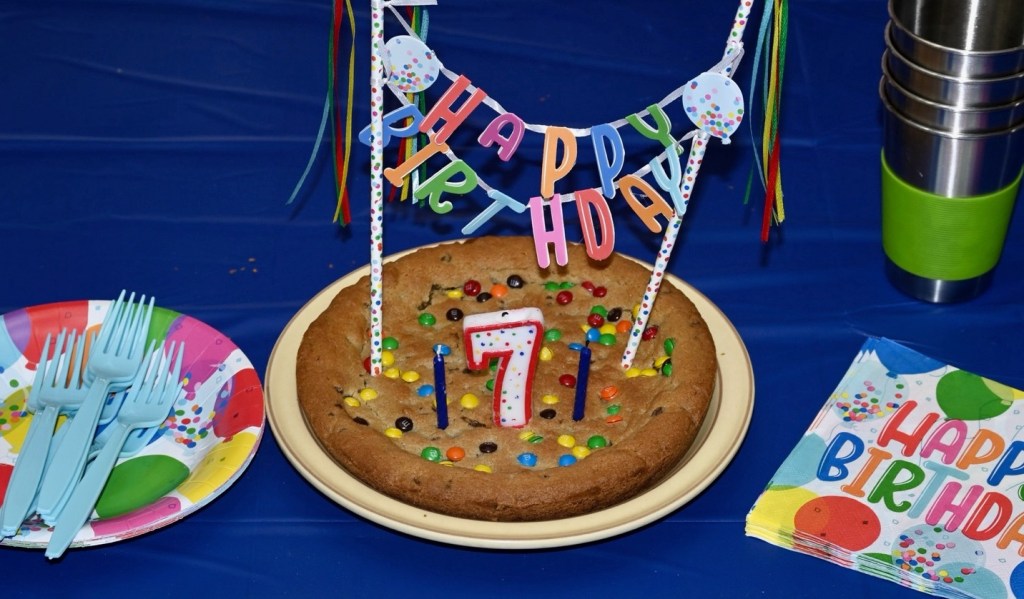
Happy 7th Birthday, Big E

Ethan’s mom: Seven years ago tonight, I held two babies in my arms. I would give anything to have held them both today.

We should have had two seven year olds blowing out candles, ripping off wrapping paper, and flashing their snaggletooth grins today, but we only had one.

I don’t have any deep thoughts or new insights tonight. I just wanted to say happy birthday to my Big E. We sure did miss you today, buddy.

Tracing the Rainbow Through the Rain

Ethan’s Mom: Each year, Bible Study Fellowship sets aside the last week of our class for “Share Day.” This is a week where all class members are invited to share what God has taught them over the course of the last eight months of intensive personal and small group Bible study. It provides a sense of celebration and of closure for the study. This year has been an intense one: People of the Promised Land: Kingdom Divided. This study has brought us through 15 different books of the Old Testament, as we studied the period of Israel’s history after King Solomon through the fall of Judah to the Babylonians in 587 BC.

The material was more intimidating, but the fellowship and bonding in our discussion group was the same as previous years. Saying goodbye to the group you have walked alongside since September is always difficult. This year, however, is even more of an ending than usual for me. Next year, I am going to transfer from the daytime women’s class to the nighttime women’s class. The daytime class has a program for babies and preschool children; the evening class has a program for school aged children and teenagers. Next year, I, my husband, and four big kids will all attend BSF together, in different small groups but meeting in the same host church. I am confident this is a transition that needs to be made, but goodbyes are always hard, even if they are right.

As I reflect on the ending of this study, my time with this class, and my role as a group leader, a verse from our study of Isaiah comes to mind. In Isaiah 25:1 the prophet says, “LORD, you are my God; I will exalt you and praise your name, for in perfect faithfulness you have done wonderful things, things planned long ago.” This post is my way of exalting God as I reflect and process through the ending of this study, my time with this BSF class, and my role as a group leader.

In a way, it is also a way of looking back and taking stock of my journey of healing this far. Saying goodbye to my BSF class feels very weighty because so much of my story as Ethan’s mom is all tangled up with my experience with BSF. I attended an orientation class in April 2016 to register myself, a 3 year old, and a 1 year old for the next year’s study. When I returned to the host church in August 2016, I brought my 3 year old, 1 year old, and a surprise set of twins in utero. BSF was one of the places I carried Ethan during our short time together.

The study in 2016-2017 was the book of John, and my group leader was Laurie. Our small group met in the Media Room of the church, surrounded by giant rolls of paper and baskets of craft supplies. After discussing the lesson, we would move to the sanctuary to hear the teaching leader’s lecture. That very first lecture included encouragement to remain faithful to studying God’s Word even when it didn’t make sense or left you with unanswered questions. Just act on what you do know and keep going. Those words have come back to me several times since that first lecture.

Studying John was a gift. The gospel of John has some distinctions from the three synoptic gospels, including the seven “I am” statements. That fall, I got to know Jesus in a deeper and more personal way by studying this particular book using the four step method of BSF. In the coming spring, I would need to draw on that knowledge more than I could have ever anticipated. I needed to know who He was in order to face the future that held unspeakable tragedy.

My group was also a blessing to me from day one. I was very nervous about the twins being born very prematurely, as I had issues with premature labor with all three preceding pregnancies. Laurie told me she was going to pray that the babies would make it to 36 weeks. I thought that was pretty optimistic but appreciated the sentiment. Just after the New Year, my boys were born at 36 weeks.

Two months later, Laurie and a couple of others showed up at our house with a huge basket of toys for the kids and gift cards to all manner of kid-friendly takeout or drive-through restaurants. I was so touched that they would see the kids’ needs as well as mine. Some ladies joined our meal train. Laurie watched #4 so that Ethan’s dad and I could visit the cemetery alone. One of the group members even took me out for a massage that summer, knowing from personal experience that grief is surprisingly physical in its manifestation.

Remember the teaching leader’s encouragement to just keep at it, even when you don’t understand? I returned to class much sooner than I think people expected. Just do what you know to do — well, by then what I knew and found value in was doing my lesson and attending class every Tuesday. The first week, our group was combined with another group due to Laurie being out. After the other ladies headed down to lecture, my group members circled up and prayed for me. I mean they prayed FOR me — I couldn’t even say “Dear God” much less speak any sort of coherent prayer, and they stepped in to offer prayers that I literally could not pray but wanted so badly to say.

The next week, our Scripture reading included the passage about Jesus’ burial. One of the questions was, “why do you think it was important that Jesus was buried?” I surprised myself by sharing my answer. “As a person who has recently spent a lot of time at a graveside, it is very important to me that he was buried.” As strange as it sounds, studying that passage of Jesus’ burial was the most meaningful thing I could have read soon after burying my son. I’m sure we went on to have meaningful discussions about the resurrection, but what stands out to me is that week we talked about how Jesus’ friends cared for his body and mourned the loss of his life.

The next study was Romans, from the fall of 2017 to the spring of 2018. To be honest, this is the year that is the fuzziest in my mind. I think that makes sense, as most of my physical, emotional, and spiritual energy was spent on survival. However, I think the gift of this study was a systematic, rational review of some of the basic doctrines of my faith. When I was questioning everything I thought I knew about God, I worked through a structured study of the New Testament’s longest book on Christian theology. It addressed my questions on a macro-level (Why do we deserve death? What is God’s plan for us?) so that I could begin to process through them on a micro-level (Why did this happen to my child? What is God’s plan for him? For me?).

In 2018-2019, I completed my first Old Testament study with BSF. This study was known at the time as People of the Promised Land I, and it covered the period from when Joshua led the people through the Jordan River to the Promised Land through the reign of King Solomon. This coincided with my experience at the inCompete Retreat, which I have referred to often on this blog because it was a definite turning point for me. I remember working on my BSF lesson while at the retreat, and it was about Joshua placing his foot on the neck of his enemies foreshadowing Jesus’ ultimate victory over death. God had promised the Israelites victory and possession of the Promised Land; however, they still had to fight the battle. That was analogous to my stage of healing — God had promised to bind up my wounds, but I had to participate in the healing process. God had promised to be with me in the battle to overcome the effects of trauma in my body, mind, and spirit, but I needed to start “doing the work.”

Part of that work was re-engaging with people and pushing back out of my comfort zone, which had shrunk substantially after Ethan died. So when I was asked to take on a leadership role in the next year’s study, I agreed with a good deal of hesitation. By this time, I was completely sold on the format and method of BSF and was really looking forward to facilitating a group discussion and participating in the weekly leaders’ meetings. I knew I wanted our group to be a safe place to share, but I didn’t know how much personally I should share about Ethan in a group of young mothers. That actually has been a concern each year I have served as a leader, but the first year was the most intimidating. This post details the circumstances surrounding the beginning of the year, and I found God to be faithful in equipping me to minister from within my “prison” throughout the entire year. I discovered that I really enjoyed being a GL and that, with God’s help, I actually did a pretty good job in that position.

The spring we studied Acts was the beginning of the COVID-19 pandemic. After evaluating all the risks and necessary precautions, our BSF class went virtual for the 2020-2021 study of Genesis. My group that year was surprisingly close, given that we never met each other in person until the last day of class when I hosted a lunch to celebrate the end of the year. I remember telling one girl, “Wow! I had no idea you were so tall!” It’s hard to gauge height while people are in a tiny square on your computer. This was one of two years when I really felt like my experiences with grief and loss were directly helpful to some of my group members. Genesis was an interesting study, and I really learned a lot from my group members and their perspectives. As an example of my many “light bulb moments” was the realization that I had always read Genesis 3:13 with a punitive tone in God’s voice, like I sound when I discover permanent marker on my freshly painted living room walls. But during the discussion, one member said, “What is this you have done?” with hurt, not anger, in her voice. Since then, I have tried to be aware of the tone of voice I hear when I read Scripture, trying out different emotions as I read tricky passages to see what fits into the immediate context and what we know about God’s character. Throughout the year, we persevered through technical difficulties and toddler photobombers, and I saw God answer some big prayers and use his people to encourage each other in profound ways.

For our Matthew study in 2021-2022, we were back in person and back in the New Testament. If studying John grew my love for Jesus, studying Matthew grew my respect for him. Jesus was truly an amazing teacher; he always had the right words, illustrations, and posture in dealings with a wide range of people. Several lessons helped me wrestle with some hurtful events at my church — allowing me to see the sin in my heart that has played a role and reminders that deepest needs are met by Jesus even when his followers get it wrong.

Another overarching theme was the upside-down kingdom of God. My group experienced this reality in a tangible and unforgettable way. Just before our first class, the substitute teaching leader let me know that one of my group members had received the results of prenatal testing that morning and was carrying a baby with Down syndrome. Walking through this study while she was absorbing this reality and preparing for her baby’s arrival was a high privilege. And even as this friend was wrestling through some difficult feelings, she encouraged me that my story, Ethan’s story, mattered. My group even brought me a hydrangea to class on March 1st, which fell on a Tuesday. It is planted in our Ethan garden at home.

Ten days later, this precious baby entered the world at 12:01 a.m. on March 10th. That was too much of a coincidence to not mean something, but it was a lot to process, especially when she ended up with the same heart defect as well. Her birthday is a sign to me that God will one day fully redeem that day, and her story of healing reminds me that God will fully heal all his children in due time. Through BSF and our study of Matthew, Baby E. and Ethan’s lives will be intertwined with each other in God’s beautiful story of redemption until His Kingdom comes in full.

I will go into details about this year in a second post, as this entry is already too long and I need space to work through some complex thoughts related to the Kingdom Divided. Spoiler alert: I am going to revisit a recurring theme on this blog and dive into a paradox. For now, I want to conclude this post by stepping back to take a view over the whole landscape of the past seven years.

I am amazed by all that I have learned and experienced through BSF since 2016. Not to mention what a blessing it has been to my children, which would be a whole other post. It hasn’t always been easy. Sometimes a comment during a discussion was hurtful, sometimes people’s personalities clashed, and sometimes the topic for the week seemed like really bad timing. I have been forced to look straight into the face of my grief more times than I can count, whether at home completing my lesson, in the group discussion, or in lecture. But just like setting a broken bone, pain is part of the healing, too.

God has used it all in his relentless pursuit of my heart — both my idolatrous, selfish, sinful heart and my wounded, doubting, grieving heart. Just like the people of Israel, I am tempted to forget God’s past faithfulness, both because of my sin and my loss. But Love did not let me go. He prepared for me to encounter His Word and His people through my local BSF Day Women’s Class during this portion of my journey in the Shadowlands, and I will forever be grateful.

O Love that Wilt Not Let Me Go

O Love that will not let me go,

I rest my weary soul in thee.

I give thee back the life I owe,

that in thine ocean depths its flow

may richer, fuller be.

O Light that follows all my way,

I yield my flick’ring torch to thee.

My heart restores its borrowed ray,

that in thy sunshine’s blaze its day

may brighter, fairer be.

O Joy that seekest me through pain,

I cannot close my heart to thee.

I trace the rainbow through the rain,

and feel the promise is not vain,

that morn shall tearless be.

O Cross that liftest up my head,

I dare not ask to fly from thee.

I lay in dust, life’s glory dead,

and from the ground there blossoms red,

life that shall endless be.

George Matheson

Talking about Trust

Ethan’s Mom: Our summer ended with an emergency room visit and overnight ICU admission for my husband. The chaplain who had helped me navigate the ER came by the ICU very early the next morning. She had been in the room when I was giving the doctor Greg’s medical history, which included Ethan’s sudden unexplained death. After asking for an update on his condition, she asked me some very insightful questions. We talked about how hard it was to trust a God who offers no guarantees of healing or recovery. She said that He does promise to make everything new but wondered aloud if that process might purposefully include pain.

I was thinking back to this conversation as I was trying to reflect on this year’s BSF study of the People of the Promised Land: Kingdom Divided, which began just a few weeks after my husband’s accident. The next to last question asked us to write one sentence summarizing God’s message to us during this study. That was a hard one, given that our study took us through a wide range of history, prophecy, and even poetry this year. We read over 5000 verses, many of which I had never read before. I learned so much that I struggled to even think of a single, coherent message, much less one that felt personalized for me – until I prayed on my afternoon walk for God to reveal what He wanted me to take away from this year. I was listening to my walking playlist, and the song “Keep Your Eyes Open” by Christa Wells came through my earbuds. A single line within the chorus jumped out at me like a flashing neon sign: Trust me. That was my sentence, two simple words. Trust me.

Of course it was. Once it popped into my earbuds, it was so obvious. I remember thinking at points throughout the last year that the word “trust” was showing up everywhere – BSF lessons, sermons, verse-of-the-day emails, everywhere. But how exactly did it manifest in our Kingdom Divided study?

One recurrent theme for this study was God’s sovereignty. He keeps His promises, He uses nations to bring judgment on other nations, etc. One week, a fellow group leader asked me if the idea of God’s sovereignty gave me any comfort, given my family’s experiences. The answer was so close to the surface that it flew out loud and clear before I could filter it: NO. I can accept that God is all-powerful, but that has not been a thought that has brought me much comfort over the past 6 years. In fact, when I hear “You are sovereign” uttered in prayer, my stomach still lurches.

I know rationally that the opposite would not be any better. If God is not sovereign, who is driving this bus? As Cameron Cole writes in his book, Therefore I Have Hope, “if God had nothing to do with my son’s death, then certain pockets of life – the really awful ones in particular – are given over to chaos because the God of the Universe is removed from them.”

I do, in fact, want God to be sovereign. But I also want Him to be good. Knowing someone is in full control of your circumstances is not very helpful if you don’t trust that person. How can I trust God when he ordained for my child to live for only 63 days? Cole goes on to say, “The matter of God’s sovereignty and goodness evokes tension…These paradoxes become far more confusing when they are your paradoxes.” Indeed.

I can see this tension played out throughout the historical narrative and, even more so, the prophetic books we studied this year. We heard prophecies of judgment and destruction over and over. The idolatry was out of control, and the stubborn people refused to repent and return to God. There would be a day of reckoning for all of their sin. That’s mostly what comes to mind when we hear about “the God of the Old Testament.” One of the biggest surprises for me this year was seeing the patience, mercy, and goodness of God before, during, and after the fall of Israel and Judah. “The God of the New Testament” was right there in every book as well.

In fact, many of the verses that end up on coffee mugs, throw pillows, and hand-lettered signs are actually from this portion of Scripture.

Even youths grow tired and weary,
and young men stumble and fall;
but those who hope in the Lord
will renew their strength.
They will soar on wings like eagles;
they will run and not grow weary,
they will walk and not grow faint.

Isaiah 40:30-31

“For I know the plans I have for you,” declares the Lord, “plans to prosper you and not to harm you, plans to give you hope and a future.”

Jeremiah 29:11

Because of the Lord’s great love we are not consumed,
for his compassions never fail.
They are new every morning;
great is your faithfulness.

Lamentations 3:22-23

The Lord your God is with you,
the Mighty Warrior who saves.
He will take great delight in you;
in his love he will no longer rebuke you,
but will rejoice over you with singing.

Zephaniah 3:17

Taken out of context, these verses appear to promise that we will be #blessed with never-ending energy, security, and love. But it is not all goodness and light. In fact, all of these verses are located very near some extremely hard to read declarations of judgment and impending destruction, sometimes in the very same chapter. As we moved through the divided kingdom, I could see the tension I have felt in my experience played out in the tension between God’s justice and mercy, His sovereignty and goodness, His protection of His people and His righteous judgment of their sin, and more.

At some point during the year, someone stated that God does not sacrifice one of his attributes and the expense of another one of His attributes. God is sovereign, but not at the expense of His goodness. He is good, but not at the expense of His sovereignty. Cole puts it this way, “God can remain fully in control during tragedies while still being completely good.” Sit with that for a minute and tell me it doesn’t make your head hurt.

But this study also included insights into the personal struggles of God’s people, particularly His prophets. Just a few examples: Elijah, after defeating all the prophets of Baal in a divine showdown, found himself alone and depressed to the point where he wanted to die. Hosea’s heart was broken by an unfaithful wife. Jonah ran from his assignment and then threw himself a pity party. Jeremiah, the weeping prophet, did not have enough tears to cry over the destruction of his people. Habakkuk questioned God and sat down to await an explanation.

I cannot resolve the tension; I can only sit in the paradox. While there, I cannot turn off my emotions or stop from asking questions. But God doesn’t ask me to do so. Our notes on Lamentations state that “the Bible encourages hurting people to verbalize hard questions and express profound grief…We should never hesitate to pour out our most honest grievances to God. Trusting God does not require ignoring anguish.”

However, even in the anguish, He invites me to trust him. One week later, the notes from our study of Habakkuk reminded me that “because God is who He is, His sovereign but mysterious ways can be utterly trusted…He can be trusted to reign over this world and your life. God’s holiness, might, compassion, justice, and faithfulness stand behind everything His sovereign will allows.”

Sometimes, His sovereign will allows The Worst. Cole ends each chapter in his book with a portion of the “Narrative of Hope” that he wrote after his young son’s sudden and unexpected death. The chapter on Providence ends with these words:

My trial is not a random accident. Nothing comes into my life but through God’s perfect discretion. God remains in control of all circumstances. He has a hand in my painful circumstances, which means that his hand can extend to redeem my life. God is good. The evil in this world and the suffering in my circumstances do not represent his character. The perfectly kind and loving person, Jesus Christ, is the very image of the character of God. The cross reassures me of his love and sovereignty. I can trust him, knowing that he is fully good and fully in control.

The perfectly kind and loving person of Jesus was described in Isaiah 53 as the Suffering Servant. The week we read that passage, I was struck by the first part of verse 4. “Surely he took up our pain and bore our suffering…” Not only our sin but also our pain and suffering. In doing so, Jesus expresses the height of God’s love and sovereignty. For now, I keep my eyes on the cross and await the day when I won’t have to hold the tension anymore. Instead, I will hold Ethan again. On that day, I will be so glad I trusted Him.

On this mountain he will destroy
the shroud that enfolds all peoples,
the sheet that covers all nations;

He will swallow up death forever.
The Sovereign Lord will wipe away the tears
from all faces;
he will remove his people’s disgrace
from all the earth.
The Lord has spoken.

In that day they will say,

“Surely this is our God;
we trusted in him, and he saved us.
This is the Lord, we trusted in him;
let us rejoice and be glad in his salvation.”

Isaiah 23:7-9

When Knowing is not the Answer

Ethan’s Dad:

HERE’S A STORY ABOUT UNCERTAINTY. In the early 20th Century, technology kept improving and the instruments kept improving and the instruments used for scientific measurements kept growing more precise. So did the clocks, to the extent that train schedules could finally be synchronized across Europe. That different trains in different places could leave their stations at the same time — well, that was very important to the patent office in Bern, Switzerland. But it was also very curious to a clerk who worked there.

‘Albert Einstein said, we used to think we knew what ‘at the same time’ meant,’ says Hans Halvorson, a professor of philosophy at Princeton. ‘It meant “simultaneous.” And the whole relativity revolution was Einstein saying, “Wait, when we have really precise measurements, what we thought of as being the same time breaks down.” We don’t really know what it means to say something happened in New Jersey at the same time as something happened in Sydney, Australia.’

It turns out to be the driving force of the breakthroughs that define modern physics. ‘What happened,’ Halvorson says, ‘was that experimental techniques kept getting better and better so they could pin down things more and more. But what they were finding was that as one thing was pinned down more and more precisely, it was making other questions harder and harder to answer.’

This seeming paradox — more knowledge leading to less certainty — pertains more to quantum physics than it does to relativity. But according to Halvorson, the underlying philosophical questions have never been settled, ‘because there are people who very much hope that this is a temporary thing and we’ll eventually figure out how to beat it and others who think it’s telling us something about how we’re embedded in our reality. We have to figure out what it is about human beings that makes us think we can without limit make our knowledge more precise. Because that turns out not to be true.’

Tom Junod: How the Dez Bryant no-catch call changed the NFL Forever

Why am I starting a post by quoting from a sports article that was all about the vagaries of instant replay in the NFL? Because it unexpectedly contained an exposition about the human thirst for knowledge and, conversely, how that thirst seems cursed because it is never satisfied. To be sure, the philosophy professor quoted in the article does not say humanity is cursed; he describes it in terms of a scientific conundrum because “educated” people are not supposed to invoke primordial ideas like a “curse.” After all, we have evolved beyond such thinking, haven’t we? That was what the scientific revolution was all about as far as the post-modern world is concerned: ridding the world of religious superstitions.

Unless, of course, the “curse” is describing something inherent in the human condition. In the very first book of the Bible, Genesis, there is a story about how the first humans, Adam and Eve — who were special creations made by God in his image and likeness — destroyed their relationship with their Maker. (See Genesis 3). It is a story that, even in our ever-increasing religiously pluralistic society, nearly everyone knows. God told Adam and Eve that they could eat from any tree in the Garden of Eden except the Tree of Knowledge of Good and Evil. With some encouragement from Satan, who was disguised in the form of snake, Adam and Eve disobeyed God’s command and ate fruit from the Tree of Knowledge. Satan had told Eve that when she ate the fruit “your eyes will be opened and you will be like God, knowing good and evil.” (Genesis 3:5, NIV). That was partially true: Adam and Eve did obtain knowledge they were previously unaware of, but they did not become “like God” because they did not become all-knowing — far from it. Of course, it was not the fruit that imparted knowledge; it was the act of disobedience, which deprived them of innocence and opened the door to forsaking the good that God intended for them.

It turned out that knowledge of evil was not a good thing. The knowledge Adam and Eve gained caused them to feel guilty, to cast blame rather than assume responsibility, to lie and thus become less trusting of each other, and to feel scared of God rather than feel enveloped by His love for them. Just as menacing, they passed this knowledge on to their offspring, and that knowledge led to anger and jealousy by one brother toward the other, who then conceived the idea of murder as a solution to the problem. (See Genesis 4). People have lived with the terrible consequences of this knowledge ever since.

Thus, one of the lessons of that story from the beginning of human history is that more knowledge is not necessarily the panacea we like to believe that it is. We like to believe that inevitably the more we know, the better off we are; that the answers to our problems are just around the next bend, if only we can see a little further ahead in order to gain more information; that if we seek knowledge, it will reward us with ever-increasing benefits. But deep within ourselves, or at least the more years we spend on this earth, we start to doubt this belief about knowledge.

I write all of that because for a while now I have been pondering how certain situations in my life have been characterized by a lack of knowledge. As Ethan’s Mom wrote in a recent post, I had an accident a little over six months ago that was caused by falling off a ladder. I sustained a severe concussion, I had to go the emergency room (which brings painful memories in itself — especially on this day), and apparently I had multiple seizures while I was unconscious, which was a completely new phenomenon for me. The concussion initially caused some unpleasant after-effects such as sensitivity to noise, extreme tiredness, and some confusion. The fact of the seizures meant I was put on preventative medication and was not permitted to drive at all for six months. On top of all of that, a neurologist showed me an MRI scan that seemed to indicate that there are some potential problems in my brain.

So, throughout this entire period after the accident I have been wondering why it even happened. I do not remember the fall itself, but I know it is likely that the ladder became unstable and I simply lost my balance. I then had the misfortune of hitting the back of my head on something very hard. But that is just the physical explanation for the accident. What I really want to know is why did I fall, on that particular day just before my birthday; why did I have to sustain a severe concussion? Why did I have seizures that prevented me from being able to drive members of my family anywhere for six months? Why did there need to be all those physical scans performed on my body that raised the specter of several things being wrong with me, including with the one instrument I use the most: my brain?

It has been more than six months and I still do not know the answers to those questions. It has felt like a metaphorical parallel to the “dream” I had of me falling backwards off a ladder into nothing but darkness: no ground, nothing visible, just a pit of darkness. There is nothing. No explanation. No clarity. No ah ha moment revealing a purpose for this drastic event that came out of nowhere.

Of course, that scenario has happened to me before, in the worst way imaginable, six years ago today. That event of March 10th, 2017, is one I could never forget. And when it happened, all I felt was agony, darkness, and confusion. It has been six years since Ethan slipped away, and there has been no genuine clarity, no ah ha moment, no revelation of why God allowed that to happen. Oh, our knowledge has increased. We know that Ethan’s heart condition was a factor in his death. We know he was weaker than the doctors thought. We know that something the night before was off with him even more than usual. But those are just bare physical facts. They are not real answers to why our precious boy would be robbed of his life and why we would be robbed of his presence for the rest of our earthly lives. I have no such answers despite immeasurable amounts of time spent pondering, praying, and wondering about it all.

It is not because of insufficient effort that I lack the knowledge. It is not because of a lack of reading or learning or listening that I do not have an answer beyond the fact that some tragedies occur because creation is torn and shattered by a scourge of evil. And because of that, I have been wondering if the notion that having that knowledge will make it better is simply not true. Maybe I do not have the answer because it is best I don’t.

So, maybe those philosophers who say that it is inherent in our existence that further knowledge breeds more uncertainty are right. Perhaps the fact that things become less clear the more we know does speak to the human condition. Every time we look further into space we find there is more there than we thought and less we understand about it than we theorized. The further we probe into the smallest particles of existence, the less predictable the behavior of matter seems to be and the less certain we are of how that unseen world operates. As Bono sings in the opening of U-2’s City of Blinding Lights “The more you see, the less you know, the less you find out as you go, I knew much more then, than I do now.” What if that uncertainty itself is purposeful?

To go back to Genesis 3, I believe it is possible that the reason God commanded Adam and Eve not to desire knowledge for its own sake (not to eat from the tree of knowledge of good and evil) was because knowledge is a false god. It tempts you into believing that all you need is to discover the right answer and everything will be okay when the reality is that further probing often just produces futility because there is always another permutation out there. I am not saying that exploration and discovery and learning are bad or pointless. I am talking about treating knowledge as an end, rather than as a means to the right end — as if the answers to life’s fundamental questions lie in obtaining more knowledge, or that if we can just be precise enough, work hard enough, study enough, the answer will reveal itself. I think God was trying to tell us that is not true: In essence, He was saying: “Do not seek knowledge, seek Me. I am the answer you are looking for because you are dependent upon Me.” Adam and Eve were tempted to “be like God.” (Genesis 3:5). In contrast, Paul tells us that Jesus, even though He was God, “did not count equality with God a thing to be grasped, but emptied himself, by taking the form of a servant, being born in the likeness of men.” (Philippians 2:6-7, ESV). We do not need to be God; we need to be with God.

I ask why Ethan died because it is natural for me to pose the question. I know God does not condemn the inquiry. He expects it. But what He does not want me to do is to assume there is an answer that I should be able to find out or understand this side of Heaven. We look for answers because it is inherent in our nature to seek knowledge. We want to solve the problem. But what if we are not meant to know the answer, or even, what if there is no good answer beyond that evil exists and wreaks havoc upon this world? What if we are supposed to sit in that void of uncertainty where knowledge is forsaken because we are meant to be dependent upon the Lord?

That thought is why I despise the saying “don’t waste your suffering.” I certainly believe that God’s purpose in the grand scheme of our lives is to bring us closer to Him — to make us more like Jesus — and that suffering can move us in that direction. But not everything that happens to us occurs for that purpose. When a phrase like “don’t waste your suffering” is glibly thrown around — especially to those who are in the midst of tragedy — it not so subtly implies that there is some “higher purpose” for every kind of suffering a person endures, that we should be striving to ascertain that purpose, and that, if we do not discover that purpose, perhaps we are just not listening to God closely enough. However, God tells us:

‘For my thoughts are not your thoughts,
neither are your ways my ways,’ declares the Lord.
‘For as the heavens are higher than the earth,
so are my ways higher than your ways
and my thoughts than your thoughts.’

(Isaiah 55:8-9, ESV). Given that disparity, we do not — and dare I say cannot — know all of the answers for why some things happen as they do, and we put ourselves in God’s place, as Adam and Eve sought to do, when we persistently assume and seek such answers.

In fact, Ethan’s Mom pointed out to me earlier this week that the whole concept of “don’t waste your suffering” is a very American way of viewing this issue. It assumes that pain and suffering are some sort of self-help program that we are supposed to be availing ourselves of in order to improve our character. We Americans particularly view ourselves as problem-solvers. Every question has an answer if we just put our minds to it. There is nothing we cannot accomplish if we just keep trying. But that attitude is the exact opposite of what our spiritual lives are supposed to reflect. We are supposed to comes to grips with our constant need for dependence on God. We do not save ourselves: Jesus does. Isn’t that void of knowledge the place where faith resides?

And even if such mysteries bring us to that place of dependence because of unimaginable loss, it does not mean that God intended for that loss to happen. Just because we learn something does not mean that is why it occurs because correlation does not necessarily equal causation. We can thank God for blessings that come out of tragedies while still lamenting the awfulness of the events themselves. Being thankful in our troubles does not mean we must forget about them. After all, the Psalms of lament are just as much a part of Scripture as the Psalms of praise.

We always want this neat little bow on everything, to somehow make it “happily ever after” in the here and now even though God clearly says in both Isaiah (25:8-9) and Revelation (21:1-5) that such happiness will not come until the end of this age. It is the materialist, not the Christian, who desperately strives for and clings to happiness now because for him there is nothing else.

So, to me the proper spiritual response to real, heart-rending pain is not “don’t waste your suffering”; it is “don’t despair in your suffering” because God grieves about it with you and His Son experienced it, and precisely because of that, one day it will be made right. Hold fast in dependence upon Him until then. Do not buy the lie that all is lost because you do not see the good in your suffering. Because sometimes there is no good in an evil thing, which is why we need the One who not only redeems situations while we are here, but who also will restore situations when we are all at last with Him for eternity.

Later in that same U-2 song I referenced earlier, Bono sings: “And I miss you when you’re not around, I’m getting ready to leave the ground.” Every day, and especially on this day, I miss you not being around, Ethan. And through Jesus’ sanctifying work, I am “getting ready to leave the ground” of this physical world where, thankfully, I will see Ethan again. “Amen! Come, Lord Jesus!” (Revelation 22:20).

Quick note to end 2022

Ethan’s Mom: Well, I have had a few blog posts rattling around in my head but didn’t get anything written in the last few months of the year. I am hoping to be more intentional with this space in 2023, but before the calendar flips, I did want to share a post I wrote for The Morning that was published this week. I am grateful for this organization, which has been so helpful to me personally, and for the chance to write to a larger audience of grieving moms. “Facing the New Year Without Your Baby” is my second piece for their blog, describing the unexpected grief that comes with New Year’s Eve and Day. Please check out their website for resources including a blog, podcast, and online community for moms who have experienced pregnancy and infant loss. We will be back on our blog in 2023 as we face our sixth year missing our sweet Ethan and honoring his life in this space.