Joy Found in “The Morning”

Earlier this summer, I was invited on a girls trip to the beach.  My daughter, one “old” friend, one “new” friend, and all three moms spent a few days with the sand between our toes.  I love the beach – the sights, the sounds, the smells – so I knew the trip was going to be fun.  An added bonus I did not realize until we were there chatting under the beach umbrella was that all three girls had brothers and only brothers.  So even though the other two moms had older children, we were all in the same boat as far as parenting middle school girls for the first time.  We traded tips on finding appropriate swimwear and navigating big emotions.  It can be so nice to be among people living a shared experience.  “You too? I thought I was the only one…” are usually welcome words that can bring relief and validation.  

This holds true even when the shared experience is one you would never wish for anyone.  Sometimes people describe being a bereaved parent as being a member of a club to which no one wants to belong.  We wish no one else would ever join our ranks, but the reality is that our number will continue to grow until Jesus returns.  Recently, the devastation of flash flooding in Texas took the lives of at least 36 children.  Who knows how many were born still or died in the night or succumbed to cancer during the past 24 hours alone?

Even though I wish this were not the case, it is.  And there are some things that bereaved mothers share that no one else can understand fully.  I cannot tell you how invaluable it has been for me to develop friendships with moms who are at similar places in their grief, as well as those who are further down the road and those who are just beginning.  

Soon after Ethan died, a coworker put me in contact with an old friend of hers that was developing an online ministry for mothers impacted by miscarriage and infant loss.  My first experience with what would become The Morning was a beautiful art print with Ethan’s name on it, which was given to me by this coworker.  I did not know at the time that this print (which still hangs in our playroom) was the beginning of such a meaningful relationship.  

In 2018, The Morning released a podcast, “The Joyful Mourning,” hosted by the ministry’s founder, Ashlee Proffitt.  I listened to every single episode for the first few years, many times while taking #4 on walks in his stroller.  I heard the story of Ashlee’s son, who was six weeks old when he died unexpectedly of SIDS.  It was like walking around the neighborhood with a friend and mentor, receiving much needed encouragement and practical advice.  She shared how grief had changed her relationships, her parenting, and her faith.  She interviewed moms, each of whom shared their own stories.  Sometimes the details were similar to our story, other times not as much.  In other episodes, professionals explained the physical, emotional, and relational effects of grief.  Most episodes offered some very practical advice, and each episode offered something even more valuable — hope.  

The ministry added an online community to facilitate interactions between mothers.  The Morning Community grew into a multifaceted support system — a place where everyone was invited to tell the story of their babies, vent frustrations, and receive encouragement.  The Morning added another “big sister” to act as a mentor in this space.  Meg Walker was exactly what the community needed.  Her writing skills and her ability to connect with people, even virtually, made everyone feel welcomed and valued.  Eventually, they added community moderators to assist in managing the online community.  I served as one for six months and had a much better understanding of the sacrifice Meg willingly gave, even while her own family was growing.  Meg gave us questions to discuss, checked in on us during holidays and hard days, and made everyone feel that their baby mattered.  

To illustrate the kind of support this group provides, consider the universal dilemma of the bereaved mother.  “How many children do you have?” may seem like small talk to most people.  To mothers who have children in heaven, it feels like crossing a minefield, every time.  When I answer 5, the follow up questions will almost always reveal that one has died, and the reactions to that fact are awkward at best, painful at worst.  When I answer 4, I feel that I am being disloyal to Ethan and discrediting my motherhood.  I have five children that I love with my entire being.  Five children that I do my best to support and to celebrate.  Five children that I pray will know the love of their Creator and play their role in His redemptive story.  But that is a lot to try and sort out with a new acquaintance on the ball field or in the band booster club.  

Every so often, a new member of the community would ask how to handle this situation.  The other newer members would agree, “yes!  I never know what to say!”  The older members would encourage the woman to do what she feels most comfortable given the particular circumstance and that it does get more automatic with practice.  And everyone would reaffirm that the child in heaven is no less a part of her family and that she is no less a mother to him/her than if that baby was in her arms right now.  

That’s the kind of sisterhood that grew under Ashlee and Meg’s leadership.  And I haven’t even begun to discuss the other ways The Morning has touched lives — devotionals, workshops, holiday support groups, specialized merchandise, templates for funeral programs, cell phone wallpaper, suggestions for how to remember your baby during each changing season, and very helpful guides for family and friends seeking to love a grieving mother well.   All the resources and websites are beautifully designed with soft colors and meaningful images.  On Ethan’s birthday, I write an entry in his linen bound birthday journal.  Each winter, I wear my “One Day Closer” sweatshirt and drink coffee from a mug received from another community member during a Christmas mug exchange.  They give me a measure of comfort on the long gray days between Ethan’s birthday and the anniversary of his death.  

During this summer, Ashlee and Meg are taking a sabbatical to seek God’s guidance for the future of The Morning.  I have been praying that they will experience much needed rest from their labors of the past few years and hear His voice leading them in the way forward.  Whatever God has in mind for The Morning, I know He will continue to work healing in the lives of grieving mothers.  After all, Jesus’ own mother is “in the club” and he provided for her with one of his final breaths.  For this period of time and for my own life, The Morning has been a conduit of His grace, and I will be eternally thankful for the work his servants have done for me and for countless other mothers who are learning that “joy can be found, even amidst the morning.”

This Thing is Not Going to Break You

By Christa Wells

You could not plan for this, No, there was no silhouette

Up against the pink horizon to warn you of the hit

But you absorbed it all with grace, Like a child you spoke of faith unmoved, That holds onto you

This thing is going to try to break you

But it doesn’t have to, You’re showing us how

This thing is going to bend and shape you, But He won’t let it take you

You know it somehow, This thing is not going to break you

You could take your loss, You could hide away from us

With your grief lassoed around you, But you’re laying it in the sun

And you stare straight into the light, You say you’d rather go blind than look away, What can I say?

This thing is going to try to break you, But it doesn’t have to

You’re showing us how, This thing is going to bend and shape you

But He won’t let it take you, You know it somehow

This thing is not going to break you, this thing is not going to break you,

this thing is not going to break you
Waiting on Glory: Year Seven

Ethan’s Dad: Last week our Bible Study Fellowship Group was studying John 17, which is the prayer of Jesus before he goes to the cross in which He petitions the Father concerning His disciples and then for all believers. John 17:24 says: “Father, I want those you have given me to be with me where I am, and to see my glory, the glory you have given me because you loved me before the creation of the world.”

When our teaching leader got to that verse, he told a story about a nurse friend who worked at a hospital and who was taking care of a man who was having a heart problem. At one point in the middle of the night, the man coded, and the nurse had to pump his chest. For a moment, he did not respond, and the nurse saw a look of complete peace come over the man’s face. The nurse and the code team were able to revive the man. The next morning, the man woke up and was recovering well. The nurse went to him as she was leaving her shift because she wanted to ask him about that moment in which she saw his face seem so peaceful in the midst of the emergency. The man told her that he had seen Jesus and that the sense of security, belonging, and especially joy that he felt was unlike anything he had ever experienced. The man said he wanted to stay with Jesus, but that Jesus had told him it was not his time yet.

Our teaching leader related that story as a way of attempting to convey a taste of what it will feel like for believers in the presence of Jesus — to see His glory and to be with Him in eternity. For most of the people sitting in that chapel listening to the story, I am sure it was a reassuring and inspiring vignette. But it made me sick, almost physically sick, to the point that I wondered if I would need to walk out of the room.

For anyone who has read snippets of our story about Ethan, you might guess why the story produced that effect. Ethan had a heart defect. Ethan coded, on this very day, seven years ago. His amazing Mom tried to revive him while I stood by in helpless disbelief. The EMTs tried to revive him on the way to the hospital. The emergency room doctor and his team did everything they could for 20 minutes. Nothing. There was no revival. There was no peace. There was no happy story to tell. Our baby was gone after two incredibly short, hard months, in an instant. It was separation: cold, stark, and ongoing. I have no words to adequately describe it, and honestly, that is probably a good thing because no one would want to read about such emptiness.

And I started reliving that moment the instant our teaching leader mentioned that man’s heart trouble. I do not blame the teaching leader at all. This happens to us at times, and we never quite know what might set it off. I am sure the fact that it was close to this day had something to do with it, because it does not happen as often as it once did, and sometimes I wonder about that. It is not that time heals the hurt, as some people are all too fond of saying, but that time makes it feel more distant — until there is a trigger. Because when it happens, it feels very real, all too real, being right back there on that March 10th, the day that changed everything.

So, I took some deep breaths; I zoned out from the lecture for a little bit. I felt the deep ache inside. I wondered for the millionth time why Ethan is not here with us. Why does his twin brother not have his sidekick? Why do we not have five children sitting at the table every night? Why does Ethan not get to experience our laughter, our fights, our Friday-night movies, our family road trips? Why do we not get to see his smile, hear his voice, watch him run, feel his hugs? The enormity of what we all have lost because his little heartbeat stopped is incalculable.

There are many entries in this blog filled with musings about that why. This one is not about that. It is, first, just meant as a lament, because I still mourn over losing him. The sadness deserves — demands — to be acknowledged. Time does not heal it; time just spreads out the anguish so that it is not felt as deeply all the time. My heart is still broken, Ethan, and it always will be, as long as I am here. I do not believe that there is anything wrong in admitting that.

But there is another part to the story. After I started to come out of my flashback, I started to think again about what Jesus had said. “Father, I want those you have given me to be with me where I am, and to see my glory, the glory you have given me because you loved me before the creation of the world.” Jesus wants us to be with Him where He is. He wants us to live in His glory. Just as the Father loved Jesus before the creation of the world, Jesus loved us before we were ever created. So, is that what Ethan saw when he closed his eyes that last time? Did he see Jesus in glory, holding out His arms to embrace our frail little boy? Jesus informs his disciples before His prayer that “in my Father’s house are many rooms; if that were not so, would I have told you that I am going to prepare a place for you? And if I go to prepare a place for you, I will come back and take you to be with me that you also may be where I am.” (John 14:2-3). Jesus invited Ethan into His home. He said, “My child, you fought bravely, you gave all you could to stay with your family because you know how much they love you, but it is time now to rest with me. See how much I love you,” holding out His scarred hands, “and feel the glory that surrounds you,” a glory that is, somehow, more wonderful than the warmth he felt in his Mother’s arms.

Even more shortly before His prayer, Jesus tells his disciples: “So it is with you: Now is your time of grief, but I will see you again and you will rejoice, and no one will take away your joy.” (John 16:22). Ethan arrived at our true home before I have, but I will join him one day. And when I do, no one will be able to steal that joy ever again. “He will wipe away every tear from our eyes. There will be no more death, or mourning, or crying, or pain.” (Revelation 21:4). There will just be joy: Joy in being with our Savior, and joy in seeing my son again! Jesus has promised, and it will be.

As Jesus said, though, before that time, there is grief. Jesus acknowledges that. He did not say there is anything wrong with that. For some, that time of grief is longer than it is for others. I do not know why that is because it certainly seems unfair. “God knows we ache, when He asks us to go on. How do we go on?” (Ellie Holcomb, Red Sea Road). He asks us to go on in the knowledge that comes from faith as to what lies ahead in the end. The end is Jesus, the author and finisher of our faith. Jesus was there for Ethan seven years ago on this day. And He will be there with me and Ethan’s Mom on our last days. He is waiting to show us His glory, the glory Ethan already has seen and is surrounded by right now.

I can say that because Jesus is also here, right now, even in this ever-present moment of grief. He is here just as He was on that cross, bearing all shame, pain, anguish, anger, wrath, blood, and broken hearts. Right there Jesus and the Father experienced separation, loneliness, despair, darkness, the emptiness of that loved one not being there — a separation even more painful than ours because they had been together forever. He knows what this grief is to us, even more than we know it ourselves. Then Jesus died and His heart stopped beating.

But three days later “His heart beats, His blood begins to flow, waking up what was dead a moment ago.” (Andrew Peterson, His Heart Beats). His death will end Death, once and for all. He returned to glory so that we can join Him in glory. Jesus is there, in glory, waiting. Ethan is there, in glory, waiting. I am here, for so long as He calls me to care for the precious ones that remain here, waiting. But for those of us in Christ, waiting is hoping because “we celebrate in the hope of the glory of God.” (Romans 5:2).

This I call to mind, and therefore I have hope:

Because of the Lord’s great love we are not consumed, for his compassions never fail.

They are new every morning; great is your faithfulness.

I say to myself, ‘The Lord is my portion; therefore I will wait for him [hope in Him].’

The Lord is good to those whose hope is in him [who wait on Him], to the one who seeks him;

it is good to wait quietly for the salvation of the Lord.

Lamentations 3:21-26

Christmas is Big Enough

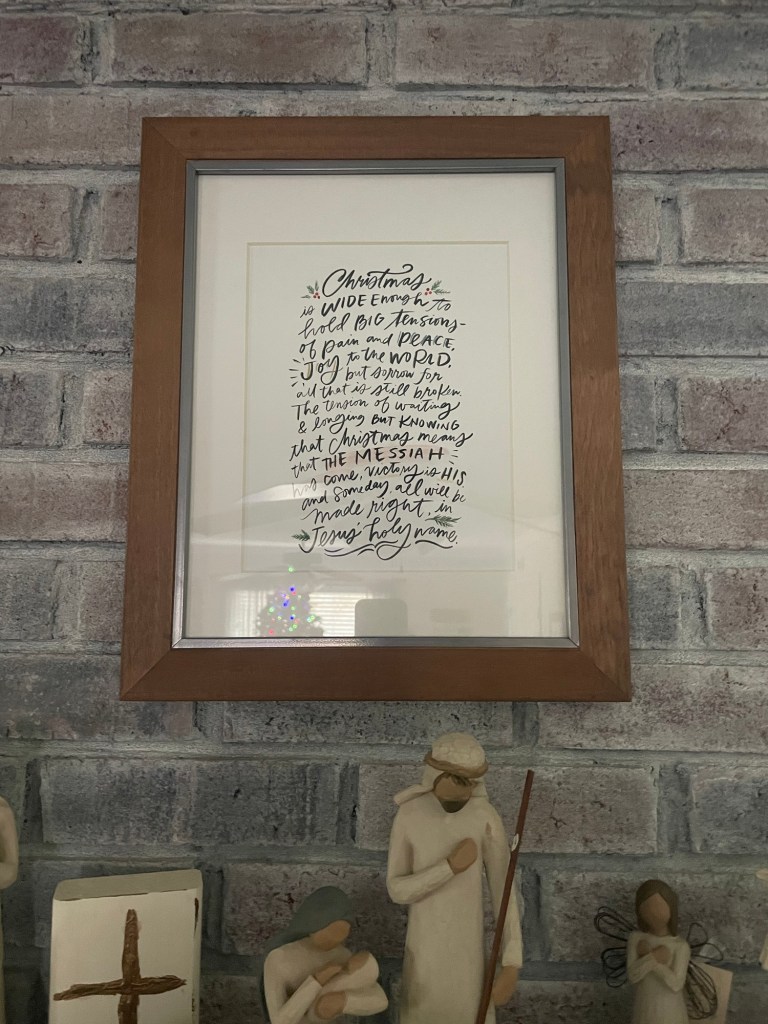
Ethan’s Mom: A couple of years ago, I found a hand-lettered print that we now display every Christmas. It reads:

Christmas is wide enough to hold big tensions – of pain and peace, joy to the world but sorrow for all that is still broken. The tension of waiting & longing but knowing that Christmas means that the Messiah has come, victory is His, and someday all will be made right, in Jesus’ holy name.

I need that reminder every year. I remember sitting in a grief counselor’s office in the fall of 2017 asking if I would ever enjoy Christmas again. I used to love Christmas, I said, but I want to skip the whole thing this year. My capacity to hold joy and sorrow has grown significantly over the last six years, but I still struggle to hold all the joy of Christmas with the pain of missing Ethan. Although we have developed traditions which keep his memory alive in our celebrations, we have never spent a Christmas with our entire family. The closest we have been was in 2016 when I was 34 weeks pregnant with the twins.

This year, the words from that print seem especially significant.  The Wednesday after Thanksgiving, a teenager in our church died unexpectedly.  The following Sunday was both the first week of Advent and his memorial service.  I shed many tears between those two days.  I cried for the abrupt end of his life, for his parents and siblings, and for his friends at church and their families.  

I also cried for the abrupt end of Ethan’s life, for my family, and for me.  There are several details that differ between our stories.  For instance, Ethan’s siblings were much younger and grieved in a very different way than teenaged siblings would after sixteen years of life together.  But you don’t have to look too hard for the similarities.  One night, we went to bed without any indication that our sons would not be alive the next morning.  We both had taken last group pictures of our children not knowing we would never have a complete family photo again.  We were both left with a million questions, most of which have no answer.  All of these thoughts swept me back to March 2017 in a way that I had not experienced in a long time.  

Like many people who love this family and wanted to support them in the shocking aftermath of that day, I wanted to do something. It turns out, our immediate role was not to make a casserole or send flowers, it was to light a candle.

Our family had been asked to light the first candle of Advent the day before anyone had any notion that the week would take such a tragic turn. The litugrical calendar specifies a theme for each week of Advent, and the first week is hope. Sometime late in the week, I realized how important it would be to light that particular candle on the very day that held not only the first worship services since this teenager passed away but also his memorial service later that afternoon.

It may not seem like a lot to light a small candle in the face of so much darkness; I confess that I initially thought it might not even matter to anyone except for me.  But then I remembered an exceprt from one of my favorite read aloud series, “The Green Ember.”  The series follows a group of rabbits as they fight for freedom from their birds of prey captors, and the four books are full of examples of true courage and hope.  In book three, after the wizened captain explains to the young hero that his job in the upcoming rebellion is not to fight but to unfurl a banner over the battle raging below, the young rabbit denies his instinct to charge into the battle. 

How could he help them? He knew he could help them most by shifting the battle in any small way…Then he remembered Helmer’s words, ‘Symbols matter, more than you might imagine.’ Picket’s heart was pumping fast, and he wanted badly to join the battle. But he banked and swept over the center of the skirmish…He waved the torn banner back and forth. “For the Mended Wood!” he cried. He heard an answering shout over the din of war and felt inside the fire of the good fight. He knew that all around, from the desperate fighters in the square to the hundreds rushing into First Warren through the west wall breach, the sight of this renowned warrior waving the true king’s banner atop this desecration of a statue was one to set the faintest heart on fire.

Ember Rising by SD Smith

I do not claim to be a “renowned warrior” but I am a veteran fighter in the ongoing battle against the darkness of dispair. After six Christmases of “holding the tension between joy to the world and sorrow for all that is still broken,” I felt that our family was uniquely empowered to light the candle of hope that morning. It felt like a mission. The hope candle is the first candle, lit before the candles of peace, joy, and love can shine. It’s the first flicker of light, breaking the darkness. It paves the way toward the full illumination of the Advent wreath with its Christ candle glowing in the center on Christmas Day.

I pray that tiny flame shifted the battle in any small way for our church family that morning. I have heard from a few people who reached out to say that the meaning was not lost on them. In some mysterious way, that candle also shined a little tiny bit of redemption on our story. If you have read this blog at all, you know this has been the hardest thing Ethan’s dad and I have experienced, individually and together. But we are still here, standing, fighting for the light, holding on to hope through another Christmas season without Ethan.

One week later, we gathered for our church Christmas musical, a wonderful concert with an intergenerational choir, orchestra, and scenes from the nativity. It was a truly joyful time, but not without its own moments of sorrow. The juxtaposition between the two weeks was apparent – one very sad day with a spark of hope and one very joyful day with a bittersweet note in the air. We could gather for both, knowing that Christmas is big enough to hold it all.

On this Christmas night, whether you find yourself holding on fiercely to a small flickering flame of hope or in the warm glow of a joyful celebration or somewhere in between, I pray that you know “that the Messiah has come, victory is His, and someday all will be made right, in Jesus’ holy name.” Amen.

Light of the World

By: We the Kingdom

Light of the world, treasure of Heaven
Brilliant like the stars, in the wintery sky
Joy of the Father, reach through the darkness
Shine across the earth, send the shadows to flight
Light of the world, from the beginning
The tragedies of time, were no match for Your love
From great heights of glory, You saw my story
God, You entered in, and became one of us

Sing hallelujah, sing hallelujah
Sing hallelujah for the things He has done
Come and adore Him, bow down before Him
Sing hallelujah to the light of the world

Light of the world, crown in a manger
Born for the Cross, to suffer, to save
High King of Heaven, death is the poorer
We are the richer, by the price that He paid

Sing hallelujah, sing hallelujah
Sing hallelujah for the things He has done
Come and adore Him, bow down before Him
Sing hallelujah to the light of the world

Light of the world, soon will be coming
With fire in His eyes, He will ransom His own
Through clouds He will lead us, straight into glory
And there He shall reign, forevermore

Sing hallelujah, sing hallelujah
Sing hallelujah for the things He has done
Come and adore Him, bow down before Him
Sing hallelujah to the light of the world
The light of the world

Talking about Trust

Ethan’s Mom: Our summer ended with an emergency room visit and overnight ICU admission for my husband. The chaplain who had helped me navigate the ER came by the ICU very early the next morning. She had been in the room when I was giving the doctor Greg’s medical history, which included Ethan’s sudden unexplained death. After asking for an update on his condition, she asked me some very insightful questions. We talked about how hard it was to trust a God who offers no guarantees of healing or recovery. She said that He does promise to make everything new but wondered aloud if that process might purposefully include pain.

I was thinking back to this conversation as I was trying to reflect on this year’s BSF study of the People of the Promised Land: Kingdom Divided, which began just a few weeks after my husband’s accident. The next to last question asked us to write one sentence summarizing God’s message to us during this study. That was a hard one, given that our study took us through a wide range of history, prophecy, and even poetry this year. We read over 5000 verses, many of which I had never read before. I learned so much that I struggled to even think of a single, coherent message, much less one that felt personalized for me – until I prayed on my afternoon walk for God to reveal what He wanted me to take away from this year. I was listening to my walking playlist, and the song “Keep Your Eyes Open” by Christa Wells came through my earbuds. A single line within the chorus jumped out at me like a flashing neon sign: Trust me. That was my sentence, two simple words. Trust me.

Of course it was. Once it popped into my earbuds, it was so obvious. I remember thinking at points throughout the last year that the word “trust” was showing up everywhere – BSF lessons, sermons, verse-of-the-day emails, everywhere. But how exactly did it manifest in our Kingdom Divided study?

One recurrent theme for this study was God’s sovereignty. He keeps His promises, He uses nations to bring judgment on other nations, etc. One week, a fellow group leader asked me if the idea of God’s sovereignty gave me any comfort, given my family’s experiences. The answer was so close to the surface that it flew out loud and clear before I could filter it: NO. I can accept that God is all-powerful, but that has not been a thought that has brought me much comfort over the past 6 years. In fact, when I hear “You are sovereign” uttered in prayer, my stomach still lurches.

I know rationally that the opposite would not be any better. If God is not sovereign, who is driving this bus? As Cameron Cole writes in his book, Therefore I Have Hope, “if God had nothing to do with my son’s death, then certain pockets of life – the really awful ones in particular – are given over to chaos because the God of the Universe is removed from them.”

I do, in fact, want God to be sovereign. But I also want Him to be good. Knowing someone is in full control of your circumstances is not very helpful if you don’t trust that person. How can I trust God when he ordained for my child to live for only 63 days? Cole goes on to say, “The matter of God’s sovereignty and goodness evokes tension…These paradoxes become far more confusing when they are your paradoxes.” Indeed.

I can see this tension played out throughout the historical narrative and, even more so, the prophetic books we studied this year. We heard prophecies of judgment and destruction over and over. The idolatry was out of control, and the stubborn people refused to repent and return to God. There would be a day of reckoning for all of their sin. That’s mostly what comes to mind when we hear about “the God of the Old Testament.” One of the biggest surprises for me this year was seeing the patience, mercy, and goodness of God before, during, and after the fall of Israel and Judah. “The God of the New Testament” was right there in every book as well.

In fact, many of the verses that end up on coffee mugs, throw pillows, and hand-lettered signs are actually from this portion of Scripture.

Even youths grow tired and weary,
and young men stumble and fall;
but those who hope in the Lord
will renew their strength.
They will soar on wings like eagles;
they will run and not grow weary,
they will walk and not grow faint.

Isaiah 40:30-31

“For I know the plans I have for you,” declares the Lord, “plans to prosper you and not to harm you, plans to give you hope and a future.”

Jeremiah 29:11

Because of the Lord’s great love we are not consumed,
for his compassions never fail.
They are new every morning;
great is your faithfulness.

Lamentations 3:22-23

The Lord your God is with you,
the Mighty Warrior who saves.
He will take great delight in you;
in his love he will no longer rebuke you,
but will rejoice over you with singing.

Zephaniah 3:17

Taken out of context, these verses appear to promise that we will be #blessed with never-ending energy, security, and love. But it is not all goodness and light. In fact, all of these verses are located very near some extremely hard to read declarations of judgment and impending destruction, sometimes in the very same chapter. As we moved through the divided kingdom, I could see the tension I have felt in my experience played out in the tension between God’s justice and mercy, His sovereignty and goodness, His protection of His people and His righteous judgment of their sin, and more.

At some point during the year, someone stated that God does not sacrifice one of his attributes and the expense of another one of His attributes. God is sovereign, but not at the expense of His goodness. He is good, but not at the expense of His sovereignty. Cole puts it this way, “God can remain fully in control during tragedies while still being completely good.” Sit with that for a minute and tell me it doesn’t make your head hurt.

But this study also included insights into the personal struggles of God’s people, particularly His prophets. Just a few examples: Elijah, after defeating all the prophets of Baal in a divine showdown, found himself alone and depressed to the point where he wanted to die. Hosea’s heart was broken by an unfaithful wife. Jonah ran from his assignment and then threw himself a pity party. Jeremiah, the weeping prophet, did not have enough tears to cry over the destruction of his people. Habakkuk questioned God and sat down to await an explanation.

I cannot resolve the tension; I can only sit in the paradox. While there, I cannot turn off my emotions or stop from asking questions. But God doesn’t ask me to do so. Our notes on Lamentations state that “the Bible encourages hurting people to verbalize hard questions and express profound grief…We should never hesitate to pour out our most honest grievances to God. Trusting God does not require ignoring anguish.”

However, even in the anguish, He invites me to trust him. One week later, the notes from our study of Habakkuk reminded me that “because God is who He is, His sovereign but mysterious ways can be utterly trusted…He can be trusted to reign over this world and your life. God’s holiness, might, compassion, justice, and faithfulness stand behind everything His sovereign will allows.”

Sometimes, His sovereign will allows The Worst. Cole ends each chapter in his book with a portion of the “Narrative of Hope” that he wrote after his young son’s sudden and unexpected death. The chapter on Providence ends with these words:

My trial is not a random accident. Nothing comes into my life but through God’s perfect discretion. God remains in control of all circumstances. He has a hand in my painful circumstances, which means that his hand can extend to redeem my life. God is good. The evil in this world and the suffering in my circumstances do not represent his character. The perfectly kind and loving person, Jesus Christ, is the very image of the character of God. The cross reassures me of his love and sovereignty. I can trust him, knowing that he is fully good and fully in control.

The perfectly kind and loving person of Jesus was described in Isaiah 53 as the Suffering Servant. The week we read that passage, I was struck by the first part of verse 4. “Surely he took up our pain and bore our suffering…” Not only our sin but also our pain and suffering. In doing so, Jesus expresses the height of God’s love and sovereignty. For now, I keep my eyes on the cross and await the day when I won’t have to hold the tension anymore. Instead, I will hold Ethan again. On that day, I will be so glad I trusted Him.

On this mountain he will destroy
the shroud that enfolds all peoples,
the sheet that covers all nations;

He will swallow up death forever.
The Sovereign Lord will wipe away the tears
from all faces;
he will remove his people’s disgrace
from all the earth.
The Lord has spoken.

In that day they will say,

“Surely this is our God;
we trusted in him, and he saved us.
This is the Lord, we trusted in him;
let us rejoice and be glad in his salvation.”

Isaiah 23:7-9

Quick note to end 2022

Ethan’s Mom: Well, I have had a few blog posts rattling around in my head but didn’t get anything written in the last few months of the year. I am hoping to be more intentional with this space in 2023, but before the calendar flips, I did want to share a post I wrote for The Morning that was published this week. I am grateful for this organization, which has been so helpful to me personally, and for the chance to write to a larger audience of grieving moms. “Facing the New Year Without Your Baby” is my second piece for their blog, describing the unexpected grief that comes with New Year’s Eve and Day. Please check out their website for resources including a blog, podcast, and online community for moms who have experienced pregnancy and infant loss. We will be back on our blog in 2023 as we face our sixth year missing our sweet Ethan and honoring his life in this space.

A Birthday with Bereavement

Ethan’s Dad: We have just concluded the Christmas season, pondering Christ’s coming to us as one of us, born as a baby in a stable. The very One who is above all things lowered himself to become a human infant, with all the confusion, helplessness, and utter dependence on others that entails. Five years ago today, our twins, Noah and Ethan, did the same thing, in a precarious way, no less, being born in an ambulance being driven to a hospital in an ice storm. Little did we know at that time how vulnerable Ethan actually was (though his mother always had an inkling that he was somehow different). Jesus did not have Ethan’s health issues when He was born, but the fact that He experienced the general vulnerability of infancy helps me when I think about Ethan on this day.

Identification is not everything: no matter how similar another person’s experiences may be to our own, everyone experiences life in a unique way, and it is good to keep that in mind whenever you think you know what someone else is going through. But shared experiences are integral to bonding and to persevering through difficult experiences. The Creator of us also became one of us, and so there is no corner of our being of which we can say He is unfamiliar or does not understand. I have always believed that the Lord was with us on that anxious (and for my wife, extremely painful) ambulance ride, just as the Lord was with Joseph and Mary in that stable on that cold night so long ago. But then He showed up in the flesh for them, and, in the ultimate reversal, He needed them just as much as they loved Him. My wife brought ours into the world on this cold day five years ago, we nurtured them the best we knew, and Jesus said, “whoever cares for the least of those among you has cared for Me.” (Matthew 25:40).

But the book of Matthew also recounted another event that occurred within a couple of years after Jesus’ birth that rarely receives notice. In modern Bible translations, it is referred to as the “Massacre of the Innocents,” and it comes to mind because, as hard as it is to think about, I also have always believed that the Lord was with me on another ambulance ride with Ethan that occurred two months after the twins’ birth, and that ride always also accompanies this day.

At the time of Jesus’ birth, King Herod ruled over the Jewish province for the Romans. Herod was, by any standard, an abjectly evil king who never hesitated to employ violence in order to preserve his grip on power. During his reign, he murdered his wife, three of his sons, his mother-in-law, his brother-in-law, and many others who he perceived were threats to his position. Matthew does not provide that background; instead, he relates the event in short order. The wise men had failed to return to Herod after finding Jesus — despite his request that they do so — because God had warned them in a dream not to go back to Herod. In Herod’s twisted mind, Jesus was a threat to his power because the wise men had told Herod that a messiah, the “king of the Jews,” had been born within the past two years in Bethlehem. “Then Herod, when he realized that he had been outwitted by the wise men, flew into a rage. He gave orders to massacre all the boys in and around Bethlehem who were two years old and under, in keeping with the time he had learned from the wise men.” (Matthew 2:16). Joseph and Mary fled with Jesus to Egypt before this massacre occurred because God warned Joseph about Herod’s plan.  But no such warning came to the rest of the families in Bethlehem, and Herod’s order of infanticide was carried out with precision.

The details of this event render it apparent why it is not often dwelt upon in churches or Bible studies. Matthew tells the story in passing to explain why Jesus ended up in Egypt, which fulfilled a messianic prophecy. But such a traumatic event deserves some pondering because, for the parents who remained in Bethlehem, it involved what is every parent’s worst fear: that one of their children would suddenly face death, and there would be nothing they could do about it. The Bible recognizes this by having Matthew pause to acknowledge the pain of those families who became collateral damage in this tale of the Christ, by quoting Jeremiah 31:15:

“This is what the Lord says:

‘A voice is heard in Ramah,
mourning and great weeping,
Rachel weeping for her children
and refusing to be comforted,
because they are no more.'”

There is more to that reference than just another fulfillment of Scripture. There is pain and suffering and senseless loss caused by the sinful desires of a cruel king whom God allowed to be on the throne. Many reasons can be produced as to why Herod was there, such as his grand building projects — one of which included the new Temple in Jerusalem — his interest in the Jewish king that helped the wise men find Jesus and spurred Joseph and Mary’s flight to Egypt, and, thinking ahead, so that Herod’s son could be involved in Jesus’s trial before the crucifixion. But the excruciating pain and loss caused by Herod’s rule also deserves notice. We may not be able to understand why God allowed this ugly abhorrence against innocent children, but we do a disservice to truth and faith if we just ignore that difficulty.

Unfortunately, the pain and loss described Jeremiah 31:15 is all too familiar to us. Our baby was not murdered, but he was taken from us suddenly and without explanation after he had been preserved through that perilous delivery and was to undergo surgery to repair his broken heart. The fact that God sees and acknowledges the pain of such losses is not an answer to why it happens, but it is worth something to know that God is not entirely aloof or detached from our personal tragedies that, in the larger scheme, seem to become mere footnotes in history. In fact, God’s identification goes well beyond acknowledgment, because He experienced the loss of His only Son in an excruciating and unjust manner.

The implication of fulfilled prophecy also offers some solace because such fulfillment means that God knows the future and arranges affairs to accomplish His grand design. The whole story of Jesus’s life is a testament to that truth, and while we cannot fully comprehend how the vagaries of evil come into that design, knowing that the evil does cannot derail God’s ultimate purposes is a lifeline for faith when our circumstances are dire.

A third, somewhat unexpected, balm comes from a further reading of Jeremiah 31. The chapter is actually relating a prophecy of joy, containing such lines from the Lord as “I have loved you with an everlasting love; I have drawn you with unfailing kindness,” (v. 3) and “I will turn their mourning into gladness; I will give them comfort and joy instead of sorrow.” (v. 13). But most interesting to me is what comes immediately after verse 15:

“This is what the Lord says:

‘Restrain your voice from weeping
and your eyes from tears,
for your work will be rewarded,”
declares the Lord.
‘They will return from the land of the enemy.
So there is hope for your descendants,’ declares the Lord.
‘Your children will return to their own land.'”

In the immediate context, of course, the passage is talking about a return from exile for the Israelites, but the broader application is to the final promised land “the better country — a heavenly one.” (Hebrews 11:16). Thus, God does much more than just acknowledge the torturous agony that comes with losing a child; He promises that one day our children will return to us in the new place He has prepared for us (just as His Son returned to Him in glory). (John 14:2; Hebrews 11:16). And, of course, this is why Jesus came as that helpless baby: so that this seemingly relentless evil that haunts our days on this earth would not be the end of the story. The Massacre of the Innocents reminds us that great sadness and pain remained in the wake of the immense joy of Jesus’ birth, but it also proclaims to us of the hope of glory. (“Through Christ we have gained access by faith into this grace in which we now stand, and so we boast in the hope of the glory of God.” Romans 5:2).

And so it is for me on this day. I rejoice in the joy of celebrating Noah’s birth and presence with us. He is adorable and maddening, brilliant and confounding, silly yet sometimes deeply serious, boundless with energy and appetite for dessert. Our lives our infinitely better because he joined us five years ago. Yet our hearts ache for his missing brother, who may have been like Noah in some ways, but undoubtedly would have contrasted in other respects. Like those parents in Bethlehem so long ago, we are left to celebrate this day of Ethan’s coming without him, while holding on to the truth that one day he will return to us because this is what the Lord says. It is an incomplete celebration that awaits that joyful morning of reunion made possible by Immanuel. Happy Fifth birthday, Ethan! We love you always and forever.

Three Years

Ethan’s Dad: What does three years mean? It means never getting to see Ethan run around with a foam light saber and talk about using “the forest” (the Force). There will never be any catching him as he tries to run out of the kitchen to avoid having his mouth and hands wiped off. We will not be playing hide and seek where he thinks he’s being sneaky but he is really hiding in plain sight. I won’t be jumping on the trampoline with him while his brothers and sister fall down laughing because the bounces are too high for them to keep up. We do not hear his cry when he wakes up from a nightmare or a bad cough and get up to come console him. There are no walks in the sunshine where we end up having to carry him. There is no constant companion by N’s side, dressed in identical clothes, copying each other as they drive toy cars around the playroom.

This is what irretrievable loss means. It occurs every day, for three years and counting, as we walk on without our little caboose. Our lives are more “normal” now because the more you keep living beyond the day of loss, the more you develop rhythms of life that consist of a family with just four children. It isn’t that you forget — Never That — but that it becomes achingly familiar to go about the activities of life in his absence. I suppose it is that way with all loss.

Except that, in this case, N always provides a physical reminder of what we are missing with Ethan not here. Through no fault of his own, every joy we experience with N comes with a catch, a prick of that wound which will not altogether heal this side of heaven. Of course N is his own person, but they are twins, so there is a very real sense in which they are always bound together. Overall, it is a tremendous blessing that N serves as both a comfort for, and a reminder of, losing Ethan, but it is a blessing forever touched with sadness.

But then there is also the aspect of Ethan’s uniqueness, and this is the part that is perhaps the hardest of all. It is the reality that because Ethan died so young, there are so many traits we never had the privilege of discovering about him that make him different than his twin and everyone else. Would his eyes have stayed that deep blue? (I like to think so). Would he have been stubborn or easy-going? Would he have been the rambunctious sort or a quiet thinker? Would he have been interested in a variety of foods (like his mom) or extremely picky (like his dad)? Would he have loved art or science or history or math or sports? The list seems endless, and with it so does the depth of the loss. Like all parents, we thought that we would have decades to watch Ethan grow (along with his siblings), not two months, and then suddenly there was . . . nothing. So yes, it has been three years, but what comes to mind is a few thousand little things that will not happen, that will never be revealed here, because he is gone.

There is a perspective in this world that would compare all of the foregoing as being akin to crying over spilled milk. This view tells us that life is about results, it is about what you accomplish or produce, that what matters is what “moves the needle” to make people take action, and that you should only invest your life in what you can control. Some call this view “realism.” The premise of realism is a material one, and if you accept that premise — what is real is what you see — this view is entirely correct: Not one moment thinking about Ethan, not all the tears shed for his loss, no matter how many words are written to help express the rending of our hearts . . . none of it will change the reality that Ethan is gone; none of it will bring him back to us. By the realist’s standard then, none of these expressions matter. Why should we grieve at all if everything is transient and immediate material effects are all we value?

But the Bible — and I think our hearts -– tell us that ultimate reality is marked by the things that are unchanging, unseen, and not even done by us. Ecclesiastes 3:11 says “God has made everything beautiful in its time; He has also set eternity in the hearts of men; yet they cannot fathom what He has done from beginning to end.” Yes, there is beauty in this world, but our hearts tell us there is more, that there are things which are enduring and defy concrete understanding. Second Corinthians 4:18 tells us that we should “fix our eyes not on what is seen, but on what is unseen, since what is seen is temporary, but what is unseen is eternal.” Revelation 21:4 relates that there will come a time when “there will be no more death, or mourning, or crying, or pain, for these former things have passed away.” First Corinthians 13:8 proclaims that “where there are prophecies, they will cease; where there are tongues, they will be stilled; where there is knowledge, it will pass away,” but that “Love never fails.”

Our grief, our longing, and our continued remembrance of Ethan does not change the material reality of his absence, but it matters because it reflects our steadfast love for him. That love is real and enduring. It expresses God’s truth that Ethan is a gift to our family, he is unique, and he is eternal. Two months was far too short; these last three years have felt far too long; and this melancholy ache will be with us for the remainder of our time on this earth. But our love, and more importantly, God’s love, transcends all of that, so that we do not “grieve without hope” because “Jesus died and was raised to life again, and when Jesus returns, God will bring back with Him the believers who have died.” 1 Thessalonians 4:14. Thus, the years after his loss may continue to mount, but we will still grieve — albeit sometimes in different ways than we did at first — because we will always love him and know that God loves him, and that Love will one day “turn our weeping into dancing, remove our sadness and cover us with joy.” Psalm 30:11 (as rendered by Ellie Holcomb in The Broken Beautiful).

Happy Birthday, Ethan

Happy 3rd Birthday, our precious Little Caboose. We can’t put a present at the end of your bed for you to open this morning. We can’t sing Happy Birthday to you and watch your smile. We won’t be wondering where to go for dinner because you and your twin brother picked different places.  We can’t see you try to blow out candles on a cake with Noah and then watch you stuff your face with it. We can’t watch you tear wrapping paper off of presents and then hear you giggle with glee when you see what is inside. We won’t be able to take you with us when we go off to Disney World next week to celebrate as we have done when each of our children has turned 3.

All we can do is continue to love you, remember you, and long for the day when we finally will get to celebrate with you. “For we know in whom we believe, and that He is able to keep you, our Ethan, who we have committed to Him, until the day Jesus returns.” (2 Timothy 1:12).

The day you were born was filled with trauma, and the too few days after that we had with you were hard on you and your little heart. But never, ever doubt, son, that each and every one of those days was a gift we will treasure forever. We miss you terribly every single day, dear Ethan, but especially so on this day which marks our introduction to your contemplative blue eyes and irresistibly adorable face.  We love you always and forever.  Celebrate a little with the Lord today, but be ready for the ultimate party filled with tears and cheers on that day we will be there to hug and hold you again.

Catch You on the Flip Side

In my last blog post, I shared some about the beginning of my experience as a BSF discussion group leader. We are now almost 3 months into our class, and I have 14 ladies in my group, 6 of whom are currently pregnant. One is an unexpected 4th pregnancy, just like my twins, and that has brought up a lot of emotions. Leadership has been challenging in ways I expected and in ways I didn’t. It has been a blessing in ways I expected and in ways I didn’t as well.

As with my other 3 years of BSF, God seems to be zeroing in on the lessons I need in this stage of my journey through the shadowlands; however, that doesn’t mean that those lessons are easy to receive.

It’s been a tough few weeks here in my head and heart heading into the holiday season. In BSF, we have been talking a lot about suffering as we went from discussing Peter’s miraculous jail break in Acts 12 to his writings in 1 Peter. Suffering is a tricky topic for me. On the one hand it is really hard to fight the tendency to judge others’ stories of suffering against mine. On the other hand, I don’t want to really face the depths of my own suffering; the grief is still sometimes so raw.

The week we talked about the jailbreak was hard because it prompted a discussion about why James was executed by King Herod while Peter was miraculously delivered from danger the night before his show trial. Well, those sorts of questions are really tough for anyone to face head on, I think. When you can identify with James instead of Peter, it gets even harder. Both were “top 3” disciples; both were being prayed for by the church. Why the huge disparity in their stories? And why was James a little blip in the chapter that goes into such details about Peter’s rescue? He almost seems like an afterthought.

There is a family we know whose little girl was almost born while her mom was one of many, many people snowed in at work during a bad storm almost six years ago. But she wasn’t; Ethan and his brother were the ones born in an ambulance on the frozen highway. This little girl was diagnosed with a heart defect that was similar to Ethan’s. In fact, the day we found out about his VSD, her mom was one of the first non-family members I called, looking for advice and encouragement, knowing that she had a successful open heart surgery the summer before. After Ethan died, it was excruciating to see this preschooler living a normal life, starting kindergarten, even getting discharged from cardiology follow up visits. My son didn’t live long enough to have surgery to fix his heart. This is insane to admit, but I would find myself being jealous that Ethan didn’t “get to” have open heart surgery, like it was a prize that he didn’t win. Even though the heart defect was not the primary cause of death, it is still hard to think about all the prayers that were answered for her but not Ethan. It has gotten easier over the past two years, but I still have moments of secret bitterness towards this innocent little girl. That’s just one example. Every time I hear or read “God is so good!” in response to someone’s physical healing, I just cringe. Why wasn’t he good to my baby, too?

The next week’s lesson was from 1 Peter, and it was still hard but more hopeful. The lecture that week had several points that really resonated with me, but I want to focus on the section concerning “New life in Jesus shifts a believer’s focus to HOPE.”

“Blessed be the God and Father of our Lord Jesus Christ, who according to His great mercy has given us new birth into a living hope through the resurrection of Jesus Christ from the dead, and into an inheritance that is incorruptible and undefiled and unfading, reserved in heaven for us who through faith are guarded by the power of God for salvation that is ready to be revealed in the last time.” (1 Peter 1:3–5)

Our BSF teaching leader said that in suffering, God can “develop and refine our faith, loosening our grip on this world and leading us to trust the unseen reality of God Himself.” Nothing has loosened my grip on this world more than my child leaving it.

When Ethan’s dad leaves for his BSF group on Monday nights, the kids are usually still finishing up dinner. They have this game that has developed over time. Everyone tries to be the first to yell, “Catch you on the flip side!” when he comes in the kitchen to say goodbye. Whoever is beaten to the punch yells back, “No, no – catch YOU on the flip side!” They continue this back and forth for a few minutes, then Ethan’s dad will yell “Catchyouontheflipside” really fast and duck out of the kitchen.

This always makes me smile but the other day it occurred to me how profound this little game really is. They shift their focus from leaving to the hope of their reunion, and that makes all the difference in their parting.

My favorite quote from the lecture was “Eternal realities stabilize us and sustain us in daily realities.” I might consider getting it tattooed on my arm. If there is any other way to make it through the daily realities of traumatic bereavement, I surely don’t know of it.

I will never get a handprint turkey, never see Ethan in his preschool Thanksgiving program. Instead of thinking about stocking stuffers for Ethan, I went to Hobby Lobby to pick out new Christmas decorations for his graveside. I am planning ways to celebrate my twin boys on their 3rd birthday at Disneyworld, despite the fact that one will not be with us at “the happiest place on earth.”

Those are just a few examples from the past week. I could go on with a whole list of big and small daily realities that have knocked me off balance or made me want to quit altogether, but a pity party is not the goal of this post. The point is that the only thing that keeps me from utter despair when facing moments like these are, in fact, eternal realities stabilizing and sustaining me.

God is good, even though I cannot always feel or comprehend this truth.

I will not have a handprint turkey, but one day I will hold his hand.

I will not celebrate Christmas with him this year, but one day we will sing together in the presence of the Savior.

Jesus has made a way for my family to be together in a place that is so much better than Disneyworld I literally cannot conceive of it. And we get to stay, together, FOREVER.

Catch you on the flip side, my sweet Ethan. Catch you on the flip side.

On the Road to Emmaus

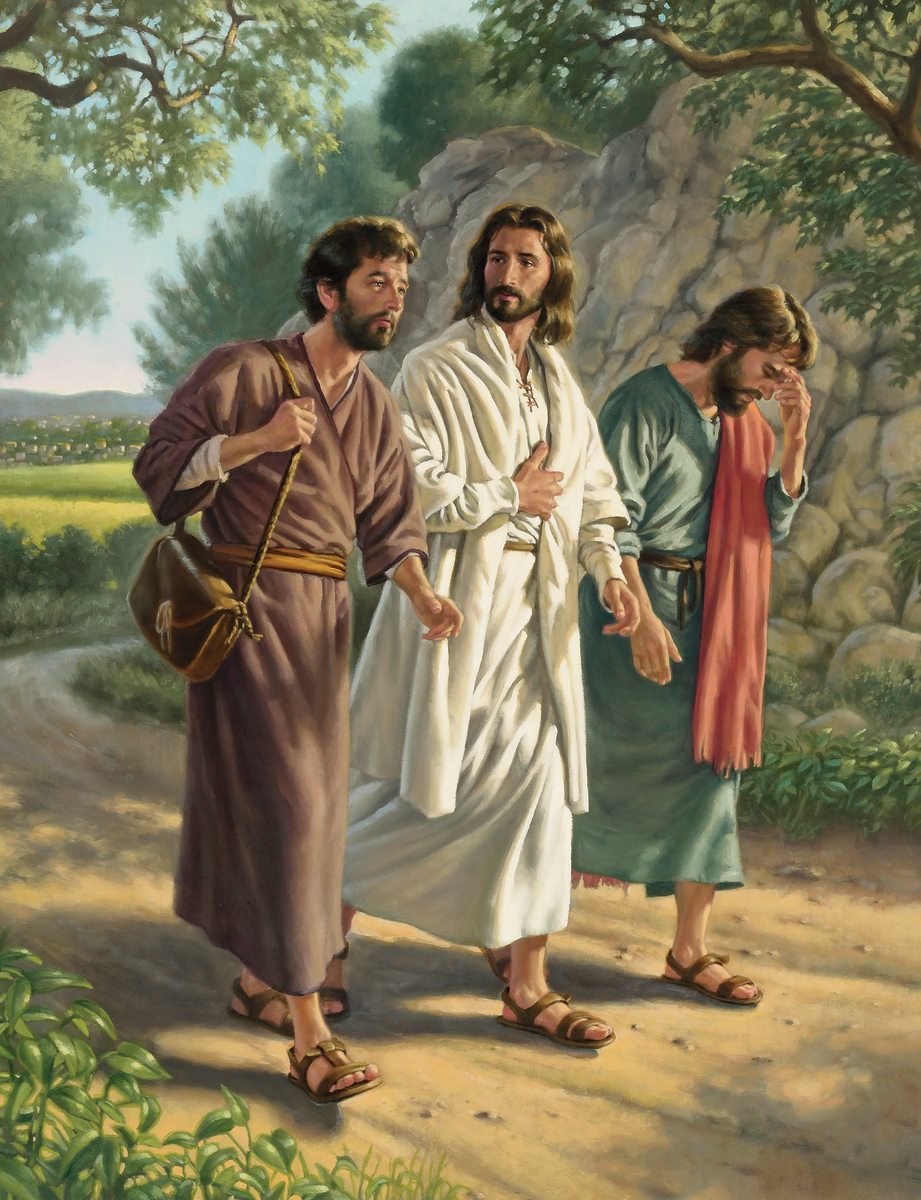
Road to Emmaus

Several weeks ago a pastor at our church gave a sermon based on the story of the Road to Emmaus. For anyone who might be unfamiliar with it, the story can be found in Luke 24:13-35, and it is about who two followers of Jesus encountered when they were walking to a village about seven miles from Jerusalem on the day Jesus rose from the dead — before that news had widely spread. There are many fascinating aspects to the story, but this time when I was reading it one particular fact struck me in a way it had not done before. The story begins like this:

“That same day two of Jesus’ followers were walking to the village of Emmaus, seven miles from Jerusalem. As they walked along they were talking about everything that had happened. As they talked and discussed these things, Jesus himself suddenly came and began walking with them. But God kept them from recognizing him.

“Jesus asked them, ‘What are you discussing so intently as you walk along?’

“They stopped short, sadness written across their faces. Then one of them, Cleopas, replied, ‘You must be the only person in Jerusalem who hasn’t heard about all the things that have happened there the last few days.’

“‘What things?’ Jesus asked.

“‘The things that happened to Jesus, the man from Nazareth,’ they said. ‘He was a prophet who did powerful miracles, and he was a mighty teacher in the eyes of God and all the people. But our leading priests and other religious leaders handed him over to be condemned to death, and they crucified him. We had hoped he was the Messiah who had come to rescue Israel. This all happened three days ago.

“‘Then some women from our group of his followers were at his tomb early this morning, and they came back with an amazing report. They said his body was missing, and they had seen angels who told them Jesus is alive! Some of our men ran out to see, and sure enough, his body was gone, just as the women had said.

“Then Jesus said to them, ‘You foolish people! You find it so hard to believe all that the prophets wrote in the Scriptures. Wasn’t it clearly predicted that the Messiah would have to suffer all these things before entering his glory?’ Then Jesus took them through the writings of Moses and all the prophets, explaining from all the Scriptures the things concerning himself.”

What struck me was the line: “But God kept them from recognizing him.” (Luke 24:16). The immediate question that comes to mind is why? Why did God prevent these followers from recognizing Jesus the moment He appeared to them? As the story relates, the men were clearly distraught by the events of the crucifixion. As I attempted to convey in my last post, His followers’ whole worlds were turned upside down when Jesus was killed. These men tell Jesus that they had “hoped he was the Messiah,” and then those hopes were seemingly dashed by Jesus’ sudden and gruesome demise, which they probably witnessed. So, why in the world would God prevent these grieving men from recognizing Jesus standing in the flesh before them?

Of course, you start to get some sense of the answer as the story unfolds. First, the men honestly told Jesus what they believed: they thought Jesus was a great prophet and teacher, but they were unconvinced that He was the Messiah. Jesus then explained the Scriptures (what we today call the Old Testament) to them as they were meant to be understood, with Jesus at their center. His teaching was so powerful that the men literally begged Him to stay with them longer even though they still didn’t actually know who He was.

“By this time they were nearing Emmaus and the end of their journey. Jesus acted as if he were going on, but they begged him, ‘Stay the night with us, since it is getting late.’ So he went home with them. As they sat down to eat, he took the bread and blessed it. Then he broke it and gave it to them. Suddenly, their eyes were opened, and they recognized him. And at that moment he disappeared!

“They said to each other, ‘Didn’t our hearts burn within us as he talked with us on the road and explained the Scriptures to us?’ And within the hour they were on their way back to Jerusalem. There they found the eleven disciples and the others who had gathered with them, who said, ‘The Lord has really risen! He appeared to Peter.'”

After the encounter, the men didn’t sit around or go to bed; they got right back on the road back to Jerusalem to tell the Disciples what had happened to them. They were practically bursting with the news. These men, who had been followers, were now true believers in Jesus as the Savior of the world because now they had to tell people about Him.

Thus, by the end of the story, it becomes clear that God kept the men from initially recognizing Jesus for their own good. Their belief needed the uncertainty, and, dare I say, the pain, that came from not understanding what had happened to Jesus. It needed those prompting questions from a seeming stranger to bring their honest doubts to the surface. The men also clearly needed guidance from Jesus to traverse this spiritual journey from anxiety to exuberance about Jesus, but they did not really know that was their need. In short, in order for the men to experience a progression from factual knowledge about the Bible and Jesus to genuine understanding and faith in who Jesus really is, the men had to be kept in the dark for a little while. Timing was crucial to a correct understanding of the answers they sought.

So, you might be thinking: “That’s all very interesting with regard to how people come to a saving knowledge of Jesus, but why are you writing about it in this blog that is dedicated to Ethan?” And the answer is that I think God can be telling us more than one thing through the stories He has preserved for us in the Bible. I have no doubt that the story of the men on the Road to Emmaus is about a journey toward faith in Jesus. But it also can have something to say about how God raises His children.

No one knows us better than God because He made us. “For you created my inmost being; you knit me together in my mother’s womb.” (Psalm 139:13). He knows what we need, and, just as important, when we need it. So, when this story says, “God kept them from recognizing Jesus,” it suggests that there are times that God purposefully does not reveal to us the answer to a question we ask — even when we desperately want an answer for good an understandable reasons — because the timing is not right for us to receive that answer. For reasons we cannot fathom at the time, we must walk through a period of pain, uncertainty, inquisition, and spiritual guidance from the Lord before we are prepared to fully grasp the import of the answer.

If you think about it, we do the same with our own children. Children ask questions all the time that we know the answers to, but for a variety of reasons we do not provide them with an immediate direct answer. In many cases, we do not reveal the answer because the child is not ready to understand the answer. It is better for the child that the answer waits for a more appropriate time. This can be true for something as simple as a birthday surprise or as profound as how they came to be. In fact, there are even times when we will tell them the true answer because it is unavoidable, but they will not come to grasp the full import of that answer until many years later. I know this last one to be true from telling our other children when we came home from the hospital on March 10, 2017, that Ethan was not coming home. Our other children are still too young to really understand what his absence means.

The question I always ask God is Why? Why would You let our Ethan die so young, before we could see all he was meant to be? Why would You perform this miraculous work of creating so precious a creature inside his mother — together with his brother Noah — and then let that “wonderful work” die in our arms? (Psalm 139:14). Why would You allow this harrowing experience of twins being born in the back of an ambulance in an ice storm, only to then watch one of them expire after being raced to a hospital in another ambulance? Why would You have him be born with a hole in his heart, so that each of his days before a necessary (but supposedly common) surgery were a painful struggle for him, only to have him leave us before he could have that operation? Why? Why? Why?

Aside from the cold reality that evil really does exist in this world, God has not given me an answer. And to be honest, I believe that I am going to live the rest of my life — however long it is — without receiving an answer. I know that sounds depressing. And again, to be honest, there are a lot of times that the silence that surrounds that pleading question is just that: depressing, forlorn, dark — much like I imagine those men on that Road felt two days after Jesus had cried out from the Cross “My God, my God, why have You forsaken me?” before He breathed His last. (Matthew 27:46).

But it is also good to remember that this does not mean there isn’t an answer. The answer to Jesus’ question from the Cross came the moment He took His first breath in that tomb Sunday morning. The answer to those men’s questions was standing right in front of them even though they did not yet know it. It is a mistake to be believe that just because you do not receive an immediate answer to a heartfelt question that no answer exists -– or that you will never receive it. Sometimes the when is just as important as the what.

And I believe that there is a reason I have to wait for the answer to my question. I am well aware in saying this that it means God is purposefully allowing me to travel this road of uncertainty, doubt, and yes, even pain before I receive the answer. That is not an easy thing to accept, but the truth is often not easy; it is, however, necessary. And, by the way, that does not mean it is easy for God to make me wait, just as it is sometimes hard for me to keep an answer from my own children. God knows that I ache, and grieve, and wonder, and I believe that it rends His heart to watch me go through this experience. (Psalm 56:8).  But if sometimes what is best is not what is easiest, then that is as true for God as it is for us. So, in His infinite wisdom, He keeps the knowledge from me even though it pains Him to do so.

But please do not misunderstand: I am not saying that God thought Ethan needed to die in order for me to experience some kind of spiritual progression in my life. Some well-meaning Christians, in a round about way, say things like this to fellow believers who have suffered excruciating losses in an attempt to offer meaning for a senseless event. It isn’t true. What these people do not realize is that what they are really saying is that the loved one the fellow believer lost was just a pawn for God’s work in that believer’s life. That is an insult, not a comfort. How could this be if Ethan, like all of the other precious ones who are tragically lost through no fault of their own, is “fearfully and wonderfully made?” (Psalm 139:14). Pardon me for the bluntness, but this idea that all things occur for your own betterment is an extraordinarily selfish view of life. There is a distinct and important difference between understanding that God can produce good from the ash of tragic circumstances and saying that tragic circumstances are for our good. The former is Biblical truth; the latter is nothing less than the denial of the existence of evil.

What I am saying is that for some reason, I am not ready for the full answer to this question of Why. I think it is likely that at least part of the reason is simply that my finite existence is incapable of understanding it. Regardless, what is important for me to grasp is that sometimes God does not give us an immediate answer, not because it doesn’t exist or because we don’t deserve one, but rather because it is absolutely necessary for us to wait in order for the answer to have the meaning it is intended to have. And so I must wait. But I do not wait as one with no hope:

“It is wrong to say that the Almighty does not listen, to say the Almighty is not concerned. You say you cannot see him, but He will bring justice if you will only wait.” (Job 35:13-14).

One day I will have an answer, but it will be better than just a mystery revealed; it will include setting this wrong aright again.

“Yes, the Sovereign Lord is coming in power. He will rule with a powerful arm…. He will carry His lambs in His arms, holding them close to His heart.” (Isaiah 40:10-11).

I will not just get to see why; like the men on that Road, I will get to see Who is the answer. And I will see Him holding Ethan in His arms . . . waiting for me.