 Ethan’s Dad: My wife has mentioned in this space before that sitting in church can be a trying experience for us. We never know when a song, a prayer, or a statement made in Sunday School banter might open the floodgates of sadness that reside within us from losing Ethan. Of course, this is also true in everyday encounters, but we have found that the likelihood of it occurring is magnified in church because mortality and miracles are topics of discussion in church much more often than in everyday life.
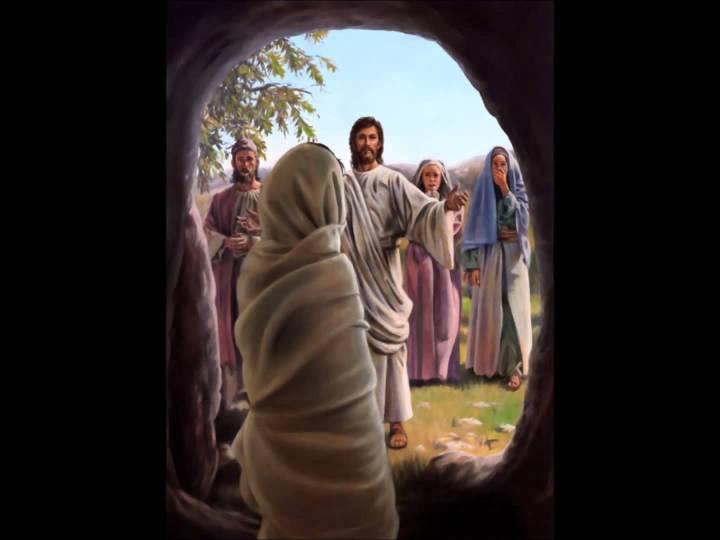
One of those occasions occurred this past Sunday when our pastor was giving a sermon titled “Who is Jesus.” It was part of a series he has been doing in which he has listed three descriptions of Jesus in each sermon and expounded upon them. The first of those descriptions this past Sunday was that Jesus is “the resurrection and the life.” This is a description Jesus gave about himself that is recorded in the book of John, chapter 11, that tells the story of Jesus raising Lazarus from the dead. In one part of the story, Jesus has a captivating conversation with Martha, the brother of Lazarus. Just after Martha informed Jesus that Lazarus has died, Jesus said:
“Your brother will rise again.”
“Martha answered, ‘I know he will rise again in the resurrection at the last day.’
“Jesus said to her, ‘I am the resurrection and the life. He would believes in me will live, even though he dies, and whoever lives and believes in me will never die. Do you believe this?’
“‘Yes, Lord,’ she told him, ‘I believe that you are the Christ, the son of God, who was to come into the world.’” (John 11:23-27)
Our pastor was, of course, right that Jesus’s pronouncement about himself in this passage is foundational to the Christian life because it revealed to Martha (and all who would later read those words) who Jesus was in the grandest eternal sense and what they must do to inherit eternal life, which was simply to believe in who He really was. My problem was not with the pastor’s reference to this exchange or to the story of Lazarus in general. My issue was with the pastor’s use of something Martha said right before this part of their conversation.
When Martha first heard that Jesus had arrived in Bethany — the town where she, her sister Mary, and Lazarus had lived — she said to him, “Lord, if only you had been here, my brother would not have died.” (v. 21). To fully understand this comment, you have to know that several days earlier Martha and Mary had sent Jesus a message informing Him that Lazarus was sick, and they no doubt had expected Jesus to come quickly to Lazarus’s aid. Instead, Jesus arrived in Bethany four days after Lazarus had died. Jesus’s delay piled confusion on top of the crushing grief Martha was feeling because of her brother’s death.
Our pastor chose to focus on those two little words near the beginning of Martha’s statement: “if only.” The pastor did a riff on how we all have “if only” times in our lives, i.e, times when we believe that things could have been different if only God had acted or if only we had made a different choice. He made some statement about how, in thinking this way, we are often more focused on temporal things while God is concerned with eternal matters. Again, that is a true statement in itself (to a degree). And I believe the pastor’s point was that whatever those “if only” moments might be in our lives, Jesus is the ultimate answer to them because He is the resurrection and the life.
Now, as I have said, I had no theological problem with any of this in the abstract. My issue was that as soon as the pastor started talking about “if only” moments, my mind (and my wife’s) immediately veered to March 10, 2017, and that horrific period when we literally screamed for God to save our precious Ethan. We begged; we pleaded; we cried oceans of tears. . . . And nothing happened.
So, here is the thing about Martha’s statement that the pastor chose to gloss over: she was right. If Jesus had been there before Lazarus had died, He could have saved Lazarus from death. Indeed, in all likelihood Martha had seen Jesus do it before for total strangers. All she was wondering was: why didn’t Jesus come earlier and save His friend Lazarus? And is that really such a bad thing to wonder about?
I don’t think so. For one thing, Jesus did not rebuke Martha in any way for her implied question. In fact, if she had not wondered about it, I think it would mean that Martha did not really believe that Jesus was who He said He was. But we know this isn’t true because Martha gave not one, but two great statements of faith. Right after Martha made her “if only” statement, she said: “But I know that even now God will give you whatever you ask.” (v. 22). And then when Jesus asks her if she believes that He is the resurrection and the life, Martha responds unequivocally: “Yes, Lord, I believe that you are the Christ, the Son of God who was to come into the world.” (v. 27).
As one who has been where Martha was, in the throes somber grief, I have to say that this is a wonderful testimony on her part. The Holy Spirit must have encouraged her, but it is truly admirable that Martha did not let her deep sorrow swallow her faith in Jesus at that moment. The sincerity of Martha’s faith practically explodes off the page because of the palpably desperate moment in which she expresses those statements. It is not unlike that moment when a thief hanging on a cross, in the midst of excruciating agony, expressed his faith in Jesus even as Jesus was on a cross right beside him (Luke 23:40-43), or when Stephen asked the Lord to forgive his executioners as they stone him and he proclaimed that he saw Jesus standing at God’s right hand in heaven. (Acts 7:54-60). To proclaim Jesus as Lord when doubt has enveloped the heart and darkness is one’s sole companion: those are the testimonies that speak most to me because I know first-hand how difficult it becomes in that lonely place to cling to this truth.
But as commendable as Martha’s faith is, do not lose sight of the fact that, at the same time, she questioned Jesus’s timing. For faith and questions are not incompatible; they are, in a sense, inseparable. We do not continue to learn about who Jesus is if we do not keep wondering about why things must be the way they are. For Jesus is “the author and perfecter of our faith,” (Hebrews 12:2), where “perfect” really means “finish” or “complete.” Our faith must mature, and it only does so when we probe and ask Jesus to show us who He is, just as Martha did. And I think the answer she received stretched beyond her imagination, because how could one really conceive that Jesus was going to call Lazarus forth out of that tomb, and that Lazarus would actually walk out of it as if nothing at all had happened to him?
So as I sat there in the pew now only half listening to the rest of the sermon, I kept poring over this story about Lazarus, a story like the widow of Zarephath, which inevitably causes a believer who loses someone close to him or her to wonder, just as Martha did: Why didn’t you save him, Lord? And I am not afraid to confess that I did not receive an answer. But what I did see was something I had never noticed before in all my years of being told about and then reading this story. It was this: Doing this was really hard for Jesus.
I don’t mean the raising of Lazarus from the dead. Indeed, the remarkable thing is that that was the easy part for Jesus. For Jesus, raising Lazarus was no different than restoring a blind man’s sight or causing a lame man to walk or walking on water. Certainly, it seemed different to everyone else, but for the One “through whom all things were created, things in heaven and on earth, visible and invisible,” resurrection is not difficult. (Colossians 1:16; see also John 1:3).
No, what was really difficult for Jesus was not saving Lazarus before he died. Go back to when Martha and Mary first sent their message to Jesus telling Him that Lazarus was sick. John 11:3 says: “So the sisters sent word to Jesus, ‘Lord, the one you love is sick.’” Martha and Mary knew Jesus would understand that they were talking about Lazarus, which tells us that Jesus and Lazarus must have been extremely close friends. Jesus responded to this message by saying: “This sickness will not end in death. No, it is for God’s glory so that God’s Son may be glorified through it.” (v. 4). This response, though somewhat cryptic at this point in the story, tells us that something bigger was going on than anyone could really understand.
But then John decides to give the reader an interesting side note.
“Jesus loved Martha and her sister and Lazarus. Yet, when He heard that Lazarus was sick, he stayed where He was two more days.” (vv. 5-6).
This note drives home the point that Jesus loved all three of these people very much, and yet He did not do what everyone would think He would do and rush to see Lazarus, Martha, and Mary. No, instead, Jesus essentially decided to kill time with his Disciples while Martha and Mary watched their brother suffer and die. Despite appearances, this isn’t callousness; it is the exact opposite: it is unfathomable love. John is telling us that Jesus really wanted to rush to Lazarus’s side, but that for the sake of something greater, He had to wait.
This point is reinforced again when Jesus said to his Disciples: “Lazarus is dead, and for your sake I am glad I was not there, so that you may believe.” (vv. 14-15). Jesus says He is glad for their sakes, not His own, because if this was just about His personal feelings, He would not have allowed Lazarus to die. Jesus was also acknowledging here that if He had been there, He would have healed Lazarus rather than letting him die. Think about it: where in the Gospels is there a time when Jesus refused an in-person request for healing? He certainly would not have refused to heal if He was standing before his dear friends watching Lazarus suffer. So, Jesus did not go right away because He knew what had to happen — Lazarus dying — and that it would not have happened if He had gone to them sooner.
John decides to make very sure the reader does not miss how difficult this was for Jesus by noting that when Jesus saw Mary and her friends weeping near Lazarus’s tomb, “He was deeply moved in spirit and troubled,” (v. 33). And then he observes that “Jesus wept” when He saw Lazarus’s tomb. (v. 35). The word “troubled” that is used in verse 33 is the same root word Jesus later used in the Garden of Gesthsemane to describe His spirit in its agony before the crucifixion. And yet again, just before Jesus raises Lazarus, John notes that “Jesus, once more deeply moved, came to the tomb.” (v. 38).
John (God, really) is practically begging his readers recognize that Lazarus’s death precipitated intense pain for Jesus. Jesus understood that allowing Lazarus to die had caused great pain and grief for people He loved very much. Jesus weeps for the real anguish that is present even though He is about to remove the reason for it by raising Lazarus from the dead.
In the same way, I believe that God weeps for us in our sorrow for Ethan’s loss. God knows that Ethan is with Him and that He will raise Ethan again for us to see one day, but He also knows that there is real and genuine suffering caused right now by Ethan’s absence. He knows that torment because Jesus lived it. The fact that Jesus is the resurrection and the life gives us incredible hope for eternity, but it does not erase our reality of agonizing loss in the here and now. God does not ask us to ignore or diminish that reality because He has shared it.
So God wants us to know that He truly understands our pain and grief. But in this incarnation story, God tells us more than just that He felt as we feel. He tells us that there are times when, in His love, He refrains from acting to save even though it deeply wounds Him to stay His healing hand. In the immediate sense it is not what He wants: God does not enjoy seeing our suffering, and it hurts Him even beyond what we can imagine because He knows that He can help us. But sometimes God chooses “to stay away from Bethany for a couple of days” even as He hears our cries. I do not pretend to know why He makes this choice at some times while at others He rushes to save one in need.
Certainly the answer comes easier in the Lazarus story, for Jesus delayed coming so that He could demonstrate that His power extends even over death itself. Further, Jesus’s raising of Lazarus started to bring the conspiracy against Jesus to a head because the miracle caused a great many more people to believe in Him, and, in turn, the religious leaders resolved that Jesus must be stopped at all cost. So His raising of Lazarus became a part of the chain of events that led to the crucifixion, which caused His death, which precipitates His resurrection, and leads to our redemption.
God’s choice to refrain from acting in our circumstances does not portend such heady consequences — at least so far as I can see. I believe that at least in part the answer to why He sometimes stays His healing hand lies in the fact that this world is corrupted by evil, and in many cases God must let the consequences of that evil play out; otherwise, love and choice do not exist. And part of the answer lies in how suffering occasions examples like Martha who proclaim their belief in Jesus even as they drown in sorrow, and by so doing they embolden others to believe likewise. But those are only partial answers. Right now we know in part, but there will be a time when we will know in full. (See 1 Corinthians 13:12).
Yet, as much as I wonder about a complete answer to the why question, even a full answer would not bring Ethan back. Consequently, for me what is more important is the knowledge that God’s failure to act does not equate to a failure to care. God can simultaneously allow and yet participate in our suffering. In fact, this also happens when people sin. Sin hurts the sinner and often those around him or her. But it also grieves God to see His children participate in evil. Thus, whether the suffering is caused by the world’s brokenness or by human rebellion, God permits pain knowing that it will cause Him intense pain as well, all because of His greater purposes.
In the story of Lazarus Jesus tells us that greater purpose is “God’s glory,” (v. 4) and our eternal lives (v. 25). The stories of our earthly lives take places within that context, and so ultimately we can take lasting comfort in the assurance that the tragedies which befall us — tragedies seen by a God who hurts with us as we experience them — will one day be made right again. One day He will call Ethan forth and we will see him again because Jesus truly is the resurrection and the life.

 Walking in the Shadowlands