Counterfeit “Resurrection”

Ethan’s Mom: Tacky skeletons hanging out of windows or lounging in Adirondack chairs.  Kitschy faux tombstones in front yards.  A larger-than-life inflatable Grim Reaper on the corner.  A house just down from my parents actually has a full tableau that includes 4 skeleton pallbearers carrying a fake coffin into a full fake cemetery.

This is Halloween 2021, and I cannot wait for it to be over. Because the sooner it arrives, the sooner people can pack all that mess up for another year and I can go back to walking or driving around my neighborhood without Death mocking me.

For the past 4 years, I have tried to figure out the appeal of this decor and the overall fascination with the macabre.  Every year I remain completely flummoxed as to why I see even more skeletons waving from the yards in my perfectly nice neighborhood, why people who cannot even acknowledge death in its real context go all out to celebrate a cartoon version of it, and why the easy and fun neighborhood trick or treating of my childhood has turned into… this?   

The only new thought I had this year is that maybe this is all another example of Satan taking something that has a basis in truth and twisting it into something false, taking something that has real, eternal meaning and cheapening it to the point of casual “fun.”  In the process, he is able to desensitize and damage our very souls. 

Yes, the dead will rise again – but not as creepy skeletons or disgusting zombies.  

Our family recently planted fall pansies in Ethan’s garden at our preschool.  In the spring, we planted flowers with the students, but the garden needed a freshening up for fall after all the spring/summer annuals faded.  At the end, I read the Liturgy for the Planting of Flowers, just as I do every time we work in the garden.  I got choked up on this line, just like I do every time I read it aloud.

Though our eyes yet strain to see it so, these tiny seeds, bulbs, or velvet buds we have

planted are more substantial than all the collected evils of this groaning world.

They are like a banner planted on a hilltop,

proclaiming God’s right ownership of these lands

long unjustly claimed by tyrants and usurpers.

They are a warrant and a witness,

each blossom shouting from the earth

that death is a lie,

that beauty and immortality

are what we were made for.

Every Moment Holy by Douglas McKelvey

Death is a lie, not a joke.

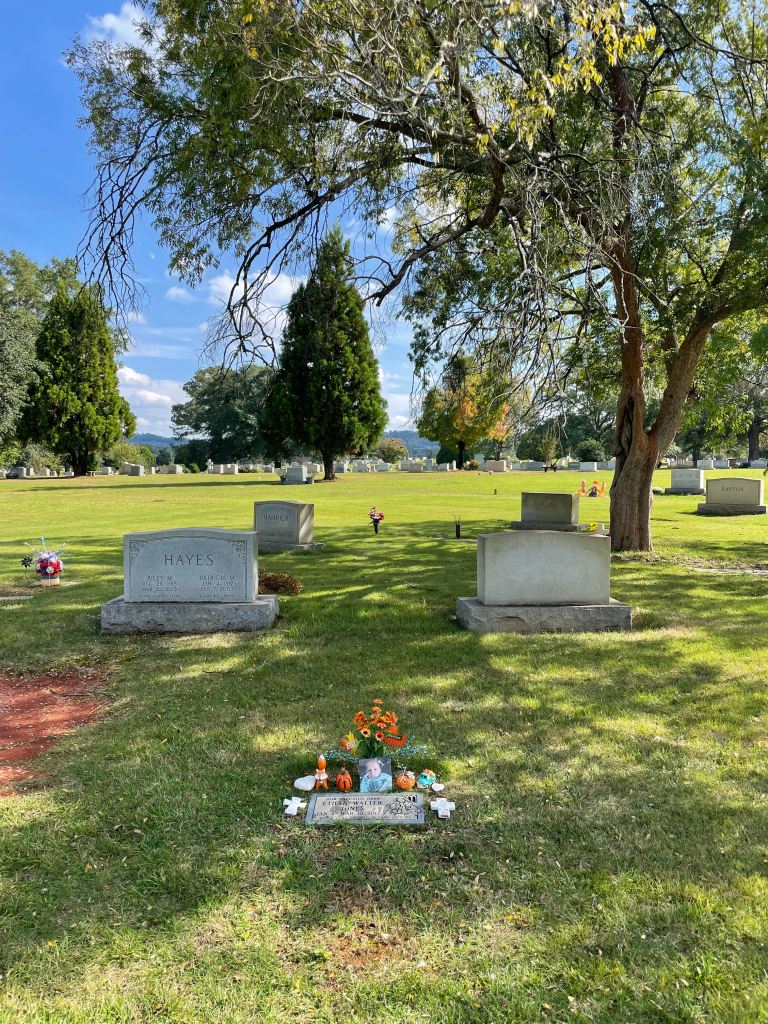
The fake cemetery in the yard down the street may have headstones with funny inscriptions, but my baby’s name is inscribed on a real marker in a real (and actually quite beautiful) cemetery where his real body lies waiting for the resurrection of the saints.  And on that day, their creepy, bony arms won’t shoot out of the ground like those tacky skeletons.  They will be raised imperishable, fully embodying all that God designed for us to be.   Until then, it is a struggle to believe that His promise of resurrection is true, especially in October.  All the decorations make it hard to follow the command found in Phillippians 4:8.

Finally, brothers, whatever is true, whatever is honorable, whatever is right, whatever is pure, whatever is lovely, whatever is admirable— if anything is excellent or praiseworthy— think on these things. 

Phillippians 4:8

I’m doing my best over here.  So can we just stick to pumpkins next year?  Please?

Acknowledging the Paradox of God’s Control

Ethan’s Dad: Those who read the last post know that I now want to embark on a deeper exploration of what we Christians really mean when we say “God is in control.” I have had much of what follows written for a while, but I have hesitated in committing it to this space because, frankly, this whole area just isn’t easy, and the last thing I want to do is make any Christian feel stupid for holding to a different understanding of it. But Andrew Peterson says in his book Adorning the Dark that in the creative process intention matters more than execution, by which I think he means you should not let the fear of expressing your thoughts imperfectly keep you from expressing them at all. With that in mind, I am going to press forward, in the full knowledge that the waters into which I am about to wade are much more vast than my mind is capable of navigating with any degree of precision. I do so anyway because, for me, what happened to Ethan demands that I confront it.

I mentioned in the last post that the callousness of the statement “God is in control” is one reason you should not repeat it to a person who has just suffered a tragic loss. Another reason is that it isn’t true — at least not in the sense that many Christians mean it when they say it. Rather than be pejorative, I will illustrate the viewpoint to which I am referring by quoting from a book I read called You Can Trust God to Write Your Story by Nancy DeMoss Wolgemuth and Robert Wolgemuth. I use this book not because it is unique in its view; on the contrary, there are many works that express the same notion. This just happens to be the latest I read which espouses this view.

The authors begin one chapter in which they discuss their view of what “God’s providence,” i.e., control, means by quoting with approval from someone else:

“‘How unspeakably precious and sweet it is when we can believe that God our Father in heaven is absolutely directing the most minute circumstances of our short sojourn in this wilderness world. That nothing, however trivial, takes place, whether it relates to the body or the soul, but is under His control, that is ordered by Himself.'” Mary Winslow

Later, they pick up this theme with the following explanation:

“The word [providence] also speaks to His wise, sovereign rule over every detail of His creation. Now, this is admittedly a subject that can stir up animated arguments. But there are basically two options. Either 1. God sovereignly causes, and or permits, everything to happen that happens in our lives and in this world, or 2. God stands by and watches passively and powerlessly unwilling or unable to do anything about what happens. … Where would we be without the certain knowledge that He’s got the whole world in His hands and that every detail of our lives and days is ordered by our all-wise, all-knowing, loving God? … To be helpless victims of chance, tossed about on the storms of life; that would be forever disconcerting and tragic. Thank God, it is not the case.”

As this excerpt shows, when some Christians say “God is in control,” they mean to be precisely that black-and-white about it: that literally EVERYTHING in our lives is absolutely controlled by God. To these people, when Jesus said, “There isn’t a sparrow that falls to the ground apart from God’s will” (Matthew 10:29), Jesus was actually saying that God caused the sparrow to fall.

What is entirely left out of that explanation (and essentially makes no express appearance in You Can Trust God to Write Your Story) is the existence of evil. “When the enemy comes like a flood, the Spirit of the Lord will lift up a standard against him.” (Isaiah 59:19). “Be sober-minded; be watchful. Your adversary the Devil prowls around like a roaring lion, seeking someone to devour.” (1 Peter 5:8). Evil is real; Satan has genuine power; the whole world has an unnatural aspect to it. To minimize, ignore or even deny this is to contradict a clear message from the Bible.

To me, you cannot have an honest discussion about God’s providence unless you frankly face the existence of evil in this world. Glossing over evil shortchanges God’s justice, Jesus’ sacrifice on the Cross, and people’s pain.

If what I have just said is true, then why would some Christians hold to what I would call the robotic view of God’s providence? I believe it is born from a good intention: to acknowledge God as all-powerful. But the view is driven by a false dichotomy. As the passage from the Wolgemuths’ book above indicates, such Christians think you must pick between a God who stages every minute of life like a marionette player controls puppets or a God who lacks the ability to do anything in the face of natural chaos. If that is really the choice, then it’s no wonder they pick the first option.

But the logical conclusion of this view of providence, to put it in stark personal terms, is that God killed Ethan. I reject that notion as an outrageous and unnecessary slander of God. Ethan died because we live in a sinful world in which life is sometimes senselessly cut short. However, if God controls absolutely everything, then the presence of sin in this world cannot be explained.

By definition, sin is rebellion against God. It is the reason humanity is condemned by God and it is the reason Jesus had to come and be the perfect, sinless sacrifice to save us from eternal damnation. It is one thing to say that God planned Jesus’ redemption of our sin from the foundation of the world; it is entirely another thing to say that God wills us to sin. The former is true because God knows everything that will happen before it occurs and so He planned a way to rescue us from ourselves. The latter is not possible because God cannot desire or will us to do that which is against His will, i.e, to do evil. The reason we can be condemned for our sinful actions is because we bear responsibility for our own choices. But that is not possible if there is no real choice, if God actually plans and controls every minute detail of our lives. The only way Jesus’ sacrifice has eternal meaning is if there is real choice: choice for humanity to follow or reject God, and choice for Jesus to lay down His life or not. Otherwise, the Garden of Gesthemene is a joke: what kind of struggle is Jesus having in the Garden if He has no choice in the matter? Jesus prays: “Father, if you are willing, take this cup from me; yet not my will, but yours be done.” (Luke 22:42). Luke goes on to obverse that “being in anguish, He prayed more earnestly, and His sweat was like drops of blood falling to the ground.” (v. 44). Isn’t this what true obedience to the Lord involves: foregoing our own desires and submitting to His will? That type of obedience isn’t possible if the only will in existence is God’s.

I completely understand why people have a difficult time comprehending how it is possible for God to be all-powerful, but that He allows things to happen that are not what He desires, or to put it another way, God’s sovereignty and our liberty coexist. One verse that well-illustrates this paradox quotes Peter in his speech at Pentecost to a large crowd of Jews saying: “This man [Jesus] was handed over to you by God’s set purpose and foreknowledge; and you, with the help of wicked men [the Romans], put Him to death by nailing Him to a cross.” (Acts 2:23). There is no doubt that the crucifixion of Christ was a wicked act perpetuated by those who willingly succumbed to evil desires, and therefore deserved condemnation for for their deeds. But of course it had been God’s plan for forever that the Messiah must suffer and die. The one does not negate the other. This is why Jesus would say on the Cross: “Father, forgive them, for they know not what they do.” (Luke 23:34). Those people were in need of forgiveness because what they had done was wrong, outside of God’s will for them, even though the crucifixion was part of His plan, and, in fact, was the very reason Christ could seek forgiveness for them.

As head-scratching as this paradox may be, if faith teaches us anything, it is that the truth is not limited by our understanding. Indeed, throughout the story of God’s redemption of humanity, simplicity and incomprehensibility co-exist. We know that humanity was given a choice, but we do not fully know why God offered one. We know that God came into our world as a human baby, but we don’t completely understand how God could be fully human. We know that Jesus came to save us, but we cannot fully comprehend why He would be willing to do such a thing given who we are in comparison to Him and our repeated rejections of God. We know that Jesus died on a cross, yet we cannot fully grasp how the eternal God could cease to live. We know that in His death Jesus was separated from God the Father, but given that Jesus is fully God we cannot conceive of what this separation could entail. We know that Jesus rose from the dead, but in our own experience we have never known or seen anyone come back from death. At a certain point, we have to accept these things on faith even though we cannot fully understand or explain them.

So, is it really asking too much to believe that it is possible for God to know all and to be able to orchestrate the grand design of His will without His controlling every single thing that occurs in this world? In other words, I am simply saying that God allows things to happen that are not within His immediate will. If this wasn’t the case, why would Jesus command us to pray “Your Kingdom come, Your will be done on earth as it is in heaven”? (Matthew 6:10).  When we pray this, we are asking that this present evil age would pass away and that all creation would come into conformance with His will (and that we would be His instruments for ushering this new creation into existence).

Those things outside of His will do not catch God off guard; they do not throw Him for a loop and force Him to drastically alter His ultimate plan for humanity. But those things do grieve Him. God certainly desires that people would not make the wrong choices He knows are coming. It hurts Him to watch us experience the tragedies that are inflicted by the cruelties that mar this fallen world. Such hurt and pain, and the desire to see us make better choices — to follow His will more closely — would not be possible for God if all of what occurred was controlled and purposed by Him.

To be a Christian is to believe that there is immense evil in this world and in us which requires a Savior beyond ourselves to rectify, and that Jesus is that Savior because He is is God in the flesh, who bore our sins on the Cross unto death, and then overcame death by rising again, thereby confirming that He is greater than the evil in this world. Thus, God is, indeed, sovereign over evil, but He is not a party to it.

There is no perfect way to explain how this could be, but one way to think of it is the idea of relinquishment of control. Jesus repeatedly called Satan the “prince of this world” (John 12:31, 14:30, 16:11). In one of those passages, Jesus says “the prince of this world is coming. He has no power over me.” (John 14:30). In Job 1:12, God tells Satan: “Everything [Job] has is in your power, but on the man himself do not lay a finger.” God didn’t tell Satan what to do, but only the limit of what he could not do. Thus, although God’s Power is clearly greater, and the power Satan has is dictated by what God allows, Satan has real power and control in this world. I believe that the same is true for people. God has granted us a certain amount of control over our own lives; it obviously is not ultimate control because we are subject to so many other forces: natural, satanic, and heavenly, but there is control.

As human beings we cannot help but ask: but why would God allow such horrendous evil? Why must some children die so young? Why are there viruses that wreak havoc without warning?

I cannot give a truly satisfying answer to that perpetual question. But one possibly helpful analogy, though not a perfect one by any means (no analogy related to God can be), is democratic government. In that theory of government, the people have ultimate political power to govern how they live their lives, but they cede some of that power to a central governing authority so that certain tasks, like security for society, can be better accomplished. Well, it just might be that the reason God relinquishes some of His authority to Satan and to human beings is because it is the best way to achieve some of what He seeks to accomplish with His creation. If we return to that passage in John that I quoted earlier, after Jesus observes that Satan has no power over Him, He continues: “But [Satan] comes so that the world may learn that I love the Father and do exactly what my Father has commanded me.” (John 14:31). So, Satan had a role in testing and torturing Christ, and those actions would illustrate Jesus’ love for God the Father and for us. What if God’s willingness to cede control, which allows for the existence of evil, helps manifest His love for us and our love for Him?

In fact, at least in this existence, there cannot be love without choice. God chose to create us; He did not need us to sustain His existence. He desired our existence: creating us was a labor of love. Love, by its nature must be freely given, and freely received. And if love is a choice, then there must be an alternative. So, there can be no choice if there is no evil.

Because God loves us, we must trust that there is a purpose behind this evil. I don’t mean a purpose to the evil thing itself, but a purpose to the experience of suffering. As in, there must be something we are meant to gain from this painful life that will make the next one more meaningful than it otherwise would be. After all, surely you have wondered why God doesn’t just skip this part and take us all to Glory so that we can avoid this whole mess. This chaos causes us immeasurable pain, and seeing us suffer grieves Him more than we can know, so that seems like an awful lot of trouble to go through given that He is all-powerful and could just hit the fast-forward button, if you will, and take us to our true home. But think about what else we would miss if He did that — if he removed any experience of evil from our lives. We would miss the full extent of His love demonstrated through Christ, and we would miss countless opportunities to display love to those who are suffering (I miss too many as it is) and so to experience love at a level that is otherwise not possible.

And I think there must be even more that we would miss without experiencing evil that we cannot comprehend on this side of Heaven. The Apostle Paul hints at this in 2 Corinthians 4:6-7 when he says:

“God, who said, ‘Let light shine out of darkness,’ made His light shine in my heart to give me the light of the knowledge of the glory of God in the face of Christ. But I have this treasure in an earthen vessel to show that this all-surpassing power is from God and not from me.”

Would we truly understand that we need God, and how much we need Him, if there was no evil? God knows that our greatest joy comes in being with Him because we were made for Him and in His likeness. But in order for us to come to that understanding, perhaps it takes really strong medicine, a cure that from our perspective feels far worse than the disease. It is a little like a parent telling his or her child what the wise choice in a situation would be, but the parent knows he or she has to let the child make his or her own decision, so that he or she can truly learn why the wise choice was the best one — even if it means watching the child choose poorly. Maybe God has to allow evil to unfold so that we learn what life without God really means.

As I said at the beginning of this post, these reasons absolutely should not, dare not, cause us to minimize evil and suffering in our own lives and in the lives of others. But in the long term, we have to trust that even this pervasive evil and suffering is ultimately, eternally for our good because God is all good and all creation was first good before it was marred by evil.

So, is God in control? Yes, but at the same time He allows us to decide whether He should be in control of our lives. What we do, because of sin, is do things our own way. In His grace, hopefully at some point we notice that we are not really in control of a lot (hello coronavirus) and that even in the things we do control we tend to screw up. That way, it becomes painfully obvious that we are in need of a Savior. If we accept Him by understanding that He is able to accept us, even with all of our flaws, because of Jesus’ perfect sacrifice, and we truly desire to live for Him, then the rest of our time on this earth is about continually relinquishing control of our lives to His Spirit’s leading. For our goal is to be “crucified with Christ, so that we no longer live, but Christ lives in us.” (Galatians 2:20). In a very real sense, then, God relinquishes some control to us in order for us to learn that it is best to relinquish control to Him.

Relinquishing that control does not mean you will have no more trouble. Jesus makes no such promise; instead, His promise is that “in this world you will have trouble, but fear not because I have overcome the world.” (John 16:33). In other words, do not believe the lie that because bad things happen, He will not make it right in the end. He will because He has defeated sin and death. We have to have the faith to wait, to persevere, to see what He already knows.
When Love Refrains: What Else the Story of Lazarus Tells us about God

Lazarus 1Ethan’s Dad: My wife has mentioned in this space before that sitting in church can be a trying experience for us. We never know when a song, a prayer, or a statement made in Sunday School banter might open the floodgates of sadness that reside within us from losing Ethan. Of course, this is also true in everyday encounters, but we have found that the likelihood of it occurring is magnified in church because mortality and miracles are topics of discussion in church much more often than in everyday life.
One of those occasions occurred this past Sunday when our pastor was giving a sermon titled “Who is Jesus.” It was part of a series he has been doing in which he has listed three descriptions of Jesus in each sermon and expounded upon them. The first of those descriptions this past Sunday was that Jesus is “the resurrection and the life.” This is a description Jesus gave about himself that is recorded in the book of John, chapter 11, that tells the story of Jesus raising Lazarus from the dead.  In one part of the story, Jesus has a captivating conversation with Martha, the brother of Lazarus.  Just after Martha informed Jesus that Lazarus has died, Jesus said:

“Your brother will rise again.”

“Martha answered, ‘I know he will rise again in the resurrection at the last day.’

“Jesus said to her, ‘I am the resurrection and the life. He would believes in me will live, even though he dies, and whoever lives and believes in me will never die. Do you believe this?’

“‘Yes, Lord,’ she told him, ‘I believe that you are the Christ, the son of God, who was to come into the world.’” (John 11:23-27)

Our pastor was, of course, right that Jesus’s pronouncement about himself in this passage is foundational to the Christian life because it revealed to Martha (and all who would later read those words) who Jesus was in the grandest eternal sense and what they must do to inherit eternal life, which was simply to believe in who He really was. My problem was not with the pastor’s reference to this exchange or to the story of Lazarus in general. My issue was with the pastor’s use of something Martha said right before this part of their conversation.

When Martha first heard that Jesus had arrived in Bethany — the town where she, her sister Mary, and Lazarus had lived — she said to him, “Lord, if only you had been here, my brother would not have died.” (v. 21). To fully understand this comment, you have to know that several days earlier Martha and Mary had sent Jesus a message informing Him that Lazarus was sick, and they no doubt had expected Jesus to come quickly to Lazarus’s aid.  Instead, Jesus arrived in Bethany four days after Lazarus had died.  Jesus’s delay piled confusion on top of the crushing grief Martha was feeling because of her brother’s death.

Our pastor chose to focus on those two little words near the beginning of Martha’s statement: “if only.” The pastor did a riff on how we all have “if only” times in our lives, i.e, times when we believe that things could have been different if only God had acted or if only we had made a different choice. He made some statement about how, in thinking this way, we are often more focused on temporal things while God is concerned with eternal matters. Again, that is a true statement in itself (to a degree). And I believe the pastor’s point was that whatever those “if only” moments might be in our lives, Jesus is the ultimate answer to them because He is the resurrection and the life.

Now, as I have said, I had no theological problem with any of this in the abstract. My issue was that as soon as the pastor started talking about “if only” moments, my mind (and my wife’s) immediately veered to March 10, 2017, and that horrific period when we literally screamed for God to save our precious Ethan. We begged; we pleaded; we cried oceans of tears. . . . And nothing happened.

So, here is the thing about Martha’s statement that the pastor chose to gloss over: she was right. If Jesus had been there before Lazarus had died, He could have saved Lazarus from death. Indeed, in all likelihood Martha had seen Jesus do it before for total strangers. All she was wondering was: why didn’t Jesus come earlier and save His friend Lazarus? And is that really such a bad thing to wonder about?

I don’t think so. For one thing, Jesus did not rebuke Martha in any way for her implied question. In fact, if she had not wondered about it, I think it would mean that Martha did not really believe that Jesus was who He said He was. But we know this isn’t true because Martha gave not one, but two great statements of faith. Right after Martha made her “if only” statement, she said: “But I know that even now God will give you whatever you ask.” (v. 22). And then when Jesus asks her if she believes that He is the resurrection and the life, Martha responds unequivocally: “Yes, Lord, I believe that you are the Christ, the Son of God who was to come into the world.” (v. 27).

As one who has been where Martha was, in the throes somber grief, I have to say that this is a wonderful testimony on her part. The Holy Spirit must have encouraged her, but it is truly admirable that Martha did not let her deep sorrow swallow her faith in Jesus at that moment. The sincerity of Martha’s faith practically explodes off the page because of the palpably desperate moment in which she expresses those statements. It is not unlike that moment when a thief hanging on a cross, in the midst of excruciating agony, expressed his faith in Jesus even as Jesus was on a cross right beside him (Luke 23:40-43), or when Stephen asked the Lord to forgive his executioners as they stone him and he proclaimed that he saw Jesus standing at God’s right hand in heaven. (Acts 7:54-60).  To proclaim Jesus as Lord when doubt has enveloped the heart and darkness is one’s sole companion: those are the testimonies that speak most to me because I know first-hand how difficult it becomes in that lonely place to cling to this truth.

But as commendable as Martha’s faith is, do not lose sight of the fact that, at the same time, she questioned Jesus’s timing. For faith and questions are not incompatible; they are, in a sense, inseparable. We do not continue to learn about who Jesus is if we do not keep wondering about why things must be the way they are. For Jesus is “the author and perfecter of our faith,” (Hebrews 12:2), where “perfect” really means “finish” or “complete.” Our faith must mature, and it only does so when we probe and ask Jesus to show us who He is, just as Martha did. And I think the answer she received stretched beyond her imagination, because how could one really conceive that Jesus was going to call Lazarus forth out of that tomb, and that Lazarus would actually walk out of it as if nothing at all had happened to him?

So as I sat there in the pew now only half listening to the rest of the sermon, I kept poring over this story about Lazarus, a story like the widow of Zarephath, which inevitably causes a believer who loses someone close to him or her to wonder, just as Martha did: Why didn’t you save him, Lord? And I am not afraid to confess that I did not receive an answer. But what I did see was something I had never noticed before in all my years of being told about and then reading this story. It was this: Doing this was really hard for Jesus.

I don’t mean the raising of Lazarus from the dead. Indeed, the remarkable thing is that that was the easy part for Jesus. For Jesus, raising Lazarus was no different than restoring a blind man’s sight or causing a lame man to walk or walking on water. Certainly, it seemed different to everyone else, but for the One “through whom all things were created, things in heaven and on earth, visible and invisible,” resurrection is not difficult. (Colossians 1:16; see also John 1:3).

No, what was really difficult for Jesus was not saving Lazarus before he died. Go back to when Martha and Mary first sent their message to Jesus telling Him that Lazarus was sick. John 11:3 says: “So the sisters sent word to Jesus, ‘Lord, the one you love is sick.’” Martha and Mary knew Jesus would understand that they were talking about Lazarus, which tells us that Jesus and Lazarus must have been extremely close friends. Jesus responded to this message by saying: “This sickness will not end in death. No, it is for God’s glory so that God’s Son may be glorified through it.” (v. 4). This response, though somewhat cryptic at this point in the story, tells us that something bigger was going on than anyone could really understand.

But then John decides to give the reader an interesting side note.

“Jesus loved Martha and her sister and Lazarus. Yet, when He heard that Lazarus was sick, he stayed where He was two more days.” (vv. 5-6).

This note drives home the point that Jesus loved all three of these people very much, and yet He did not do what everyone would think He would do and rush to see Lazarus, Martha, and Mary. No, instead, Jesus essentially decided to kill time with his Disciples while Martha and Mary watched their brother suffer and die. Despite appearances, this isn’t callousness; it is the exact opposite: it is unfathomable love. John is telling us that Jesus really wanted to rush to Lazarus’s side, but that for the sake of something greater, He had to wait.

This point is reinforced again when Jesus said to his Disciples: “Lazarus is dead, and for your sake I am glad I was not there, so that you may believe.” (vv. 14-15). Jesus says He is glad for their sakes, not His own, because if this was just about His personal feelings, He would not have allowed Lazarus to die. Jesus was also acknowledging here that if He had been there, He would have healed Lazarus rather than letting him die. Think about it: where in the Gospels is there a time when Jesus refused an in-person request for healing? He certainly would not have refused to heal if He was standing before his dear friends watching Lazarus suffer. So, Jesus did not go right away because He knew what had to happen — Lazarus dying — and that it would not have happened if He had gone to them sooner.

John decides to make very sure the reader does not miss how difficult this was for Jesus by noting that when Jesus saw Mary and her friends weeping near Lazarus’s tomb, “He was deeply moved in spirit and troubled,” (v. 33). And then he observes that “Jesus wept” when He saw Lazarus’s tomb. (v. 35). The word “troubled” that is used in verse 33 is the same root word Jesus later used in the Garden of Gesthsemane to describe His spirit in its agony before the crucifixion. And yet again, just before Jesus raises Lazarus, John notes that “Jesus, once more deeply moved, came to the tomb.” (v. 38).

John (God, really) is practically begging his readers recognize that Lazarus’s death precipitated intense pain for Jesus. Jesus understood that allowing Lazarus to die had caused great pain and grief for people He loved very much. Jesus weeps for the real anguish that is present even though He is about to remove the reason for it by raising Lazarus from the dead.

In the same way, I believe that God weeps for us in our sorrow for Ethan’s loss. God knows that Ethan is with Him and that He will raise Ethan again for us to see one day, but He also knows that there is real and genuine suffering caused right now by Ethan’s absence. He knows that torment because Jesus lived it. The fact that Jesus is the resurrection and the life gives us incredible hope for eternity, but it does not erase our reality of agonizing loss in the here and now. God does not ask us to ignore or diminish that reality because He has shared it.

So God wants us to know that He truly understands our pain and grief. But in this incarnation story, God tells us more than just that He felt as we feel. He tells us that there are times when, in His love, He refrains from acting to save even though it deeply wounds Him to stay His healing hand. In the immediate sense it is not what He wants: God does not enjoy seeing our suffering, and it hurts Him even beyond what we can imagine because He knows that He can help us. But sometimes God chooses “to stay away from Bethany for a couple of days” even as He hears our cries. I do not pretend to know why He makes this choice at some times while at others He rushes to save one in need.

Certainly the answer comes easier in the Lazarus story, for Jesus delayed coming so that He could demonstrate that His power extends even over death itself. Further, Jesus’s raising of Lazarus started to bring the conspiracy against Jesus to a head because the miracle caused a great many more people to believe in Him, and, in turn, the religious leaders resolved that Jesus must be stopped at all cost. So His raising of Lazarus became a part of the chain of events that led to the crucifixion, which caused His death, which precipitates His resurrection, and leads to our redemption.

God’s choice to refrain from acting in our circumstances does not portend such heady consequences — at least so far as I can see. I believe that at least in part the answer to why He sometimes stays His healing hand lies in the fact that this world is corrupted by evil, and in many cases God must let the consequences of that evil play out; otherwise, love and choice do not exist. And part of the answer lies in how suffering occasions examples like Martha who proclaim their belief in Jesus even as they drown in sorrow, and by so doing they embolden others to believe likewise. But those are only partial answers. Right now we know in part, but there will be a time when we will know in full. (See 1 Corinthians 13:12).

Yet, as much as I wonder about a complete answer to the why question, even a full answer would not bring Ethan back. Consequently, for me what is more important is the knowledge that God’s failure to act does not equate to a failure to care. God can simultaneously allow and yet participate in our suffering. In fact, this also happens when people sin. Sin hurts the sinner and often those around him or her. But it also grieves God to see His children participate in evil. Thus, whether the suffering is caused by the world’s brokenness or by human rebellion, God permits pain knowing that it will cause Him intense pain as well, all because of His greater purposes.

In the story of Lazarus Jesus tells us that greater purpose is “God’s glory,” (v. 4) and our eternal lives (v. 25). The stories of our earthly lives take places within that context, and so ultimately we can take lasting comfort in the assurance that the tragedies which befall us — tragedies seen by a God who hurts with us as we experience them — will one day be made right again. One day He will call Ethan forth and we will see him again because Jesus truly is the resurrection and the life.

Kept for Us

Picture 281

Ethan’s Dad: Last week was somewhat difficult because it included a 10th (as we have mentioned before, Ethan died on March 10, 2017). And on evening of the 10th last week, which was a Wednesday, I was at church helping with my oldest son’s activity group that has age rages from first grade through sixth grade. The leader of the group that night read the kids the story of Elijah and the widow of Zarephath from 1 Kings 17:7-24.

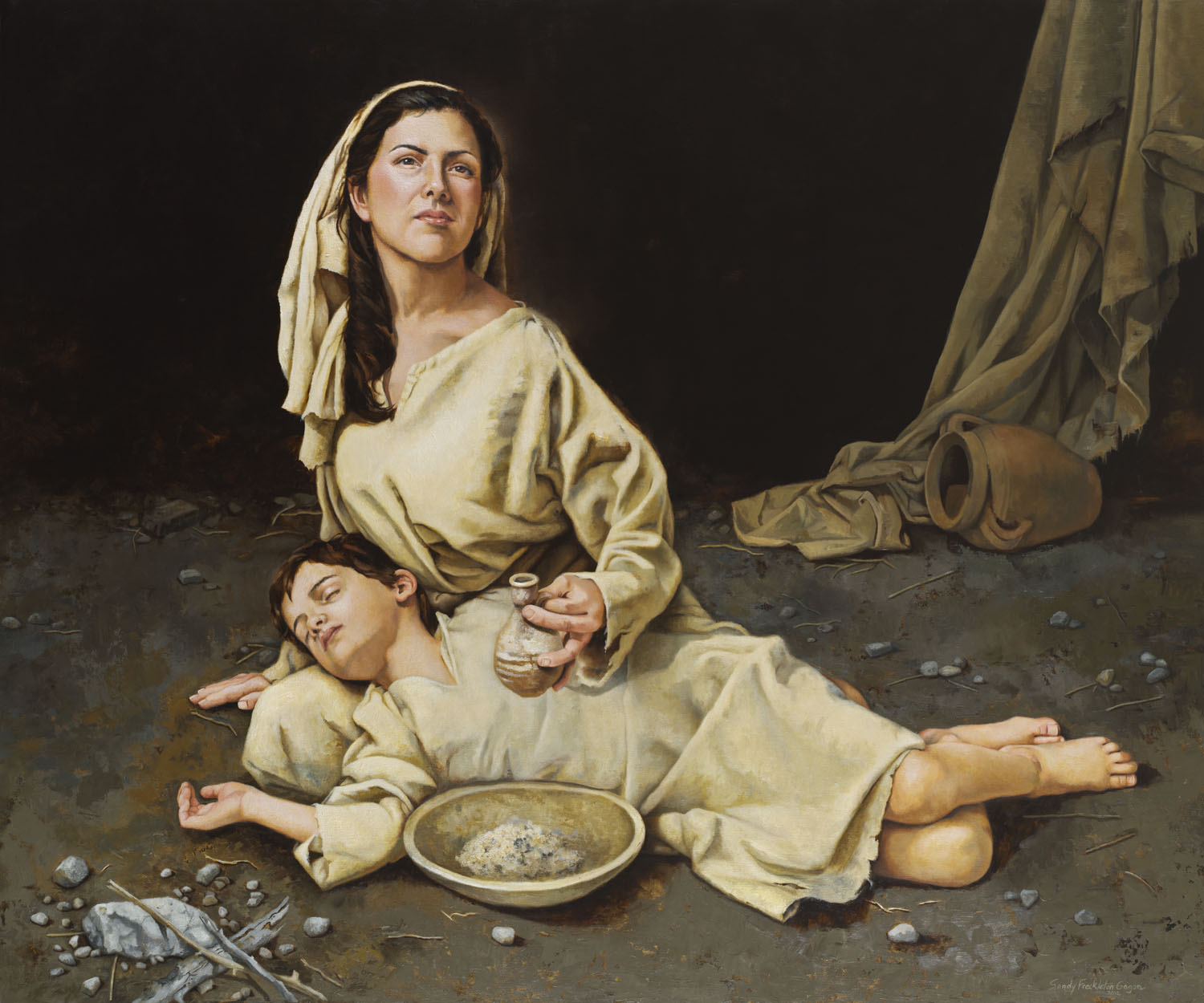
For those of you unfamiliar with that story, it involves the prophet Elijah’s encounter with an Israelite widow and her son who are starving to death in the midst of a drought and famine brought about as a result God’s punishment against Israel’s evil King Ahab. The part of the story that is repeated most often concerns Elijah asking the widow for some water and bread. She readily gives him water, but she initially hesitates at offering him bread because the widow says that she and her son only have enough ingredients to make bread for one more meal for themselves. Elijah tells her not to be afraid, to make her meal, but to give him some bread first because the Lord had told him that she will always have enough flour and olive oil in her containers to make bread until the day the Lord sends rain and the crops grow again. So, the widow made bread for Elijah, and events unfolded exactly as Elijah had said: “There was always enough flour and olive oil left in the containers, just as the Lord had promised through Elijah.” (verse 16).

That part of the story is usually told as an example of what happens when someone shows faith in the Lord. Indeed, the Wednesday group leader summarized it by saying: “You do what the Lord says and good things happen to you. I am not saying a miracle will always happen, but good things result from obedience.”

The leader then went on to discuss the second part of the story, which is not told as often. 1 Kings 17:17-24 relates that later on the widow’s son somehow became sick and he eventually died. The widow expresses her anguish to Elijah, saying:

“‘O man of God, what have you done to me? Have you come here to point out my sins and kill my son?’

“‘Give me your son,’ Elijah replied. He took him from her arms, carried him to the upper room where he was staying, and laid him on his bed. Then he cried out to the Lord, ‘Lord my God, have you brought tragedy even on this widow I am staying with, by causing her son to die?’ Then he stretched himself out on the boy three times and cried out to the Lord, ‘Lord my God, let this boy’s life return to him!’

“The Lord heard Elijah’s cry, and the boy’s life returned to him, and he lived. Elijah picked up the child and carried him down from the room into the house. He gave him to his mother and said, ‘Look, your son is alive!’

“Then the woman said to Elijah, ‘Now I know that you are a man of God and that the word of the Lord from your mouth is the truth.'”

The group leader did not add much commentary to his reading of this part of the story beyond observing that the widow blamed Elijah even though he had nothing to do with her son’s death, and that God is able to do great things. For the moment, I do not want to focus on the probable meaning of Elijah’s raising of the boy back to life. Instead, I want to convey what hearing a story like that can feel like for someone who has experienced the loss of a child.

We have so far not related the details of Ethan’s death in this space because that is an extraordinarily personal and painful memory. What I will say is that his passing was very sudden, and as it was happening, as efforts were made to resuscitate him, we literally screamed to God to save our child. Immediately after we were told to accept that he was gone, we cried rivers of tears, pleading over and over for the Lord to bring our Ethan back to us.

Nothing happened. His body became cold. His life slipped away. We were left in the dark.

I don’t write that to make you feel sorry for us. I relate it because that is the way it is for many parents who lose a child. And so when you read a story like Elijah’s raising of the widow’s son, what someone in our position immediately starts thinking about is the death of our own child. Why didn’t God bring Ethan back to life? Was it because I did not have enough faith like the widow? Was this a punishment for some unrepentant sin? To many people it is just a Bible story. To us, because we have lived this, it (like so many other stories) takes on an entirely different character.

So, I felt discouraged coming home from church that night. That Friday, the same boys’ church activity group went on a camp out with their dads. All of the kids seemed to enjoy it very much, including our oldest, who caught his first fish during the outing. However, that night while the kids were playing, the men were sitting around the campfire chatting. At one point, for some inexplicable reason, one of the dads turned the conversation to talking about people’s ashes, and urns, and then cemetery plots. I got up and walked away from the fire because the discussion depressed me. What was idle talk to them was nothing to joke around about to me because my youngest son’s body rests in a cemetery. I felt disquieted the rest of the night (and not just because I was sleeping on the ground in a tent).

But then on the following Saturday evening and Sunday morning before church, I was reading the Scripture excerpts for those days from Daily Light for the Daily Path (my copy is in the English Standard Version, unlike most of the online versions which are King James), and some of the verses unfolded into a timely reminder:

“Your will be done on earth as it is in heaven.” (Matthew 6:10)

“Understand what the will of the Lord is.” (Ephesians 5:17)

“It is not the will of your Father who is in heaven that one of these little ones should perish.” (Matthew 18:14)

“Christ died and rose and lives again that He might be Lord of both the dead and the living.” (Romans 14:9)

It was not God’s will that Ethan would die. Sometimes “this present darkness” distorts God’s perfect will in this imperfect world. (Ephesians 6:12). That is not to say that God did not know or could not have prevented Ethan’s death — He certainly did and He definitely could have, but in this instance, evil was allowed to run its course. Yet, this is one of the reasons Christ died and rose again: so that He could reign over death and prevent such a little one from eternally perishing.

Later that same Sunday morning as I was sitting in church, the Scripture reading for the service included 2 Timothy 1:12. The second part of that verse says: “I know in Whom I believe and I am persuaded that He is able to keep that which I have committed to Him until that day.” I used to take that verse simply in its context of Paul discussing preaching the gospel to unbelievers. After Ethan’s death, however, the verse became a promise from God for us: that He will keep Ethan, who we have committed to Him, until the day Christ returns. (This interpretation stems from the context of verse 10: “our Savior, Christ Jesus … has destroyed death and has brought life and immortality to light through the gospel.”)  Obviously we did not willingly give Ethan away; evil robbed us and him of his earthly life too soon. But God has promised to keep and guard Ethan for us until we come to him. Ever since I was reminded of that verse shortly after his death, I have included it in a string of verses I repeat when I visit Ethan’s grave.

So I sat in the pew thinking about that, and about the verses on the Lord’s will I had read earlier that morning, and then the music minister had the congregation sing the hymn “I Know Whom I Have Believed,” which is based upon 2 Timothy 1:12. If you are unfamiliar with the hymn, the fourth stanza says:

“I know not what of good or ill
May be reserved for me,
Of weary ways or golden days,
Before His face I see.”

This is followed by the refrain, which is repeated after each stanza:

“But I know Whom I have believed,
And am persuaded that He is able
To keep that which I’ve committed
Unto Him against that day.”

Then the final stanza reads:

“I know not when my Lord may come,
At night or noonday fair,
Nor if I walk the vale with Him,
Or meet Him in the air.”

By the time we finished singing that hymn, I felt overwhelmed with God’s reassurance that even though a miracle did not occur on that day Ethan passed, and even though his tiny body is resting in that small grave I so often visit, Ethan is okay because he is being kept safe by God until that glorious day. As I was reminded today: “Behold, the Lord God will come with power, and His arm will rule for Him. … He will gather His lambs in His arms and carry them close to His heart.” (Isaiah 40:10,11).

And as for Elijah’s raising of the widow’s son, it should be remembered that even the widow, with her great faith, despaired when her son died. She earnestly questioned Elijah as to why God would perform a miracle to keep her and her son alive only to let her son die of a sickness. It must have seemed like a cruel joke. Elijah himself did not understand what God was doing, asking God: “Lord my God, have you brought tragedy even on this widow I am staying with, by causing her son to die?”

God did not rebuke their doubts, which merely stemmed from a lack of understanding. As I explained above, both the widow and Elijah erred in concluding that God caused the boy’s death. He did allow it, but He did not cause it — there is a difference (as difficult as it may be to see) between causing the tragedy and allowing it to unfold. For what the widow and Elijah could not know is that this event was meant to foreshadow a much greater one hundreds of years later.

The widow’s son died; Elijah laid his body over the boy’s body three times; the boy came back to life; and the widow exclaimed that by this miracle she knew Elijah was a man of God who spoke the truth.

Mary had a son named Jesus. He was crucified on a cross even after He had performed many miracles. (Mary was probably a widow when this occurred because Joseph is not mentioned in the Gospel accounts after Jesus’s childhood, and on the cross Jesus told his disciple John to take care of Mary). Jesus was buried, and after three days God resurrected Him from the dead. And it is by His resurrection that we know Jesus is God and that He spoke the truth.

The point is that there was something larger going on with the boy’s death that neither the widow nor Elijah could comprehend because the events that would give its context lay in the distant future. I am not saying that every death of a child has a larger purpose beyond demonstrating with stark coldness the evil that pervades this world. But I am saying that the fact that we may not understand why a tragedy occurs does not mean God allowed it to happen without preparing the future context in which it will be wiped away. Because in that future

“The Lord God will swallow up death forever. He will wipe away the tears from all faces. He will remove the reproach of His people from all the earth. And in that day it will be said: “This is our God, we have waited for Him, and He has saved us. This is our Lord, we have trusted in Him; come, let us be glad and rejoice in His salvation.'” (Isaiah 25:8-9).

Until that day, “the Lord will bless and keep Ethan, and make His face to shine upon Ethan and be gracious to him and give him peace.” (Numbers 6:24-25).