Living in the In Between

Ethan’s Dad: Particularly since we recently celebrated Easter, I want to pick up a thread of what Ethan’s mom talked about in her last post. If you are a Christian, there can be a palpable tension about the subject of death. We are taught from early on in our Christian walk that the existence of death is a consequence of sin that began with Adam and Eve in the Garden of Eden. It signifies the seriousness of the separation between God and humanity sin produces. Yet, we are also taught that death is not the true end of the story of life: that yes, Jesus came and died, but also that He rose from the grave, and because He conquered death, we will be reunited with God — and with everyone who has died believing upon Jesus — in the age to come. Thus, for the Christian, death is simultaneously understood as the ultimate enemy of God’s original design for creation and also as an obstacle that Jesus has overcome, and so it should not be feared. At times, you will even read or hear Christians — wrongly I think — attempt to meld those two ideas into a lesson that death is really just a natural part of life.

The theme of Ash Wednesday is sometimes twisted into this idea that death is a natural part of life. Ash Wednesday asks us to ponder the fact that we are dust. From dust we came and to dust we shall return. (Genesis 3:19). The Psalmist prays for God to teach us to number our days. (Psalm 90:12). Paul reminds us that we are the clay and God is the potter. (Romans 9:19-21). So, this idea runs throughout Scripture. On Ash Wednesday, the fact that we are dust is said solemnly — with a sense that we prefer not to think about death, that we avoid the fragility of life, that we distract ourselves from reality.

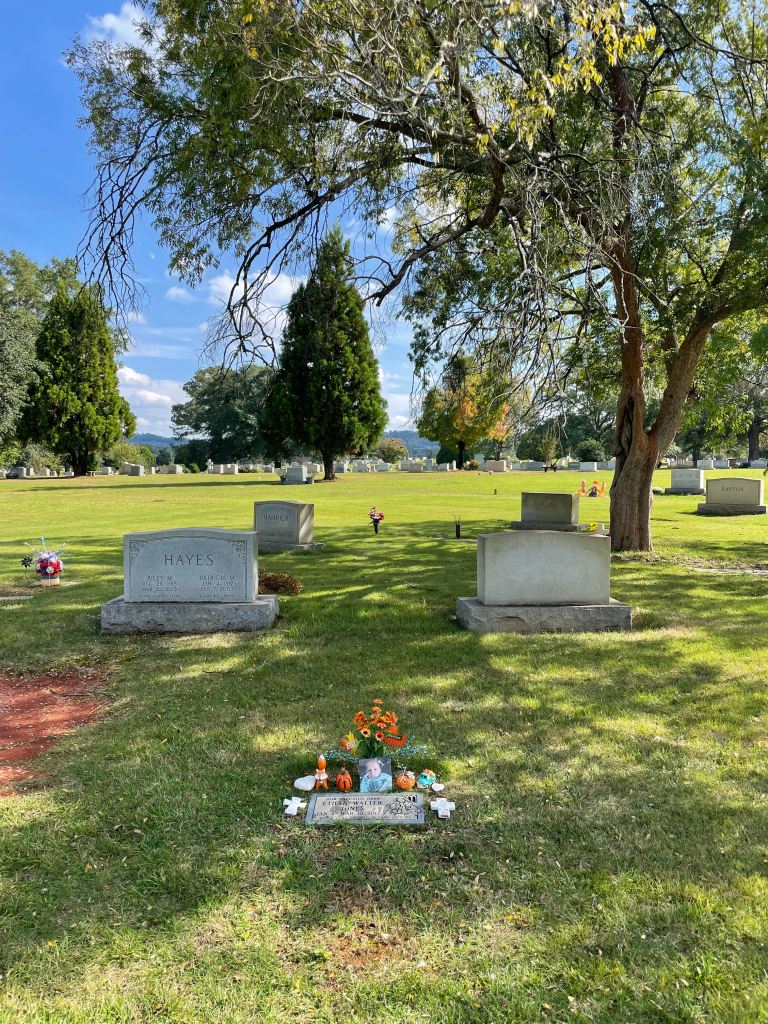
But what about those of us for whom death is all too real? Each week, I take time to sit at Ethan’s grave, and death is all around me. I carry Ethan’s death with me every day. I do not have to will myself to ponder the fleeting nature of life here on earth because I helplessly watched it slip away from a two-month old. So, for me, Ash Wednesday does not conjure anything that I strive to avoid. And saying that we just need to accept that death is part of life feels like asking me to be okay with Ethan’s death. But I cannot do that. No matter how much I contemplate the inevitability of death, or the lack of control over when it comes, or the fact that it affects everyone, it does not quell this knot within me that screams that this is wrong, that it is not the way it should be, that a theft has occurred which cannot be restored.

Moreover, the idea that we are “just dust” does not tell the whole story of who we are. Scientists will tell you that our bodies are made primarily of carbon and water. But in the Bible, dust and clay are used as metaphors to give us pictures of our relationship with God, not as scientific observations. The Bible is full of exhortations about our souls, the spiritual part of our being.

  • Deuteronomy 6:5: “Love the Lord your God with all your heart and with all your soul and with all your strength.”
  • Psalm 23:3: “He refreshes my soul.”
  • Psalm 35:9: “Then my soul will rejoice in the Lord and delight in his salvation.”
  • Psalm 84:2: “My soul yearns, even faints, for the courts of the Lord; my heart and my flesh cry out for the living God.”
  • Matthew 10:28 (Jesus speaking): “Do not be afraid of those who kill the body but cannot kill the soul. Rather, be afraid of the One who can destroy both soul and body in hell.”
  • Hebrews 6:19: “We have this hope [of salvation by Jesus] as an anchor for the soul, firm and secure.”
  • 1 Peter 1:9: “For you are receiving the end result of your faith, the salvation of your souls.”

Thus, the Bible teaches that when our bodies die, our souls do not. Furthermore, the Bible tells us that the birth of sin into the world did not just result in physical death; it caused spiritual separation between God and humanity. In fact, this is deemed to be the more serious aspect of sin’s consequences. And when Jesus died on the Cross, He did not just take our deserving physical punishment for sin; He also endured spiritual separation from God. This is why He says on the Cross: “My God, my God, why have you forsaken me?” (Matthew 27:46).

That takes us forward to Easter because when Jesus rose from the grave, He unequivocally conquered physical death, but He also restored the spiritual gap between God and humanity. The central message of Christianity is that “God so loved the world” — that is, humanity, we physical and spiritual beings who bear His image — “that he gave His one and only Son, that whoever believes in Him shall not perish but have eternal life.” (John 3:16). That eternal life is both physical and spiritual. Revelation ends with the resounding proclamation that one day Jesus “will wipe every tear from our eyes. There will be no more death, or mourning or crying or pain, for the old order of things has passed away.” (Revelation 21:4). Paul also tells us that when “the end comes, [Jesus] will hand over the kingdom to God the Father after he has destroyed all dominion, authority and power. For Jesus must reign until he has put all his enemies under his feet. The last enemy to be destroyed is death.” (1 Corinthians 15:24-26).

So, death is the enemy that Jesus has overcome. Yet, for us, physical death is still here. It lingers, and it hurts. And that accounts for the tension I mentioned at the beginning of this post. The tension exists because, if you are a Christian, you live in the “in between”: the “already but not yet” context of knowing and believing that Jesus came, died, and rose again to save us from sin and death, but that He has not yet come again to place all things under His feet.

We are not unique in living in an “in between” age. The Israelites lived for hundreds of years in between the promise of a Messiah to come and His arrival. In fact, if you date it from the first implicit reference to Jesus in Genesis 3:15, they lived for thousands of years before His coming. Micah 7:7 echoes the sentiment: “I will watch in hope for the Lord. I will wait for the God of my salvation. My God will hear me.” Certainly, our “in between” age is better than theirs because, by the grace of God, we know who the Messiah is and what He has done, and even what He will do at the appointed time. But it is still not an easy time because there is pain, separation, and loss that exist in abundance in this world.

When Adam and Eve sinned in the Garden, could God have separated them (and by extension us) from Himself spiritually without imposing physical death as a part of the equation? In the sense that God can do anything, I suppose this was possible. But as I said earlier, the Bible tells us that to be human means that we have a dual nature: physical and spiritual. This is why, in order for God to experience everything as we do, He had to become fully human; God is spirit (John 4:24), but through Jesus He also became flesh (John 1:14). For us, committing sin means spiritual separation from God, but it also ultimately entails physical death. So, one reason Jesus had to physically die on the Cross and not “just” experience spiritual separation from God the Father was because the consequences of sin for human beings involves experiencing both, and then His saving humanity required reuniting the physical and the spiritual for eternity though a physical resurrection.

In other words, Jesus died not only to restore the communion of our spirits with the Lord, but also to redeem our bodies. To put it simply, matter matters. Sometimes I think we Christians lose sight of this fact because Jesus talked so often about how His “kingdom is not of this world.” (John 18:36). Christians get caught up in thinking that Jesus meant that His kingdom is just spiritual rather than physical, but it is not quite that simple. Jesus is the King of both heaven and earth.

“For the Lord is the great God, the great King above all gods. In his hand are the depths of the earth, and the mountain peaks belong to him. The sea is his, for he made it, and his hands formed the dry land.”

(Psalm 95:3-5). God’s creation of this world and of us as dual-nature beings, Jesus’s incarnation, His physical death and His resurrection — they all resoundingly demonstrate that our physical world, this flesh-and-blood life, is important. This is precisely why death is a profound event: the cessation of physical life — especially the deaths of the His creations made in His image — is no trifling matter to God. It is not just “the natural way of things”; it is a blight that Jesus came to reverse.

So, death is wrong, it is the enemy, because our lives are sacred and precious. But there is this part of me that keeps wondering if there is some other kind of purpose to death than just being a foil — the desolation that we praise Jesus for overcoming — while we Christians live this “in between,” which, in the personal sense, means we have been spiritually reborn (John 3:3), while we await the physical resurrection. During this “in between” we live with the loss of those who go before us and face our own physical deaths. Why?

Is it, at least in part, that it serves as a way for us to measure what is to come? Romans 8:18 reminds us that we should “consider the sufferings of the present time as not worthy to be compared to the glory which shall be revealed to us.” In a sense, that is asking us to do a comparison of our lives in the present physical world and our lives in the future in God’s restored kingdom. Are we only capable of measuring the bounty of eternity by facing, possessing, and living with a temporal ending to our own lives and the lives of those we love? Isaiah 51:6 commands us to:

“Lift up our eyes to the heavens, look at the earth beneath; the heavens will vanish like smoke, the earth will wear out like a garment and its inhabitants die like flies. But the Lord’s salvation will last forever, the Lord’s righteousness will never fail.”

Will we only grasp the permanence of God’s saving grace through Jesus after having lived, loved, and lost in this time of mortality? We would only be able to do this because of the unique creations God made us to be. That is, because an integral part of us is physical, we experience the agony of death — both those around us and ourselves — but because our souls are eternal, we will be able to remember our physical lives, the loss that death brought, and how Jesus rescued us from that despair. This is perhaps part of what Peter meant when he said that “even angels long to look into these things” that pertain to the salvation of our souls,” because they do not experience this dual life. (1 Peter 1:12).

The loss of Ethan honestly would be soul crushing without the hope of the resurrection. Living with this loss forces me to surrender what is beyond my control to God in a way that nothing else is probably capable of doing. So, it just may be that through experiencing the devastation of death that we grow to understand that life is only truly lived through and for our Maker.
Counterfeit “Resurrection”

Ethan’s Mom: Tacky skeletons hanging out of windows or lounging in Adirondack chairs.  Kitschy faux tombstones in front yards.  A larger-than-life inflatable Grim Reaper on the corner.  A house just down from my parents actually has a full tableau that includes 4 skeleton pallbearers carrying a fake coffin into a full fake cemetery.

This is Halloween 2021, and I cannot wait for it to be over. Because the sooner it arrives, the sooner people can pack all that mess up for another year and I can go back to walking or driving around my neighborhood without Death mocking me.

For the past 4 years, I have tried to figure out the appeal of this decor and the overall fascination with the macabre.  Every year I remain completely flummoxed as to why I see even more skeletons waving from the yards in my perfectly nice neighborhood, why people who cannot even acknowledge death in its real context go all out to celebrate a cartoon version of it, and why the easy and fun neighborhood trick or treating of my childhood has turned into… this?   

The only new thought I had this year is that maybe this is all another example of Satan taking something that has a basis in truth and twisting it into something false, taking something that has real, eternal meaning and cheapening it to the point of casual “fun.”  In the process, he is able to desensitize and damage our very souls. 

Yes, the dead will rise again – but not as creepy skeletons or disgusting zombies.  

Our family recently planted fall pansies in Ethan’s garden at our preschool.  In the spring, we planted flowers with the students, but the garden needed a freshening up for fall after all the spring/summer annuals faded.  At the end, I read the Liturgy for the Planting of Flowers, just as I do every time we work in the garden.  I got choked up on this line, just like I do every time I read it aloud.

Though our eyes yet strain to see it so, these tiny seeds, bulbs, or velvet buds we have

planted are more substantial than all the collected evils of this groaning world.

They are like a banner planted on a hilltop,

proclaiming God’s right ownership of these lands

long unjustly claimed by tyrants and usurpers.

They are a warrant and a witness,

each blossom shouting from the earth

that death is a lie,

that beauty and immortality

are what we were made for.

Every Moment Holy by Douglas McKelvey

Death is a lie, not a joke.

The fake cemetery in the yard down the street may have headstones with funny inscriptions, but my baby’s name is inscribed on a real marker in a real (and actually quite beautiful) cemetery where his real body lies waiting for the resurrection of the saints.  And on that day, their creepy, bony arms won’t shoot out of the ground like those tacky skeletons.  They will be raised imperishable, fully embodying all that God designed for us to be.   Until then, it is a struggle to believe that His promise of resurrection is true, especially in October.  All the decorations make it hard to follow the command found in Phillippians 4:8.

Finally, brothers, whatever is true, whatever is honorable, whatever is right, whatever is pure, whatever is lovely, whatever is admirable— if anything is excellent or praiseworthy— think on these things. 

Phillippians 4:8

I’m doing my best over here.  So can we just stick to pumpkins next year?  Please?

What is in a Name?

Ethan’s Dad: We are studying the book of Matthew in Bible Study Fellowship this year, and right near the beginning when Matthew is relating the angel’s revelation of Christ’s birth to Joseph, the angel commands Joseph to name Christ “Jesus, because He will save His people from their sins.” (Matthew 1:21). This signified God’s plan from the foundation of the world to enable humanity to spend eternity with God. Matthew then comments that Jesus’s birth also took place to fulfill a prophecy (from Isaiah 7:14) about the Messiah which said: “The virgin will conceive and give birth to a son, and they will call him Immanuel” (which means ‘God with us’).” (Matthew 1:23). This indicated that Christ would walk among us and experience our humanity in all its highs and lows.

This idea that Christ is both with us and saves us is a vital truth. A lot of times we tend toward either/or thinking: things are all one way or all another. We do this because it is easier than seeing nuance in the people who cross our path and in comprehending the issues that confront us in our lives. That is one of the many reasons this COVID thing has been so difficult; there are no clean answers to how we live with it. But Jesus is sufficient for our needs, and that is reflected even in His names.

The fact that Jesus came to save His people from their sins demonstrates that the here and now is not everything. The people who live as if it is misunderstand the purpose of this life, which is a staging ground for eternity. So much of what Christ talked about referred to His Kingdom, which is not of this world (John 18:36), and which must be comprehended through the lens of eternity. For example, when Jesus said “the meek will inherit the earth” (Matthew 5:5), He did not mean they would possess this earth; indeed, if anything, the truly humble are mocked for their refusal to “get while the getting is good.” No, Jesus meant that the humble will inherit a place of honor in eternity. The same is true for several statements in the Old Testament. Many Christians like to quote Jeremiah 29:11, which says in one translation: “‘I know the plans I have for you,’ says the Lord, ‘plans to prosper you and not to harm you; plans to give you a hope and a future.'” This verse is so popular that you see it on t-shirts, on coffee mugs, on bookmarks, and on Bible covers. There is an assumption among some Christians that this passage somehow means that God is going to make sure your life on this earth goes swimmingly. Some even use it to claim that God intends to make them rich. But if you read Jeremiah chapter 29 in its entirety, you discover that the Lord says this to the Israelites at the same time He is telling them that they will be in exile in a foreign land for 70 years. So, why would God make a promise like the one in verse 29 if most of the Israelites were going to be in captivity for the rest of their earthly lives? It seems obvious that a life of captivity in a foreign land was not a recipe for a prosperous life. But that is because God was not just talking about the immediate here and now – which in itself required patience for those who would live beyond the 70th year — but the future: God did indeed have a plan to prosper His people — for all eternity. And so on it goes for many of the promises in the Bible. Jesus said, “In this world you will have trouble, but take heart! I have overcome the world.” (John 16:33). In other words, our comfort for troubles in this world is knowing the Jesus has ultimately defeated sin and death, and we can look forward to that triumph.

But that does not mean this life is nothing, or an illusion, or not worth investing in. Jesus, Immanuel, came to be with us, in this life, on this earth. This part of life has significant meaning too. “By His will we live, move, and have our being.” (Revelation 4:11). We are purposefully here, living these lives to become more like Christ and to bring others to a saving knowledge of Him. I am reminding myself of that in writing it. Sometimes I want to fly away to Ethan, to leave behind the questions, the difficulties, and the drudgery that accompanies this existence. But “the earth is the Lord’s, and everything in it, the world and all who dwell in it.” (Psalm 24:1). So as much as salvation for eternity is a gift, this life is a gift as well. This is why Ethan’s life being cut so tragically short is so immensely hard to live with and to understand. Yet, the fact that Jesus is “God with us” proclaims that presence on this earth — no matter how short — is a treasure. Thus, Ethan’s conception, his birth — as crazy as it was — his short two-months of frail, struggling presence with us, mean more than just the bare facts of their happening. They mean God wants him, that Ethan is a part of the vast image of God we all reflect, that we are meant to be part of Ethan and he of us, and that Jesus was, and is, with Him too.

“Great are the works of the Lord, they are pondered by all who delight in them.
Splendid and majestic is His work, and His righteousness endures forever.
He has caused His wonderful acts to be remembered, the Lord is gracious and compassionate.” (Psalm 111:2-4).

I confess that sometimes I can get so wrapped up in Ethan’s death that I forget the loving kindness of his life. The name “Ethan” is Hebrew, and it means “strong,” “safe,” “solid,” and “firm.” We did not pick it because of its meaning, but I truly believe that Ethan was strong to stay with us as long as he did. I will always long for his presence and wonder why he could not have stayed with us. But because he was here, he was a splendid and majestic work, and he is remembered. And because Jesus is both “God with us” and the One who “saves His people from their sins,” that is not all there is to Ethan’s story. In Jesus’ arms he waits for us, where we will continue life in the Kingdom, together.

The Futility of Going Back to the Future

Ethan’s Dad: Have you ever noticed how much people are obsessed with time? The common observation is that ours is a fast-food culture, which means we want/demand everything to happen as instantly as possible. But the obsession doesn’t stop there. Countless stories, television shows, and movies revel in imagining that we could manipulate time — whether that entails traveling backward to remedy tragedies and mistakes or jumping forward to discover what awaits us, and they posit questions about the consequences of moving either way on the timeline. We long for this power over time even though there is no realistic indication that we could obtain it.

But that does not stop people from thinking about the possibility of time-travel. In this vein, I recently read a news story about the paradox of time-travel. The paradox of time-travel is that if a person was to travel back in time in order to fix something that went wrong in history — like trying to prevent Adam and Eve from eating the fruit that caused the fall of humanity into sin — fixing that problem would mean that the problem would no longer exist when that person returned to his or her own time, so there would be no motivation to go back in time in the first place. Put another way, things happen the way they happen, and if they unfolded another way than was intended we could never know it because we are creatures of the time we are born in. However, a prolific young scientist in Australia claims to have demonstrated through mathematics that the paradox of time-travel does not exist. The young man says that if you were to go back in time and fix a problem, events would conspire in such a way that the problem would occur anyway. In the example I just referenced, if you stop Adam and Eve from eating the fruit, someone else would still disobey God, and we would still have sin. So, the motivation for going back to fix the problem would still exist for the time-traveler, and thus there is no paradox. Of course, if the Australian mathematician is correct, the lack of a paradox also means that even if humans could go back in time, they could only change a particular variable of time, not what ultimately happens in the timeline. In other words, there is an inevitability to the unfolding of events even though human agency makes deliberate choices about how to do things.

You might think this is a strange topic to explore in this blog. But to me this theory sounds an awful lot like God’s planning of time in this world. We know choice exists because without it love would not be real. However, we also know from the Bible that God has had a plan from before the beginning of time as to how humanity’s arc, and God’s salvation, would unfold. One of the verses I recite every time I visit Ethan’s grave is a paraphrase of Titus 1:1-2: “The faith of those chosen of God and the knowledge of truth are a faith and knowledge that rest in the hope of eternal life which God, who does not lie, promised before the beginning of time.” The prophet Isaiah proclaims: “O Lord, You are my God; I will exalt you and praise your name, for in perfect faithfulness You have done marvelous things, things planned long ago.” (Isaiah 25:1). Ecclesiastes 3:11 (my all-time favorite verse) informs: “[God] has made everything beautiful in its time; He has also set eternity in the hearts of men. Yet they cannot fathom what He has done from beginning to end.” These (and many other) Bible verses point to God setting up time as an unfolding story and yet planning for eternity even before He started the clock of history. People often wonder how these two things can be simultaneously true. But if time operates in such a way that we are able to make deliberate choices and yet the grand sweep of history unfolds only one way, i.e., we cannot manipulate the timeline (because we are not God), then it seems to me that we have at least a partial answer to the mystery. God has designed our timeline in such a way that our billions of variable choices impact us, but they do not affect the destination of history, which culminates with salvation through Christ for all who believe.

Pondering such a model of existence is both mind-boggling and awe-inspiring. The question that often arises from such pondering about time and eternity is: why would God set all of this in motion if He knew about all of the atrocities that would subsequently transpire? Or, as Fyodor Dostoevsky famously asked in “The Grand Inquisitor” chapter of The Brothers Karamazov: How can God say that all of this is worth the suffering of even one starving child? The consequences of the abhorrent evil Adam and Eve brought into this world are enormous, some would say, incalculable.

I think the answer to The Brothers K question lies in coming to appreciate that there is no reason that we should exist at all apart from God’s grace. God was here before all of the creation we see and that we are still discovering: Absolutely nothing required Him to make all of this and all of us in the first place. He never had to say “Let there be light.” He could have left Earth formless and void. Nothing mandated that He create creatures in His image. Yes, there is a whole lot about this world that is evil and dark and relentlessly unforgiving; viruses are part of that, as are the unexplained deaths of infant children, and seemingly a million other cruel things. But before all of that there was God. And by His own choice, first there was light, and then there was the gift of life. And all of that was immeasurably good. Moreover, beyond the irreplaceable gift of existence is the fact that God accounted from the beginning for humanity’s going astray, and His solution to that immense problem entailed sacrificing His own Son. If we stop and think about all of that first, before all else, it should produce a profound sense of gratitude and thankfulness. As the Psalmist said: “It is good to proclaim your unfailing love in the morning, and your faithfulness in the evening.” (Psalm 92:2). Such an attitude of thankfulness as a starting point can change our perspective of what we see before us. It does not erase evil, but it reminds us that the good, that life itself, is not a brutal fact of necessity, but is truly a gift from God.

I always lament (and forever will) that Ethan did not get to live more of this life, but I am thankful that He lived at all, and I should remember that the same is true for me and everyone else. As the Psalmist also reminds us, “For with You is the fountain of life; in Your light we see light.” (Psalm 36:9). The light of life is sparked by thankfulness to the God who gave us everything. Can we honestly say that never existing would have been better than the evil that plagues the world, especially given what God foreshadowed in the Garden of Eden and brought about through Jesus? The Lord declares: “I make known the end from the beginning, from ancient times, what is still to come. I say, ‘My purpose will stand, and I will do all that I please.'” (Isaiah 46:10). That end is this:

“The Lord God will swallow up death forever.
He will wipe away the tears from all faces;
He will remove the disgrace of His people from this whole earth.
For the Lord has spoken.

And in that day it will be said: ‘This is our God;
We have waited for Him and He has saved us.
This is our Lord;
Come let us be glad and rejoice in His salvation.'”

(Isaiah 25:8-9).

The inexpressible hope of this end to time-bound life is why God’s answer to Job in chapters 38-41 of that difficult work is not as heartless as it can seem from our perspective of sympathizing with Job’s immense suffering.

“Then the Lord spoke to Job out of the storm. He said:

“Who is this that obscures my plans
with words without knowledge?
Brace yourself like a man;
I will question you,
and you shall answer me.

“Where were you when I laid the earth’s foundation?
Tell me, if you understand.
Who marked off its dimensions? Surely you know!
Who stretched a measuring line across it?
On what were its footings set,
or who laid its cornerstone—
while the morning stars sang together
and all the angels shouted for joy?

“Who shut up the sea behind doors
when it burst forth from the womb,
when I made the clouds its garment
and wrapped it in thick darkness,
when I fixed limits for it
and set its doors and bars in place,
when I said, ‘This far you may come and no farther;
here is where your proud waves halt’?

“Have you ever given orders to the morning,
or shown the dawn its place,
that it might take the earth by the edges
and shake the wicked out of it?
The earth takes shape like clay under a seal;
its features stand out like those of a garment.
The wicked are denied their light,
and their upraised arm is broken.

“Have you journeyed to the springs of the sea
or walked in the recesses of the deep?
Have the gates of death been shown to you?
Have you seen the gates of the deepest darkness?
Have you comprehended the vast expanses of the earth?
Tell me, if you know all this.

“What is the way to the abode of light?
And where does darkness reside?
Can you take them to their places?
Do you know the paths to their dwellings?
Surely you know, for you were already born!
You have lived so many years!

“….

“Do you known the laws of the heavens?
Can you set up God’s dominion over the earth?

“….

“Who endowed the heart with wisdom
or gave understanding to the mind?

“….

“Would you discredit my justice?
Would you condemn me to justify yourself?

“….

“Then Job replied to the Lord:

“‘I know that you can do all things;
no purpose of yours can be thwarted.
You asked, “Who is this that obscures my plans without knowledge?”
Surely I spoke of things I did not understand,
things too wonderful for me to know.

“‘You said, “Listen now, and I will speak;
I will question you,
and you shall answer me.”
My ears had heard of you
but now my eyes have seen you.
Therefore I despise myself
and repent in dust and ashes.'”

Job 38:1-20, 33, 36; 40:9; 42:1-6.

God was not saying to Job that He did not care about Job’s suffering; after all, He was very careful to curtail Satan’s desire to destroy Job. But God was saying that He has existed from before the beginning of time and that He created this world with His own rules and intentions. For some reason, God did not (fully) reveal the end of history to Job, and, as with Job, He does not reveal all of the reasons for the shattering events of our earthly lives. Yet, for us to question God’s ways without accounting for the entire picture is to approach sophistry. The Lord does not despise heartfelt questions: God did not stop Job from asking his questions over and over again, and the Psalms are full of questions to God for why He allows things to occur the way they do. But God desires that we not assume a position of authority as if we have the knowledge and power only He possesses.

Accepting that we cannot fully comprehend why events unfold as they do, and that we cannot actually alter God’s plan, can bring some peace in the turbulence of life. For one thing, from these truths it follows that just because we cannot fathom a reason for an occurrence does not mean that there is no reason for it (a mistake often made by atheists). For another, it means that no matter how terribly we screw up, we cannot throw God for a loop because events will inevitably culminate with Jesus’s return, God’s victory over sin and death, and eternal life in glory with Him for those who believe. We must always keep this end in mind as we traverse our story in time because there will be life events we desperately wish we could do over.

For instance, it is only natural that I wonder about that March night and morning in 2017: that maybe if I had done just one thing differently Ethan would still be alive. But I cannot go back because, for whatever reason, this is how the story unfolded, and I am a part of this time, not outside of it like God. Moreover, as his mother and I know by now (though a part of each of us will always struggle to admit it), nothing we did caused Ethan to die. For a combination of reasons, unknown to us and to the medical world, his little body could not hold on anymore. He spent one last night and early morning close to us, and then he left and was welcomed into the arms of Jesus. And as painful as Ethan’s absence always will be during the remainder of our time here on earth, we must always remember that this catastrophic event is not the end of story. God, at the end of time, will, in a sense, undo time’s scars.

From His Word, we can see that God’s love overcomes this wretched evil and that the evil ultimately will be wiped away. This means that there is something in this time-bound life that is vital to our lives in eternity. Part of the importance is obviously God’s demonstration of His love for us, which had to physically unfold in order to be truly appreciated.  I have been saying that God is outside of time, but perhaps even more wonderous than that is the fact that God actually chose to enter our time in order to ensure its glorious ending.  God not only set time in motion; He marked its defining moment with His own presence, and then sacrifice.

But I suspect that part of the importance of living this life is the idea Andrew Peterson suggests in his song Don’t You Want to Thank Someone for This

“And when the world is new again
And the children of the King
Are ancient in their youth again
Maybe it’s a better thing
A better thing

“To be more than merely innocent
But to be broken then redeemed by love
Maybe this old world is bent
But it’s waking up
And I’m waking up”

There is some way that experiencing this life, both in its immense joys and wrenching sorrows, heightens our lives in eternity in a way that would not have been true if all of this had not occurred. We cannot know exactly how that is; our charge is to trust that this is true because of what we do know: that God so loves us that He gave His only Son to die for us, that Jesus rose again, and that one day we will spend eternity with Him. Those are the timeless truths for our time-bound lives.