The Time Is Soon

Ethan’s Dad: Eight years. It has been eight years since we last saw Ethan — experienced him — alive. Eight years since I heard his cry: he would wail, scream, go on for quite a while, but also sigh. Eight years since I felt his breath. It could be halting and shaky, but it also could be very gentle. Eight years since I fed him those bottles of milk and formula. That was always difficult for me. I felt that I could never get him to drink enough. It was not for lack of effort — he tried very hard — but there was almost always some left. The best part of that was when he was finished and was tired. When he slept peacefully, he was like an angel. Eight years since I saw those eyes open: those dreamy, contemplative eyes that always gave the impression he was thinking about something interesting. I wish I knew those thoughts. Eight years since feeling his warmth. He liked to be held close. It was his love language because he could not yet really speak.

It has been eight years, but the time is relative — it both flies and crawls. It flies because in one sense it feels like an instant since that moment of loss happened; that time is frozen in our hearts. It crawls in the sense that each day without him aches, and we long to see him again. But the reality is that we live in this present time, each next moment, without him. God asks us to go on because our journeys in these earthen vessels are not finished. We have not spiritually matured to the point of being ready to see Him, which means we are not able to see him yet either. No matter how much we may wish it, we cannot change this reality.

It makes me think about the difference between how God experiences time versus how we do. Several of the stories I read to our kids revolve around altering time. Characters are able to jump back and forth — unwind, rewind, or see what is coming ahead. Of course, that is all fiction. God has made us to traverse time in one direction, always moving forward. But God does not experience time that way.

I recently finished reading C.S. Lewis’s Voyage of the Dawn Treader to our smaller kids. In it, there is a scene in which one of the main characters, Lucy Pevensie, interacts with Aslan the lion, who is (for those who may not know) an allegorical stand-in for Jesus in the Chronicles of Narnia series. At the end of the scene, Aslan tells Lucy that he must leave her, and he says:

“Do not look so sad. We shall meet soon again.”
“Please, Aslan,” said Lucy, “what do you call soon?”
“I call all times soon,” said Aslan.

That exchange is a not so veiled reference to Jesus’ words in Revelation 22:12-13 in which He says: “Behold, I am coming soon! My reward is with me, and I will give to everyone according to what he has done. I am the Alpha and the Omega, the First and the Last, the Beginning and the End.”

Soon” takes on an enlarged meaning because of what Jesus says about Himself being before and after all other things. In Revelation 1:8, Jesus similarly says, “I am the Alpha and the Omega, who is, and who was, and who is to come, the Almighty.” In the same chapter, verses 17-18, He says, “Do not be afraid. I am the First and the Last. I am the Living One; I was dead, and behold I am alive forever and ever! And I hold the keys of death and Hades.” Just before Jesus ascends into heaven at the end of His first coming, He gives the disciples the command to go tell everyone about Him, and He adds: “And surely I am with you always, to the very end of the age.” Matthew 28:20.
In the Old Testament, when God speaks to Moses from the burning bush, Moses asks God:

“Suppose I go to the Israelites and say to them, ‘The God of your fathers has sent me to you,’ and they ask me, ‘What is his name?’ Then what shall I tell them?”
“God said to Moses, ‘I AM WHO I AM. This is what you are to say to the Israelites: I AM has sent me to you.'” Exodus 3: 13-14

Unlike us, who experience time as one forward horizon, God is present everywhere, all at once. This is why He knows the future and can speak with certainty about it, and why He can speak to anyone at any time. Lest you think that God has it easy because He is not immersed in time as we are, think for a second about what it means to see everything and to be everywhere. Could you or I handle the immensity of that? I know that I sometimes feel an almost overwhelming sense of dread when I read the news about all the calamities that happen around the world every day. It is too much for us to digest. Even though we only experience remote harms second-hand, the sheer number of them burdens us. Think about if you were there for each and every catastrophe — for all-time, throughout history. In that light, the fact that we live in time and have no choice but to move on to the next moment is a blessing because we do not continually or infinitely live through any moment all the time.

But God also chose to willingly experience time as we do when Jesus was incarnated. In that earthly life, you could practically hear Jesus’ heart breaking when he lamented over Jerusalem: “Jerusalem, Jerusalem, you who kill the prophets and stone those sent to you, how often I have longed to gather your children together, as a hen gathers her chicks under her wings, and you were not willing.” Matthew 23:37. When Jesus came to Lazarus’s tomb, He openly wept — twice. John 11:35 & 38. In the Garden of Gethsemane, Jesus tells His disciples: “My soul is overwhelmed with sorrow to the point of death.” He then prays earnestly: “My Father, if it is possible, may this cup be taken from me. Yet, not as I will, but as you will.” Matthew 26:38,39. Jesus then goes to the Cross and experiences an agonizing and excruciating death that includes separation from God the Father. In all of those moments, Jesus knew the future, but He experienced time as it unfolded, just as we do, and so He felt as we do.

Likewise, when Jesus healed those in need, He made them well for their remaining time on earth; He did not rewind time such that those people never experienced the pain, harm, and loss they had known up until that time. He renewed and redeemed those individuals, as much on the inside as the outside, but they still carried with them what they had lived in their brokenness before they had met Him.

Why am I getting into all of this about time — for God and for us? Because in these past eight years there have been countless times that I have wished I could go back, or I have wished I could have known what was going to happen, so that somehow, some way, Ethan would still be with us. I particularly do this on each March 10th.

But we all do this for certain points in our lives, don’t we? Our fascination with time travel boils down to wanting to fix things, to make right what has gone wrong. We do not want to retrace our steps, but rather to redirect them. But we are not made that way or for that purpose.

In that same exchange between Aslan and Lucy in Voyage of the Dawn Treader, a little before the part I quoted above, Lucy asks Aslan if she has messed something up to the point that it can never be the same again, and whether it would have been different if she had not made the mistake. Aslan answers:

“Child, did I not explain to you once before that no one is ever told what would have happened?”

There is no “what if?” because there is no going back. For us, there is this moment, and the next, and the one after that. And what happens matters, for this earthly life and the heavenly one. This is why Jesus said, “Whatever you did for one of the least of these brothers of mine, you did for me,” which paradoxically connects directly with His command “Do not store up for yourselves treasures on earth …, but store up for yourselves treasures in heaven.” Matthew 25:40; 6:19-20.

I cannot undo our loss of Ethan. I cannot unwind the pain and misery and missed opportunities of all we do not get to experience with Ethan for the rest of our days here. But because each moment in time matters — as do the losses that accumulate with each day that passes — Ethan’s presence here for even that brief two-month time eight years ago also matters. He matters and he cannot be erased because Ethan is a child of God. “How great is the love the Father has lavished on us, that we should be called children of God! And that is what we are!” 1 John 3:1

Yes, the knowledge that God is always present both hurts and helps. It hurts because it means He was there in that moment, and yet He did not stop it. He had the power to halt it or to unwind it, yet, for reasons we cannot know, He did not. But it also helps because it means God was there from the start.

“Where can I go from your Spirit?
Where can I flee from your presence?
“If I go up to the heavens, you are there;
if I make my bed in the depths, you are there.
“If I rise on the wings of the dawn,
if I settle on the far side of the sea,
even there your hand will guide me,
your right hand will hold me fast.
“If I say, ‘Surely the darkness will hide me
and the light become night around me,’
even the darkness will not be dark to you;
the night will shine like the day,
for darkness is as light to you.
“For you created my inmost being;
you knit me together in my mother’s womb.
I praise you because I am fearfully and wonderfully made;
your works are wonderful,
I know that full well.
“My frame was not hidden from you
when I was made in the secret place,
when I was woven together in the depths of the earth.
“Your eyes saw my unformed body;
all the days ordained for me were written in your book
before one of them came to be.”
Psalm 139:7-16

God created Ethan. He created him with a purpose and a destiny. Part of that purpose was to be with us, even as exceedingly short as it was, and for us to love him and him to love us. We do not know what our lives would have been like if he had stayed with us, and we are not meant to know. But we are told where Ethan is and where, one day, we will be.

“Do not let your hearts be troubled. Trust in God, trust also in me. In my Father’s house are many rooms; if it were not so, I would have told you. I am going there to prepare a place for you. And if I go, I will come back and take you to be with me that you may also be where I am.” John 14:1-3

So, when, exactly, is that? “He who testifies to these things says, ‘Yes, I am coming soon.'” Revelation 22:20. Yes, to Jesus all times are “soon.” It is not so with us, but we are meant to live as if that is the case — as if time is both present and imminent — happening soon. With the help of the Spirit, we are to become like Him as much as it is possible in our present, earthly, time-bound existence because then, one day, we will be like Him. “What we will be has not yet been made known. But we know that when [Jesus] appears, we shall be like Him, for we shall see Him as he is.” 1 John 3:2. And we will see our Ethan too, at which point soon will be now. “Amen. Come, Lord Jesus.” Revelation 22:20.
When Fortune Cookie Theology Isn’t Good Enough

Ethan’s Dad: So since we last made an entry here, everyone’s lives have been affected in some way or other by the COVID-19 virus, more commonly referred to as the coronavirus. Some parts of our lives have been put on hold, and for some their worlds have been completely turned upside down. If you are in that last category, please know that we are praying for you.

There is so much that has been, and could be, said about the virus and the chaos it has created. But one thing I certainly think the situation has starkly demonstrated is that there is a lot about our lives we do not control. You cannot really control whether you will get the virus or not (you can enhance or diminish probabilities, but that isn’t the same as control). You cannot control what effect the virus will have on you if you do contract it: will you be asymptotic, severely afflicted, or somewhere in between? You cannot control how the stock market will react to the measures that have been taken to mitigate the effects of the virus. And so on it goes.

A natural reaction people often have to the realization that they do not control as much as they believed they did is to feel fear. It is the same for things we cannot fully understand: a natural fear accompanies a lack of knowledge or a lack of control. For Christians, this fear can be managed, mollified, or even defeated by the thought that God is in control and that He understands all that is going on.

We have already been through an event of horrifying chaos in which we were completely helpless, watching our son’s life expire without warning, no matter how much we screamed for it not to be so.  And in the immediate aftermath of that horror, we had our share of “armchair theologians” tell us that it was all okay because “God is in control” and “everything is part of His plan.”  In attempting to absorb those responses, I came to understand that in such a time, the proclamation that “God is in control” turns into a mantra, a crutch that is used to quickly move past difficult questions rather than to honor God’s truth.

When “God is in control” acts as an incantation in the face of all we don’t understand, as the full-stop answer when we have no answers, then it loses its value as a foundation for faith.  When someone is in the midst of overwhelming grief, there is no capacity to delve into what “control” really entails, and so, rather than the statement serving as a faith conversation starter, the “good Christian” — the hurt Christian — will immediately nod his or her head and say no more.

This is one of the reasons you should not blithely say “God is in control” (or a variation of it) to a fellow Christian who has just suffered a tragic loss. You may think it sounds comforting, but to someone who has just lost someone irreplaceable, it is belligerent and cold. The sheer finality of the statement does not allow the sufferer any space to grieve, to fume, to question. It says: “Don’t be sad. Don’t worry. Don’t wonder. Just accept that this is how God planned it.”

I can tell you from personal experience that the person who is suffering the loss will not appreciate what you are saying; he or she will resent it, loathe it, scream (at least inwardly) about it, and then feel guilty for those perfectly acceptable feelings. (It was only later that I learned to extend some grace toward those who would share this “bit of wisdom” with me, a grace born from the realization that it can be extremely difficult to find a “right way” to comfort someone suffering a profound loss). In the end, you are not ministering to that person with this trite expression; you are really just trying to make yourself feel better about what has happened because you don’t have a good explanation for it. But hey, at least you were able to say something Biblical about it, and that’s a lot better than saying nothing, right?

Actually, this might surprise you, but one of the best things you can do is to say very little, and instead just be there to listen — even if the person suffering isn’t saying anything. Mind you, I am not saying that you should just pretend the terrible thing didn’t happen for fear of upsetting the person more. Acknowledgment of a person’s loss is crucial. There has never been a moment in which my wife and l have wished that people would just act like Ethan did not die, because failing to acknowledge that is like saying he never existed, he never mattered. Just because you cannot specifically identify with a person’s loss because you haven’t suffered the same thing does not mean you cannot acknowledge it. By mentioning the one who was lost, you are not going to cause the sufferer to feel a deeper despair than he or she is already experiencing. You will be honoring the rightness of the grief because it shows you know the loss was real.

But beyond the acknowledgment, listen and give the one who is grieving room to express true feelings of anger, bewilderment, and even some despair. Allowing that honesty without sermonizing can be its own witness to that person. If you want to do something with the Bible, then go to the Psalms with them. Read Psalm 13 or 77 or 88 with them so that they can know it is okay to feel as they do. For why else would such expressions of despair and questioning be in God’s Word? Loving in this kind of a situation is not about spouting fortune-cookie theology to solve a problem, but about listening to the questions, the expressions of anger, and the sighs of anguish and despair.  It is about being present while giving space for real grief.

That is about all this post can handle.  Since I have fired a shot across the bow about what God’s control might really mean in relation to evils like a child’s death or an insidious virus, I will follow up with another, much lengthier entry. But for the moment, remember that when it comes to the throes of grief, listening is far more important that dispensing answers.

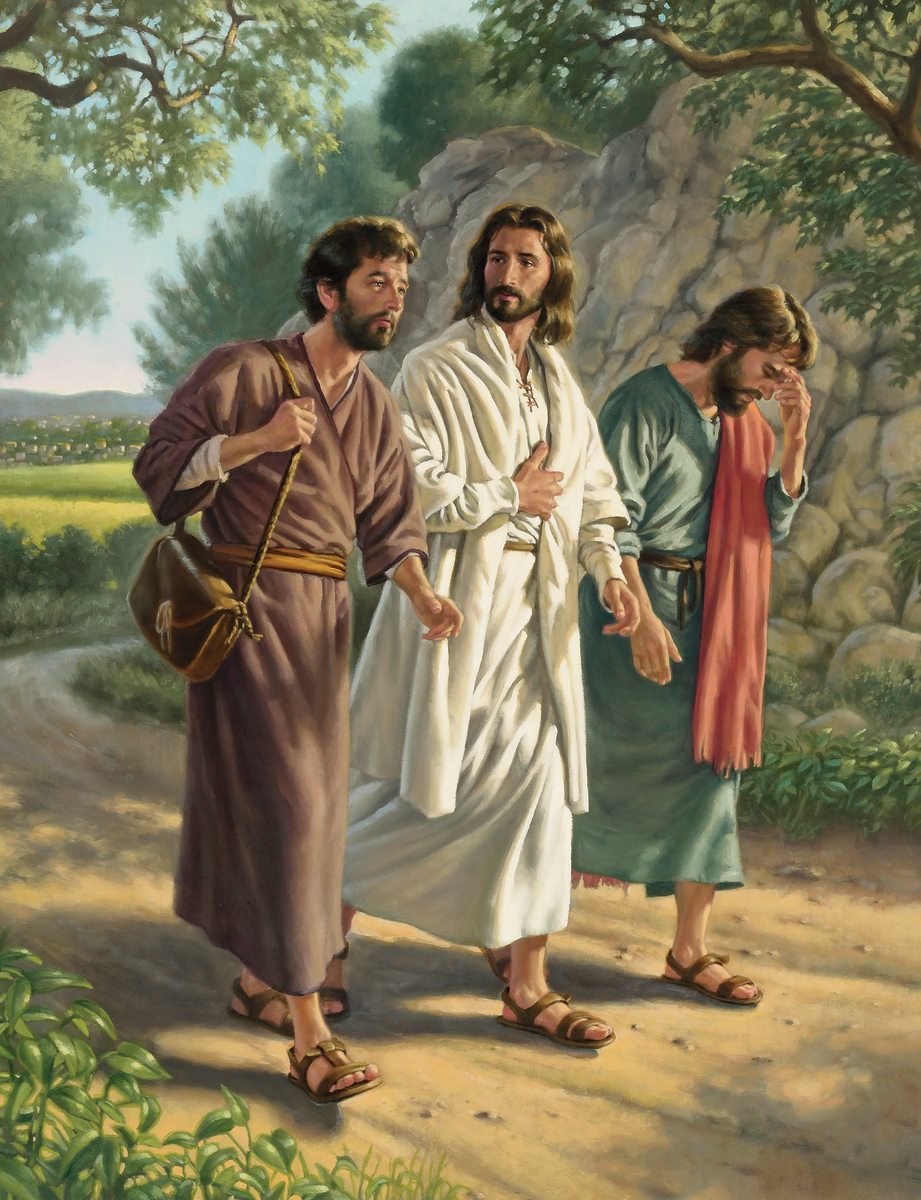
On the Road to Emmaus

Road to Emmaus

Several weeks ago a pastor at our church gave a sermon based on the story of the Road to Emmaus. For anyone who might be unfamiliar with it, the story can be found in Luke 24:13-35, and it is about who two followers of Jesus encountered when they were walking to a village about seven miles from Jerusalem on the day Jesus rose from the dead — before that news had widely spread. There are many fascinating aspects to the story, but this time when I was reading it one particular fact struck me in a way it had not done before. The story begins like this:

“That same day two of Jesus’ followers were walking to the village of Emmaus, seven miles from Jerusalem. As they walked along they were talking about everything that had happened. As they talked and discussed these things, Jesus himself suddenly came and began walking with them. But God kept them from recognizing him.

“Jesus asked them, ‘What are you discussing so intently as you walk along?’

“They stopped short, sadness written across their faces. Then one of them, Cleopas, replied, ‘You must be the only person in Jerusalem who hasn’t heard about all the things that have happened there the last few days.’

“‘What things?’ Jesus asked.

“‘The things that happened to Jesus, the man from Nazareth,’ they said. ‘He was a prophet who did powerful miracles, and he was a mighty teacher in the eyes of God and all the people. But our leading priests and other religious leaders handed him over to be condemned to death, and they crucified him. We had hoped he was the Messiah who had come to rescue Israel. This all happened three days ago.

“‘Then some women from our group of his followers were at his tomb early this morning, and they came back with an amazing report. They said his body was missing, and they had seen angels who told them Jesus is alive! Some of our men ran out to see, and sure enough, his body was gone, just as the women had said.

“Then Jesus said to them, ‘You foolish people! You find it so hard to believe all that the prophets wrote in the Scriptures. Wasn’t it clearly predicted that the Messiah would have to suffer all these things before entering his glory?’ Then Jesus took them through the writings of Moses and all the prophets, explaining from all the Scriptures the things concerning himself.”

What struck me was the line: “But God kept them from recognizing him.” (Luke 24:16). The immediate question that comes to mind is why? Why did God prevent these followers from recognizing Jesus the moment He appeared to them? As the story relates, the men were clearly distraught by the events of the crucifixion. As I attempted to convey in my last post, His followers’ whole worlds were turned upside down when Jesus was killed. These men tell Jesus that they had “hoped he was the Messiah,” and then those hopes were seemingly dashed by Jesus’ sudden and gruesome demise, which they probably witnessed. So, why in the world would God prevent these grieving men from recognizing Jesus standing in the flesh before them?

Of course, you start to get some sense of the answer as the story unfolds. First, the men honestly told Jesus what they believed: they thought Jesus was a great prophet and teacher, but they were unconvinced that He was the Messiah. Jesus then explained the Scriptures (what we today call the Old Testament) to them as they were meant to be understood, with Jesus at their center. His teaching was so powerful that the men literally begged Him to stay with them longer even though they still didn’t actually know who He was.

“By this time they were nearing Emmaus and the end of their journey. Jesus acted as if he were going on, but they begged him, ‘Stay the night with us, since it is getting late.’ So he went home with them. As they sat down to eat, he took the bread and blessed it. Then he broke it and gave it to them. Suddenly, their eyes were opened, and they recognized him. And at that moment he disappeared!

“They said to each other, ‘Didn’t our hearts burn within us as he talked with us on the road and explained the Scriptures to us?’ And within the hour they were on their way back to Jerusalem. There they found the eleven disciples and the others who had gathered with them, who said, ‘The Lord has really risen! He appeared to Peter.'”

After the encounter, the men didn’t sit around or go to bed; they got right back on the road back to Jerusalem to tell the Disciples what had happened to them. They were practically bursting with the news. These men, who had been followers, were now true believers in Jesus as the Savior of the world because now they had to tell people about Him.

Thus, by the end of the story, it becomes clear that God kept the men from initially recognizing Jesus for their own good. Their belief needed the uncertainty, and, dare I say, the pain, that came from not understanding what had happened to Jesus. It needed those prompting questions from a seeming stranger to bring their honest doubts to the surface. The men also clearly needed guidance from Jesus to traverse this spiritual journey from anxiety to exuberance about Jesus, but they did not really know that was their need. In short, in order for the men to experience a progression from factual knowledge about the Bible and Jesus to genuine understanding and faith in who Jesus really is, the men had to be kept in the dark for a little while. Timing was crucial to a correct understanding of the answers they sought.

So, you might be thinking: “That’s all very interesting with regard to how people come to a saving knowledge of Jesus, but why are you writing about it in this blog that is dedicated to Ethan?” And the answer is that I think God can be telling us more than one thing through the stories He has preserved for us in the Bible. I have no doubt that the story of the men on the Road to Emmaus is about a journey toward faith in Jesus. But it also can have something to say about how God raises His children.

No one knows us better than God because He made us. “For you created my inmost being; you knit me together in my mother’s womb.” (Psalm 139:13). He knows what we need, and, just as important, when we need it. So, when this story says, “God kept them from recognizing Jesus,” it suggests that there are times that God purposefully does not reveal to us the answer to a question we ask — even when we desperately want an answer for good an understandable reasons — because the timing is not right for us to receive that answer. For reasons we cannot fathom at the time, we must walk through a period of pain, uncertainty, inquisition, and spiritual guidance from the Lord before we are prepared to fully grasp the import of the answer.

If you think about it, we do the same with our own children. Children ask questions all the time that we know the answers to, but for a variety of reasons we do not provide them with an immediate direct answer. In many cases, we do not reveal the answer because the child is not ready to understand the answer. It is better for the child that the answer waits for a more appropriate time. This can be true for something as simple as a birthday surprise or as profound as how they came to be. In fact, there are even times when we will tell them the true answer because it is unavoidable, but they will not come to grasp the full import of that answer until many years later. I know this last one to be true from telling our other children when we came home from the hospital on March 10, 2017, that Ethan was not coming home. Our other children are still too young to really understand what his absence means.

The question I always ask God is Why? Why would You let our Ethan die so young, before we could see all he was meant to be? Why would You perform this miraculous work of creating so precious a creature inside his mother — together with his brother Noah — and then let that “wonderful work” die in our arms? (Psalm 139:14). Why would You allow this harrowing experience of twins being born in the back of an ambulance in an ice storm, only to then watch one of them expire after being raced to a hospital in another ambulance? Why would You have him be born with a hole in his heart, so that each of his days before a necessary (but supposedly common) surgery were a painful struggle for him, only to have him leave us before he could have that operation? Why? Why? Why?

Aside from the cold reality that evil really does exist in this world, God has not given me an answer. And to be honest, I believe that I am going to live the rest of my life — however long it is — without receiving an answer. I know that sounds depressing. And again, to be honest, there are a lot of times that the silence that surrounds that pleading question is just that: depressing, forlorn, dark — much like I imagine those men on that Road felt two days after Jesus had cried out from the Cross “My God, my God, why have You forsaken me?” before He breathed His last. (Matthew 27:46).

But it is also good to remember that this does not mean there isn’t an answer. The answer to Jesus’ question from the Cross came the moment He took His first breath in that tomb Sunday morning. The answer to those men’s questions was standing right in front of them even though they did not yet know it. It is a mistake to be believe that just because you do not receive an immediate answer to a heartfelt question that no answer exists -– or that you will never receive it. Sometimes the when is just as important as the what.

And I believe that there is a reason I have to wait for the answer to my question. I am well aware in saying this that it means God is purposefully allowing me to travel this road of uncertainty, doubt, and yes, even pain before I receive the answer. That is not an easy thing to accept, but the truth is often not easy; it is, however, necessary. And, by the way, that does not mean it is easy for God to make me wait, just as it is sometimes hard for me to keep an answer from my own children. God knows that I ache, and grieve, and wonder, and I believe that it rends His heart to watch me go through this experience. (Psalm 56:8).  But if sometimes what is best is not what is easiest, then that is as true for God as it is for us. So, in His infinite wisdom, He keeps the knowledge from me even though it pains Him to do so.

But please do not misunderstand: I am not saying that God thought Ethan needed to die in order for me to experience some kind of spiritual progression in my life. Some well-meaning Christians, in a round about way, say things like this to fellow believers who have suffered excruciating losses in an attempt to offer meaning for a senseless event. It isn’t true. What these people do not realize is that what they are really saying is that the loved one the fellow believer lost was just a pawn for God’s work in that believer’s life. That is an insult, not a comfort. How could this be if Ethan, like all of the other precious ones who are tragically lost through no fault of their own, is “fearfully and wonderfully made?” (Psalm 139:14). Pardon me for the bluntness, but this idea that all things occur for your own betterment is an extraordinarily selfish view of life. There is a distinct and important difference between understanding that God can produce good from the ash of tragic circumstances and saying that tragic circumstances are for our good. The former is Biblical truth; the latter is nothing less than the denial of the existence of evil.

What I am saying is that for some reason, I am not ready for the full answer to this question of Why. I think it is likely that at least part of the reason is simply that my finite existence is incapable of understanding it. Regardless, what is important for me to grasp is that sometimes God does not give us an immediate answer, not because it doesn’t exist or because we don’t deserve one, but rather because it is absolutely necessary for us to wait in order for the answer to have the meaning it is intended to have. And so I must wait. But I do not wait as one with no hope:

“It is wrong to say that the Almighty does not listen, to say the Almighty is not concerned. You say you cannot see him, but He will bring justice if you will only wait.” (Job 35:13-14).

One day I will have an answer, but it will be better than just a mystery revealed; it will include setting this wrong aright again.

“Yes, the Sovereign Lord is coming in power. He will rule with a powerful arm…. He will carry His lambs in His arms, holding them close to His heart.” (Isaiah 40:10-11).

I will not just get to see why; like the men on that Road, I will get to see Who is the answer. And I will see Him holding Ethan in His arms . . . waiting for me.

A Perpetual Saturday

Ethan’s Dad: I never really gave much thought to that Saturday. It wasn’t that I was flippant about it or that I purposefully ignored it. It was just that, in the Christian tradition I grew up in (and I think most others), all of the focus is placed on Good Friday and Easter Sunday. In many ways this is perfectly understandable.

Good Friday is the cataclysmic crisis point in which everything comes crashing down, the unthinkable occurs, and abject evil appears to win. For Christians that day is the definition of the ultimate sacrifice by the only One capable of making it for our sins.

In the starkest of contrasts, Easter Sunday is the glorious climax, the triumph, the grandest of all happy endings. It is the impossible of resurrection from the dead occurring, and yet it was simultaneously inevitable if Jesus was who He said He was because death could not hold onto the Author of life. For Christians that day means a new and ultimately eternal life with God.

So it is little wonder that Saturday is overlooked or even forgotten as it bridges these two profound and all-important days. But you don’t traverse a chasm without a bridge, so it is a required part of the journey, and — I have come to realize — it is more precarious than at first it might seem to be.

Can you imagine for a moment what that day must have been like for Mary, the Disciples, and others close to Jesus? Jesus had completely changed their lives: shown them miraculous signs reminiscent of wonders spoken about by ancestors of old, opened the doors of love beyond their previous comprehension, given them a brand-new purpose for life, and offered a hope unlike any they had ever known before. He had promised them an eternity with Him.

And then it all came to a sudden and sickening end in the span of one dark day. It must have been extremely confusing for them to watch Jesus be arrested, let alone witness Him beaten, then offered to the crowds, and then crucified like a common criminal. Everything they had known, believed, and hoped was instantly shattered beyond all recognition the moment Jesus breathed His last on that cross. It had to seem almost surreal, like it had to be a nightmare that they would surely awake from at any minute.

But when Saturday dawned, the darkness was still there, and it was, if anything, more oppressive. The sheer intensity of the trauma from the previous day was replaced by the stark void of the loss. Jesus really was not there. His leadership, assurance, and love were gone. More immediately, His presence was missing. And somehow they had to go on.

Remember that they did not know what would happen on Sunday. Jesus had tried to tell them, of course, but they just couldn’t understand it. Honestly, in a way you can’t blame them. It was all unlike anything that had ever happened before. Granted, as I have said, they had witnessed Jesus precipitate several miraculous events on a smaller scale: feeding thousands with almost no food, calming raging seas and walking on water, raising Lazarus after he had been in a tomb for 4 days. But this time they had watched Him die. And not just any death, but the most gruesome devised by the Roman Empire. It had to feel devastating, bewildering, hopeless. Surely they just wanted to crawl into a shell and never come out.

So they waited . . . and wondered. What was there left to do? How do you hold onto faith when everything you believed is turned upside down? How do you maintain hope when you watch it breathe it’s final breath? How do you continue to love when what illuminates that love is buried in a tomb? The questions are endless and the answers are elusive; they feel out there, yet not accessible. That Saturday they lived in a kind of netherworld — not really dead, but not capable of fully living either.

“So they took His body down
The man who said He was the resurrection and the life
Was lifeless on the ground now
The sky was red His blood along the blade of night

“And as the Sabbath fell they shrouded Him in linen
They dressed Him like a wound
The rich man and the women
They laid Him in the tomb

“….

“So they laid their hopes away
They buried all their dreams
About the Kingdom He proclaimed
And they sealed them in the grave
As a holy silence fell on all Jerusalem”

-Andrew Peterson (God Rested)

If you haven’t already guessed it, the reason for this rumination (other than the fact that it is Easter weekend) is because for my wife and I it feels as if we are living every day in something like that Saturday. You see, on one level, the day of a tragic event is the hardest because the vividness of its devastation haunts you over and over again. But in another sense, the day after is almost harder. At the time, the day of the event seems surreal, like it can’t be happening, like you are watching it from the outside as it unfolds. But the day after the horror, the reality hits you because the frantic energy of the moment is no longer there, and a person you love gone. The stark realization of permanent absence desolates your soul and you can hardly breathe, let alone dare to believe that one day the chasm of that loss will disappear and you will be reunited again.

An irreplaceable presence, our Ethan, is missing from our lives every day. It is an absence we did not ask for or expect. And that absence stretches on, with each new day bringing an ache and unsettledness that never quite subsides. When we say we are “Walking in the Shadowlands,” this is, in large part, what we mean.

An undeniable fact about that Saturday long ago is that God knew what it would be like for those close to Jesus after He was crucified.  God knew about the pain, confusion, and uncertainty, and yet He did not break through the silence to give them reassurance. He let then wait until Sunday to see the answer for themselves. I think it is worth asking: Why did God allow them to endure that Saturday?

The most immediate answer is that He knew everything would be made right again on Sunday. But what if it was more than that? Suppose that the waiting, with all of its attendant anguish, bewilderment, and doubt, was a necessary part of the process for the revelation of the Resurrection.  Would the Disciples have fully grasped the implications of the Resurrection without experiencing what life would be without Jesus’ presence?

Of course, Christians today know how the whole story unfolded, so it is harder to grasp what the loss of Jesus must have felt like on that Saturday.  But we do experience personal losses, sometimes profound ones.  And sometimes, when there is a loss that is wretchingly dear, God asks us to wait the rest of our earthly lives — to trust Him in the midst of the daggers of pain and whirlwinds of questions — until we come to the end of that seemingly perpetual Saturday and see that the loss will be made whole.

For me, then, there is a strange comfort in the fact that dark Saturdays are not alien to Christianity; they are, in fact, apparently somehow integral to it.  It does not lessen Ethan’s loss for me, but it does show me that God knows what I am feeling, and the fact that He has let me experience it is not proof that He is not there, as some would tell you.  Instead, the loss of that precious boy, and the restless unease that accompanies it, imparts a little more understanding of what life would mean without Jesus, without His death, burial, and resurrection.  So, I will keep walking in the shadows and looking forward to dawning of that Sunday when

“the Lord Himself will descend from heaven with a shout, with the voice of the archangel and with the trumpet of God, and the dead in Christ will rise first. Then we who are alive and remain will be caught up together with them in the clouds to meet the Lord in the air, and so we shall always be with the Lord.” (1 Thessalonians 4:16-17).


The Silence of God

GethsemaneEthan’s Dad: “Silence is golden.” Except when it’s not. You might think that when there are four children 8 years of age and under running around you, you have more than enough noise, and you long for quiet. But when you know there is a voice missing, jabbering from another two year-old that you should be hearing in the din, the chaos isn’t enough. Instead what you hear is a sound of silence that pierces your soul.

As Ethan’s mom hinted at in her last post, lately I also have been thinking about another kind of silence: the silence of God.

“It’s enough to drive a man crazy; it’ll break a man’s faith
It’s enough to make him wonder if he’s ever been sane
When he’s bleating for comfort from Thy staff and Thy rod
And the heaven’s only answer is the silence of God.”

-Andrew Peterson (The Silence of God)

There seems to be an impression among some Christians that God is only silent when we are distant from Him. That is to say, the only times we don’t hear from God are when we are enmeshed in deliberate sin or when we don’t like the answer we are getting about a request we have made to God. But this is, at best, only a half-truth.

To begin with, unless you are so distant from God that your conscience is dulled, the fact is that a Christian does hear from God quite loudly in the midst of deliberate sin. God lets us know in no uncertain terms that what we are doing is wrong. That’s why it is a deliberate sin. And if we don’t like what God is telling us when we ask for something, then He isn’t actually being silent, is He?

But I think in a way what these Christians are really saying is that God is never actually silent; we are just turning a deaf ear to Him. Now, this might sound like good theology to you, but as well-meaning as it may be, it is flat wrong. The silence of God is a very a real and agonizing experience for believers the world over.

“It’ll shake a man’s timbers when he loses his heart
When he has to remember what broke him apart
This yoke may be easy, but this burden is not
When the crying fields are frozen by the silence of God.”

Moreover, the Bible does not shy away from this fact.

Job suffered with excruciating pain and loss for a stretch of time before God spoke to Him, and even when God broke the silence He did not fully explain to Job all of the reasons for his suffering. (See Job 38-41).  When Shadrach, Meshach and Abednego were sentenced to die in the fiery furnace, Scripture records that the three of them stated that “even if [God] does not [save us from the blazing furnace], we want you to know, Your Majesty, that we will not serve your gods or worship the image of gold you have set up.” (Daniel 3:18). The clear implication is that the three men were not told by God beforehand what would happen to them when they were thrown into the fire. In the period of time between the Old and New Testaments, the people of Israel lived for over 400 years without any revelation from God about their salvation through a Messiah. John the Baptist passed time in prison under Herod without hearing anything from God as to whether his ministry had made any real difference. Finally John — in apparent desperation — sent some of his followers to Jesus to ask Him whether He really was the Messiah. (See Matthew 11:2). The Disciples spent the Saturday after Jesus’ death in despondency and silence (a period worth pondering in a future post).

Are we to write off all of these people’s recorded experiences as false impressions about God? If those examples are not enough, how about Jesus himself, who exclaimed from the cross: “My God my God, why have You forsaken me?” (Matthew 27:46).

“Oh,” you say, “that was different because Jesus was taking on the sin of the world in that moment. God had to turn away. The same is not true for us.” But I think Jesus’ question was expressing the culmination of His entire experience during the crucifixion. It’s likely that God’s silence started the moment Jesus was led away from the Garden of Gethsemane by the Sanhedrin’s guards. Jesus came to earth and experienced what we experience. Did He bear more pain that we ever will or could during the crucifixion? Absolutely. But Jesus’ experience with the silence of God — perhaps more than anything else could — reflected His humanity.

“And the man of all sorrows, he never forgot
What sorrow is carried by the hearts that he bought
So when the questions dissolve into the silence of God
The aching may remain, but the breaking does not
In the holy, lonesome echo of the silence of God.”

In asking this question — “My God, my God, why have You forsaken me?” — Jesus echoed the words of David as recorded in Psalm 22. So David too experienced this silence. And, in fact, the Psalms are full of reflections on the silence of God. For instance, David in Psalm 13 inquires:

“How long, Lord? Will you forget me forever?
How long will you hide your face from me?
How long must I wrestle with my thoughts
and day after day have sorrow in my heart?
How long will my enemy triumph over me?

“Look on me and answer, Lord my God.
Give light to my eyes, or I will sleep in death,
and my enemy will say, ‘I have overcome him,’
and my foes will rejoice when I fall.”

Psalm 42, the beginning of which is often (and I believe wrongly) quoted in a happy fashion, says:

“As the deer pants for streams of water,
so my soul pants for you, my God.
My soul thirsts for God, for the living God.
When can I go and meet with God?
My tears have been my food
day and night,
while people say to me all day long,
‘Where is your God?'”

Psalm 77, which to me is one of the best passages in all of Scripture, pulls no punches:

“I cried out to God for help;
I cried out to God to hear me.
When I was in distress, I sought the Lord;
at night I stretched out untiring hands,
and I would not be comforted.

“I remembered you, God, and I groaned;
I meditated, and my spirit grew faint.
You kept my eyes from closing;
I was too troubled to speak.
I thought about the former days,
the years of long ago;
I remembered my songs in the night.
My heart meditated and my spirit asked:

“‘Will the Lord reject forever?
Will he never show his favor again?
Has his unfailing love vanished forever?
Has his promise failed for all time?
Has God forgotten to be merciful?
Has he in anger withheld his compassion?'”

And then there is Psalm 88, which is perhaps the most depressing expression of God’s silence in all of Scripture. It contains lines such as:

“You have put me in the lowest pit,
in the darkest depths.
Your wrath lies heavily on me;
you have overwhelmed me with all your waves.

“….

“I call to you, Lord, every day;
I spread out my hands to you.
Do you show your wonders to the dead?
Do their spirits rise up and praise you?
“Is your love declared in the grave,
your faithfulness in Destruction?
Are your wonders known in the place of darkness,
or your righteous deeds in the land of oblivion?

“But I cry to you for help, Lord;
in the morning my prayer comes before you.
Why, Lord, do you reject me
and hide your face from me?”

Why would God include these expressions of anguish in Scripture if the experiences were not real, and, perhaps more importantly, appropriate? God does not shy away from His silence, so why should we? The expressions of silence are there often enough that we are almost forced to face the prospect that the silence is purposeful. So why would God sometimes choose to be silent in our most painful moments, the very moments when you would think we need Him the most?

When we ask the question “why did this happen?” what we really mean is: Why weren’t You there, God? Why didn’t You stop it? Isn’t that, in part, what is behind Jesus’ haunting question: “My God, my God, why have You forsaken me?”

Yet, so often when we ask that question, what follows is silence. In our case, we screamed the question, over and over: Why did Ethan die? Why did you not tell us earlier that he wasn’t breathing? Why didn’t you stop this? Why couldn’t the paramedics save him? Why didn’t you bring Ethan back, like you did the son of the widow of Zarephath (1 Kings 17-7-24), the son of the widow of Nain (Luke 7:11-17), Jairus’s daughter (Luke 8:40-42, 49-56), and Lazarus (John 11:1-44). We received no answer, no comfort, no reassurance. Just cold, dark, silence.

It has taken me a while to realize, as I indicated above, that perhaps this silence was intentional. In fact, I think the “Why” questions might be important not so much because of answers you hope to receive, but instead precisely because they are accompanied by silence. It does not seem so at the time, but if God is not going to supernaturally intervene, then silence is really the only appropriate response in a horrific moment like that because there is no answer that will satisfy other than “I will give you your son back.” Yet God has already chosen, for whatever reason, not to provide the satisfying answer. And He is no fool. God knows that when that is the case, the response from His child will be anger, disappointment, confusion, and despair. The truth is, in that God-forsaken moment — and for a while afterward — if His answer was not “I will save Ethan,” I did not want to hear from God and He knew it.

I think that the silence occurs because the answer to “Why?” will not satisfy if it does not include an immediate fix to the brokenness. And when you sit in the silence what you start to realize is that God is not who you thought He was. This may sound like a negative thing, but that is only the case if you think you have God figured out. And if you think that, then your God is too small because He fits into your finite mind. He stretches far beyond that.

“‘For my thoughts are not your thoughts,
neither are your ways my ways,’
declares the Lord.
“‘As the heavens are higher than the earth,
so are my ways higher than your ways
and my thoughts than your thoughts.'” (Isaiah 55:8-9)

The unvarnished truth is that God is a lot more concerned with how we answer the “Who” questions of life than He is with answering our “Why” questions. For one inquiring mind, Jesus answered the question: “Who is my neighbor?” (Luke 10:29-37). The answer is: everyone. On another occasion, Jesus asked His Disciples: “Who do you say that I am?” And Jesus approved Peter’s answer: “You are the Christ, the Son of the Living God.” (Matthew 16:15-17).

And in the silence of God, this last question is the most important question of all: when your world comes crashing down around you, when the unthinkable tragedy is your reality, when you weep until you have no strength to weep anymore (1 Samuel 30:4), who do you say Jesus is? If He is just some friend or spiritual mentor or great teacher, He is useless in that moment. But if He is who Peter said He was, then He makes all the difference in the world.

Because that person, that Savior, cares for you beyond all measure and He proved it by dying for you. He didn’t just tell us He loves us, He demonstrated it in the most agonizing way conceivable to our finite minds, by dying on an instrument of torture. And beyond that, if He is who Peter said He was, then Jesus isn’t even just some martyr who died a horrible death in our place. He is alive, meaning He overcame death, and He is capable of extending, and eager to offer, that same gift to us — and to our little ones whose lives were so tragically cut short.

This is what real faith is about: it is about foregoing the “Why” based on the “Who.” If we can accept that, then we can keep on living — if not in complete peace — then at least in genuine hope. “And this hope will not disappoint us, because God’s love has been poured out in our hearts through the Holy Spirit who God has given to us.” (Romans 5:5).

When Love Refrains: What Else the Story of Lazarus Tells us about God

Lazarus 1Ethan’s Dad: My wife has mentioned in this space before that sitting in church can be a trying experience for us. We never know when a song, a prayer, or a statement made in Sunday School banter might open the floodgates of sadness that reside within us from losing Ethan. Of course, this is also true in everyday encounters, but we have found that the likelihood of it occurring is magnified in church because mortality and miracles are topics of discussion in church much more often than in everyday life.

One of those occasions occurred this past Sunday when our pastor was giving a sermon titled “Who is Jesus.” It was part of a series he has been doing in which he has listed three descriptions of Jesus in each sermon and expounded upon them. The first of those descriptions this past Sunday was that Jesus is “the resurrection and the life.” This is a description Jesus gave about himself that is recorded in the book of John, chapter 11, that tells the story of Jesus raising Lazarus from the dead.  In one part of the story, Jesus has a captivating conversation with Martha, the brother of Lazarus.  Just after Martha informed Jesus that Lazarus has died, Jesus said:

“Your brother will rise again.”

“Martha answered, ‘I know he will rise again in the resurrection at the last day.’

“Jesus said to her, ‘I am the resurrection and the life. He would believes in me will live, even though he dies, and whoever lives and believes in me will never die. Do you believe this?’

“‘Yes, Lord,’ she told him, ‘I believe that you are the Christ, the son of God, who was to come into the world.’” (John 11:23-27)

Our pastor was, of course, right that Jesus’s pronouncement about himself in this passage is foundational to the Christian life because it revealed to Martha (and all who would later read those words) who Jesus was in the grandest eternal sense and what they must do to inherit eternal life, which was simply to believe in who He really was. My problem was not with the pastor’s reference to this exchange or to the story of Lazarus in general. My issue was with the pastor’s use of something Martha said right before this part of their conversation.

When Martha first heard that Jesus had arrived in Bethany — the town where she, her sister Mary, and Lazarus had lived — she said to him, “Lord, if only you had been here, my brother would not have died.” (v. 21). To fully understand this comment, you have to know that several days earlier Martha and Mary had sent Jesus a message informing Him that Lazarus was sick, and they no doubt had expected Jesus to come quickly to Lazarus’s aid.  Instead, Jesus arrived in Bethany four days after Lazarus had died.  Jesus’s delay piled confusion on top of the crushing grief Martha was feeling because of her brother’s death.

Our pastor chose to focus on those two little words near the beginning of Martha’s statement: “if only.” The pastor did a riff on how we all have “if only” times in our lives, i.e, times when we believe that things could have been different if only God had acted or if only we had made a different choice. He made some statement about how, in thinking this way, we are often more focused on temporal things while God is concerned with eternal matters. Again, that is a true statement in itself (to a degree). And I believe the pastor’s point was that whatever those “if only” moments might be in our lives, Jesus is the ultimate answer to them because He is the resurrection and the life.

Now, as I have said, I had no theological problem with any of this in the abstract. My issue was that as soon as the pastor started talking about “if only” moments, my mind (and my wife’s) immediately veered to March 10, 2017, and that horrific period when we literally screamed for God to save our precious Ethan. We begged; we pleaded; we cried oceans of tears. . . . And nothing happened.

So, here is the thing about Martha’s statement that the pastor chose to gloss over: she was right. If Jesus had been there before Lazarus had died, He could have saved Lazarus from death. Indeed, in all likelihood Martha had seen Jesus do it before for total strangers. All she was wondering was: why didn’t Jesus come earlier and save His friend Lazarus? And is that really such a bad thing to wonder about?

I don’t think so. For one thing, Jesus did not rebuke Martha in any way for her implied question. In fact, if she had not wondered about it, I think it would mean that Martha did not really believe that Jesus was who He said He was. But we know this isn’t true because Martha gave not one, but two great statements of faith. Right after Martha made her “if only” statement, she said: “But I know that even now God will give you whatever you ask.” (v. 22). And then when Jesus asks her if she believes that He is the resurrection and the life, Martha responds unequivocally: “Yes, Lord, I believe that you are the Christ, the Son of God who was to come into the world.” (v. 27).

As one who has been where Martha was, in the throes somber grief, I have to say that this is a wonderful testimony on her part. The Holy Spirit must have encouraged her, but it is truly admirable that Martha did not let her deep sorrow swallow her faith in Jesus at that moment. The sincerity of Martha’s faith practically explodes off the page because of the palpably desperate moment in which she expresses those statements. It is not unlike that moment when a thief hanging on a cross, in the midst of excruciating agony, expressed his faith in Jesus even as Jesus was on a cross right beside him (Luke 23:40-43), or when Stephen asked the Lord to forgive his executioners as they stone him and he proclaimed that he saw Jesus standing at God’s right hand in heaven. (Acts 7:54-60).  To proclaim Jesus as Lord when doubt has enveloped the heart and darkness is one’s sole companion: those are the testimonies that speak most to me because I know first-hand how difficult it becomes in that lonely place to cling to this truth.

But as commendable as Martha’s faith is, do not lose sight of the fact that, at the same time, she questioned Jesus’s timing. For faith and questions are not incompatible; they are, in a sense, inseparable. We do not continue to learn about who Jesus is if we do not keep wondering about why things must be the way they are. For Jesus is “the author and perfecter of our faith,” (Hebrews 12:2), where “perfect” really means “finish” or “complete.” Our faith must mature, and it only does so when we probe and ask Jesus to show us who He is, just as Martha did. And I think the answer she received stretched beyond her imagination, because how could one really conceive that Jesus was going to call Lazarus forth out of that tomb, and that Lazarus would actually walk out of it as if nothing at all had happened to him?

So as I sat there in the pew now only half listening to the rest of the sermon, I kept poring over this story about Lazarus, a story like the widow of Zarephath, which inevitably causes a believer who loses someone close to him or her to wonder, just as Martha did: Why didn’t you save him, Lord? And I am not afraid to confess that I did not receive an answer. But what I did see was something I had never noticed before in all my years of being told about and then reading this story. It was this: Doing this was really hard for Jesus.

I don’t mean the raising of Lazarus from the dead. Indeed, the remarkable thing is that that was the easy part for Jesus. For Jesus, raising Lazarus was no different than restoring a blind man’s sight or causing a lame man to walk or walking on water. Certainly, it seemed different to everyone else, but for the One “through whom all things were created, things in heaven and on earth, visible and invisible,” resurrection is not difficult. (Colossians 1:16; see also John 1:3).

No, what was really difficult for Jesus was not saving Lazarus before he died. Go back to when Martha and Mary first sent their message to Jesus telling Him that Lazarus was sick. John 11:3 says: “So the sisters sent word to Jesus, ‘Lord, the one you love is sick.’” Martha and Mary knew Jesus would understand that they were talking about Lazarus, which tells us that Jesus and Lazarus must have been extremely close friends. Jesus responded to this message by saying: “This sickness will not end in death. No, it is for God’s glory so that God’s Son may be glorified through it.” (v. 4). This response, though somewhat cryptic at this point in the story, tells us that something bigger was going on than anyone could really understand.

But then John decides to give the reader an interesting side note.

“Jesus loved Martha and her sister and Lazarus. Yet, when He heard that Lazarus was sick, he stayed where He was two more days.” (vv. 5-6).

This note drives home the point that Jesus loved all three of these people very much, and yet He did not do what everyone would think He would do and rush to see Lazarus, Martha, and Mary. No, instead, Jesus essentially decided to kill time with his Disciples while Martha and Mary watched their brother suffer and die. Despite appearances, this isn’t callousness; it is the exact opposite: it is unfathomable love. John is telling us that Jesus really wanted to rush to Lazarus’s side, but that for the sake of something greater, He had to wait.

This point is reinforced again when Jesus said to his Disciples: “Lazarus is dead, and for your sake I am glad I was not there, so that you may believe.” (vv. 14-15). Jesus says He is glad for their sakes, not His own, because if this was just about His personal feelings, He would not have allowed Lazarus to die. Jesus was also acknowledging here that if He had been there, He would have healed Lazarus rather than letting him die. Think about it: where in the Gospels is there a time when Jesus refused an in-person request for healing? He certainly would not have refused to heal if He was standing before his dear friends watching Lazarus suffer. So, Jesus did not go right away because He knew what had to happen — Lazarus dying — and that it would not have happened if He had gone to them sooner.

John decides to make very sure the reader does not miss how difficult this was for Jesus by noting that when Jesus saw Mary and her friends weeping near Lazarus’s tomb, “He was deeply moved in spirit and troubled,” (v. 33). And then he observes that “Jesus wept” when He saw Lazarus’s tomb. (v. 35). The word “troubled” that is used in verse 33 is the same root word Jesus later used in the Garden of Gesthsemane to describe His spirit in its agony before the crucifixion. And yet again, just before Jesus raises Lazarus, John notes that “Jesus, once more deeply moved, came to the tomb.” (v. 38).

John (God, really) is practically begging his readers recognize that Lazarus’s death precipitated intense pain for Jesus. Jesus understood that allowing Lazarus to die had caused great pain and grief for people He loved very much. Jesus weeps for the real anguish that is present even though He is about to remove the reason for it by raising Lazarus from the dead.

In the same way, I believe that God weeps for us in our sorrow for Ethan’s loss. God knows that Ethan is with Him and that He will raise Ethan again for us to see one day, but He also knows that there is real and genuine suffering caused right now by Ethan’s absence. He knows that torment because Jesus lived it. The fact that Jesus is the resurrection and the life gives us incredible hope for eternity, but it does not erase our reality of agonizing loss in the here and now. God does not ask us to ignore or diminish that reality because He has shared it.

So God wants us to know that He truly understands our pain and grief. But in this incarnation story, God tells us more than just that He felt as we feel. He tells us that there are times when, in His love, He refrains from acting to save even though it deeply wounds Him to stay His healing hand. In the immediate sense it is not what He wants: God does not enjoy seeing our suffering, and it hurts Him even beyond what we can imagine because He knows that He can help us. But sometimes God chooses “to stay away from Bethany for a couple of days” even as He hears our cries. I do not pretend to know why He makes this choice at some times while at others He rushes to save one in need.

Certainly the answer comes easier in the Lazarus story, for Jesus delayed coming so that He could demonstrate that His power extends even over death itself. Further, Jesus’s raising of Lazarus started to bring the conspiracy against Jesus to a head because the miracle caused a great many more people to believe in Him, and, in turn, the religious leaders resolved that Jesus must be stopped at all cost. So His raising of Lazarus became a part of the chain of events that led to the crucifixion, which caused His death, which precipitates His resurrection, and leads to our redemption.

God’s choice to refrain from acting in our circumstances does not portend such heady consequences — at least so far as I can see. I believe that at least in part the answer to why He sometimes stays His healing hand lies in the fact that this world is corrupted by evil, and in many cases God must let the consequences of that evil play out; otherwise, love and choice do not exist. And part of the answer lies in how suffering occasions examples like Martha who proclaim their belief in Jesus even as they drown in sorrow, and by so doing they embolden others to believe likewise. But those are only partial answers. Right now we know in part, but there will be a time when we will know in full. (See 1 Corinthians 13:12).

Yet, as much as I wonder about a complete answer to the why question, even a full answer would not bring Ethan back. Consequently, for me what is more important is the knowledge that God’s failure to act does not equate to a failure to care. God can simultaneously allow and yet participate in our suffering. In fact, this also happens when people sin. Sin hurts the sinner and often those around him or her. But it also grieves God to see His children participate in evil. Thus, whether the suffering is caused by the world’s brokenness or by human rebellion, God permits pain knowing that it will cause Him intense pain as well, all because of His greater purposes.

In the story of Lazarus Jesus tells us that greater purpose is “God’s glory,” (v. 4) and our eternal lives (v. 25). The stories of our earthly lives take places within that context, and so ultimately we can take lasting comfort in the assurance that the tragedies which befall us — tragedies seen by a God who hurts with us as we experience them — will one day be made right again. One day He will call Ethan forth and we will see him again because Jesus truly is the resurrection and the life.

Visiting with a Shadow

Ethan’s Dad: I still visit regularly, usually three days a week. For the first full year, I visited nearly every single day. I know some people think it is strange that I would go to Ethan’s grave so often. I suppose in their minds it seems like it would be too painful to visit such a place over and over again. But it is extremely important to remember, when supporting friends, neighbors, or loved ones who have sustained losses, that people grieve in different ways and they need to be given the space to do so. What I do is no better or worse, no more normal or weirder than how my wife seeks to survive in the midst of her grief. She visits his grave as well, though not as often, but she journals, for instance, much more frequently than I have. We are each dealing with an unexpected absence, a weight that may tug on our hearts more heavily at some times than others, but that always remains with us wherever we go. Yet we are different people and so our methods of carrying the weight correspond with our own personalities. And so it is with all who carry burdens of loss.

At first when I visited, I mostly talked to Ethan. I should clarify in mentioning this that it isn’t that I believe Ethan is there — at least not the part of him that matters most. My wife recently wrote a post about some of the awful day that was Ethan’s funeral. And while there was much that was unspeakably difficult about that particular day, one revelation for me occurred when we saw his little body in the tiny casket. We cried rivers of tears. We read letters to him that we placed in the casket. We hugged a lot. But one thing that was very apparent to me was that Ethan was not really there. His precious, frail body was there . . . but it was cold and impassive. . . the light of life was gone from it.

This is a difficult idea to put into words because it honestly can only be experienced, not exactly described, and yet it is not an experience I would wish for anyone. But in that tragic moment when you see your still baby who was so vibrant only a few days before, there comes this clear sense that something is truly amiss: You come face to face with the truth that a person is much more than just flesh and blood. People have spirits which make them who they truly are. The contrast between our real Ethan and what was left of him in that casket was so stark that this spiritual reality was undeniable. Our Ethan — the curious, quiet, lovable, strong, immaculately precious boy — is with the Lord. He is laughing now, rather than hurting, and waiting for us (though the wait will seem like nothing to him because time is nonexistent in heaven).

Alas, time is all too real to us, and to me it seems to go by much more slowly now than before Ethan’s passing. And so I choose to pass some of that time by sitting next to his grave. It is not the most vital part of him, but it is all we have left here in this in-between place we call the Shadowlands. It is my tangible connection to him. It is a place-holder until the joyous reunion.

Over time, my conversations with Ethan morphed into talking to God more often than talking to Ethan because He is my spiritual connection to Ethan. God is the reason a reunion will happen, made possible by Jesus’ sacrifice on the Cross. Jesus said He is “the Alpha and the Omega, the First and the Last, the Beginning and the End” — of all things. (Revelation 22:13). This means He is also the God of this off-kilter in-between time in which we find ourselves.

At times, walking in these shadows, it can seem as if He has abandoned us, left us to our own devices.

“I cried out to God for help;
I cried out to God to hear me.

“When I was in distress, I sought the Lord;
at night I stretched out untiring hands,
and I would not be comforted.

“I remembered you, God, and I groaned;
I meditated, and my spirit grew faint.”

(Psalm 77:1-3). In fact, that is one reason that at first I only talked to Ethan: Because I did not feel God there, all I felt was a black hole, a yawning abyss from which no light could emanate or escape.

But in the end, faith is not about feelings, it is about will, submission of the will really, but will nonetheless. And when you press on through the shadows you discover that there is light there after all.  (And how could it be otherwise?  For shadows are only seen because of the light that illuminates reality). The light is not a bolt that thunders, at least not for me, but a flicker that whispers your name and tells you to keep listening. And so the conversations become less and less audible and more and more reflections pouring over the Bible, His words that come alive because of His Spirit communing with our own when we seek Him.

I don’t mean for it to sound like magic. It is not. There is no trick and this is not fantasy land. I do not live in a state of Zen or blessedness or higher consciousness or whatever else some beliefs choose to call their willful blindness toward the tragedies of life. Nor do I mean to sound super-spiritual, for the contemplation is born from desperation, not holiness. I am weak. I am hurt. I still feel out of sorts. I still cry because of this inexplicable loss that neither Ethan nor we deserved to experience.

And so I sit next to the place where Ethan’s little body resides. I sit still in the quiet (there are few places quieter than a large cemetery).  And in that stillness I know that God is there (Psalm 46:10), and I dare to trust that Ethan is with Him, waiting. My heart yearns: Come quickly, Lord Jesus, Come. (Revelation 22:20).

Taking the Path of Paradox

Ethan’s Dad: Karl Marx famously said: “Religion is the opiate of the masses.” This remark says more about Marx than it does about religion. That is, it shows that Marx knew very little about true religion and only focused on what he wanted to believe about religion.  Marx told himself that people believed in religion because it provided them with a delusion that masked the truth of their sterile lives. In other words, religion supposedly made the lives of ordinary people easier for them at the expense of facing reality.

Any true practitioner of the major religions can tell you that Marx’s framework is nonsense.  It is anything but easy to take religion seriously.  Most religions, to one degree or other, require a person to do at least one thing that is directly contrary to our basic nature: pay homage to something higher than ourselves.  In this sense, religion is not natural at all.  It is not an easy way to escape reality; it requires a certain transcendence of it.  The easier path does not acknowledge demands outside of ourselves.  The easier path treats survival as its own reward and lives accordingly, sacrificing anyone and anything that gets in the way of the self.

In a sense, Christianity raises the level of natural difficulty to a whole different level than other major religions.  How so?  A pivotal difference between Christianity and other religions is that Christianity says that we cannot save ourselves, only Jesus can do that. Thus, Christianity removes the control over our lives that other religions seek to bestow by making our actions play a consequential role in our ultimate destiny.  Because of this difference, Christians are not supposed to act out of obligation or to earn a reward, but out of love: a love for God and what He has done for us in Jesus, and a love for others that grows from that love for God.

But again, this love does not come naturally or easily.  We are born loving ourselves, first, foremost, and always, and second loving those who help us most. We must be shown by God (through His Spirit) that He does the most and cares the most for us, and that even strangers deserve our love because God loves them just the way He loves us.

The militant atheist Richard Dawkins has said that it would be much better for humanity if people just acknowledged that life is “empty, pointless, futile, a desert of meaninglessness and insignificance.” (Richard Dawkins, The God Delusion, p. 360).  He argues that people create problems for themselves when they seek to attach meaning to a universe of “blind physical forces and genetic replication” where “some people are going to get hurt, other people are going to get lucky, and you won’t find any rhyme or reason in it, nor any justice.”  (Dawkins, A River Out of Eden, pp. 132-33).  This view is nothing more than a post-modern rendition of Marx’s riff about religion. It is this notion that “reality” — by which people like Marx and Dawkins mean their belief that there is no spiritual reality and the only real existence is matter and physical energy (what I will call materialism) — is harder for people to accept than the fantasy of another world beyond this one.

Such contrasting thoughts can provide for an interesting, if esoteric, philosophical debate, but at this point you are probably wondering what any of this has to do with Ethan.  The answer is, actually quite a bit.  This debate takes on an entirely different dimension when you face the unexpected death of your child.  If Marx and Dawkins are right, then that death is just part of life and there is no greater significance or meaning to it.  If Christianity is right, then . . . .

I want you to stop for a second and ask yourself if Christianity is really the easier choice here? If life and death are accidents of nature, then why should another person’s death affect us at all? There is a sense in which the materialist view makes things very easy because then life is what it is and there is nothing to reconcile. There is no higher obligation, let alone a rational reason to love because that implies an attachment beyond the self with accompanying burdens that last after other people are gone forever.  And since you are an accident too, whatever befalls you is not evil or cruel or unfair, but rather it is just the reality of it all and it matters not because you will end permanently as well.

Now, if Christianity is true, it means that God loves us beyond all measure of our comprehension, and yet for some reason He allowed our Ethan to die — through no fault of his or ours — before he got to do (and we were privileged to witness) a thousand things in his life.  God knew Ethan’s death would cause us unfathomable pain, and yet He allowed it to happen.  As a Christian, I cannot say this happened because it caught God by surprise or He was unable to save Ethan, because the Bible tells us that God is all-knowing and all-powerful. (And indeed, why would God, if He is real, be less than that?) As a Christian, I cannot say (the way the Marx/Dawkins adherent can) that this was simply an accident of nature.  No, instead I have to hold onto a paradox: that there is an all-knowing, all-powerful, and ever loving God, and yet somehow there also exists a pervasive natural evil in this world that at times robs us of those we love.  It says God calls us His children and still somehow He allows this evil that inflicts unspeakable harm upon us.

And this is far from the only paradox Christianity asks a believer to accept.  We must believe that God transcends time and yet that He stepped into time.  That He is infinite and yet He became finite. That He is Spirit and yet He became flesh.  That He is eternal and yet that He died. That by His death and resurrection He gave us life everlasting. That we are here, and yet this is not our home.  A real belief in Jesus means all of these things. And yet the likes of Marx and Dawkins want to say this is the easier path in life?

I will grant that there is a segment of Christianity for which it could be said that it is easier than the materialism of Marx and Dawkins. It is the segment that ignores the paradoxes — particularly the first one regarding the existence of evil — by claiming that absolutely everything happens for a particular reason, that God wills everything for His purposes, and so there is no room for questioning or wondering.  Instead, all is as it should be, you just have to have the faith to accept it.  This is not the post for me to explain all the ways I think such a brand of Christianity misunderstands Biblical truth.  It will have to suffice here to observe that such a Christianity leaves no room for actual evil or for authentic faith.  So I leave it aside and ask again: is Christianity the easier path in life?

The answer is “No,” but at bottom that isn’t even really the right question. We should not be surprised that Marx and Dawkins assume that people select religion over materialism because it is easier. They hold this view precisely because they are materialists: to them the material is all that motivates people, and so most people inevitably will select the easier road in life.  Of course, this view is self-contradictory because it fails to explain why there are people like Marx and Dawkins who do not select such a path.  When you drill down, the answer comes down to the fact that they believe that they are just smarter than the rest of us.  In the end, that is their real motivation for such a view: a demonstration of superiority.  And you do not have to read much of Marx or Dawkins for proof of this smugness (a natural trait that, at time, we all display).  I would also argue that a lack of belief in God fits nicely with this claim of superiority because it means that there is no being superior to them.

If you put aside the lens of materialism for a moment, however, and imagine that people sometimes make choices based on something other than comfort, then you might see the real reason why people would select Christianity over materialism. When you watch your baby dying before your eyes, you scream and shout in bitter anguish, and then you collapse in a pool of silent despondency, wondering where God is; you do not have the luxury of a comfortable Christianity.  You feel numb; cold; hopeless; alone.

You are left with this: Is it true? Is there a love that surrounds this? Is there a hope that transcends it? Is there ultimately a triumph of the good despite the harsh reality of such abject evil?

This place of haunting loss is where faith is not a a tingly feeling or a rote creed.  It is a conscious decision to persevere in spite of the deep wound in your heart. It is where, as Andrew Peterson says in one of his many honest songs,

“faith is a burden, it’s a weight to bear
It’s brave and bittersweet
And hope is hard to hold to
Lord I believe, only help my unbelief
Till there’s no more faith and no more hope
I’ll see your face and Lord I’ll know
That only love remains.”

My wife and I (and a host of other Christians that have experienced abominations of evil even worse than our own) do not believe in Christianity because it is easy.  We believe because, while you are drowning in the abyss of evil, you realize there is something else there, something beyond you, something above you — Someone who knows all about this because He suffered the loss of a child, experienced a separation unlike any we could comprehend, endured torture, embraced an ignominious death, and bore the sins of the world — all at the same time.  Does He understand what we endure?  How can He not?

Christianity does not deny the existence — and even the pervasiveness — of darkness in this world.  It simply insists that God ultimately has overcome the darkness.  The materialist views Christianity as delusional because of its insistence on a spiritual reality, but there is a a raw concreteness to Christianity that materialism cannot match because true Christianity not only recognizes suffering for what it is, it endures it, and it promises that God will ultimately overwhelm it because of what Jesus has done.

“Where can I go from your Spirit?
Where can I flee from your presence?
If I go up to the heavens, you are there;
if I make my bed in the depths, you are there.

“If I rise on the wings of the dawn,
if I settle on the far side of the sea,
even there your hand will guide me,
your right hand will hold me fast.

“If I say, ‘Surely the darkness will hide me
and the light become night around me,’
even the darkness will not be dark to you;
the night will shine like the day,
for darkness is as light to you.” (Psalm 139:7-12)

“[B]ecause of the tender mercy of our God, the Sunrise from on high came from heaven to shine on those living in darkness and in the shadow of death, and to guide their feet into the path of peace.” (Luke 1:78-79)

Jesus said: “I have come into the world as a light, so that no one who believes in me should stay in darkness.” (John 12:46)

Thus, by holding onto the paradoxes inherent in the Christian faith we are planted in a reality far more profound than the shallow materialist vision that seeks (and spectacularly fails) to maximize pleasure and avoid pain at all costs because it insists that the here-and-now is all that matters.  Instead, we are renewed by a Spirit that only a lasting hope could bring. “Therefore, though outwardly we are wasting away, inwardly we are being renewed day by day.” (2 Corinthians 4:16).  Another paradox — and thank God for that.