On the Road to Emmaus

Road to Emmaus

Several weeks ago a pastor at our church gave a sermon based on the story of the Road to Emmaus. For anyone who might be unfamiliar with it, the story can be found in Luke 24:13-35, and it is about who two followers of Jesus encountered when they were walking to a village about seven miles from Jerusalem on the day Jesus rose from the dead — before that news had widely spread. There are many fascinating aspects to the story, but this time when I was reading it one particular fact struck me in a way it had not done before. The story begins like this:

“That same day two of Jesus’ followers were walking to the village of Emmaus, seven miles from Jerusalem. As they walked along they were talking about everything that had happened. As they talked and discussed these things, Jesus himself suddenly came and began walking with them. But God kept them from recognizing him.

“Jesus asked them, ‘What are you discussing so intently as you walk along?’

“They stopped short, sadness written across their faces. Then one of them, Cleopas, replied, ‘You must be the only person in Jerusalem who hasn’t heard about all the things that have happened there the last few days.’

“‘What things?’ Jesus asked.

“‘The things that happened to Jesus, the man from Nazareth,’ they said. ‘He was a prophet who did powerful miracles, and he was a mighty teacher in the eyes of God and all the people. But our leading priests and other religious leaders handed him over to be condemned to death, and they crucified him. We had hoped he was the Messiah who had come to rescue Israel. This all happened three days ago.

“‘Then some women from our group of his followers were at his tomb early this morning, and they came back with an amazing report. They said his body was missing, and they had seen angels who told them Jesus is alive! Some of our men ran out to see, and sure enough, his body was gone, just as the women had said.

“Then Jesus said to them, ‘You foolish people! You find it so hard to believe all that the prophets wrote in the Scriptures. Wasn’t it clearly predicted that the Messiah would have to suffer all these things before entering his glory?’ Then Jesus took them through the writings of Moses and all the prophets, explaining from all the Scriptures the things concerning himself.”

What struck me was the line: “But God kept them from recognizing him.” (Luke 24:16). The immediate question that comes to mind is why? Why did God prevent these followers from recognizing Jesus the moment He appeared to them? As the story relates, the men were clearly distraught by the events of the crucifixion. As I attempted to convey in my last post, His followers’ whole worlds were turned upside down when Jesus was killed. These men tell Jesus that they had “hoped he was the Messiah,” and then those hopes were seemingly dashed by Jesus’ sudden and gruesome demise, which they probably witnessed. So, why in the world would God prevent these grieving men from recognizing Jesus standing in the flesh before them?

Of course, you start to get some sense of the answer as the story unfolds. First, the men honestly told Jesus what they believed: they thought Jesus was a great prophet and teacher, but they were unconvinced that He was the Messiah. Jesus then explained the Scriptures (what we today call the Old Testament) to them as they were meant to be understood, with Jesus at their center. His teaching was so powerful that the men literally begged Him to stay with them longer even though they still didn’t actually know who He was.

“By this time they were nearing Emmaus and the end of their journey. Jesus acted as if he were going on, but they begged him, ‘Stay the night with us, since it is getting late.’ So he went home with them. As they sat down to eat, he took the bread and blessed it. Then he broke it and gave it to them. Suddenly, their eyes were opened, and they recognized him. And at that moment he disappeared!

“They said to each other, ‘Didn’t our hearts burn within us as he talked with us on the road and explained the Scriptures to us?’ And within the hour they were on their way back to Jerusalem. There they found the eleven disciples and the others who had gathered with them, who said, ‘The Lord has really risen! He appeared to Peter.'”

After the encounter, the men didn’t sit around or go to bed; they got right back on the road back to Jerusalem to tell the Disciples what had happened to them. They were practically bursting with the news. These men, who had been followers, were now true believers in Jesus as the Savior of the world because now they had to tell people about Him.

Thus, by the end of the story, it becomes clear that God kept the men from initially recognizing Jesus for their own good. Their belief needed the uncertainty, and, dare I say, the pain, that came from not understanding what had happened to Jesus. It needed those prompting questions from a seeming stranger to bring their honest doubts to the surface. The men also clearly needed guidance from Jesus to traverse this spiritual journey from anxiety to exuberance about Jesus, but they did not really know that was their need. In short, in order for the men to experience a progression from factual knowledge about the Bible and Jesus to genuine understanding and faith in who Jesus really is, the men had to be kept in the dark for a little while. Timing was crucial to a correct understanding of the answers they sought.

So, you might be thinking: “That’s all very interesting with regard to how people come to a saving knowledge of Jesus, but why are you writing about it in this blog that is dedicated to Ethan?” And the answer is that I think God can be telling us more than one thing through the stories He has preserved for us in the Bible. I have no doubt that the story of the men on the Road to Emmaus is about a journey toward faith in Jesus. But it also can have something to say about how God raises His children.

No one knows us better than God because He made us. “For you created my inmost being; you knit me together in my mother’s womb.” (Psalm 139:13). He knows what we need, and, just as important, when we need it. So, when this story says, “God kept them from recognizing Jesus,” it suggests that there are times that God purposefully does not reveal to us the answer to a question we ask — even when we desperately want an answer for good an understandable reasons — because the timing is not right for us to receive that answer. For reasons we cannot fathom at the time, we must walk through a period of pain, uncertainty, inquisition, and spiritual guidance from the Lord before we are prepared to fully grasp the import of the answer.

If you think about it, we do the same with our own children. Children ask questions all the time that we know the answers to, but for a variety of reasons we do not provide them with an immediate direct answer. In many cases, we do not reveal the answer because the child is not ready to understand the answer. It is better for the child that the answer waits for a more appropriate time. This can be true for something as simple as a birthday surprise or as profound as how they came to be. In fact, there are even times when we will tell them the true answer because it is unavoidable, but they will not come to grasp the full import of that answer until many years later. I know this last one to be true from telling our other children when we came home from the hospital on March 10, 2017, that Ethan was not coming home. Our other children are still too young to really understand what his absence means.

The question I always ask God is Why? Why would You let our Ethan die so young, before we could see all he was meant to be? Why would You perform this miraculous work of creating so precious a creature inside his mother — together with his brother Noah — and then let that “wonderful work” die in our arms? (Psalm 139:14). Why would You allow this harrowing experience of twins being born in the back of an ambulance in an ice storm, only to then watch one of them expire after being raced to a hospital in another ambulance? Why would You have him be born with a hole in his heart, so that each of his days before a necessary (but supposedly common) surgery were a painful struggle for him, only to have him leave us before he could have that operation? Why? Why? Why?

Aside from the cold reality that evil really does exist in this world, God has not given me an answer. And to be honest, I believe that I am going to live the rest of my life — however long it is — without receiving an answer. I know that sounds depressing. And again, to be honest, there are a lot of times that the silence that surrounds that pleading question is just that: depressing, forlorn, dark — much like I imagine those men on that Road felt two days after Jesus had cried out from the Cross “My God, my God, why have You forsaken me?” before He breathed His last. (Matthew 27:46).

But it is also good to remember that this does not mean there isn’t an answer. The answer to Jesus’ question from the Cross came the moment He took His first breath in that tomb Sunday morning. The answer to those men’s questions was standing right in front of them even though they did not yet know it. It is a mistake to be believe that just because you do not receive an immediate answer to a heartfelt question that no answer exists -– or that you will never receive it. Sometimes the when is just as important as the what.

And I believe that there is a reason I have to wait for the answer to my question. I am well aware in saying this that it means God is purposefully allowing me to travel this road of uncertainty, doubt, and yes, even pain before I receive the answer. That is not an easy thing to accept, but the truth is often not easy; it is, however, necessary. And, by the way, that does not mean it is easy for God to make me wait, just as it is sometimes hard for me to keep an answer from my own children. God knows that I ache, and grieve, and wonder, and I believe that it rends His heart to watch me go through this experience. (Psalm 56:8).  But if sometimes what is best is not what is easiest, then that is as true for God as it is for us. So, in His infinite wisdom, He keeps the knowledge from me even though it pains Him to do so.

But please do not misunderstand: I am not saying that God thought Ethan needed to die in order for me to experience some kind of spiritual progression in my life. Some well-meaning Christians, in a round about way, say things like this to fellow believers who have suffered excruciating losses in an attempt to offer meaning for a senseless event. It isn’t true. What these people do not realize is that what they are really saying is that the loved one the fellow believer lost was just a pawn for God’s work in that believer’s life. That is an insult, not a comfort. How could this be if Ethan, like all of the other precious ones who are tragically lost through no fault of their own, is “fearfully and wonderfully made?” (Psalm 139:14). Pardon me for the bluntness, but this idea that all things occur for your own betterment is an extraordinarily selfish view of life. There is a distinct and important difference between understanding that God can produce good from the ash of tragic circumstances and saying that tragic circumstances are for our good. The former is Biblical truth; the latter is nothing less than the denial of the existence of evil.

What I am saying is that for some reason, I am not ready for the full answer to this question of Why. I think it is likely that at least part of the reason is simply that my finite existence is incapable of understanding it. Regardless, what is important for me to grasp is that sometimes God does not give us an immediate answer, not because it doesn’t exist or because we don’t deserve one, but rather because it is absolutely necessary for us to wait in order for the answer to have the meaning it is intended to have. And so I must wait. But I do not wait as one with no hope:

“It is wrong to say that the Almighty does not listen, to say the Almighty is not concerned. You say you cannot see him, but He will bring justice if you will only wait.” (Job 35:13-14).

One day I will have an answer, but it will be better than just a mystery revealed; it will include setting this wrong aright again.

“Yes, the Sovereign Lord is coming in power. He will rule with a powerful arm…. He will carry His lambs in His arms, holding them close to His heart.” (Isaiah 40:10-11).

I will not just get to see why; like the men on that Road, I will get to see Who is the answer. And I will see Him holding Ethan in His arms . . . waiting for me.

A Perpetual Saturday

Ethan’s Dad: I never really gave much thought to that Saturday. It wasn’t that I was flippant about it or that I purposefully ignored it. It was just that, in the Christian tradition I grew up in (and I think most others), all of the focus is placed on Good Friday and Easter Sunday. In many ways this is perfectly understandable.

Good Friday is the cataclysmic crisis point in which everything comes crashing down, the unthinkable occurs, and abject evil appears to win. For Christians that day is the definition of the ultimate sacrifice by the only One capable of making it for our sins.

In the starkest of contrasts, Easter Sunday is the glorious climax, the triumph, the grandest of all happy endings. It is the impossible of resurrection from the dead occurring, and yet it was simultaneously inevitable if Jesus was who He said He was because death could not hold onto the Author of life. For Christians that day means a new and ultimately eternal life with God.

So it is little wonder that Saturday is overlooked or even forgotten as it bridges these two profound and all-important days. But you don’t traverse a chasm without a bridge, so it is a required part of the journey, and — I have come to realize — it is more precarious than at first it might seem to be.

Can you imagine for a moment what that day must have been like for Mary, the Disciples, and others close to Jesus? Jesus had completely changed their lives: shown them miraculous signs reminiscent of wonders spoken about by ancestors of old, opened the doors of love beyond their previous comprehension, given them a brand-new purpose for life, and offered a hope unlike any they had ever known before. He had promised them an eternity with Him.

And then it all came to a sudden and sickening end in the span of one dark day. It must have been extremely confusing for them to watch Jesus be arrested, let alone witness Him beaten, then offered to the crowds, and then crucified like a common criminal. Everything they had known, believed, and hoped was instantly shattered beyond all recognition the moment Jesus breathed His last on that cross. It had to seem almost surreal, like it had to be a nightmare that they would surely awake from at any minute.

But when Saturday dawned, the darkness was still there, and it was, if anything, more oppressive. The sheer intensity of the trauma from the previous day was replaced by the stark void of the loss. Jesus really was not there. His leadership, assurance, and love were gone. More immediately, His presence was missing. And somehow they had to go on.

Remember that they did not know what would happen on Sunday. Jesus had tried to tell them, of course, but they just couldn’t understand it. Honestly, in a way you can’t blame them. It was all unlike anything that had ever happened before. Granted, as I have said, they had witnessed Jesus precipitate several miraculous events on a smaller scale: feeding thousands with almost no food, calming raging seas and walking on water, raising Lazarus after he had been in a tomb for 4 days. But this time they had watched Him die. And not just any death, but the most gruesome devised by the Roman Empire. It had to feel devastating, bewildering, hopeless. Surely they just wanted to crawl into a shell and never come out.

So they waited . . . and wondered. What was there left to do? How do you hold onto faith when everything you believed is turned upside down? How do you maintain hope when you watch it breathe it’s final breath? How do you continue to love when what illuminates that love is buried in a tomb? The questions are endless and the answers are elusive; they feel out there, yet not accessible. That Saturday they lived in a kind of netherworld — not really dead, but not capable of fully living either.

“So they took His body down
The man who said He was the resurrection and the life
Was lifeless on the ground now
The sky was red His blood along the blade of night

“And as the Sabbath fell they shrouded Him in linen
They dressed Him like a wound
The rich man and the women
They laid Him in the tomb

“….

“So they laid their hopes away
They buried all their dreams
About the Kingdom He proclaimed
And they sealed them in the grave
As a holy silence fell on all Jerusalem”

-Andrew Peterson (God Rested)

If you haven’t already guessed it, the reason for this rumination (other than the fact that it is Easter weekend) is because for my wife and I it feels as if we are living every day in something like that Saturday. You see, on one level, the day of a tragic event is the hardest because the vividness of its devastation haunts you over and over again. But in another sense, the day after is almost harder. At the time, the day of the event seems surreal, like it can’t be happening, like you are watching it from the outside as it unfolds. But the day after the horror, the reality hits you because the frantic energy of the moment is no longer there, and a person you love gone. The stark realization of permanent absence desolates your soul and you can hardly breathe, let alone dare to believe that one day the chasm of that loss will disappear and you will be reunited again.

An irreplaceable presence, our Ethan, is missing from our lives every day. It is an absence we did not ask for or expect. And that absence stretches on, with each new day bringing an ache and unsettledness that never quite subsides. When we say we are “Walking in the Shadowlands,” this is, in large part, what we mean.

An undeniable fact about that Saturday long ago is that God knew what it would be like for those close to Jesus after He was crucified.  God knew about the pain, confusion, and uncertainty, and yet He did not break through the silence to give them reassurance. He let then wait until Sunday to see the answer for themselves. I think it is worth asking: Why did God allow them to endure that Saturday?

The most immediate answer is that He knew everything would be made right again on Sunday. But what if it was more than that? Suppose that the waiting, with all of its attendant anguish, bewilderment, and doubt, was a necessary part of the process for the revelation of the Resurrection.  Would the Disciples have fully grasped the implications of the Resurrection without experiencing what life would be without Jesus’ presence?

Of course, Christians today know how the whole story unfolded, so it is harder to grasp what the loss of Jesus must have felt like on that Saturday.  But we do experience personal losses, sometimes profound ones.  And sometimes, when there is a loss that is wretchingly dear, God asks us to wait the rest of our earthly lives — to trust Him in the midst of the daggers of pain and whirlwinds of questions — until we come to the end of that seemingly perpetual Saturday and see that the loss will be made whole.

For me, then, there is a strange comfort in the fact that dark Saturdays are not alien to Christianity; they are, in fact, apparently somehow integral to it.  It does not lessen Ethan’s loss for me, but it does show me that God knows what I am feeling, and the fact that He has let me experience it is not proof that He is not there, as some would tell you.  Instead, the loss of that precious boy, and the restless unease that accompanies it, imparts a little more understanding of what life would mean without Jesus, without His death, burial, and resurrection.  So, I will keep walking in the shadows and looking forward to dawning of that Sunday when

“the Lord Himself will descend from heaven with a shout, with the voice of the archangel and with the trumpet of God, and the dead in Christ will rise first. Then we who are alive and remain will be caught up together with them in the clouds to meet the Lord in the air, and so we shall always be with the Lord.” (1 Thessalonians 4:16-17).


The Hills and Valleys

Ethan’s Mom: If you have ever read a book, pamphlet, or website about grief, you know that there are “stages of grief.” If you’ve read a few, you likely know that these are not linear stages. You don’t progress neatly through denial, anger, bargaining, depression and acceptance. I never liked the word “acceptance” but that’s probably a topic for another blog post…

So much of the last two years for me has been spent cycling back and forth from “Am I sad enough?” to “How can I survive if I am this sad forever?” It’s particularly frustrating when just a random day becomes heavy under the weight of unexpected grief.

The last few days I have felt anxiety swelling up inside. Sometimes I don’t know what part of that to attribute to my personality, my more generic “mom anxiety”, or to grief. I know sometimes when I am too busy, the emotions build up. Apparently you can put grief on hold but it will have it’s way eventually. It particularly doesn’t help when regular stress compounds the feelings. For instance, Ethan’s twin brother has in the past 10 days (over our spring break road trip, no less) chewed through his pacifier and climbed out of his crib. Thus, my youngest child at home is sleeping his second night in a toddler bed upstairs as I write this. The transition to a big bed is never smooth, and indeed last night there was a lot of crying and waking. That is stressful anyway, but then you add the layer of “how would we do this with 2 two-year olds? Would they be getting up to play or climbing into one bed?” and “These are just more milestones I’ll never experience with Ethan, everyone is just leaving him in the past.” It’s not an overt, stop-me-in-my-tracks pain but more of a generalized cloud over me.

As much as I have heard the stages of grief are not sequential, predictable, or linear, I have always thought of the imagery of the valley as talking about a period of time where the pain is intense and the grief is overwhelming. And certainly, the darkest valley of my life was the first two weeks of March two years ago. Nothing else comes close. Yet, these smaller dips in the pathway can be so challenging in their own right. The little valleys are all but invisible to outsiders and often completely unexpected. No one could have anticipated that the last few days would be tough for me when I had no idea myself.

On the way home from BSF I was pondering our discussion about the Proverbs 31 woman. Our leader encouraged us not to think about this passage as a to-do list or worse, a list of ways we don’t measure up. She reminded us that God sees us every time we serve our family, even if no one else does. She told us that El Roi, the God who Sees, is one of her favorite names of God. This brought to mind a book I am reading with a small group of women over six weeks this spring, Sensible Shoes. One of the characters has a tattoo of an eye on her wrist. The original meaning was to remind her of El Roi, the God who saw her when she was a young single mother in desperate circumstances. Over time, the eye turned from a loving gaze to a judgmental all-seeing eye watching her mess up over and over. The storyline for her character includes how she is learning how God really does see her and truly loves her both because of and in spite of who she is.

As I was pondering the idea of El Roi in my present circumstances, “Hills and Valleys” by Tauren Wells came on the car radio. It was such an encouraging reminder that I am not alone. When I was 14, I spent the summer at a far away camp where I didn’t know a soul. On a particularly lonely day, I received a note from my dear Grandmom that said, “Remember, we Christians are never alone.” On many, many occasions since then, I have recalled that note, written in her slightly messy handwriting and signed with her trademark phrase, “Don’t forget you’re loved.”

Instead of worrying about stages of grief or progress or setbacks, I am realizing I should be focused on climbing hills, trudging through valleys, and taking things a step at a time, always grateful for El Roi and the people he has placed in my life to walk alongside me on this journey. It’s not always easy to believe, but no matter where I am or how I feel, I am not alone and I am loved.

“I’ve walked among the shadows
You wiped my tears away
And I’ve felt the pain of heartbreak
And I’ve seen the brighter days
And I’ve prayed prayers to heaven from my lowest place
And I have held the blessings
God, you give and take away

“No matter what I have, Your grace is enough
No matter where I am, I’m standing in Your love

“On the mountains, I will bow my life
To the one who set me there
In the valley, I will lift my eyes to the one who sees me there
When I’m standing on the mountain aft, didn’t get there on my own
When I’m walking through the valley end, no I am not alone!

“You’re God of the hills and valleys
Hills and Valleys
God of the hills and valleys
And I am not alone”

The Silence of God

GethsemaneEthan’s Dad: “Silence is golden.” Except when it’s not. You might think that when there are four children 8 years of age and under running around you, you have more than enough noise, and you long for quiet. But when you know there is a voice missing, jabbering from another two year-old that you should be hearing in the din, the chaos isn’t enough. Instead what you hear is a sound of silence that pierces your soul.
As Ethan’s mom hinted at in her last post, lately I also have been thinking about another kind of silence: the silence of God.

“It’s enough to drive a man crazy; it’ll break a man’s faith
It’s enough to make him wonder if he’s ever been sane
When he’s bleating for comfort from Thy staff and Thy rod
And the heaven’s only answer is the silence of God.”

-Andrew Peterson (The Silence of God)

There seems to be an impression among some Christians that God is only silent when we are distant from Him. That is to say, the only times we don’t hear from God are when we are enmeshed in deliberate sin or when we don’t like the answer we are getting about a request we have made to God. But this is, at best, only a half-truth.

To begin with, unless you are so distant from God that your conscience is dulled, the fact is that a Christian does hear from God quite loudly in the midst of deliberate sin. God lets us know in no uncertain terms that what we are doing is wrong. That’s why it is a deliberate sin. And if we don’t like what God is telling us when we ask for something, then He isn’t actually being silent, is He?

But I think in a way what these Christians are really saying is that God is never actually silent; we are just turning a deaf ear to Him. Now, this might sound like good theology to you, but as well-meaning as it may be, it is flat wrong. The silence of God is a very a real and agonizing experience for believers the world over.

“It’ll shake a man’s timbers when he loses his heart
When he has to remember what broke him apart
This yoke may be easy, but this burden is not
When the crying fields are frozen by the silence of God.”

Moreover, the Bible does not shy away from this fact.

Job suffered with excruciating pain and loss for a stretch of time before God spoke to Him, and even when God broke the silence He did not fully explain to Job all of the reasons for his suffering. (See Job 38-41).  When Shadrach, Meshach and Abednego were sentenced to die in the fiery furnace, Scripture records that the three of them stated that “even if [God] does not [save us from the blazing furnace], we want you to know, Your Majesty, that we will not serve your gods or worship the image of gold you have set up.” (Daniel 3:18). The clear implication is that the three men were not told by God beforehand what would happen to them when they were thrown into the fire. In the period of time between the Old and New Testaments, the people of Israel lived for over 400 years without any revelation from God about their salvation through a Messiah. John the Baptist passed time in prison under Herod without hearing anything from God as to whether his ministry had made any real difference. Finally John — in apparent desperation — sent some of his followers to Jesus to ask Him whether He really was the Messiah. (See Matthew 11:2). The Disciples spent the Saturday after Jesus’ death in despondency and silence (a period worth pondering in a future post).

Are we to write off all of these people’s recorded experiences as false impressions about God? If those examples are not enough, how about Jesus himself, who exclaimed from the cross: “My God my God, why have You forsaken me?” (Matthew 27:46).

“Oh,” you say, “that was different because Jesus was taking on the sin of the world in that moment. God had to turn away. The same is not true for us.” But I think Jesus’ question was expressing the culmination of His entire experience during the crucifixion. It’s likely that God’s silence started the moment Jesus was led away from the Garden of Gethsemane by the Sanhedrin’s guards. Jesus came to earth and experienced what we experience. Did He bear more pain that we ever will or could during the crucifixion? Absolutely. But Jesus’ experience with the silence of God — perhaps more than anything else could — reflected His humanity.

“And the man of all sorrows, he never forgot
What sorrow is carried by the hearts that he bought
So when the questions dissolve into the silence of God
The aching may remain, but the breaking does not
In the holy, lonesome echo of the silence of God.”

In asking this question — “My God, my God, why have You forsaken me?” — Jesus echoed the words of David as recorded in Psalm 22. So David too experienced this silence. And, in fact, the Psalms are full of reflections on the silence of God. For instance, David in Psalm 13 inquires:

“How long, Lord? Will you forget me forever?
How long will you hide your face from me?
How long must I wrestle with my thoughts
and day after day have sorrow in my heart?
How long will my enemy triumph over me?

“Look on me and answer, Lord my God.
Give light to my eyes, or I will sleep in death,
and my enemy will say, ‘I have overcome him,’
and my foes will rejoice when I fall.”

Psalm 42, the beginning of which is often (and I believe wrongly) quoted in a happy fashion, says:

“As the deer pants for streams of water,
so my soul pants for you, my God.
My soul thirsts for God, for the living God.
When can I go and meet with God?
My tears have been my food
day and night,
while people say to me all day long,
‘Where is your God?'”

Psalm 77, which to me is one of the best passages in all of Scripture, pulls no punches:

“I cried out to God for help;
I cried out to God to hear me.
When I was in distress, I sought the Lord;
at night I stretched out untiring hands,
and I would not be comforted.

“I remembered you, God, and I groaned;
I meditated, and my spirit grew faint.
You kept my eyes from closing;
I was too troubled to speak.
I thought about the former days,
the years of long ago;
I remembered my songs in the night.
My heart meditated and my spirit asked:

“‘Will the Lord reject forever?
Will he never show his favor again?
Has his unfailing love vanished forever?
Has his promise failed for all time?
Has God forgotten to be merciful?
Has he in anger withheld his compassion?'”

And then there is Psalm 88, which is perhaps the most depressing expression of God’s silence in all of Scripture. It contains lines such as:

“You have put me in the lowest pit,
in the darkest depths.
Your wrath lies heavily on me;
you have overwhelmed me with all your waves.

“….

“I call to you, Lord, every day;
I spread out my hands to you.
Do you show your wonders to the dead?
Do their spirits rise up and praise you?
“Is your love declared in the grave,
your faithfulness in Destruction?
Are your wonders known in the place of darkness,
or your righteous deeds in the land of oblivion?

“But I cry to you for help, Lord;
in the morning my prayer comes before you.
Why, Lord, do you reject me
and hide your face from me?”

Why would God include these expressions of anguish in Scripture if the experiences were not real, and, perhaps more importantly, appropriate? God does not shy away from His silence, so why should we? The expressions of silence are there often enough that we are almost forced to face the prospect that the silence is purposeful. So why would God sometimes choose to be silent in our most painful moments, the very moments when you would think we need Him the most?

When we ask the question “why did this happen?” what we really mean is: Why weren’t You there, God? Why didn’t You stop it? Isn’t that, in part, what is behind Jesus’ haunting question: “My God, my God, why have You forsaken me?”

Yet, so often when we ask that question, what follows is silence. In our case, we screamed the question, over and over: Why did Ethan die? Why did you not tell us earlier that he wasn’t breathing? Why didn’t you stop this? Why couldn’t the paramedics save him? Why didn’t you bring Ethan back, like you did the son of the widow of Zarephath (1 Kings 17-7-24), the son of the widow of Nain (Luke 7:11-17), Jairus’s daughter (Luke 8:40-42, 49-56), and Lazarus (John 11:1-44). We received no answer, no comfort, no reassurance. Just cold, dark, silence.

It has taken me a while to realize, as I indicated above, that perhaps this silence was intentional. In fact, I think the “Why” questions might be important not so much because of answers you hope to receive, but instead precisely because they are accompanied by silence. It does not seem so at the time, but if God is not going to supernaturally intervene, then silence is really the only appropriate response in a horrific moment like that because there is no answer that will satisfy other than “I will give you your son back.” Yet God has already chosen, for whatever reason, not to provide the satisfying answer. And He is no fool. God knows that when that is the case, the response from His child will be anger, disappointment, confusion, and despair. The truth is, in that God-forsaken moment — and for a while afterward — if His answer was not “I will save Ethan,” I did not want to hear from God and He knew it.

I think that the silence occurs because the answer to “Why?” will not satisfy if it does not include an immediate fix to the brokenness. And when you sit in the silence what you start to realize is that God is not who you thought He was. This may sound like a negative thing, but that is only the case if you think you have God figured out. And if you think that, then your God is too small because He fits into your finite mind. He stretches far beyond that.

“‘For my thoughts are not your thoughts,
neither are your ways my ways,’
declares the Lord.
“‘As the heavens are higher than the earth,
so are my ways higher than your ways
and my thoughts than your thoughts.'” (Isaiah 55:8-9)

The unvarnished truth is that God is a lot more concerned with how we answer the “Who” questions of life than He is with answering our “Why” questions. For one inquiring mind, Jesus answered the question: “Who is my neighbor?” (Luke 10:29-37). The answer is: everyone. On another occasion, Jesus asked His Disciples: “Who do you say that I am?” And Jesus approved Peter’s answer: “You are the Christ, the Son of the Living God.” (Matthew 16:15-17).

And in the silence of God, this last question is the most important question of all: when your world comes crashing down around you, when the unthinkable tragedy is your reality, when you weep until you have no strength to weep anymore (1 Samuel 30:4), who do you say Jesus is? If He is just some friend or spiritual mentor or great teacher, He is useless in that moment. But if He is who Peter said He was, then He makes all the difference in the world.

Because that person, that Savior, cares for you beyond all measure and He proved it by dying for you. He didn’t just tell us He loves us, He demonstrated it in the most agonizing way conceivable to our finite minds, by dying on an instrument of torture. And beyond that, if He is who Peter said He was, then Jesus isn’t even just some martyr who died a horrible death in our place. He is alive, meaning He overcame death, and He is capable of extending, and eager to offer, that same gift to us — and to our little ones whose lives were so tragically cut short.

This is what real faith is about: it is about foregoing the “Why” based on the “Who.” If we can accept that, then we can keep on living — if not in complete peace — then at least in genuine hope. “And this hope will not disappoint us, because God’s love has been poured out in our hearts through the Holy Spirit who God has given to us.” (Romans 5:5).

Tough Chicks

pieta-1499.jpg!Large

Ethan’s Mom: Last week before church started I was visiting with a friend who should be celebrating her first Christmas as a grandmother. Her daughter, whom I remember being in the youth group when we first joined our church, was due in October with a baby girl but is now in “the club” after her daughter was stillborn this summer. Although our stories have some pretty significant differences, we are both believers and mommies to babies in heaven, which makes Christmastime more important and more painful than you might realize. At the end of our chat, my friend looked at me and said “You both are really tough chicks.” I chuckled at first but then said, “You know what? We are.”

One theme that has popped up again in Bible Study Fellowship this year as we are studying the People of the Promised Land is that people play a role in God’s plan for their lives. God promised them the land, but they had to go take it. They had to take the first step into the Jordan River, blow their trumpets outside the walls of Jericho, and show up for battle when they were completely outnumbered. Last year when we studied Romans, we learned that salvation is the same way. It is not by our own will or volition we are saved, but there is some kind of mystery of how God enables us to receive His salvation through faith — not the absence of doubt but the presence of faithfulness. I remember one of the teaching leaders illustrations was about a man who walked (or maybe rode a bike?) on a tight wire across Niagara Falls. He asked the crowd if they believed he could carry someone across with him, and the crowd went wild with cheers… until he asked for a volunteer. No one came forward to show their faith in his ability by the action of volunteering.

There are days I literally have no idea how I made it through, and I know there was something supernatural going on. But even on those days, I have to choose to get out of the bed. To be honest, nearly two years later, the days where that is a sacrificial choice are fewer but not gone. Just today I had two conversations (with my friend and my husband) that basically ended in us shaking our heads as we said “It’s just really, really hard.” Sometimes there is just nothing else to say.

I didn’t sign up for this. It is my honor to be Ethan’s mom, but it is a really, really hard job.

Which brings me to the actual point of this blog post — there is a woman, really a girl, who signed up for the toughest mothering gig ever. When the angel showed up to tell Mary, “You will conceive and give birth to a son and you will call his name JESUS,” she didn’t try to find out exactly what would be involved before saying yes. She had one (understandable I’d say) logistical question but quickly came to “I am the Lord’s slave, may it be done to me according to your word.”

I can remember in 2016 sitting in the Christmas Eve service, 34 weeks pregnant with the twins, thinking how amazing Mary was for traveling to Bethlehem. At that moment, if Greg had told me we needed to take a trip to his homeland of Ohio, I would have pointed at my huge belly and declared that “we” would not be making this trip with him. Even still, nine hours in the car cannot be compared to a few days on a donkey. Mary is a rock star, I thought.

Two weeks later, there was an ice storm in Birmingham, and I went into labor with no way to get to the hospital. A fire-rescue truck came to our aid and attempted to get me to the only accessible hospital, which I had never even seen before much less planned to go to for delivery. There was no room for my husband in the back with me, so he watched  their births as best he could through the small window up front. There was no one to hold my hand, no technology to monitor the babies, no nurses to coach me through the contractions, and no mom standing nearby with a camera and moral support.

After we got to the hospital and they asked me a million registration and medical history questions, one of the nurses asked if she could call my mom for me. YES! If there is ever a time when a daughter wants her mom, it is when she herself becomes a mom (or becomes a mom again).

Back to Mary — she makes this crazy trip on a donkey. I have always wondered whether or not she expected to make it back before the baby was born. It is not inconceivable that the difficult trip contributed to premature labor and the baby took everyone a bit by surprise. Either way, whether she knew she would be away for the birth or not, she was. No mom or familiar midwife to coach her through her very first delivery. No familiar and safe home in which to welcome her baby.  She was probably in the last place she would have thought she would deliver the Son of God.

This is a far cry from the typical nativity scene played out in churches and yard displays. We just went to the live nativity at our church, and I think ours is typical of most of these programs. Mary and Joseph walk straight to the stable. At best, Mary looks about 6 months pregnant and is moving pretty well. Lights go out. Lights come up. Mary and Joseph sit beaming at a baby doll either in Mary’s arms or the manger. Shepherds and Wisemen arrive, and everyone just looks goo goo eyed at the baby. Curtain.

Now, don’t misunderstand me — I am not advocating that we all bring our children to watch an actress screaming in pain with bloody rags around the stable. I just think maybe we should all realize that was part of Mary and Joseph’s experience as much as the goo goo eyes.

Yes, Joseph found that kind innkeeper. But how many doors did he knock on first? How close were the contractions when they finally found the stable? Did Joseph deliver Jesus and if so, how did he know what to do? Did Mary think “oh how charming this little manger is, full of nice clean hay” or did she cringe as she put Jesus down in the feeding trough because her arms were too tired to hold him another minute? When Mary said, “Let it be done to me as you have said” could she have imagined this? Did she think “this is not what I signed up for as the mother of the Messiah”? What an amazing honor, what a really, really hard job.

Andrew Peterson’s song, “Labor of Love,” conveys the real scene well:

“It was not a silent night
There was blood on the ground
You could hear a woman cry
In the alleyways that night
On the streets of David’s town

“And the stable was not clean
And the cobblestones were cold
And little Mary full of grace
With the tears upon her face
Had no mother’s hand to hold

“It was a labor of pain
It was a cold sky above
But for the girl on the ground in the dark
With every beat of her beautiful heart
It was a labor of love

“Noble Joseph by her side
Callused hands and weary eyes
There were no midwives to be found
On the streets of David’s town
In the middle of the night

“So he held her and he prayed
Shafts of moonlight on his face
But the baby in her womb
He was the maker of the moon
He was the Author of the faith
That could make the mountains move

It was a labor of pain
It was a cold sky above
But for the girl on the ground in the dark
With every beat of her beautiful heart
It was a labor of love

“For little Mary full of grace
With the tears upon her face
It was a labor of love.”

I was really upset for weeks about how the twins came into the world. Turns out, having twins (one breech) in the back of a moving ambulance in an ice storm is a walk in the park compared to burying one of them two months later. It didn’t get any easier for Mary either. When Simeon tells her “a sword will pierce your soul,” he is not kidding. She gets to see the miracles, but she is there at the foot of the cross, watching her baby cry out in terrible pain. She watches him die.

At the retreat I went to in September, the counselor handed out small cards with a picture of Michelangelo’s Pieta on them. I had never seen this sculpture before. Mary is holding the body of Jesus after his crucifixion. She has one hand cradling him and the other open and pointed up, as if she is both holding on and letting go at the same time. According to Catholic tradition, Mary was the first person to hold Jesus and the last. That was her holy and sacred duty and privilege as his mother. Mary, blessed among women, is my new #1 hero in the faith. She isn’t just a smiling, well-coiffed new mother in a charming, rustic stable. She is the toughest of all tough chicks.

If you are reading this as a mother of a baby in heaven, hear me say this — you are a tough chick. God has promised to see you through to heaven where He will wipe all the tears from your eyes and reunite you with your sweet baby. Keep choosing to fight the darkness, and know you are winning the battle even if all you can do is take your next breath. If you can’t take it day by day, back up to hour by hour, or even minute by minute. I am praying for you as I write this, and I think you have a special place near to the heart of the Mary as well. After all, she is in “the club” too. But most of all, you are seen and known by the God who was faithful to strengthen Mary for her very unique mission and is able to strengthen you for yours.

When Love Refrains: What Else the Story of Lazarus Tells us about God

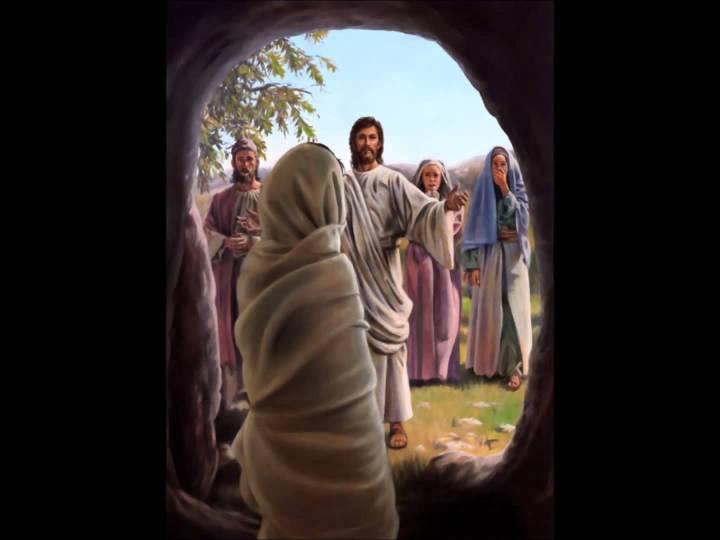
Lazarus 1Ethan’s Dad: My wife has mentioned in this space before that sitting in church can be a trying experience for us. We never know when a song, a prayer, or a statement made in Sunday School banter might open the floodgates of sadness that reside within us from losing Ethan. Of course, this is also true in everyday encounters, but we have found that the likelihood of it occurring is magnified in church because mortality and miracles are topics of discussion in church much more often than in everyday life.

One of those occasions occurred this past Sunday when our pastor was giving a sermon titled “Who is Jesus.” It was part of a series he has been doing in which he has listed three descriptions of Jesus in each sermon and expounded upon them. The first of those descriptions this past Sunday was that Jesus is “the resurrection and the life.” This is a description Jesus gave about himself that is recorded in the book of John, chapter 11, that tells the story of Jesus raising Lazarus from the dead.  In one part of the story, Jesus has a captivating conversation with Martha, the brother of Lazarus.  Just after Martha informed Jesus that Lazarus has died, Jesus said:

“Your brother will rise again.”

“Martha answered, ‘I know he will rise again in the resurrection at the last day.’

“Jesus said to her, ‘I am the resurrection and the life. He would believes in me will live, even though he dies, and whoever lives and believes in me will never die. Do you believe this?’

“‘Yes, Lord,’ she told him, ‘I believe that you are the Christ, the son of God, who was to come into the world.’” (John 11:23-27)

Our pastor was, of course, right that Jesus’s pronouncement about himself in this passage is foundational to the Christian life because it revealed to Martha (and all who would later read those words) who Jesus was in the grandest eternal sense and what they must do to inherit eternal life, which was simply to believe in who He really was. My problem was not with the pastor’s reference to this exchange or to the story of Lazarus in general. My issue was with the pastor’s use of something Martha said right before this part of their conversation.

When Martha first heard that Jesus had arrived in Bethany — the town where she, her sister Mary, and Lazarus had lived — she said to him, “Lord, if only you had been here, my brother would not have died.” (v. 21). To fully understand this comment, you have to know that several days earlier Martha and Mary had sent Jesus a message informing Him that Lazarus was sick, and they no doubt had expected Jesus to come quickly to Lazarus’s aid.  Instead, Jesus arrived in Bethany four days after Lazarus had died.  Jesus’s delay piled confusion on top of the crushing grief Martha was feeling because of her brother’s death.

Our pastor chose to focus on those two little words near the beginning of Martha’s statement: “if only.” The pastor did a riff on how we all have “if only” times in our lives, i.e, times when we believe that things could have been different if only God had acted or if only we had made a different choice. He made some statement about how, in thinking this way, we are often more focused on temporal things while God is concerned with eternal matters. Again, that is a true statement in itself (to a degree). And I believe the pastor’s point was that whatever those “if only” moments might be in our lives, Jesus is the ultimate answer to them because He is the resurrection and the life.

Now, as I have said, I had no theological problem with any of this in the abstract. My issue was that as soon as the pastor started talking about “if only” moments, my mind (and my wife’s) immediately veered to March 10, 2017, and that horrific period when we literally screamed for God to save our precious Ethan. We begged; we pleaded; we cried oceans of tears. . . . And nothing happened.

So, here is the thing about Martha’s statement that the pastor chose to gloss over: she was right. If Jesus had been there before Lazarus had died, He could have saved Lazarus from death. Indeed, in all likelihood Martha had seen Jesus do it before for total strangers. All she was wondering was: why didn’t Jesus come earlier and save His friend Lazarus? And is that really such a bad thing to wonder about?

I don’t think so. For one thing, Jesus did not rebuke Martha in any way for her implied question. In fact, if she had not wondered about it, I think it would mean that Martha did not really believe that Jesus was who He said He was. But we know this isn’t true because Martha gave not one, but two great statements of faith. Right after Martha made her “if only” statement, she said: “But I know that even now God will give you whatever you ask.” (v. 22). And then when Jesus asks her if she believes that He is the resurrection and the life, Martha responds unequivocally: “Yes, Lord, I believe that you are the Christ, the Son of God who was to come into the world.” (v. 27).

As one who has been where Martha was, in the throes somber grief, I have to say that this is a wonderful testimony on her part. The Holy Spirit must have encouraged her, but it is truly admirable that Martha did not let her deep sorrow swallow her faith in Jesus at that moment. The sincerity of Martha’s faith practically explodes off the page because of the palpably desperate moment in which she expresses those statements. It is not unlike that moment when a thief hanging on a cross, in the midst of excruciating agony, expressed his faith in Jesus even as Jesus was on a cross right beside him (Luke 23:40-43), or when Stephen asked the Lord to forgive his executioners as they stone him and he proclaimed that he saw Jesus standing at God’s right hand in heaven. (Acts 7:54-60).  To proclaim Jesus as Lord when doubt has enveloped the heart and darkness is one’s sole companion: those are the testimonies that speak most to me because I know first-hand how difficult it becomes in that lonely place to cling to this truth.

But as commendable as Martha’s faith is, do not lose sight of the fact that, at the same time, she questioned Jesus’s timing. For faith and questions are not incompatible; they are, in a sense, inseparable. We do not continue to learn about who Jesus is if we do not keep wondering about why things must be the way they are. For Jesus is “the author and perfecter of our faith,” (Hebrews 12:2), where “perfect” really means “finish” or “complete.” Our faith must mature, and it only does so when we probe and ask Jesus to show us who He is, just as Martha did. And I think the answer she received stretched beyond her imagination, because how could one really conceive that Jesus was going to call Lazarus forth out of that tomb, and that Lazarus would actually walk out of it as if nothing at all had happened to him?

So as I sat there in the pew now only half listening to the rest of the sermon, I kept poring over this story about Lazarus, a story like the widow of Zarephath, which inevitably causes a believer who loses someone close to him or her to wonder, just as Martha did: Why didn’t you save him, Lord? And I am not afraid to confess that I did not receive an answer. But what I did see was something I had never noticed before in all my years of being told about and then reading this story. It was this: Doing this was really hard for Jesus.

I don’t mean the raising of Lazarus from the dead. Indeed, the remarkable thing is that that was the easy part for Jesus. For Jesus, raising Lazarus was no different than restoring a blind man’s sight or causing a lame man to walk or walking on water. Certainly, it seemed different to everyone else, but for the One “through whom all things were created, things in heaven and on earth, visible and invisible,” resurrection is not difficult. (Colossians 1:16; see also John 1:3).

No, what was really difficult for Jesus was not saving Lazarus before he died. Go back to when Martha and Mary first sent their message to Jesus telling Him that Lazarus was sick. John 11:3 says: “So the sisters sent word to Jesus, ‘Lord, the one you love is sick.’” Martha and Mary knew Jesus would understand that they were talking about Lazarus, which tells us that Jesus and Lazarus must have been extremely close friends. Jesus responded to this message by saying: “This sickness will not end in death. No, it is for God’s glory so that God’s Son may be glorified through it.” (v. 4). This response, though somewhat cryptic at this point in the story, tells us that something bigger was going on than anyone could really understand.

But then John decides to give the reader an interesting side note.

“Jesus loved Martha and her sister and Lazarus. Yet, when He heard that Lazarus was sick, he stayed where He was two more days.” (vv. 5-6).

This note drives home the point that Jesus loved all three of these people very much, and yet He did not do what everyone would think He would do and rush to see Lazarus, Martha, and Mary. No, instead, Jesus essentially decided to kill time with his Disciples while Martha and Mary watched their brother suffer and die. Despite appearances, this isn’t callousness; it is the exact opposite: it is unfathomable love. John is telling us that Jesus really wanted to rush to Lazarus’s side, but that for the sake of something greater, He had to wait.

This point is reinforced again when Jesus said to his Disciples: “Lazarus is dead, and for your sake I am glad I was not there, so that you may believe.” (vv. 14-15). Jesus says He is glad for their sakes, not His own, because if this was just about His personal feelings, He would not have allowed Lazarus to die. Jesus was also acknowledging here that if He had been there, He would have healed Lazarus rather than letting him die. Think about it: where in the Gospels is there a time when Jesus refused an in-person request for healing? He certainly would not have refused to heal if He was standing before his dear friends watching Lazarus suffer. So, Jesus did not go right away because He knew what had to happen — Lazarus dying — and that it would not have happened if He had gone to them sooner.

John decides to make very sure the reader does not miss how difficult this was for Jesus by noting that when Jesus saw Mary and her friends weeping near Lazarus’s tomb, “He was deeply moved in spirit and troubled,” (v. 33). And then he observes that “Jesus wept” when He saw Lazarus’s tomb. (v. 35). The word “troubled” that is used in verse 33 is the same root word Jesus later used in the Garden of Gesthsemane to describe His spirit in its agony before the crucifixion. And yet again, just before Jesus raises Lazarus, John notes that “Jesus, once more deeply moved, came to the tomb.” (v. 38).

John (God, really) is practically begging his readers recognize that Lazarus’s death precipitated intense pain for Jesus. Jesus understood that allowing Lazarus to die had caused great pain and grief for people He loved very much. Jesus weeps for the real anguish that is present even though He is about to remove the reason for it by raising Lazarus from the dead.

In the same way, I believe that God weeps for us in our sorrow for Ethan’s loss. God knows that Ethan is with Him and that He will raise Ethan again for us to see one day, but He also knows that there is real and genuine suffering caused right now by Ethan’s absence. He knows that torment because Jesus lived it. The fact that Jesus is the resurrection and the life gives us incredible hope for eternity, but it does not erase our reality of agonizing loss in the here and now. God does not ask us to ignore or diminish that reality because He has shared it.

So God wants us to know that He truly understands our pain and grief. But in this incarnation story, God tells us more than just that He felt as we feel. He tells us that there are times when, in His love, He refrains from acting to save even though it deeply wounds Him to stay His healing hand. In the immediate sense it is not what He wants: God does not enjoy seeing our suffering, and it hurts Him even beyond what we can imagine because He knows that He can help us. But sometimes God chooses “to stay away from Bethany for a couple of days” even as He hears our cries. I do not pretend to know why He makes this choice at some times while at others He rushes to save one in need.

Certainly the answer comes easier in the Lazarus story, for Jesus delayed coming so that He could demonstrate that His power extends even over death itself. Further, Jesus’s raising of Lazarus started to bring the conspiracy against Jesus to a head because the miracle caused a great many more people to believe in Him, and, in turn, the religious leaders resolved that Jesus must be stopped at all cost. So His raising of Lazarus became a part of the chain of events that led to the crucifixion, which caused His death, which precipitates His resurrection, and leads to our redemption.

God’s choice to refrain from acting in our circumstances does not portend such heady consequences — at least so far as I can see. I believe that at least in part the answer to why He sometimes stays His healing hand lies in the fact that this world is corrupted by evil, and in many cases God must let the consequences of that evil play out; otherwise, love and choice do not exist. And part of the answer lies in how suffering occasions examples like Martha who proclaim their belief in Jesus even as they drown in sorrow, and by so doing they embolden others to believe likewise. But those are only partial answers. Right now we know in part, but there will be a time when we will know in full. (See 1 Corinthians 13:12).

Yet, as much as I wonder about a complete answer to the why question, even a full answer would not bring Ethan back. Consequently, for me what is more important is the knowledge that God’s failure to act does not equate to a failure to care. God can simultaneously allow and yet participate in our suffering. In fact, this also happens when people sin. Sin hurts the sinner and often those around him or her. But it also grieves God to see His children participate in evil. Thus, whether the suffering is caused by the world’s brokenness or by human rebellion, God permits pain knowing that it will cause Him intense pain as well, all because of His greater purposes.

In the story of Lazarus Jesus tells us that greater purpose is “God’s glory,” (v. 4) and our eternal lives (v. 25). The stories of our earthly lives take places within that context, and so ultimately we can take lasting comfort in the assurance that the tragedies which befall us — tragedies seen by a God who hurts with us as we experience them — will one day be made right again. One day He will call Ethan forth and we will see him again because Jesus truly is the resurrection and the life.

Kept for Us

Picture 281

Ethan’s Dad: Last week was somewhat difficult because it included a 10th (as we have mentioned before, Ethan died on March 10, 2017). And on evening of the 10th last week, which was a Wednesday, I was at church helping with my oldest son’s activity group that has age rages from first grade through sixth grade. The leader of the group that night read the kids the story of Elijah and the widow of Zarephath from 1 Kings 17:7-24.

For those of you unfamiliar with that story, it involves the prophet Elijah’s encounter with an Israelite widow and her son who are starving to death in the midst of a drought and famine brought about as a result God’s punishment against Israel’s evil King Ahab. The part of the story that is repeated most often concerns Elijah asking the widow for some water and bread. She readily gives him water, but she initially hesitates at offering him bread because the widow says that she and her son only have enough ingredients to make bread for one more meal for themselves. Elijah tells her not to be afraid, to make her meal, but to give him some bread first because the Lord had told him that she will always have enough flour and olive oil in her containers to make bread until the day the Lord sends rain and the crops grow again. So, the widow made bread for Elijah, and events unfolded exactly as Elijah had said: “There was always enough flour and olive oil left in the containers, just as the Lord had promised through Elijah.” (verse 16).

That part of the story is usually told as an example of what happens when someone shows faith in the Lord. Indeed, the Wednesday group leader summarized it by saying: “You do what the Lord says and good things happen to you. I am not saying a miracle will always happen, but good things result from obedience.”

The leader then went on to discuss the second part of the story, which is not told as often. 1 Kings 17:17-24 relates that later on the widow’s son somehow became sick and he eventually died. The widow expresses her anguish to Elijah, saying:

“‘O man of God, what have you done to me? Have you come here to point out my sins and kill my son?’

“‘Give me your son,’ Elijah replied. He took him from her arms, carried him to the upper room where he was staying, and laid him on his bed. Then he cried out to the Lord, ‘Lord my God, have you brought tragedy even on this widow I am staying with, by causing her son to die?’ Then he stretched himself out on the boy three times and cried out to the Lord, ‘Lord my God, let this boy’s life return to him!’

“The Lord heard Elijah’s cry, and the boy’s life returned to him, and he lived. Elijah picked up the child and carried him down from the room into the house. He gave him to his mother and said, ‘Look, your son is alive!’

“Then the woman said to Elijah, ‘Now I know that you are a man of God and that the word of the Lord from your mouth is the truth.'”

The group leader did not add much commentary to his reading of this part of the story beyond observing that the widow blamed Elijah even though he had nothing to do with her son’s death, and that God is able to do great things. For the moment, I do not want to focus on the probable meaning of Elijah’s raising of the boy back to life. Instead, I want to convey what hearing a story like that can feel like for someone who has experienced the loss of a child.

We have so far not related the details of Ethan’s death in this space because that is an extraordinarily personal and painful memory. What I will say is that his passing was very sudden, and as it was happening, as efforts were made to resuscitate him, we literally screamed to God to save our child. Immediately after we were told to accept that he was gone, we cried rivers of tears, pleading over and over for the Lord to bring our Ethan back to us.

Nothing happened. His body became cold. His life slipped away. We were left in the dark.

I don’t write that to make you feel sorry for us. I relate it because that is the way it is for many parents who lose a child. And so when you read a story like Elijah’s raising of the widow’s son, what someone in our position immediately starts thinking about is the death of our own child. Why didn’t God bring Ethan back to life? Was it because I did not have enough faith like the widow? Was this a punishment for some unrepentant sin? To many people it is just a Bible story. To us, because we have lived this, it (like so many other stories) takes on an entirely different character.

So, I felt discouraged coming home from church that night. That Friday, the same boys’ church activity group went on a camp out with their dads. All of the kids seemed to enjoy it very much, including our oldest, who caught his first fish during the outing. However, that night while the kids were playing, the men were sitting around the campfire chatting. At one point, for some inexplicable reason, one of the dads turned the conversation to talking about people’s ashes, and urns, and then cemetery plots. I got up and walked away from the fire because the discussion depressed me. What was idle talk to them was nothing to joke around about to me because my youngest son’s body rests in a cemetery. I felt disquieted the rest of the night (and not just because I was sleeping on the ground in a tent).

But then on the following Saturday evening and Sunday morning before church, I was reading the Scripture excerpts for those days from Daily Light for the Daily Path (my copy is in the English Standard Version, unlike most of the online versions which are King James), and some of the verses unfolded into a timely reminder:

“Your will be done on earth as it is in heaven.” (Matthew 6:10)

“Understand what the will of the Lord is.” (Ephesians 5:17)

“It is not the will of your Father who is in heaven that one of these little ones should perish.” (Matthew 18:14)

“Christ died and rose and lives again that He might be Lord of both the dead and the living.” (Romans 14:9)

It was not God’s will that Ethan would die. Sometimes “this present darkness” distorts God’s perfect will in this imperfect world. (Ephesians 6:12). That is not to say that God did not know or could not have prevented Ethan’s death — He certainly did and He definitely could have, but in this instance, evil was allowed to run its course. Yet, this is one of the reasons Christ died and rose again: so that He could reign over death and prevent such a little one from eternally perishing.

Later that same Sunday morning as I was sitting in church, the Scripture reading for the service included 2 Timothy 1:12. The second part of that verse says: “I know in Whom I believe and I am persuaded that He is able to keep that which I have committed to Him until that day.” I used to take that verse simply in its context of Paul discussing preaching the gospel to unbelievers. After Ethan’s death, however, the verse became a promise from God for us: that He will keep Ethan, who we have committed to Him, until the day Christ returns. (This interpretation stems from the context of verse 10: “our Savior, Christ Jesus … has destroyed death and has brought life and immortality to light through the gospel.”)  Obviously we did not willingly give Ethan away; evil robbed us and him of his earthly life too soon. But God has promised to keep and guard Ethan for us until we come to him. Ever since I was reminded of that verse shortly after his death, I have included it in a string of verses I repeat when I visit Ethan’s grave.

So I sat in the pew thinking about that, and about the verses on the Lord’s will I had read earlier that morning, and then the music minister had the congregation sing the hymn “I Know Whom I Have Believed,” which is based upon 2 Timothy 1:12. If you are unfamiliar with the hymn, the fourth stanza says:

“I know not what of good or ill
May be reserved for me,
Of weary ways or golden days,
Before His face I see.”

This is followed by the refrain, which is repeated after each stanza:

“But I know Whom I have believed,
And am persuaded that He is able
To keep that which I’ve committed
Unto Him against that day.”

Then the final stanza reads:

“I know not when my Lord may come,
At night or noonday fair,
Nor if I walk the vale with Him,
Or meet Him in the air.”

By the time we finished singing that hymn, I felt overwhelmed with God’s reassurance that even though a miracle did not occur on that day Ethan passed, and even though his tiny body is resting in that small grave I so often visit, Ethan is okay because he is being kept safe by God until that glorious day. As I was reminded today: “Behold, the Lord God will come with power, and His arm will rule for Him. … He will gather His lambs in His arms and carry them close to His heart.” (Isaiah 40:10,11).

And as for Elijah’s raising of the widow’s son, it should be remembered that even the widow, with her great faith, despaired when her son died. She earnestly questioned Elijah as to why God would perform a miracle to keep her and her son alive only to let her son die of a sickness. It must have seemed like a cruel joke. Elijah himself did not understand what God was doing, asking God: “Lord my God, have you brought tragedy even on this widow I am staying with, by causing her son to die?”

God did not rebuke their doubts, which merely stemmed from a lack of understanding. As I explained above, both the widow and Elijah erred in concluding that God caused the boy’s death. He did allow it, but He did not cause it — there is a difference (as difficult as it may be to see) between causing the tragedy and allowing it to unfold. For what the widow and Elijah could not know is that this event was meant to foreshadow a much greater one hundreds of years later.

The widow’s son died; Elijah laid his body over the boy’s body three times; the boy came back to life; and the widow exclaimed that by this miracle she knew Elijah was a man of God who spoke the truth.

Mary had a son named Jesus. He was crucified on a cross even after He had performed many miracles. (Mary was probably a widow when this occurred because Joseph is not mentioned in the Gospel accounts after Jesus’s childhood, and on the cross Jesus told his disciple John to take care of Mary). Jesus was buried, and after three days God resurrected Him from the dead. And it is by His resurrection that we know Jesus is God and that He spoke the truth.

The point is that there was something larger going on with the boy’s death that neither the widow nor Elijah could comprehend because the events that would give its context lay in the distant future. I am not saying that every death of a child has a larger purpose beyond demonstrating with stark coldness the evil that pervades this world. But I am saying that the fact that we may not understand why a tragedy occurs does not mean God allowed it to happen without preparing the future context in which it will be wiped away. Because in that future

“The Lord God will swallow up death forever. He will wipe away the tears from all faces. He will remove the reproach of His people from all the earth. And in that day it will be said: “This is our God, we have waited for Him, and He has saved us. This is our Lord, we have trusted in Him; come, let us be glad and rejoice in His salvation.'” (Isaiah 25:8-9).

Until that day, “the Lord will bless and keep Ethan, and make His face to shine upon Ethan and be gracious to him and give him peace.” (Numbers 6:24-25).

Over and Underneath

Ethan’s Mom: This past weekend, I attended the (in)complete Retreat for moms who have experienced stillbirth and infant loss. The weekend consisted of group sessions with a certified counselor and Bible study with a leader who had attended the first of these retreats, held in 2016. My hope in attending was to connect with other women who know the pain of this loss firsthand, and I did, in fact, develop relationships which I think will last many years. But I was surprised to find out what a milestone this retreat would become on my journey.

I really didn’t realize how tired I had become – tired of pretending, tired of avoiding, tired of trying so hard to figure it out. The best picture I can give you of the change in my soul is an overtired child. When I arrived home Sunday, I was putting an overtired, no-nap 20 month old to sleep. This is not pretty, in fact, it is nearly impossible. No amount of rocking or shushing or calm reassurances of my love or his need for sleep made any difference. Eventually, into the bed he went, still wailing at maximum volume. After 30 minutes of throwing down in his crib, I went back in and asked if I could try rocking him again. This time, he did not fight me, and his anxiety lifted as I rocked. He stilled to my voice and seemed to accept that what he needed was to sleep. I didn’t put him in the bed as soon as he stopped gasping for breath between sobs. I held him until he was relaxed and ready to accept going to sleep. My love did not change one bit, and my actions were pretty similar both times I tried to put him to bed. He wasn’t able to accept my love in the same way he typically does at bedtime because his body and mind were so incredibly tired that it was affecting him deeply. Eventually, he hit bottom and looked to the person who had been there trying to help all along.

I have been an overtired toddler in the arms of God for many months now. Perhaps those of you who interact with me are surprised by this, but that is the best description for the angst that has built up inside of me, maybe mostly since the anniversary of Ethan’s death. It has felt like people have moved so far beyond this tragedy that anytime I tried to talk about Ethan or my grief, I felt like people became very uncomfortable. Well, if there is one thing I try to avoid, it is rocking the boat. Taking responsibility for how people reacted to my life and my loss was putting a tremendous strain on me. I was overwhelmed by the darkness — fighting and punching at air, trying to wrestle with what happened to my sweet baby, my family, and my faith — but I didn’t want any help. I didn’t want to invite anyone into the darkness with me.

There were many holy moments throughout the weekend, and some I will ponder in my own heart instead of sharing them on this blog. But I want to share a message I believe I received from God the Father through his Holy Spirit and the wise counsel of the retreat staff.

The Bible study leader and I were cut from the same perfectionistic cloth. Her journey contained battles with many of the things I had been struggling with. She encouraged us that we can stop wrestling with ourselves and start wrestling with God, inviting Him into our darkness. The enemy would have us fighting within ourselves instead of going to God with questions and doubts and turmoil. If he can keep us from bringing Him the negative feelings that are so hard to feel and harder still to express to other people, even the closest of friends or family, He can keep us away from the source of healing.

It sounds easy to bring everything to God, but it isn’t, at least for me. In the first few months after Ethan died, I remember telling Greg that people needed to stop telling me about the loving arms of Jesus. I did not feel surrounded by the loving arms of Jesus. I felt like I was in a choke-hold and that Jesus, if he was even really real, was a million miles away, coolly detached from my misery.

What I didn’t realize until this weekend is that I was stuck there. I have returned to church and Bible study, and I have watched as my husband’s cracked faith seemed to cement back into place. I have a completely new and deep gratefulness and longing for the return of Christ and the redemption of the world, but for the here and now, He seemed so far away. One day He will be my hero, defeat death, and restore me to Ethan, but until then, I’m just on my own down here in this crazy messed up world, fighting all the battles that wage inside of me. Grief has been the loneliest experience of my life.

Maybe it is easy to read that and think, “Oh, how misguided. What weak faith. Of course, God is always with us, He says so.” Beggin’ your pardon, but if you have never buried a child, you have no idea what it takes to choose every moment of every day to keep trusting in a loving God who could have saved your baby in a hundred different ways but did not.

That is the paradox. My really thoughtful and deep husband addressed this in a blog post already. I guess this is my version of coming to terms with this, a little later on.

The Bible study leader encouraged us to lean into the paradox, to wrestle with God, to “pour out your heart like water before the Lord’s presence” (Lamentations 2:19). And throughout the rest of my messy, tearful, heart wrenching prayers during the weekend, I started to lean in. He spoke to my heart in a non-saccharine, non-loving-arms-of-Jesus way that He was here, and even though I couldn’t even see or acknowledge Him, that He has been here all along. He told me that it was time to stop flailing and fighting His love, that it is real and near even though it hasn’t felt like that at all.

And in that revelation, I rested. My soul rested, just like my overtired bundle of sweat and tears fell asleep in my arms as I rocked and sang over him.

I do not mean to imply that I was “fixed” this weekend or that I don’t have sadness and doubt, longing and heartbreak, and all the other emotions that can weigh so heavily on those of us who walk through the valley of the shadow of death. But I do know in a way I didn’t before, that He is with me in the valley. His rod and staff comfort me. I believe He will give me provisional grace for this messy life and have decided to trust it from here on.

I want to share the lyrics to a song that describes what I am trying to express in this post.  Jesus loves you, always, and I am praying that you can rest in this truth today.

I hear You say
“My love is over, it’s underneath
It’s inside, it’s in between
The times you doubt me
When you can’t feel
The times that you question
“Is this for real?”
The times you’re broken
The times that you mend
The times you hate me
And the times that you bend
Well my love is over, it’s underneath
It’s inside, it’s in between
These times that you’re healing
And when your heart breaks
The times that you feel like you’ve fallen from grace
The times you’re hurting
The times that you heal
The times you go hungry and are tempted to steal
In times of confusion
In chaos and pain
I’m there in your sorrow under the weight of your shame
I’m there through your heartache
I’m there in the storm
My love I will keep you by my power alone
I don’t care where you’ve fallen or where you have been
I’ll never forsake you
My love never ends
It never ends.”

Taking the Path of Paradox

Ethan’s Dad: Karl Marx famously said: “Religion is the opiate of the masses.” This remark says more about Marx than it does about religion. That is, it shows that Marx knew very little about true religion and only focused on what he wanted to believe about religion.  Marx told himself that people believed in religion because it provided them with a delusion that masked the truth of their sterile lives. In other words, religion supposedly made the lives of ordinary people easier for them at the expense of facing reality.

Any true practitioner of the major religions can tell you that Marx’s framework is nonsense.  It is anything but easy to take religion seriously.  Most religions, to one degree or other, require a person to do at least one thing that is directly contrary to our basic nature: pay homage to something higher than ourselves.  In this sense, religion is not natural at all.  It is not an easy way to escape reality; it requires a certain transcendence of it.  The easier path does not acknowledge demands outside of ourselves.  The easier path treats survival as its own reward and lives accordingly, sacrificing anyone and anything that gets in the way of the self.

In a sense, Christianity raises the level of natural difficulty to a whole different level than other major religions.  How so?  A pivotal difference between Christianity and other religions is that Christianity says that we cannot save ourselves, only Jesus can do that. Thus, Christianity removes the control over our lives that other religions seek to bestow by making our actions play a consequential role in our ultimate destiny.  Because of this difference, Christians are not supposed to act out of obligation or to earn a reward, but out of love: a love for God and what He has done for us in Jesus, and a love for others that grows from that love for God.

But again, this love does not come naturally or easily.  We are born loving ourselves, first, foremost, and always, and second loving those who help us most. We must be shown by God (through His Spirit) that He does the most and cares the most for us, and that even strangers deserve our love because God loves them just the way He loves us.

The militant atheist Richard Dawkins has said that it would be much better for humanity if people just acknowledged that life is “empty, pointless, futile, a desert of meaninglessness and insignificance.” (Richard Dawkins, The God Delusion, p. 360).  He argues that people create problems for themselves when they seek to attach meaning to a universe of “blind physical forces and genetic replication” where “some people are going to get hurt, other people are going to get lucky, and you won’t find any rhyme or reason in it, nor any justice.”  (Dawkins, A River Out of Eden, pp. 132-33).  This view is nothing more than a post-modern rendition of Marx’s riff about religion. It is this notion that “reality” — by which people like Marx and Dawkins mean their belief that there is no spiritual reality and the only real existence is matter and physical energy (what I will call materialism) — is harder for people to accept than the fantasy of another world beyond this one.

Such contrasting thoughts can provide for an interesting, if esoteric, philosophical debate, but at this point you are probably wondering what any of this has to do with Ethan.  The answer is, actually quite a bit.  This debate takes on an entirely different dimension when you face the unexpected death of your child.  If Marx and Dawkins are right, then that death is just part of life and there is no greater significance or meaning to it.  If Christianity is right, then . . . .

I want you to stop for a second and ask yourself if Christianity is really the easier choice here? If life and death are accidents of nature, then why should another person’s death affect us at all? There is a sense in which the materialist view makes things very easy because then life is what it is and there is nothing to reconcile. There is no higher obligation, let alone a rational reason to love because that implies an attachment beyond the self with accompanying burdens that last after other people are gone forever.  And since you are an accident too, whatever befalls you is not evil or cruel or unfair, but rather it is just the reality of it all and it matters not because you will end permanently as well.

Now, if Christianity is true, it means that God loves us beyond all measure of our comprehension, and yet for some reason He allowed our Ethan to die — through no fault of his or ours — before he got to do (and we were privileged to witness) a thousand things in his life.  God knew Ethan’s death would cause us unfathomable pain, and yet He allowed it to happen.  As a Christian, I cannot say this happened because it caught God by surprise or He was unable to save Ethan, because the Bible tells us that God is all-knowing and all-powerful. (And indeed, why would God, if He is real, be less than that?) As a Christian, I cannot say (the way the Marx/Dawkins adherent can) that this was simply an accident of nature.  No, instead I have to hold onto a paradox: that there is an all-knowing, all-powerful, and ever loving God, and yet somehow there also exists a pervasive natural evil in this world that at times robs us of those we love.  It says God calls us His children and still somehow He allows this evil that inflicts unspeakable harm upon us.

And this is far from the only paradox Christianity asks a believer to accept.  We must believe that God transcends time and yet that He stepped into time.  That He is infinite and yet He became finite. That He is Spirit and yet He became flesh.  That He is eternal and yet that He died. That by His death and resurrection He gave us life everlasting. That we are here, and yet this is not our home.  A real belief in Jesus means all of these things. And yet the likes of Marx and Dawkins want to say this is the easier path in life?

I will grant that there is a segment of Christianity for which it could be said that it is easier than the materialism of Marx and Dawkins. It is the segment that ignores the paradoxes — particularly the first one regarding the existence of evil — by claiming that absolutely everything happens for a particular reason, that God wills everything for His purposes, and so there is no room for questioning or wondering.  Instead, all is as it should be, you just have to have the faith to accept it.  This is not the post for me to explain all the ways I think such a brand of Christianity misunderstands Biblical truth.  It will have to suffice here to observe that such a Christianity leaves no room for actual evil or for authentic faith.  So I leave it aside and ask again: is Christianity the easier path in life?

The answer is “No,” but at bottom that isn’t even really the right question. We should not be surprised that Marx and Dawkins assume that people select religion over materialism because it is easier. They hold this view precisely because they are materialists: to them the material is all that motivates people, and so most people inevitably will select the easier road in life.  Of course, this view is self-contradictory because it fails to explain why there are people like Marx and Dawkins who do not select such a path.  When you drill down, the answer comes down to the fact that they believe that they are just smarter than the rest of us.  In the end, that is their real motivation for such a view: a demonstration of superiority.  And you do not have to read much of Marx or Dawkins for proof of this smugness (a natural trait that, at time, we all display).  I would also argue that a lack of belief in God fits nicely with this claim of superiority because it means that there is no being superior to them.

If you put aside the lens of materialism for a moment, however, and imagine that people sometimes make choices based on something other than comfort, then you might see the real reason why people would select Christianity over materialism. When you watch your baby dying before your eyes, you scream and shout in bitter anguish, and then you collapse in a pool of silent despondency, wondering where God is; you do not have the luxury of a comfortable Christianity.  You feel numb; cold; hopeless; alone.

You are left with this: Is it true? Is there a love that surrounds this? Is there a hope that transcends it? Is there ultimately a triumph of the good despite the harsh reality of such abject evil?

This place of haunting loss is where faith is not a a tingly feeling or a rote creed.  It is a conscious decision to persevere in spite of the deep wound in your heart. It is where, as Andrew Peterson says in one of his many honest songs,

“faith is a burden, it’s a weight to bear
It’s brave and bittersweet
And hope is hard to hold to
Lord I believe, only help my unbelief
Till there’s no more faith and no more hope
I’ll see your face and Lord I’ll know
That only love remains.”

My wife and I (and a host of other Christians that have experienced abominations of evil even worse than our own) do not believe in Christianity because it is easy.  We believe because, while you are drowning in the abyss of evil, you realize there is something else there, something beyond you, something above you — Someone who knows all about this because He suffered the loss of a child, experienced a separation unlike any we could comprehend, endured torture, embraced an ignominious death, and bore the sins of the world — all at the same time.  Does He understand what we endure?  How can He not?

Christianity does not deny the existence — and even the pervasiveness — of darkness in this world.  It simply insists that God ultimately has overcome the darkness.  The materialist views Christianity as delusional because of its insistence on a spiritual reality, but there is a a raw concreteness to Christianity that materialism cannot match because true Christianity not only recognizes suffering for what it is, it endures it, and it promises that God will ultimately overwhelm it because of what Jesus has done.

“Where can I go from your Spirit?
Where can I flee from your presence?
If I go up to the heavens, you are there;
if I make my bed in the depths, you are there.

“If I rise on the wings of the dawn,
if I settle on the far side of the sea,
even there your hand will guide me,
your right hand will hold me fast.

“If I say, ‘Surely the darkness will hide me
and the light become night around me,’
even the darkness will not be dark to you;
the night will shine like the day,
for darkness is as light to you.” (Psalm 139:7-12)

“[B]ecause of the tender mercy of our God, the Sunrise from on high came from heaven to shine on those living in darkness and in the shadow of death, and to guide their feet into the path of peace.” (Luke 1:78-79)

Jesus said: “I have come into the world as a light, so that no one who believes in me should stay in darkness.” (John 12:46)

Thus, by holding onto the paradoxes inherent in the Christian faith we are planted in a reality far more profound than the shallow materialist vision that seeks (and spectacularly fails) to maximize pleasure and avoid pain at all costs because it insists that the here-and-now is all that matters.  Instead, we are renewed by a Spirit that only a lasting hope could bring. “Therefore, though outwardly we are wasting away, inwardly we are being renewed day by day.” (2 Corinthians 4:16).  Another paradox — and thank God for that.

Back To School

His Mother: Today was the first day of school. We have three enrolled in school this year – 2nd grade, kindergarten, and 3K preschool. I have been trying to prepare myself for this week for a while now. After last year’s back to school festivities caught me off guard, I was expecting the waves of grief this week. But the thing is, you never know exactly what a difficult day or season will actually look like in advance. Some things might be easier than expected, other things are harder.

Back to school is, like a lot of things in our culture, getting to be a bigger and bigger deal. I remember getting new clothes and school supplies for the new year when I was growing up but not much other fanfare. There is a lot of pressure now to look and act in certain ways. You go check the class lists ASAP, milling about with other parents to talk about “who you got” even though technically I didn’t get anyone, my child did. Then there is meet the teacher day, with its obligatory new-teacher-side-hug photo to post on social media. On the crazy first day of school before getting your kids to school on time, you must stop to get perfect pictures of your kids standing outside your welcoming front door with homemade signs that document their grade, school, and what they want to be when they grow up (or some other sweet memory). Our school also has this breakfast social for kindergarten parents called “Tears and Cheers,” so that you can rejoice or mourn with others who have sent their kids on to big school this year.

You could probably imagine, even if you haven’t experienced child loss, that these milestones and photo ops could be painful. Anytime I am around a whole group of people where everyone appears to be so “normal,” the loneliness bears down on my soul: knowing that that most of the folks in the crowd have no basis for understanding what it feels like to know you will never walk your child into his first day of kindergarten. I can’t go to the breakfast because the “tears” that people are sharing over bagels are because their babies are growing up like they are supposed to do, and I have cried an ocean of tears because my baby will not.

But do you know what is the worst so far? The “All About Me” pages. I have filled out 4 forms (and I only have 3 students!) that have asked me to list my students’ siblings and ages. I am waiting to get requests for sending in a family photograph from at least one teacher, maybe more, which is also awkward. My family does not fit neatly into a blank line on a form or into a photograph. I cannot leave Ethan out – he is their brother and usually when asked how many siblings they have, my kids will answer 4. So far, they have always drawn family portraits with some representation of Ethan. I want the teachers to know they are not drawing some sort of imaginary friend! The real difficulty comes in the age part. I list names and ages until I get to Ethan. Then I stare at the paper. I can’t really write 19 months old, as that seems disingenuous. If the teacher knows our family already, I will just list his name. For instance, my daughter has the same teacher my son had during the year the twins were born and Ethan died. She actually came to the visitation, so I know she is aware of who Ethan is. For the others, I am left writing Ethan (deceased). Writing those words hurts my heart every time. The very few pictures of all 5 of us no longer show the big kids in their current ages and stages, so we send in family photos that only show the majority of our family.

I was prepared for that, in a way, given that this is our second back-to-school season without Ethan. One thing I did not expect that caused big waves of grief to crash over me earlier this week was kindergarten parent night. I requested that our daughter be assigned to the same kindergarten teacher that had showed such kindness to us during that difficult year. She loved on and watched over our son when we sent him back to school. I was excited walking in to her classroom, but then as I sat there, I realized that during that first parent night, I was sitting at those same desks with two little babies in my belly about to enter the second trimester of pregnancy. I was overwhelmed with all the changes in my life – pregnant with surprise twins, preparing to buy/sell houses, sending my firstborn to kindergarten. Those feelings came rushing back at me, and I sat there thinking how much more change, very unwelcome change, was unknown to us at that time. One thing my counselor has said on more than one occasion is how this loss changes who a person is at a very deep level. I am not the same person who sat in those small desk chairs two years ago and that realization was distressing and disorienting.

I have heard some people say that the first year after a loss is the hardest and others claim that the second year is hardest. Well, frankly, they both stink in my experience, but they do stink in different ways. The shock is completely disorienting during the first year – waking up discombobulated and having to remember that Ethan wasn’t there, trying to count 5 kids when leaving the house, etc. – and of course the trauma is fresh and causes frequent flashbacks to that horrible, terrible day and more terrible days that followed as well. Every 7th and 10th of the month weighed so heavily on us that first year. With the second year comes the realization that this nightmare is, in fact, permanent. The shock that can be so disorienting is also protective in a way, and now we are left with all the sadness, all the time. Plus, I am just tired of it all. I told my counselor it’s like when you decide to start eating healthy. You can start out with a lot of momentum but then there is a point where you realize this is not just about getting through 2 weeks without cake but a permanent change to a lifetime of carrot sticks. Not that I don’t like carrot sticks, but they aren’t as good as cake, you know? I miss cake.

I had a realization this week that maybe some things will be less painful in the years to come, but I don’t see any relief from the back-to-school grief for a long, long time. Next year, I will send Ethan’s twin brother, Noah, to his first year of preschool. The older kids have gone to Mother’s Day Out prior to preschool, but I have not been emotionally able to send Noah yet. I will pack his backpack and lunchbox, remembering the afternoon that I sat sobbing in the living room while my husband and father-in-law discussed funeral arrangements in the kitchen. My mother-in-law crossed the room to kneel beside me and hold my hand, and I choked out “I am supposed to be the one that picks out his lunchbox, not his casket.” We will take him to the same classroom that we have taken the others to at age 2, with a teacher that we adore. She decorates her room in Dr. Seuss for the new school year. Noah will pass under a door with a picture of Thing 1 and Thing 2 while every cell in my body will be crying out for our Thing 2 to walk in with him. I will come home to an empty house, which I imagine would have seemed like such an amazing thing to a mother of 5. But #5 isn’t going to go to school. Our 3 year-old tells me sometimes that Ethan “isn’t home” – he isn’t home and he isn’t going to school either.

The year after that, #3 will go to kindergarten, leaving me and Noah home 5 days-a-week. He was not supposed to have to endure my solo company – he was supposed to have a built-in playmate, not feel like an only child from 7:45-2:45 each day. Another kindergarten, another tears and cheers to skip out on…

Here’s the best/worst one yet – the next year, 2021, Noah will go to kindergarten. Alone. No debating whether or not it would be best for them to be in the same class or not. No decision on whether to match, coordinate, or just wear totally different outfits. Only 4 big kid backpacks hanging inside the door. As if that weren’t enough, my oldest will go to middle school. Middle School — where kids become teenagers. I had figured that out before the twins were even born, and I joked about how many tissues I would need that day. I think I should probably start stocking up now.

You get the idea… Each year signifies something new, if not for Noah, then for another of the kids. Milestones Ethan will never reach. The “what ifs” and “I wonders” are some of the hardest questions, and it just seems like there are a lot of those associated with back-to-school and the whole educational process, at least to this momma’s heart. I wonder if he would have eaten in the cafeteria or brown bagged it.? I wonder what his favorite subject would have been? What if the boys had totally different friends? Would I have insisted on matching backpacks and would that have resulted in protests?

I could go on and on, but I’ve got to go put snacks in backpacks and get ready for another early wake-up tomorrow. It’s the second day of school, and I have 4 kiddos earth-side depending on me to be present in their lives. I am so incredibly grateful for that job, and I want to celebrate their milestones as much as I need to grieve Ethan’s missing ones. Writing this post is helping me to do both, so thank you for taking the time to read my ramblings.