Joy Found in “The Morning”

Earlier this summer, I was invited on a girls trip to the beach.  My daughter, one “old” friend, one “new” friend, and all three moms spent a few days with the sand between our toes.  I love the beach – the sights, the sounds, the smells – so I knew the trip was going to be fun.  An added bonus I did not realize until we were there chatting under the beach umbrella was that all three girls had brothers and only brothers.  So even though the other two moms had older children, we were all in the same boat as far as parenting middle school girls for the first time.  We traded tips on finding appropriate swimwear and navigating big emotions.  It can be so nice to be among people living a shared experience.  “You too? I thought I was the only one…” are usually welcome words that can bring relief and validation.  

This holds true even when the shared experience is one you would never wish for anyone.  Sometimes people describe being a bereaved parent as being a member of a club to which no one wants to belong.  We wish no one else would ever join our ranks, but the reality is that our number will continue to grow until Jesus returns.  Recently, the devastation of flash flooding in Texas took the lives of at least 36 children.  Who knows how many were born still or died in the night or succumbed to cancer during the past 24 hours alone?

Even though I wish this were not the case, it is.  And there are some things that bereaved mothers share that no one else can understand fully.  I cannot tell you how invaluable it has been for me to develop friendships with moms who are at similar places in their grief, as well as those who are further down the road and those who are just beginning.  

Soon after Ethan died, a coworker put me in contact with an old friend of hers that was developing an online ministry for mothers impacted by miscarriage and infant loss.  My first experience with what would become The Morning was a beautiful art print with Ethan’s name on it, which was given to me by this coworker.  I did not know at the time that this print (which still hangs in our playroom) was the beginning of such a meaningful relationship.  

In 2018, The Morning released a podcast, “The Joyful Mourning,” hosted by the ministry’s founder, Ashlee Proffitt.  I listened to every single episode for the first few years, many times while taking #4 on walks in his stroller.  I heard the story of Ashlee’s son, who was six weeks old when he died unexpectedly of SIDS.  It was like walking around the neighborhood with a friend and mentor, receiving much needed encouragement and practical advice.  She shared how grief had changed her relationships, her parenting, and her faith.  She interviewed moms, each of whom shared their own stories.  Sometimes the details were similar to our story, other times not as much.  In other episodes, professionals explained the physical, emotional, and relational effects of grief.  Most episodes offered some very practical advice, and each episode offered something even more valuable — hope.  

The ministry added an online community to facilitate interactions between mothers.  The Morning Community grew into a multifaceted support system — a place where everyone was invited to tell the story of their babies, vent frustrations, and receive encouragement.  The Morning added another “big sister” to act as a mentor in this space.  Meg Walker was exactly what the community needed.  Her writing skills and her ability to connect with people, even virtually, made everyone feel welcomed and valued.  Eventually, they added community moderators to assist in managing the online community.  I served as one for six months and had a much better understanding of the sacrifice Meg willingly gave, even while her own family was growing.  Meg gave us questions to discuss, checked in on us during holidays and hard days, and made everyone feel that their baby mattered.  

To illustrate the kind of support this group provides, consider the universal dilemma of the bereaved mother.  “How many children do you have?” may seem like small talk to most people.  To mothers who have children in heaven, it feels like crossing a minefield, every time.  When I answer 5, the follow up questions will almost always reveal that one has died, and the reactions to that fact are awkward at best, painful at worst.  When I answer 4, I feel that I am being disloyal to Ethan and discrediting my motherhood.  I have five children that I love with my entire being.  Five children that I do my best to support and to celebrate.  Five children that I pray will know the love of their Creator and play their role in His redemptive story.  But that is a lot to try and sort out with a new acquaintance on the ball field or in the band booster club.  

Every so often, a new member of the community would ask how to handle this situation.  The other newer members would agree, “yes!  I never know what to say!”  The older members would encourage the woman to do what she feels most comfortable given the particular circumstance and that it does get more automatic with practice.  And everyone would reaffirm that the child in heaven is no less a part of her family and that she is no less a mother to him/her than if that baby was in her arms right now.  

That’s the kind of sisterhood that grew under Ashlee and Meg’s leadership.  And I haven’t even begun to discuss the other ways The Morning has touched lives — devotionals, workshops, holiday support groups, specialized merchandise, templates for funeral programs, cell phone wallpaper, suggestions for how to remember your baby during each changing season, and very helpful guides for family and friends seeking to love a grieving mother well.   All the resources and websites are beautifully designed with soft colors and meaningful images.  On Ethan’s birthday, I write an entry in his linen bound birthday journal.  Each winter, I wear my “One Day Closer” sweatshirt and drink coffee from a mug received from another community member during a Christmas mug exchange.  They give me a measure of comfort on the long gray days between Ethan’s birthday and the anniversary of his death.  

During this summer, Ashlee and Meg are taking a sabbatical to seek God’s guidance for the future of The Morning.  I have been praying that they will experience much needed rest from their labors of the past few years and hear His voice leading them in the way forward.  Whatever God has in mind for The Morning, I know He will continue to work healing in the lives of grieving mothers.  After all, Jesus’ own mother is “in the club” and he provided for her with one of his final breaths.  For this period of time and for my own life, The Morning has been a conduit of His grace, and I will be eternally thankful for the work his servants have done for me and for countless other mothers who are learning that “joy can be found, even amidst the morning.”

This Thing is Not Going to Break You

By Christa Wells

You could not plan for this, No, there was no silhouette

Up against the pink horizon to warn you of the hit

But you absorbed it all with grace, Like a child you spoke of faith unmoved, That holds onto you

This thing is going to try to break you

But it doesn’t have to, You’re showing us how

This thing is going to bend and shape you, But He won’t let it take you

You know it somehow, This thing is not going to break you

You could take your loss, You could hide away from us

With your grief lassoed around you, But you’re laying it in the sun

And you stare straight into the light, You say you’d rather go blind than look away, What can I say?

This thing is going to try to break you, But it doesn’t have to

You’re showing us how, This thing is going to bend and shape you

But He won’t let it take you, You know it somehow

This thing is not going to break you, this thing is not going to break you,

this thing is not going to break you
The Time Is Soon

Ethan’s Dad: Eight years. It has been eight years since we last saw Ethan — experienced him — alive. Eight years since I heard his cry: he would wail, scream, go on for quite a while, but also sigh. Eight years since I felt his breath. It could be halting and shaky, but it also could be very gentle. Eight years since I fed him those bottles of milk and formula. That was always difficult for me. I felt that I could never get him to drink enough. It was not for lack of effort — he tried very hard — but there was almost always some left. The best part of that was when he was finished and was tired. When he slept peacefully, he was like an angel. Eight years since I saw those eyes open: those dreamy, contemplative eyes that always gave the impression he was thinking about something interesting. I wish I knew those thoughts. Eight years since feeling his warmth. He liked to be held close. It was his love language because he could not yet really speak.

It has been eight years, but the time is relative — it both flies and crawls. It flies because in one sense it feels like an instant since that moment of loss happened; that time is frozen in our hearts. It crawls in the sense that each day without him aches, and we long to see him again. But the reality is that we live in this present time, each next moment, without him. God asks us to go on because our journeys in these earthen vessels are not finished. We have not spiritually matured to the point of being ready to see Him, which means we are not able to see him yet either. No matter how much we may wish it, we cannot change this reality.

It makes me think about the difference between how God experiences time versus how we do. Several of the stories I read to our kids revolve around altering time. Characters are able to jump back and forth — unwind, rewind, or see what is coming ahead. Of course, that is all fiction. God has made us to traverse time in one direction, always moving forward. But God does not experience time that way.

I recently finished reading C.S. Lewis’s Voyage of the Dawn Treader to our smaller kids. In it, there is a scene in which one of the main characters, Lucy Pevensie, interacts with Aslan the lion, who is (for those who may not know) an allegorical stand-in for Jesus in the Chronicles of Narnia series. At the end of the scene, Aslan tells Lucy that he must leave her, and he says:

“Do not look so sad. We shall meet soon again.”
“Please, Aslan,” said Lucy, “what do you call soon?”
“I call all times soon,” said Aslan.

That exchange is a not so veiled reference to Jesus’ words in Revelation 22:12-13 in which He says: “Behold, I am coming soon! My reward is with me, and I will give to everyone according to what he has done. I am the Alpha and the Omega, the First and the Last, the Beginning and the End.”

Soon” takes on an enlarged meaning because of what Jesus says about Himself being before and after all other things. In Revelation 1:8, Jesus similarly says, “I am the Alpha and the Omega, who is, and who was, and who is to come, the Almighty.” In the same chapter, verses 17-18, He says, “Do not be afraid. I am the First and the Last. I am the Living One; I was dead, and behold I am alive forever and ever! And I hold the keys of death and Hades.” Just before Jesus ascends into heaven at the end of His first coming, He gives the disciples the command to go tell everyone about Him, and He adds: “And surely I am with you always, to the very end of the age.” Matthew 28:20.
In the Old Testament, when God speaks to Moses from the burning bush, Moses asks God:

“Suppose I go to the Israelites and say to them, ‘The God of your fathers has sent me to you,’ and they ask me, ‘What is his name?’ Then what shall I tell them?”
“God said to Moses, ‘I AM WHO I AM. This is what you are to say to the Israelites: I AM has sent me to you.'” Exodus 3: 13-14

Unlike us, who experience time as one forward horizon, God is present everywhere, all at once. This is why He knows the future and can speak with certainty about it, and why He can speak to anyone at any time. Lest you think that God has it easy because He is not immersed in time as we are, think for a second about what it means to see everything and to be everywhere. Could you or I handle the immensity of that? I know that I sometimes feel an almost overwhelming sense of dread when I read the news about all the calamities that happen around the world every day. It is too much for us to digest. Even though we only experience remote harms second-hand, the sheer number of them burdens us. Think about if you were there for each and every catastrophe — for all-time, throughout history. In that light, the fact that we live in time and have no choice but to move on to the next moment is a blessing because we do not continually or infinitely live through any moment all the time.

But God also chose to willingly experience time as we do when Jesus was incarnated. In that earthly life, you could practically hear Jesus’ heart breaking when he lamented over Jerusalem: “Jerusalem, Jerusalem, you who kill the prophets and stone those sent to you, how often I have longed to gather your children together, as a hen gathers her chicks under her wings, and you were not willing.” Matthew 23:37. When Jesus came to Lazarus’s tomb, He openly wept — twice. John 11:35 & 38. In the Garden of Gethsemane, Jesus tells His disciples: “My soul is overwhelmed with sorrow to the point of death.” He then prays earnestly: “My Father, if it is possible, may this cup be taken from me. Yet, not as I will, but as you will.” Matthew 26:38,39. Jesus then goes to the Cross and experiences an agonizing and excruciating death that includes separation from God the Father. In all of those moments, Jesus knew the future, but He experienced time as it unfolded, just as we do, and so He felt as we do.

Likewise, when Jesus healed those in need, He made them well for their remaining time on earth; He did not rewind time such that those people never experienced the pain, harm, and loss they had known up until that time. He renewed and redeemed those individuals, as much on the inside as the outside, but they still carried with them what they had lived in their brokenness before they had met Him.

Why am I getting into all of this about time — for God and for us? Because in these past eight years there have been countless times that I have wished I could go back, or I have wished I could have known what was going to happen, so that somehow, some way, Ethan would still be with us. I particularly do this on each March 10th.

But we all do this for certain points in our lives, don’t we? Our fascination with time travel boils down to wanting to fix things, to make right what has gone wrong. We do not want to retrace our steps, but rather to redirect them. But we are not made that way or for that purpose.

In that same exchange between Aslan and Lucy in Voyage of the Dawn Treader, a little before the part I quoted above, Lucy asks Aslan if she has messed something up to the point that it can never be the same again, and whether it would have been different if she had not made the mistake. Aslan answers:

“Child, did I not explain to you once before that no one is ever told what would have happened?”

There is no “what if?” because there is no going back. For us, there is this moment, and the next, and the one after that. And what happens matters, for this earthly life and the heavenly one. This is why Jesus said, “Whatever you did for one of the least of these brothers of mine, you did for me,” which paradoxically connects directly with His command “Do not store up for yourselves treasures on earth …, but store up for yourselves treasures in heaven.” Matthew 25:40; 6:19-20.

I cannot undo our loss of Ethan. I cannot unwind the pain and misery and missed opportunities of all we do not get to experience with Ethan for the rest of our days here. But because each moment in time matters — as do the losses that accumulate with each day that passes — Ethan’s presence here for even that brief two-month time eight years ago also matters. He matters and he cannot be erased because Ethan is a child of God. “How great is the love the Father has lavished on us, that we should be called children of God! And that is what we are!” 1 John 3:1

Yes, the knowledge that God is always present both hurts and helps. It hurts because it means He was there in that moment, and yet He did not stop it. He had the power to halt it or to unwind it, yet, for reasons we cannot know, He did not. But it also helps because it means God was there from the start.

“Where can I go from your Spirit?
Where can I flee from your presence?
“If I go up to the heavens, you are there;
if I make my bed in the depths, you are there.
“If I rise on the wings of the dawn,
if I settle on the far side of the sea,
even there your hand will guide me,
your right hand will hold me fast.
“If I say, ‘Surely the darkness will hide me
and the light become night around me,’
even the darkness will not be dark to you;
the night will shine like the day,
for darkness is as light to you.
“For you created my inmost being;
you knit me together in my mother’s womb.
I praise you because I am fearfully and wonderfully made;
your works are wonderful,
I know that full well.
“My frame was not hidden from you
when I was made in the secret place,
when I was woven together in the depths of the earth.
“Your eyes saw my unformed body;
all the days ordained for me were written in your book
before one of them came to be.”
Psalm 139:7-16

God created Ethan. He created him with a purpose and a destiny. Part of that purpose was to be with us, even as exceedingly short as it was, and for us to love him and him to love us. We do not know what our lives would have been like if he had stayed with us, and we are not meant to know. But we are told where Ethan is and where, one day, we will be.

“Do not let your hearts be troubled. Trust in God, trust also in me. In my Father’s house are many rooms; if it were not so, I would have told you. I am going there to prepare a place for you. And if I go, I will come back and take you to be with me that you may also be where I am.” John 14:1-3

So, when, exactly, is that? “He who testifies to these things says, ‘Yes, I am coming soon.'” Revelation 22:20. Yes, to Jesus all times are “soon.” It is not so with us, but we are meant to live as if that is the case — as if time is both present and imminent — happening soon. With the help of the Spirit, we are to become like Him as much as it is possible in our present, earthly, time-bound existence because then, one day, we will be like Him. “What we will be has not yet been made known. But we know that when [Jesus] appears, we shall be like Him, for we shall see Him as he is.” 1 John 3:2. And we will see our Ethan too, at which point soon will be now. “Amen. Come, Lord Jesus.” Revelation 22:20.

A Great and Marvelous Gift

Ethan’s Dad: Our boy would have turned 8 yesterday. Of course, one boy did turn 8 — our Noah — and I certainly do not take that for granted. It is a joy to watch Noah be happy, to watch his face light up when he receives a gift he loves. But it also hurts because there should be a boy right beside him doing the same thing — lighting up our lives with his wonder at receiving new things. Ethan is not here to offer us that joy which comes from giving him presents as a celebration of being part of our lives for another year. It is the eighth year we have celebrated this day without him because he never made it even to the first birthday. I do not know how to quantify such a loss of joy, but the absence is very apparent with each smile or gasp from Noah. I usually do not feel it in that particular moment, which is a small blessing, because then I would miss the joy that is there. But later, in the silence — after the party, the laughter, the cake, and the toys — the absence is there. It is a gnawing deprivation, a robbery worse than the grandest of heists.

It is also at that moment — in the silence, amidst the darkness, surrounded by emptiness — that I am reminded that it could be worse. How? That joy could have not come in the first place. We were not trying to have twins. We were not expecting to have twins. Initially, we were just excited that we would be having another baby at all. And then that sonogram showed two heartbeats rather than one. It was colossal news. I remember Ethan’s mom, for a second, thinking it could not be true. Yet there he was, and everything changed. We already had three children. But five? Yes, five — it turns out we were delighted with that. It required a lot of scrambling, recalculating, reimagining . . . and every bit of it was worth it. (I would give absolutely anything to be living the chaos of five right now).

Even so, it still almost did not happen. There is no need here to retell the whole story in this post, but Ethan was not in the correct position around the time of birth, and then he and Noah decided to pick the rare event (for Alabama) of an ice storm, of all times, to join the world. That precipitated the elegant bravery and unflinching fortitude of their mother to will them into this world, with just a little help from an EMT in an ambulance traveling on an ice-skating rink of a road. Honestly, Ethan beat some long odds just by making it that far.

And there was still more to overcome because, a short time later, we learned of Ethan’s heart defect. Again, this post is not the place to delve into all that was involved there. However, I mention it just to illustrate the point that nothing says we were ever entitled to be graced with his presence. Ethan was a gracious, unmerited gift, a blessing bestowed despite immense obstacles. He and Noah together gave us overwhelming joy. I truly thought I was the most blessed father in the whole world.

And really, I was. That is the reason it hurts so much. To lose the double nature of that precious blessing is excruciating. I cannot hold him, hug him, tickle him, light-saber battle him, shoot hoops with him, laugh with him, correct him, watch him fall asleep, or see the light in his eyes when he opens a birthday gift. Why would such a unique gift be given and then taken away in such a brief time? This blog is full of posts exploring that inscrutable question, and the probing will continue.

But I would not know the immensity of Ethan’s absence if he was never with us in the first place. “God does great things, and unsearchable, marvelous things without number.” (Job 5:9). “Many, oh Lord, are Your wonderful works which You have done; and Your thoughts toward us cannot be recounted to You in order; if I would declare and speak of them, they are more than can be numbered.” (Psalm 40:5).

The Lord did a great and marvelous thing in giving us Ethan (and Noah) eight years ago. He was thinking about Ethan when we were not, and He gave us Ethan without our asking for such joy because the Lord “is able and willing to do more than we ask or imagine.” (Ephesians 3:20). And He continues to think about Ethan. “For I know the thoughts that I think toward you, says the Lord, thoughts of peace and not evil, to give you a future and a hope.” (Jeremiah 29:11). That Scripture passage is usually quoted as if it is some kind of high school graduation slogan. I will save all the reasons I think that is a misreading for another time, but presently I will observe that Lord is not talking about the here and now: He is referring to eternity. As much as Ethan’s absence here and now hurts, Ethan is living in peace with the Lord right now, and we soon will be. In the meantime, the Lord says to both to us and to Ethan that He “is in our midst,” and that “He will rejoice over us with gladness, He will quiet us with His love, and He will exult over us with singing.” (Zephaniah 3:17). Amen. And Happy Birthday, Ethan.

Waiting on Glory: Year Seven

Ethan’s Dad: Last week our Bible Study Fellowship Group was studying John 17, which is the prayer of Jesus before he goes to the cross in which He petitions the Father concerning His disciples and then for all believers. John 17:24 says: “Father, I want those you have given me to be with me where I am, and to see my glory, the glory you have given me because you loved me before the creation of the world.”

When our teaching leader got to that verse, he told a story about a nurse friend who worked at a hospital and who was taking care of a man who was having a heart problem. At one point in the middle of the night, the man coded, and the nurse had to pump his chest. For a moment, he did not respond, and the nurse saw a look of complete peace come over the man’s face. The nurse and the code team were able to revive the man. The next morning, the man woke up and was recovering well. The nurse went to him as she was leaving her shift because she wanted to ask him about that moment in which she saw his face seem so peaceful in the midst of the emergency. The man told her that he had seen Jesus and that the sense of security, belonging, and especially joy that he felt was unlike anything he had ever experienced. The man said he wanted to stay with Jesus, but that Jesus had told him it was not his time yet.

Our teaching leader related that story as a way of attempting to convey a taste of what it will feel like for believers in the presence of Jesus — to see His glory and to be with Him in eternity. For most of the people sitting in that chapel listening to the story, I am sure it was a reassuring and inspiring vignette. But it made me sick, almost physically sick, to the point that I wondered if I would need to walk out of the room.

For anyone who has read snippets of our story about Ethan, you might guess why the story produced that effect. Ethan had a heart defect. Ethan coded, on this very day, seven years ago. His amazing Mom tried to revive him while I stood by in helpless disbelief. The EMTs tried to revive him on the way to the hospital. The emergency room doctor and his team did everything they could for 20 minutes. Nothing. There was no revival. There was no peace. There was no happy story to tell. Our baby was gone after two incredibly short, hard months, in an instant. It was separation: cold, stark, and ongoing. I have no words to adequately describe it, and honestly, that is probably a good thing because no one would want to read about such emptiness.

And I started reliving that moment the instant our teaching leader mentioned that man’s heart trouble. I do not blame the teaching leader at all. This happens to us at times, and we never quite know what might set it off. I am sure the fact that it was close to this day had something to do with it, because it does not happen as often as it once did, and sometimes I wonder about that. It is not that time heals the hurt, as some people are all too fond of saying, but that time makes it feel more distant — until there is a trigger. Because when it happens, it feels very real, all too real, being right back there on that March 10th, the day that changed everything.

So, I took some deep breaths; I zoned out from the lecture for a little bit. I felt the deep ache inside. I wondered for the millionth time why Ethan is not here with us. Why does his twin brother not have his sidekick? Why do we not have five children sitting at the table every night? Why does Ethan not get to experience our laughter, our fights, our Friday-night movies, our family road trips? Why do we not get to see his smile, hear his voice, watch him run, feel his hugs? The enormity of what we all have lost because his little heartbeat stopped is incalculable.

There are many entries in this blog filled with musings about that why. This one is not about that. It is, first, just meant as a lament, because I still mourn over losing him. The sadness deserves — demands — to be acknowledged. Time does not heal it; time just spreads out the anguish so that it is not felt as deeply all the time. My heart is still broken, Ethan, and it always will be, as long as I am here. I do not believe that there is anything wrong in admitting that.

But there is another part to the story. After I started to come out of my flashback, I started to think again about what Jesus had said. “Father, I want those you have given me to be with me where I am, and to see my glory, the glory you have given me because you loved me before the creation of the world.” Jesus wants us to be with Him where He is. He wants us to live in His glory. Just as the Father loved Jesus before the creation of the world, Jesus loved us before we were ever created. So, is that what Ethan saw when he closed his eyes that last time? Did he see Jesus in glory, holding out His arms to embrace our frail little boy? Jesus informs his disciples before His prayer that “in my Father’s house are many rooms; if that were not so, would I have told you that I am going to prepare a place for you? And if I go to prepare a place for you, I will come back and take you to be with me that you also may be where I am.” (John 14:2-3). Jesus invited Ethan into His home. He said, “My child, you fought bravely, you gave all you could to stay with your family because you know how much they love you, but it is time now to rest with me. See how much I love you,” holding out His scarred hands, “and feel the glory that surrounds you,” a glory that is, somehow, more wonderful than the warmth he felt in his Mother’s arms.

Even more shortly before His prayer, Jesus tells his disciples: “So it is with you: Now is your time of grief, but I will see you again and you will rejoice, and no one will take away your joy.” (John 16:22). Ethan arrived at our true home before I have, but I will join him one day. And when I do, no one will be able to steal that joy ever again. “He will wipe away every tear from our eyes. There will be no more death, or mourning, or crying, or pain.” (Revelation 21:4). There will just be joy: Joy in being with our Savior, and joy in seeing my son again! Jesus has promised, and it will be.

As Jesus said, though, before that time, there is grief. Jesus acknowledges that. He did not say there is anything wrong with that. For some, that time of grief is longer than it is for others. I do not know why that is because it certainly seems unfair. “God knows we ache, when He asks us to go on. How do we go on?” (Ellie Holcomb, Red Sea Road). He asks us to go on in the knowledge that comes from faith as to what lies ahead in the end. The end is Jesus, the author and finisher of our faith. Jesus was there for Ethan seven years ago on this day. And He will be there with me and Ethan’s Mom on our last days. He is waiting to show us His glory, the glory Ethan already has seen and is surrounded by right now.

I can say that because Jesus is also here, right now, even in this ever-present moment of grief. He is here just as He was on that cross, bearing all shame, pain, anguish, anger, wrath, blood, and broken hearts. Right there Jesus and the Father experienced separation, loneliness, despair, darkness, the emptiness of that loved one not being there — a separation even more painful than ours because they had been together forever. He knows what this grief is to us, even more than we know it ourselves. Then Jesus died and His heart stopped beating.

But three days later “His heart beats, His blood begins to flow, waking up what was dead a moment ago.” (Andrew Peterson, His Heart Beats). His death will end Death, once and for all. He returned to glory so that we can join Him in glory. Jesus is there, in glory, waiting. Ethan is there, in glory, waiting. I am here, for so long as He calls me to care for the precious ones that remain here, waiting. But for those of us in Christ, waiting is hoping because “we celebrate in the hope of the glory of God.” (Romans 5:2).

This I call to mind, and therefore I have hope:

Because of the Lord’s great love we are not consumed, for his compassions never fail.

They are new every morning; great is your faithfulness.

I say to myself, ‘The Lord is my portion; therefore I will wait for him [hope in Him].’

The Lord is good to those whose hope is in him [who wait on Him], to the one who seeks him;

it is good to wait quietly for the salvation of the Lord.

Lamentations 3:21-26

Christmas is Big Enough

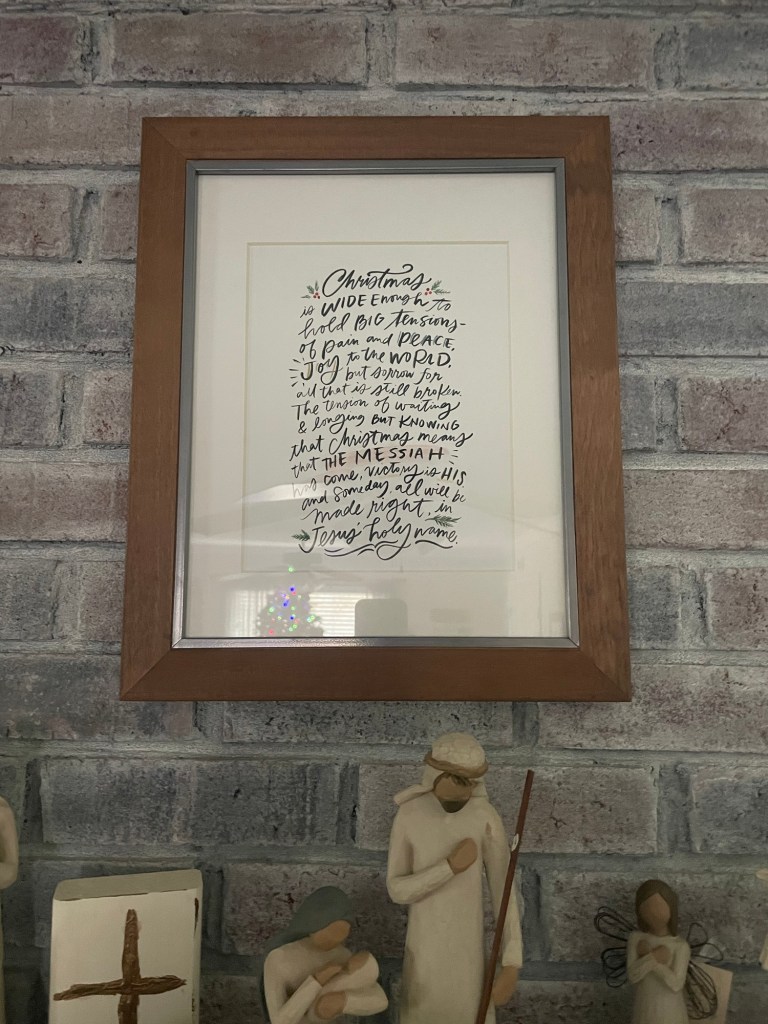
Ethan’s Mom: A couple of years ago, I found a hand-lettered print that we now display every Christmas. It reads:

Christmas is wide enough to hold big tensions – of pain and peace, joy to the world but sorrow for all that is still broken. The tension of waiting & longing but knowing that Christmas means that the Messiah has come, victory is His, and someday all will be made right, in Jesus’ holy name.

I need that reminder every year. I remember sitting in a grief counselor’s office in the fall of 2017 asking if I would ever enjoy Christmas again. I used to love Christmas, I said, but I want to skip the whole thing this year. My capacity to hold joy and sorrow has grown significantly over the last six years, but I still struggle to hold all the joy of Christmas with the pain of missing Ethan. Although we have developed traditions which keep his memory alive in our celebrations, we have never spent a Christmas with our entire family. The closest we have been was in 2016 when I was 34 weeks pregnant with the twins.

This year, the words from that print seem especially significant.  The Wednesday after Thanksgiving, a teenager in our church died unexpectedly.  The following Sunday was both the first week of Advent and his memorial service.  I shed many tears between those two days.  I cried for the abrupt end of his life, for his parents and siblings, and for his friends at church and their families.  

I also cried for the abrupt end of Ethan’s life, for my family, and for me.  There are several details that differ between our stories.  For instance, Ethan’s siblings were much younger and grieved in a very different way than teenaged siblings would after sixteen years of life together.  But you don’t have to look too hard for the similarities.  One night, we went to bed without any indication that our sons would not be alive the next morning.  We both had taken last group pictures of our children not knowing we would never have a complete family photo again.  We were both left with a million questions, most of which have no answer.  All of these thoughts swept me back to March 2017 in a way that I had not experienced in a long time.  

Like many people who love this family and wanted to support them in the shocking aftermath of that day, I wanted to do something. It turns out, our immediate role was not to make a casserole or send flowers, it was to light a candle.

Our family had been asked to light the first candle of Advent the day before anyone had any notion that the week would take such a tragic turn. The litugrical calendar specifies a theme for each week of Advent, and the first week is hope. Sometime late in the week, I realized how important it would be to light that particular candle on the very day that held not only the first worship services since this teenager passed away but also his memorial service later that afternoon.

It may not seem like a lot to light a small candle in the face of so much darkness; I confess that I initially thought it might not even matter to anyone except for me.  But then I remembered an exceprt from one of my favorite read aloud series, “The Green Ember.”  The series follows a group of rabbits as they fight for freedom from their birds of prey captors, and the four books are full of examples of true courage and hope.  In book three, after the wizened captain explains to the young hero that his job in the upcoming rebellion is not to fight but to unfurl a banner over the battle raging below, the young rabbit denies his instinct to charge into the battle. 

How could he help them? He knew he could help them most by shifting the battle in any small way…Then he remembered Helmer’s words, ‘Symbols matter, more than you might imagine.’ Picket’s heart was pumping fast, and he wanted badly to join the battle. But he banked and swept over the center of the skirmish…He waved the torn banner back and forth. “For the Mended Wood!” he cried. He heard an answering shout over the din of war and felt inside the fire of the good fight. He knew that all around, from the desperate fighters in the square to the hundreds rushing into First Warren through the west wall breach, the sight of this renowned warrior waving the true king’s banner atop this desecration of a statue was one to set the faintest heart on fire.

Ember Rising by SD Smith

I do not claim to be a “renowned warrior” but I am a veteran fighter in the ongoing battle against the darkness of dispair. After six Christmases of “holding the tension between joy to the world and sorrow for all that is still broken,” I felt that our family was uniquely empowered to light the candle of hope that morning. It felt like a mission. The hope candle is the first candle, lit before the candles of peace, joy, and love can shine. It’s the first flicker of light, breaking the darkness. It paves the way toward the full illumination of the Advent wreath with its Christ candle glowing in the center on Christmas Day.

I pray that tiny flame shifted the battle in any small way for our church family that morning. I have heard from a few people who reached out to say that the meaning was not lost on them. In some mysterious way, that candle also shined a little tiny bit of redemption on our story. If you have read this blog at all, you know this has been the hardest thing Ethan’s dad and I have experienced, individually and together. But we are still here, standing, fighting for the light, holding on to hope through another Christmas season without Ethan.

One week later, we gathered for our church Christmas musical, a wonderful concert with an intergenerational choir, orchestra, and scenes from the nativity. It was a truly joyful time, but not without its own moments of sorrow. The juxtaposition between the two weeks was apparent – one very sad day with a spark of hope and one very joyful day with a bittersweet note in the air. We could gather for both, knowing that Christmas is big enough to hold it all.

On this Christmas night, whether you find yourself holding on fiercely to a small flickering flame of hope or in the warm glow of a joyful celebration or somewhere in between, I pray that you know “that the Messiah has come, victory is His, and someday all will be made right, in Jesus’ holy name.” Amen.

Light of the World

By: We the Kingdom

Light of the world, treasure of Heaven
Brilliant like the stars, in the wintery sky
Joy of the Father, reach through the darkness
Shine across the earth, send the shadows to flight
Light of the world, from the beginning
The tragedies of time, were no match for Your love
From great heights of glory, You saw my story
God, You entered in, and became one of us

Sing hallelujah, sing hallelujah
Sing hallelujah for the things He has done
Come and adore Him, bow down before Him
Sing hallelujah to the light of the world

Light of the world, crown in a manger
Born for the Cross, to suffer, to save
High King of Heaven, death is the poorer
We are the richer, by the price that He paid

Sing hallelujah, sing hallelujah
Sing hallelujah for the things He has done
Come and adore Him, bow down before Him
Sing hallelujah to the light of the world

Light of the world, soon will be coming
With fire in His eyes, He will ransom His own
Through clouds He will lead us, straight into glory
And there He shall reign, forevermore

Sing hallelujah, sing hallelujah
Sing hallelujah for the things He has done
Come and adore Him, bow down before Him
Sing hallelujah to the light of the world
The light of the world

When Knowing is not the Answer

Ethan’s Dad:

HERE’S A STORY ABOUT UNCERTAINTY. In the early 20th Century, technology kept improving and the instruments kept improving and the instruments used for scientific measurements kept growing more precise. So did the clocks, to the extent that train schedules could finally be synchronized across Europe. That different trains in different places could leave their stations at the same time — well, that was very important to the patent office in Bern, Switzerland. But it was also very curious to a clerk who worked there.

‘Albert Einstein said, we used to think we knew what ‘at the same time’ meant,’ says Hans Halvorson, a professor of philosophy at Princeton. ‘It meant “simultaneous.” And the whole relativity revolution was Einstein saying, “Wait, when we have really precise measurements, what we thought of as being the same time breaks down.” We don’t really know what it means to say something happened in New Jersey at the same time as something happened in Sydney, Australia.’

It turns out to be the driving force of the breakthroughs that define modern physics. ‘What happened,’ Halvorson says, ‘was that experimental techniques kept getting better and better so they could pin down things more and more. But what they were finding was that as one thing was pinned down more and more precisely, it was making other questions harder and harder to answer.’

This seeming paradox — more knowledge leading to less certainty — pertains more to quantum physics than it does to relativity. But according to Halvorson, the underlying philosophical questions have never been settled, ‘because there are people who very much hope that this is a temporary thing and we’ll eventually figure out how to beat it and others who think it’s telling us something about how we’re embedded in our reality. We have to figure out what it is about human beings that makes us think we can without limit make our knowledge more precise. Because that turns out not to be true.’

Tom Junod: How the Dez Bryant no-catch call changed the NFL Forever

Why am I starting a post by quoting from a sports article that was all about the vagaries of instant replay in the NFL? Because it unexpectedly contained an exposition about the human thirst for knowledge and, conversely, how that thirst seems cursed because it is never satisfied. To be sure, the philosophy professor quoted in the article does not say humanity is cursed; he describes it in terms of a scientific conundrum because “educated” people are not supposed to invoke primordial ideas like a “curse.” After all, we have evolved beyond such thinking, haven’t we? That was what the scientific revolution was all about as far as the post-modern world is concerned: ridding the world of religious superstitions.

Unless, of course, the “curse” is describing something inherent in the human condition. In the very first book of the Bible, Genesis, there is a story about how the first humans, Adam and Eve — who were special creations made by God in his image and likeness — destroyed their relationship with their Maker. (See Genesis 3). It is a story that, even in our ever-increasing religiously pluralistic society, nearly everyone knows. God told Adam and Eve that they could eat from any tree in the Garden of Eden except the Tree of Knowledge of Good and Evil. With some encouragement from Satan, who was disguised in the form of snake, Adam and Eve disobeyed God’s command and ate fruit from the Tree of Knowledge. Satan had told Eve that when she ate the fruit “your eyes will be opened and you will be like God, knowing good and evil.” (Genesis 3:5, NIV). That was partially true: Adam and Eve did obtain knowledge they were previously unaware of, but they did not become “like God” because they did not become all-knowing — far from it. Of course, it was not the fruit that imparted knowledge; it was the act of disobedience, which deprived them of innocence and opened the door to forsaking the good that God intended for them.

It turned out that knowledge of evil was not a good thing. The knowledge Adam and Eve gained caused them to feel guilty, to cast blame rather than assume responsibility, to lie and thus become less trusting of each other, and to feel scared of God rather than feel enveloped by His love for them. Just as menacing, they passed this knowledge on to their offspring, and that knowledge led to anger and jealousy by one brother toward the other, who then conceived the idea of murder as a solution to the problem. (See Genesis 4). People have lived with the terrible consequences of this knowledge ever since.

Thus, one of the lessons of that story from the beginning of human history is that more knowledge is not necessarily the panacea we like to believe that it is. We like to believe that inevitably the more we know, the better off we are; that the answers to our problems are just around the next bend, if only we can see a little further ahead in order to gain more information; that if we seek knowledge, it will reward us with ever-increasing benefits. But deep within ourselves, or at least the more years we spend on this earth, we start to doubt this belief about knowledge.

I write all of that because for a while now I have been pondering how certain situations in my life have been characterized by a lack of knowledge. As Ethan’s Mom wrote in a recent post, I had an accident a little over six months ago that was caused by falling off a ladder. I sustained a severe concussion, I had to go the emergency room (which brings painful memories in itself — especially on this day), and apparently I had multiple seizures while I was unconscious, which was a completely new phenomenon for me. The concussion initially caused some unpleasant after-effects such as sensitivity to noise, extreme tiredness, and some confusion. The fact of the seizures meant I was put on preventative medication and was not permitted to drive at all for six months. On top of all of that, a neurologist showed me an MRI scan that seemed to indicate that there are some potential problems in my brain.

So, throughout this entire period after the accident I have been wondering why it even happened. I do not remember the fall itself, but I know it is likely that the ladder became unstable and I simply lost my balance. I then had the misfortune of hitting the back of my head on something very hard. But that is just the physical explanation for the accident. What I really want to know is why did I fall, on that particular day just before my birthday; why did I have to sustain a severe concussion? Why did I have seizures that prevented me from being able to drive members of my family anywhere for six months? Why did there need to be all those physical scans performed on my body that raised the specter of several things being wrong with me, including with the one instrument I use the most: my brain?

It has been more than six months and I still do not know the answers to those questions. It has felt like a metaphorical parallel to the “dream” I had of me falling backwards off a ladder into nothing but darkness: no ground, nothing visible, just a pit of darkness. There is nothing. No explanation. No clarity. No ah ha moment revealing a purpose for this drastic event that came out of nowhere.

Of course, that scenario has happened to me before, in the worst way imaginable, six years ago today. That event of March 10th, 2017, is one I could never forget. And when it happened, all I felt was agony, darkness, and confusion. It has been six years since Ethan slipped away, and there has been no genuine clarity, no ah ha moment, no revelation of why God allowed that to happen. Oh, our knowledge has increased. We know that Ethan’s heart condition was a factor in his death. We know he was weaker than the doctors thought. We know that something the night before was off with him even more than usual. But those are just bare physical facts. They are not real answers to why our precious boy would be robbed of his life and why we would be robbed of his presence for the rest of our earthly lives. I have no such answers despite immeasurable amounts of time spent pondering, praying, and wondering about it all.

It is not because of insufficient effort that I lack the knowledge. It is not because of a lack of reading or learning or listening that I do not have an answer beyond the fact that some tragedies occur because creation is torn and shattered by a scourge of evil. And because of that, I have been wondering if the notion that having that knowledge will make it better is simply not true. Maybe I do not have the answer because it is best I don’t.

So, maybe those philosophers who say that it is inherent in our existence that further knowledge breeds more uncertainty are right. Perhaps the fact that things become less clear the more we know does speak to the human condition. Every time we look further into space we find there is more there than we thought and less we understand about it than we theorized. The further we probe into the smallest particles of existence, the less predictable the behavior of matter seems to be and the less certain we are of how that unseen world operates. As Bono sings in the opening of U-2’s City of Blinding Lights “The more you see, the less you know, the less you find out as you go, I knew much more then, than I do now.” What if that uncertainty itself is purposeful?

To go back to Genesis 3, I believe it is possible that the reason God commanded Adam and Eve not to desire knowledge for its own sake (not to eat from the tree of knowledge of good and evil) was because knowledge is a false god. It tempts you into believing that all you need is to discover the right answer and everything will be okay when the reality is that further probing often just produces futility because there is always another permutation out there. I am not saying that exploration and discovery and learning are bad or pointless. I am talking about treating knowledge as an end, rather than as a means to the right end — as if the answers to life’s fundamental questions lie in obtaining more knowledge, or that if we can just be precise enough, work hard enough, study enough, the answer will reveal itself. I think God was trying to tell us that is not true: In essence, He was saying: “Do not seek knowledge, seek Me. I am the answer you are looking for because you are dependent upon Me.” Adam and Eve were tempted to “be like God.” (Genesis 3:5). In contrast, Paul tells us that Jesus, even though He was God, “did not count equality with God a thing to be grasped, but emptied himself, by taking the form of a servant, being born in the likeness of men.” (Philippians 2:6-7, ESV). We do not need to be God; we need to be with God.

I ask why Ethan died because it is natural for me to pose the question. I know God does not condemn the inquiry. He expects it. But what He does not want me to do is to assume there is an answer that I should be able to find out or understand this side of Heaven. We look for answers because it is inherent in our nature to seek knowledge. We want to solve the problem. But what if we are not meant to know the answer, or even, what if there is no good answer beyond that evil exists and wreaks havoc upon this world? What if we are supposed to sit in that void of uncertainty where knowledge is forsaken because we are meant to be dependent upon the Lord?

That thought is why I despise the saying “don’t waste your suffering.” I certainly believe that God’s purpose in the grand scheme of our lives is to bring us closer to Him — to make us more like Jesus — and that suffering can move us in that direction. But not everything that happens to us occurs for that purpose. When a phrase like “don’t waste your suffering” is glibly thrown around — especially to those who are in the midst of tragedy — it not so subtly implies that there is some “higher purpose” for every kind of suffering a person endures, that we should be striving to ascertain that purpose, and that, if we do not discover that purpose, perhaps we are just not listening to God closely enough. However, God tells us:

‘For my thoughts are not your thoughts,
neither are your ways my ways,’ declares the Lord.
‘For as the heavens are higher than the earth,
so are my ways higher than your ways
and my thoughts than your thoughts.’

(Isaiah 55:8-9, ESV). Given that disparity, we do not — and dare I say cannot — know all of the answers for why some things happen as they do, and we put ourselves in God’s place, as Adam and Eve sought to do, when we persistently assume and seek such answers.

In fact, Ethan’s Mom pointed out to me earlier this week that the whole concept of “don’t waste your suffering” is a very American way of viewing this issue. It assumes that pain and suffering are some sort of self-help program that we are supposed to be availing ourselves of in order to improve our character. We Americans particularly view ourselves as problem-solvers. Every question has an answer if we just put our minds to it. There is nothing we cannot accomplish if we just keep trying. But that attitude is the exact opposite of what our spiritual lives are supposed to reflect. We are supposed to comes to grips with our constant need for dependence on God. We do not save ourselves: Jesus does. Isn’t that void of knowledge the place where faith resides?

And even if such mysteries bring us to that place of dependence because of unimaginable loss, it does not mean that God intended for that loss to happen. Just because we learn something does not mean that is why it occurs because correlation does not necessarily equal causation. We can thank God for blessings that come out of tragedies while still lamenting the awfulness of the events themselves. Being thankful in our troubles does not mean we must forget about them. After all, the Psalms of lament are just as much a part of Scripture as the Psalms of praise.

We always want this neat little bow on everything, to somehow make it “happily ever after” in the here and now even though God clearly says in both Isaiah (25:8-9) and Revelation (21:1-5) that such happiness will not come until the end of this age. It is the materialist, not the Christian, who desperately strives for and clings to happiness now because for him there is nothing else.

So, to me the proper spiritual response to real, heart-rending pain is not “don’t waste your suffering”; it is “don’t despair in your suffering” because God grieves about it with you and His Son experienced it, and precisely because of that, one day it will be made right. Hold fast in dependence upon Him until then. Do not buy the lie that all is lost because you do not see the good in your suffering. Because sometimes there is no good in an evil thing, which is why we need the One who not only redeems situations while we are here, but who also will restore situations when we are all at last with Him for eternity.

Later in that same U-2 song I referenced earlier, Bono sings: “And I miss you when you’re not around, I’m getting ready to leave the ground.” Every day, and especially on this day, I miss you not being around, Ethan. And through Jesus’ sanctifying work, I am “getting ready to leave the ground” of this physical world where, thankfully, I will see Ethan again. “Amen! Come, Lord Jesus!” (Revelation 22:20).

Living in the In Between

Ethan’s Dad: Particularly since we recently celebrated Easter, I want to pick up a thread of what Ethan’s mom talked about in her last post. If you are a Christian, there can be a palpable tension about the subject of death. We are taught from early on in our Christian walk that the existence of death is a consequence of sin that began with Adam and Eve in the Garden of Eden. It signifies the seriousness of the separation between God and humanity sin produces. Yet, we are also taught that death is not the true end of the story of life: that yes, Jesus came and died, but also that He rose from the grave, and because He conquered death, we will be reunited with God — and with everyone who has died believing upon Jesus — in the age to come. Thus, for the Christian, death is simultaneously understood as the ultimate enemy of God’s original design for creation and also as an obstacle that Jesus has overcome, and so it should not be feared. At times, you will even read or hear Christians — wrongly I think — attempt to meld those two ideas into a lesson that death is really just a natural part of life.

The theme of Ash Wednesday is sometimes twisted into this idea that death is a natural part of life. Ash Wednesday asks us to ponder the fact that we are dust. From dust we came and to dust we shall return. (Genesis 3:19). The Psalmist prays for God to teach us to number our days. (Psalm 90:12). Paul reminds us that we are the clay and God is the potter. (Romans 9:19-21). So, this idea runs throughout Scripture. On Ash Wednesday, the fact that we are dust is said solemnly — with a sense that we prefer not to think about death, that we avoid the fragility of life, that we distract ourselves from reality.

But what about those of us for whom death is all too real? Each week, I take time to sit at Ethan’s grave, and death is all around me. I carry Ethan’s death with me every day. I do not have to will myself to ponder the fleeting nature of life here on earth because I helplessly watched it slip away from a two-month old. So, for me, Ash Wednesday does not conjure anything that I strive to avoid. And saying that we just need to accept that death is part of life feels like asking me to be okay with Ethan’s death. But I cannot do that. No matter how much I contemplate the inevitability of death, or the lack of control over when it comes, or the fact that it affects everyone, it does not quell this knot within me that screams that this is wrong, that it is not the way it should be, that a theft has occurred which cannot be restored.

Moreover, the idea that we are “just dust” does not tell the whole story of who we are. Scientists will tell you that our bodies are made primarily of carbon and water. But in the Bible, dust and clay are used as metaphors to give us pictures of our relationship with God, not as scientific observations. The Bible is full of exhortations about our souls, the spiritual part of our being.

  • Deuteronomy 6:5: “Love the Lord your God with all your heart and with all your soul and with all your strength.”
  • Psalm 23:3: “He refreshes my soul.”
  • Psalm 35:9: “Then my soul will rejoice in the Lord and delight in his salvation.”
  • Psalm 84:2: “My soul yearns, even faints, for the courts of the Lord; my heart and my flesh cry out for the living God.”
  • Matthew 10:28 (Jesus speaking): “Do not be afraid of those who kill the body but cannot kill the soul. Rather, be afraid of the One who can destroy both soul and body in hell.”
  • Hebrews 6:19: “We have this hope [of salvation by Jesus] as an anchor for the soul, firm and secure.”
  • 1 Peter 1:9: “For you are receiving the end result of your faith, the salvation of your souls.”

Thus, the Bible teaches that when our bodies die, our souls do not. Furthermore, the Bible tells us that the birth of sin into the world did not just result in physical death; it caused spiritual separation between God and humanity. In fact, this is deemed to be the more serious aspect of sin’s consequences. And when Jesus died on the Cross, He did not just take our deserving physical punishment for sin; He also endured spiritual separation from God. This is why He says on the Cross: “My God, my God, why have you forsaken me?” (Matthew 27:46).

That takes us forward to Easter because when Jesus rose from the grave, He unequivocally conquered physical death, but He also restored the spiritual gap between God and humanity. The central message of Christianity is that “God so loved the world” — that is, humanity, we physical and spiritual beings who bear His image — “that he gave His one and only Son, that whoever believes in Him shall not perish but have eternal life.” (John 3:16). That eternal life is both physical and spiritual. Revelation ends with the resounding proclamation that one day Jesus “will wipe every tear from our eyes. There will be no more death, or mourning or crying or pain, for the old order of things has passed away.” (Revelation 21:4). Paul also tells us that when “the end comes, [Jesus] will hand over the kingdom to God the Father after he has destroyed all dominion, authority and power. For Jesus must reign until he has put all his enemies under his feet. The last enemy to be destroyed is death.” (1 Corinthians 15:24-26).

So, death is the enemy that Jesus has overcome. Yet, for us, physical death is still here. It lingers, and it hurts. And that accounts for the tension I mentioned at the beginning of this post. The tension exists because, if you are a Christian, you live in the “in between”: the “already but not yet” context of knowing and believing that Jesus came, died, and rose again to save us from sin and death, but that He has not yet come again to place all things under His feet.

We are not unique in living in an “in between” age. The Israelites lived for hundreds of years in between the promise of a Messiah to come and His arrival. In fact, if you date it from the first implicit reference to Jesus in Genesis 3:15, they lived for thousands of years before His coming. Micah 7:7 echoes the sentiment: “I will watch in hope for the Lord. I will wait for the God of my salvation. My God will hear me.” Certainly, our “in between” age is better than theirs because, by the grace of God, we know who the Messiah is and what He has done, and even what He will do at the appointed time. But it is still not an easy time because there is pain, separation, and loss that exist in abundance in this world.

When Adam and Eve sinned in the Garden, could God have separated them (and by extension us) from Himself spiritually without imposing physical death as a part of the equation? In the sense that God can do anything, I suppose this was possible. But as I said earlier, the Bible tells us that to be human means that we have a dual nature: physical and spiritual. This is why, in order for God to experience everything as we do, He had to become fully human; God is spirit (John 4:24), but through Jesus He also became flesh (John 1:14). For us, committing sin means spiritual separation from God, but it also ultimately entails physical death. So, one reason Jesus had to physically die on the Cross and not “just” experience spiritual separation from God the Father was because the consequences of sin for human beings involves experiencing both, and then His saving humanity required reuniting the physical and the spiritual for eternity though a physical resurrection.

In other words, Jesus died not only to restore the communion of our spirits with the Lord, but also to redeem our bodies. To put it simply, matter matters. Sometimes I think we Christians lose sight of this fact because Jesus talked so often about how His “kingdom is not of this world.” (John 18:36). Christians get caught up in thinking that Jesus meant that His kingdom is just spiritual rather than physical, but it is not quite that simple. Jesus is the King of both heaven and earth.

“For the Lord is the great God, the great King above all gods. In his hand are the depths of the earth, and the mountain peaks belong to him. The sea is his, for he made it, and his hands formed the dry land.”

(Psalm 95:3-5). God’s creation of this world and of us as dual-nature beings, Jesus’s incarnation, His physical death and His resurrection — they all resoundingly demonstrate that our physical world, this flesh-and-blood life, is important. This is precisely why death is a profound event: the cessation of physical life — especially the deaths of the His creations made in His image — is no trifling matter to God. It is not just “the natural way of things”; it is a blight that Jesus came to reverse.

So, death is wrong, it is the enemy, because our lives are sacred and precious. But there is this part of me that keeps wondering if there is some other kind of purpose to death than just being a foil — the desolation that we praise Jesus for overcoming — while we Christians live this “in between,” which, in the personal sense, means we have been spiritually reborn (John 3:3), while we await the physical resurrection. During this “in between” we live with the loss of those who go before us and face our own physical deaths. Why?

Is it, at least in part, that it serves as a way for us to measure what is to come? Romans 8:18 reminds us that we should “consider the sufferings of the present time as not worthy to be compared to the glory which shall be revealed to us.” In a sense, that is asking us to do a comparison of our lives in the present physical world and our lives in the future in God’s restored kingdom. Are we only capable of measuring the bounty of eternity by facing, possessing, and living with a temporal ending to our own lives and the lives of those we love? Isaiah 51:6 commands us to:

“Lift up our eyes to the heavens, look at the earth beneath; the heavens will vanish like smoke, the earth will wear out like a garment and its inhabitants die like flies. But the Lord’s salvation will last forever, the Lord’s righteousness will never fail.”

Will we only grasp the permanence of God’s saving grace through Jesus after having lived, loved, and lost in this time of mortality? We would only be able to do this because of the unique creations God made us to be. That is, because an integral part of us is physical, we experience the agony of death — both those around us and ourselves — but because our souls are eternal, we will be able to remember our physical lives, the loss that death brought, and how Jesus rescued us from that despair. This is perhaps part of what Peter meant when he said that “even angels long to look into these things” that pertain to the salvation of our souls,” because they do not experience this dual life. (1 Peter 1:12).

The loss of Ethan honestly would be soul crushing without the hope of the resurrection. Living with this loss forces me to surrender what is beyond my control to God in a way that nothing else is probably capable of doing. So, it just may be that through experiencing the devastation of death that we grow to understand that life is only truly lived through and for our Maker.

A Birthday with Bereavement

Ethan’s Dad: We have just concluded the Christmas season, pondering Christ’s coming to us as one of us, born as a baby in a stable. The very One who is above all things lowered himself to become a human infant, with all the confusion, helplessness, and utter dependence on others that entails. Five years ago today, our twins, Noah and Ethan, did the same thing, in a precarious way, no less, being born in an ambulance being driven to a hospital in an ice storm. Little did we know at that time how vulnerable Ethan actually was (though his mother always had an inkling that he was somehow different). Jesus did not have Ethan’s health issues when He was born, but the fact that He experienced the general vulnerability of infancy helps me when I think about Ethan on this day.

Identification is not everything: no matter how similar another person’s experiences may be to our own, everyone experiences life in a unique way, and it is good to keep that in mind whenever you think you know what someone else is going through. But shared experiences are integral to bonding and to persevering through difficult experiences. The Creator of us also became one of us, and so there is no corner of our being of which we can say He is unfamiliar or does not understand. I have always believed that the Lord was with us on that anxious (and for my wife, extremely painful) ambulance ride, just as the Lord was with Joseph and Mary in that stable on that cold night so long ago. But then He showed up in the flesh for them, and, in the ultimate reversal, He needed them just as much as they loved Him. My wife brought ours into the world on this cold day five years ago, we nurtured them the best we knew, and Jesus said, “whoever cares for the least of those among you has cared for Me.” (Matthew 25:40).

But the book of Matthew also recounted another event that occurred within a couple of years after Jesus’ birth that rarely receives notice. In modern Bible translations, it is referred to as the “Massacre of the Innocents,” and it comes to mind because, as hard as it is to think about, I also have always believed that the Lord was with me on another ambulance ride with Ethan that occurred two months after the twins’ birth, and that ride always also accompanies this day.

At the time of Jesus’ birth, King Herod ruled over the Jewish province for the Romans. Herod was, by any standard, an abjectly evil king who never hesitated to employ violence in order to preserve his grip on power. During his reign, he murdered his wife, three of his sons, his mother-in-law, his brother-in-law, and many others who he perceived were threats to his position. Matthew does not provide that background; instead, he relates the event in short order. The wise men had failed to return to Herod after finding Jesus — despite his request that they do so — because God had warned them in a dream not to go back to Herod. In Herod’s twisted mind, Jesus was a threat to his power because the wise men had told Herod that a messiah, the “king of the Jews,” had been born within the past two years in Bethlehem. “Then Herod, when he realized that he had been outwitted by the wise men, flew into a rage. He gave orders to massacre all the boys in and around Bethlehem who were two years old and under, in keeping with the time he had learned from the wise men.” (Matthew 2:16). Joseph and Mary fled with Jesus to Egypt before this massacre occurred because God warned Joseph about Herod’s plan.  But no such warning came to the rest of the families in Bethlehem, and Herod’s order of infanticide was carried out with precision.

The details of this event render it apparent why it is not often dwelt upon in churches or Bible studies. Matthew tells the story in passing to explain why Jesus ended up in Egypt, which fulfilled a messianic prophecy. But such a traumatic event deserves some pondering because, for the parents who remained in Bethlehem, it involved what is every parent’s worst fear: that one of their children would suddenly face death, and there would be nothing they could do about it. The Bible recognizes this by having Matthew pause to acknowledge the pain of those families who became collateral damage in this tale of the Christ, by quoting Jeremiah 31:15:

“This is what the Lord says:

‘A voice is heard in Ramah,
mourning and great weeping,
Rachel weeping for her children
and refusing to be comforted,
because they are no more.'”

There is more to that reference than just another fulfillment of Scripture. There is pain and suffering and senseless loss caused by the sinful desires of a cruel king whom God allowed to be on the throne. Many reasons can be produced as to why Herod was there, such as his grand building projects — one of which included the new Temple in Jerusalem — his interest in the Jewish king that helped the wise men find Jesus and spurred Joseph and Mary’s flight to Egypt, and, thinking ahead, so that Herod’s son could be involved in Jesus’s trial before the crucifixion. But the excruciating pain and loss caused by Herod’s rule also deserves notice. We may not be able to understand why God allowed this ugly abhorrence against innocent children, but we do a disservice to truth and faith if we just ignore that difficulty.

Unfortunately, the pain and loss described Jeremiah 31:15 is all too familiar to us. Our baby was not murdered, but he was taken from us suddenly and without explanation after he had been preserved through that perilous delivery and was to undergo surgery to repair his broken heart. The fact that God sees and acknowledges the pain of such losses is not an answer to why it happens, but it is worth something to know that God is not entirely aloof or detached from our personal tragedies that, in the larger scheme, seem to become mere footnotes in history. In fact, God’s identification goes well beyond acknowledgment, because He experienced the loss of His only Son in an excruciating and unjust manner.

The implication of fulfilled prophecy also offers some solace because such fulfillment means that God knows the future and arranges affairs to accomplish His grand design. The whole story of Jesus’s life is a testament to that truth, and while we cannot fully comprehend how the vagaries of evil come into that design, knowing that the evil does cannot derail God’s ultimate purposes is a lifeline for faith when our circumstances are dire.

A third, somewhat unexpected, balm comes from a further reading of Jeremiah 31. The chapter is actually relating a prophecy of joy, containing such lines from the Lord as “I have loved you with an everlasting love; I have drawn you with unfailing kindness,” (v. 3) and “I will turn their mourning into gladness; I will give them comfort and joy instead of sorrow.” (v. 13). But most interesting to me is what comes immediately after verse 15:

“This is what the Lord says:

‘Restrain your voice from weeping
and your eyes from tears,
for your work will be rewarded,”
declares the Lord.
‘They will return from the land of the enemy.
So there is hope for your descendants,’ declares the Lord.
‘Your children will return to their own land.'”

In the immediate context, of course, the passage is talking about a return from exile for the Israelites, but the broader application is to the final promised land “the better country — a heavenly one.” (Hebrews 11:16). Thus, God does much more than just acknowledge the torturous agony that comes with losing a child; He promises that one day our children will return to us in the new place He has prepared for us (just as His Son returned to Him in glory). (John 14:2; Hebrews 11:16). And, of course, this is why Jesus came as that helpless baby: so that this seemingly relentless evil that haunts our days on this earth would not be the end of the story. The Massacre of the Innocents reminds us that great sadness and pain remained in the wake of the immense joy of Jesus’ birth, but it also proclaims to us of the hope of glory. (“Through Christ we have gained access by faith into this grace in which we now stand, and so we boast in the hope of the glory of God.” Romans 5:2).

And so it is for me on this day. I rejoice in the joy of celebrating Noah’s birth and presence with us. He is adorable and maddening, brilliant and confounding, silly yet sometimes deeply serious, boundless with energy and appetite for dessert. Our lives our infinitely better because he joined us five years ago. Yet our hearts ache for his missing brother, who may have been like Noah in some ways, but undoubtedly would have contrasted in other respects. Like those parents in Bethlehem so long ago, we are left to celebrate this day of Ethan’s coming without him, while holding on to the truth that one day he will return to us because this is what the Lord says. It is an incomplete celebration that awaits that joyful morning of reunion made possible by Immanuel. Happy Fifth birthday, Ethan! We love you always and forever.

What is in a Name?

Ethan’s Dad: We are studying the book of Matthew in Bible Study Fellowship this year, and right near the beginning when Matthew is relating the angel’s revelation of Christ’s birth to Joseph, the angel commands Joseph to name Christ “Jesus, because He will save His people from their sins.” (Matthew 1:21). This signified God’s plan from the foundation of the world to enable humanity to spend eternity with God. Matthew then comments that Jesus’s birth also took place to fulfill a prophecy (from Isaiah 7:14) about the Messiah which said: “The virgin will conceive and give birth to a son, and they will call him Immanuel” (which means ‘God with us’).” (Matthew 1:23). This indicated that Christ would walk among us and experience our humanity in all its highs and lows.

This idea that Christ is both with us and saves us is a vital truth. A lot of times we tend toward either/or thinking: things are all one way or all another. We do this because it is easier than seeing nuance in the people who cross our path and in comprehending the issues that confront us in our lives. That is one of the many reasons this COVID thing has been so difficult; there are no clean answers to how we live with it. But Jesus is sufficient for our needs, and that is reflected even in His names.

The fact that Jesus came to save His people from their sins demonstrates that the here and now is not everything. The people who live as if it is misunderstand the purpose of this life, which is a staging ground for eternity. So much of what Christ talked about referred to His Kingdom, which is not of this world (John 18:36), and which must be comprehended through the lens of eternity. For example, when Jesus said “the meek will inherit the earth” (Matthew 5:5), He did not mean they would possess this earth; indeed, if anything, the truly humble are mocked for their refusal to “get while the getting is good.” No, Jesus meant that the humble will inherit a place of honor in eternity. The same is true for several statements in the Old Testament. Many Christians like to quote Jeremiah 29:11, which says in one translation: “‘I know the plans I have for you,’ says the Lord, ‘plans to prosper you and not to harm you; plans to give you a hope and a future.'” This verse is so popular that you see it on t-shirts, on coffee mugs, on bookmarks, and on Bible covers. There is an assumption among some Christians that this passage somehow means that God is going to make sure your life on this earth goes swimmingly. Some even use it to claim that God intends to make them rich. But if you read Jeremiah chapter 29 in its entirety, you discover that the Lord says this to the Israelites at the same time He is telling them that they will be in exile in a foreign land for 70 years. So, why would God make a promise like the one in verse 29 if most of the Israelites were going to be in captivity for the rest of their earthly lives? It seems obvious that a life of captivity in a foreign land was not a recipe for a prosperous life. But that is because God was not just talking about the immediate here and now – which in itself required patience for those who would live beyond the 70th year — but the future: God did indeed have a plan to prosper His people — for all eternity. And so on it goes for many of the promises in the Bible. Jesus said, “In this world you will have trouble, but take heart! I have overcome the world.” (John 16:33). In other words, our comfort for troubles in this world is knowing the Jesus has ultimately defeated sin and death, and we can look forward to that triumph.

But that does not mean this life is nothing, or an illusion, or not worth investing in. Jesus, Immanuel, came to be with us, in this life, on this earth. This part of life has significant meaning too. “By His will we live, move, and have our being.” (Revelation 4:11). We are purposefully here, living these lives to become more like Christ and to bring others to a saving knowledge of Him. I am reminding myself of that in writing it. Sometimes I want to fly away to Ethan, to leave behind the questions, the difficulties, and the drudgery that accompanies this existence. But “the earth is the Lord’s, and everything in it, the world and all who dwell in it.” (Psalm 24:1). So as much as salvation for eternity is a gift, this life is a gift as well. This is why Ethan’s life being cut so tragically short is so immensely hard to live with and to understand. Yet, the fact that Jesus is “God with us” proclaims that presence on this earth — no matter how short — is a treasure. Thus, Ethan’s conception, his birth — as crazy as it was — his short two-months of frail, struggling presence with us, mean more than just the bare facts of their happening. They mean God wants him, that Ethan is a part of the vast image of God we all reflect, that we are meant to be part of Ethan and he of us, and that Jesus was, and is, with Him too.

“Great are the works of the Lord, they are pondered by all who delight in them.
Splendid and majestic is His work, and His righteousness endures forever.
He has caused His wonderful acts to be remembered, the Lord is gracious and compassionate.” (Psalm 111:2-4).

I confess that sometimes I can get so wrapped up in Ethan’s death that I forget the loving kindness of his life. The name “Ethan” is Hebrew, and it means “strong,” “safe,” “solid,” and “firm.” We did not pick it because of its meaning, but I truly believe that Ethan was strong to stay with us as long as he did. I will always long for his presence and wonder why he could not have stayed with us. But because he was here, he was a splendid and majestic work, and he is remembered. And because Jesus is both “God with us” and the One who “saves His people from their sins,” that is not all there is to Ethan’s story. In Jesus’ arms he waits for us, where we will continue life in the Kingdom, together.

Reflecting on Keller’s Catharsis

Ethan’s Dad: It surely is not a coincidence that on this day of days, I came across this article from pastor and author Timothy Keller. Even though I disagree with his Calvinism, I have always appreciated Keller’s work, which seamlessly conjoins spiritual insight with intellectual rigor. This article is no exception, offering deeply personal reflections on his diagnosis of pancreatic cancer interspersed with quotes and theories from a range of thinkers. Keller’s honesty on the subject of his seeming impending demise is refreshing and — as Walking in the Shadowlands shows — the thought process he shares and the realizations he has gained are very similar to those we have experienced in the days and years since that March 10th on which we lost Ethan. Keller’s ruminations boil down to the fact that there comes a time when you are so profoundly shaken by something that continuing to live requires more than just intellect or just emotion or just material things: it requires raw transparency, wallowing in the moment, resonating with Scripture, and aching for the reality we cannot see. When Ethan’s mother and I sit beside his grave on this day, we do not do it just to mark an event or to be morbid or to be pitied or to prevent a festering wound from healing. We do it because Ethan’s life and the loss of him matters to us in a way that shapes everything else, because his loss personally intertwines finality and eternity in a way that nothing short of Keller’s experience could. In short, we do it because of the one thing that outlasts everything else: love. The way we truly know that Jesus loves us is precisely because He died for us; therefore, death and love are forever linked, but we know that love is stronger than death because love endures after death, and Jesus’ resurrection is exclamation point of that truth. We love Ethan and we believe that God loves him even more (though it is difficult to imagine that “more”), which is why we believe we are going to see him again. That belief does not change the reality of Ethan’s present loss, of this awful pain, or of the abject darkness that accompanies our memories of this horrid day four years ago. But it does provide genuine hope because it is based on what remains when all else is torn away. We love you with all our hearts Ethan — catch you on the flip side!