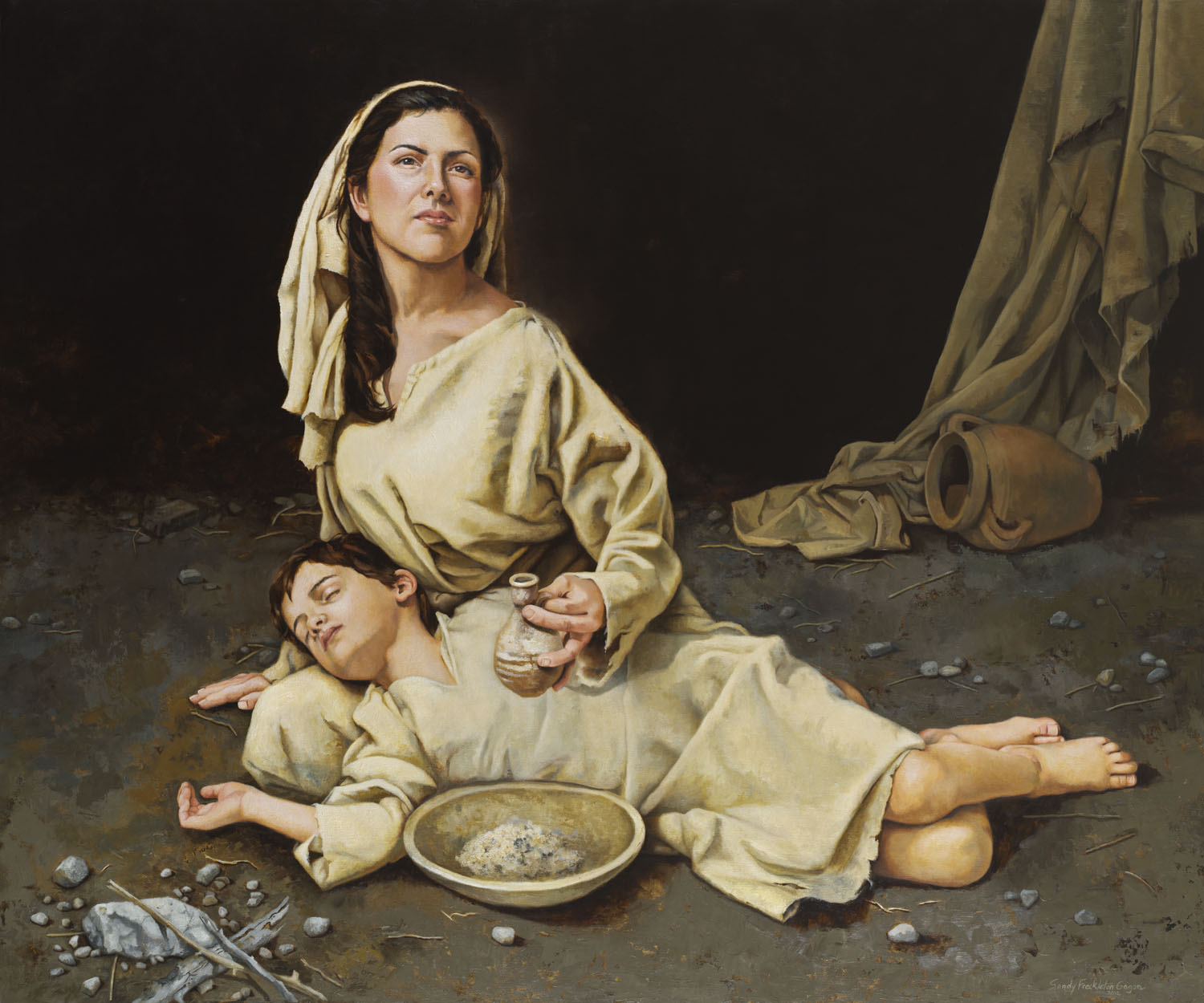
Waiting on Glory: Year Seven

Ethan’s Dad: Last week our Bible Study Fellowship Group was studying John 17, which is the prayer of Jesus before he goes to the cross in which He petitions the Father concerning His disciples and then for all believers. John 17:24 says: “Father, I want those you have given me to be with me where I am, and to see my glory, the glory you have given me because you loved me before the creation of the world.”

When our teaching leader got to that verse, he told a story about a nurse friend who worked at a hospital and who was taking care of a man who was having a heart problem. At one point in the middle of the night, the man coded, and the nurse had to pump his chest. For a moment, he did not respond, and the nurse saw a look of complete peace come over the man’s face. The nurse and the code team were able to revive the man. The next morning, the man woke up and was recovering well. The nurse went to him as she was leaving her shift because she wanted to ask him about that moment in which she saw his face seem so peaceful in the midst of the emergency. The man told her that he had seen Jesus and that the sense of security, belonging, and especially joy that he felt was unlike anything he had ever experienced. The man said he wanted to stay with Jesus, but that Jesus had told him it was not his time yet.

Our teaching leader related that story as a way of attempting to convey a taste of what it will feel like for believers in the presence of Jesus — to see His glory and to be with Him in eternity. For most of the people sitting in that chapel listening to the story, I am sure it was a reassuring and inspiring vignette. But it made me sick, almost physically sick, to the point that I wondered if I would need to walk out of the room.

For anyone who has read snippets of our story about Ethan, you might guess why the story produced that effect. Ethan had a heart defect. Ethan coded, on this very day, seven years ago. His amazing Mom tried to revive him while I stood by in helpless disbelief. The EMTs tried to revive him on the way to the hospital. The emergency room doctor and his team did everything they could for 20 minutes. Nothing. There was no revival. There was no peace. There was no happy story to tell. Our baby was gone after two incredibly short, hard months, in an instant. It was separation: cold, stark, and ongoing. I have no words to adequately describe it, and honestly, that is probably a good thing because no one would want to read about such emptiness.

And I started reliving that moment the instant our teaching leader mentioned that man’s heart trouble. I do not blame the teaching leader at all. This happens to us at times, and we never quite know what might set it off. I am sure the fact that it was close to this day had something to do with it, because it does not happen as often as it once did, and sometimes I wonder about that. It is not that time heals the hurt, as some people are all too fond of saying, but that time makes it feel more distant — until there is a trigger. Because when it happens, it feels very real, all too real, being right back there on that March 10th, the day that changed everything.

So, I took some deep breaths; I zoned out from the lecture for a little bit. I felt the deep ache inside. I wondered for the millionth time why Ethan is not here with us. Why does his twin brother not have his sidekick? Why do we not have five children sitting at the table every night? Why does Ethan not get to experience our laughter, our fights, our Friday-night movies, our family road trips? Why do we not get to see his smile, hear his voice, watch him run, feel his hugs? The enormity of what we all have lost because his little heartbeat stopped is incalculable.

There are many entries in this blog filled with musings about that why. This one is not about that. It is, first, just meant as a lament, because I still mourn over losing him. The sadness deserves — demands — to be acknowledged. Time does not heal it; time just spreads out the anguish so that it is not felt as deeply all the time. My heart is still broken, Ethan, and it always will be, as long as I am here. I do not believe that there is anything wrong in admitting that.

But there is another part to the story. After I started to come out of my flashback, I started to think again about what Jesus had said. “Father, I want those you have given me to be with me where I am, and to see my glory, the glory you have given me because you loved me before the creation of the world.” Jesus wants us to be with Him where He is. He wants us to live in His glory. Just as the Father loved Jesus before the creation of the world, Jesus loved us before we were ever created. So, is that what Ethan saw when he closed his eyes that last time? Did he see Jesus in glory, holding out His arms to embrace our frail little boy? Jesus informs his disciples before His prayer that “in my Father’s house are many rooms; if that were not so, would I have told you that I am going to prepare a place for you? And if I go to prepare a place for you, I will come back and take you to be with me that you also may be where I am.” (John 14:2-3). Jesus invited Ethan into His home. He said, “My child, you fought bravely, you gave all you could to stay with your family because you know how much they love you, but it is time now to rest with me. See how much I love you,” holding out His scarred hands, “and feel the glory that surrounds you,” a glory that is, somehow, more wonderful than the warmth he felt in his Mother’s arms.

Even more shortly before His prayer, Jesus tells his disciples: “So it is with you: Now is your time of grief, but I will see you again and you will rejoice, and no one will take away your joy.” (John 16:22). Ethan arrived at our true home before I have, but I will join him one day. And when I do, no one will be able to steal that joy ever again. “He will wipe away every tear from our eyes. There will be no more death, or mourning, or crying, or pain.” (Revelation 21:4). There will just be joy: Joy in being with our Savior, and joy in seeing my son again! Jesus has promised, and it will be.

As Jesus said, though, before that time, there is grief. Jesus acknowledges that. He did not say there is anything wrong with that. For some, that time of grief is longer than it is for others. I do not know why that is because it certainly seems unfair. “God knows we ache, when He asks us to go on. How do we go on?” (Ellie Holcomb, Red Sea Road). He asks us to go on in the knowledge that comes from faith as to what lies ahead in the end. The end is Jesus, the author and finisher of our faith. Jesus was there for Ethan seven years ago on this day. And He will be there with me and Ethan’s Mom on our last days. He is waiting to show us His glory, the glory Ethan already has seen and is surrounded by right now.

I can say that because Jesus is also here, right now, even in this ever-present moment of grief. He is here just as He was on that cross, bearing all shame, pain, anguish, anger, wrath, blood, and broken hearts. Right there Jesus and the Father experienced separation, loneliness, despair, darkness, the emptiness of that loved one not being there — a separation even more painful than ours because they had been together forever. He knows what this grief is to us, even more than we know it ourselves. Then Jesus died and His heart stopped beating.

But three days later “His heart beats, His blood begins to flow, waking up what was dead a moment ago.” (Andrew Peterson, His Heart Beats). His death will end Death, once and for all. He returned to glory so that we can join Him in glory. Jesus is there, in glory, waiting. Ethan is there, in glory, waiting. I am here, for so long as He calls me to care for the precious ones that remain here, waiting. But for those of us in Christ, waiting is hoping because “we celebrate in the hope of the glory of God.” (Romans 5:2).

This I call to mind, and therefore I have hope:

Because of the Lord’s great love we are not consumed, for his compassions never fail.

They are new every morning; great is your faithfulness.

I say to myself, ‘The Lord is my portion; therefore I will wait for him [hope in Him].’

The Lord is good to those whose hope is in him [who wait on Him], to the one who seeks him;

it is good to wait quietly for the salvation of the Lord.
Lamentations 3:21-26

Counterfeit “Resurrection”

Ethan’s Mom: Tacky skeletons hanging out of windows or lounging in Adirondack chairs.  Kitschy faux tombstones in front yards.  A larger-than-life inflatable Grim Reaper on the corner.  A house just down from my parents actually has a full tableau that includes 4 skeleton pallbearers carrying a fake coffin into a full fake cemetery.

This is Halloween 2021, and I cannot wait for it to be over. Because the sooner it arrives, the sooner people can pack all that mess up for another year and I can go back to walking or driving around my neighborhood without Death mocking me.

For the past 4 years, I have tried to figure out the appeal of this decor and the overall fascination with the macabre.  Every year I remain completely flummoxed as to why I see even more skeletons waving from the yards in my perfectly nice neighborhood, why people who cannot even acknowledge death in its real context go all out to celebrate a cartoon version of it, and why the easy and fun neighborhood trick or treating of my childhood has turned into… this?   

The only new thought I had this year is that maybe this is all another example of Satan taking something that has a basis in truth and twisting it into something false, taking something that has real, eternal meaning and cheapening it to the point of casual “fun.”  In the process, he is able to desensitize and damage our very souls. 

Yes, the dead will rise again – but not as creepy skeletons or disgusting zombies.  

Our family recently planted fall pansies in Ethan’s garden at our preschool.  In the spring, we planted flowers with the students, but the garden needed a freshening up for fall after all the spring/summer annuals faded.  At the end, I read the Liturgy for the Planting of Flowers, just as I do every time we work in the garden.  I got choked up on this line, just like I do every time I read it aloud.

Though our eyes yet strain to see it so, these tiny seeds, bulbs, or velvet buds we have

planted are more substantial than all the collected evils of this groaning world.

They are like a banner planted on a hilltop,

proclaiming God’s right ownership of these lands

long unjustly claimed by tyrants and usurpers.

They are a warrant and a witness,

each blossom shouting from the earth

that death is a lie,

that beauty and immortality

are what we were made for.

Every Moment Holy by Douglas McKelvey

Death is a lie, not a joke.

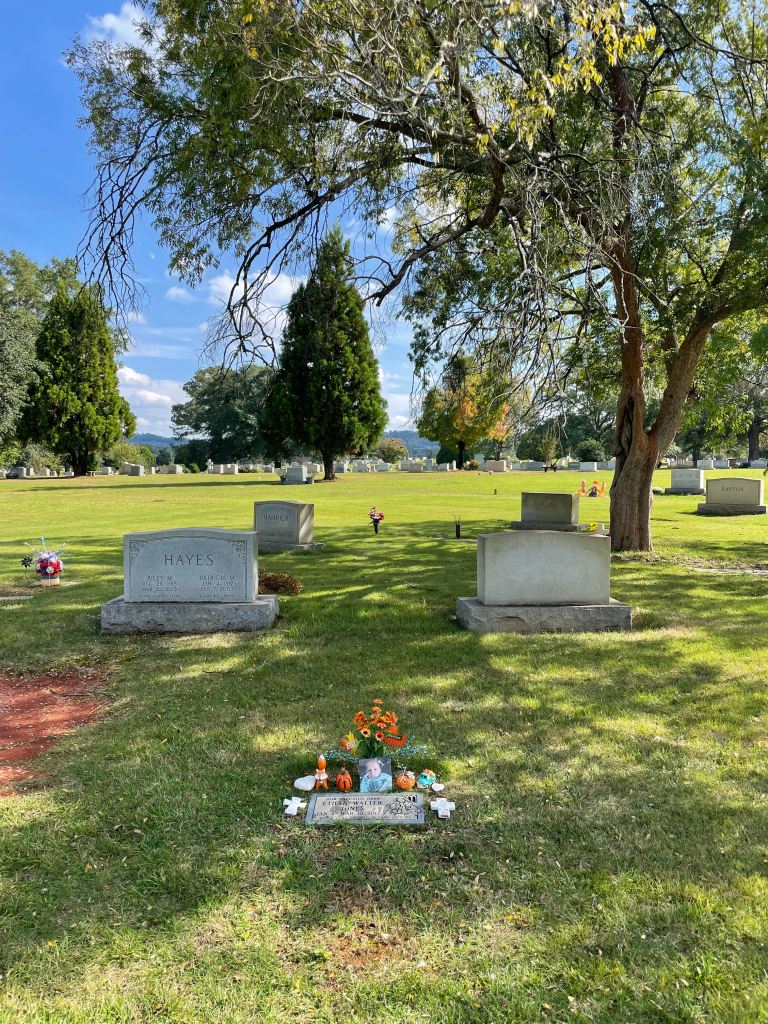
The fake cemetery in the yard down the street may have headstones with funny inscriptions, but my baby’s name is inscribed on a real marker in a real (and actually quite beautiful) cemetery where his real body lies waiting for the resurrection of the saints.  And on that day, their creepy, bony arms won’t shoot out of the ground like those tacky skeletons.  They will be raised imperishable, fully embodying all that God designed for us to be.   Until then, it is a struggle to believe that His promise of resurrection is true, especially in October.  All the decorations make it hard to follow the command found in Phillippians 4:8.

Finally, brothers, whatever is true, whatever is honorable, whatever is right, whatever is pure, whatever is lovely, whatever is admirable— if anything is excellent or praiseworthy— think on these things. 

Phillippians 4:8

I’m doing my best over here.  So can we just stick to pumpkins next year?  Please?

The Futility of Going Back to the Future

Ethan’s Dad: Have you ever noticed how much people are obsessed with time? The common observation is that ours is a fast-food culture, which means we want/demand everything to happen as instantly as possible. But the obsession doesn’t stop there. Countless stories, television shows, and movies revel in imagining that we could manipulate time — whether that entails traveling backward to remedy tragedies and mistakes or jumping forward to discover what awaits us, and they posit questions about the consequences of moving either way on the timeline. We long for this power over time even though there is no realistic indication that we could obtain it.

But that does not stop people from thinking about the possibility of time-travel. In this vein, I recently read a news story about the paradox of time-travel. The paradox of time-travel is that if a person was to travel back in time in order to fix something that went wrong in history — like trying to prevent Adam and Eve from eating the fruit that caused the fall of humanity into sin — fixing that problem would mean that the problem would no longer exist when that person returned to his or her own time, so there would be no motivation to go back in time in the first place. Put another way, things happen the way they happen, and if they unfolded another way than was intended we could never know it because we are creatures of the time we are born in. However, a prolific young scientist in Australia claims to have demonstrated through mathematics that the paradox of time-travel does not exist. The young man says that if you were to go back in time and fix a problem, events would conspire in such a way that the problem would occur anyway. In the example I just referenced, if you stop Adam and Eve from eating the fruit, someone else would still disobey God, and we would still have sin. So, the motivation for going back to fix the problem would still exist for the time-traveler, and thus there is no paradox. Of course, if the Australian mathematician is correct, the lack of a paradox also means that even if humans could go back in time, they could only change a particular variable of time, not what ultimately happens in the timeline. In other words, there is an inevitability to the unfolding of events even though human agency makes deliberate choices about how to do things.

You might think this is a strange topic to explore in this blog. But to me this theory sounds an awful lot like God’s planning of time in this world. We know choice exists because without it love would not be real. However, we also know from the Bible that God has had a plan from before the beginning of time as to how humanity’s arc, and God’s salvation, would unfold. One of the verses I recite every time I visit Ethan’s grave is a paraphrase of Titus 1:1-2: “The faith of those chosen of God and the knowledge of truth are a faith and knowledge that rest in the hope of eternal life which God, who does not lie, promised before the beginning of time.” The prophet Isaiah proclaims: “O Lord, You are my God; I will exalt you and praise your name, for in perfect faithfulness You have done marvelous things, things planned long ago.” (Isaiah 25:1). Ecclesiastes 3:11 (my all-time favorite verse) informs: “[God] has made everything beautiful in its time; He has also set eternity in the hearts of men. Yet they cannot fathom what He has done from beginning to end.” These (and many other) Bible verses point to God setting up time as an unfolding story and yet planning for eternity even before He started the clock of history. People often wonder how these two things can be simultaneously true. But if time operates in such a way that we are able to make deliberate choices and yet the grand sweep of history unfolds only one way, i.e., we cannot manipulate the timeline (because we are not God), then it seems to me that we have at least a partial answer to the mystery. God has designed our timeline in such a way that our billions of variable choices impact us, but they do not affect the destination of history, which culminates with salvation through Christ for all who believe.

Pondering such a model of existence is both mind-boggling and awe-inspiring. The question that often arises from such pondering about time and eternity is: why would God set all of this in motion if He knew about all of the atrocities that would subsequently transpire? Or, as Fyodor Dostoevsky famously asked in “The Grand Inquisitor” chapter of The Brothers Karamazov: How can God say that all of this is worth the suffering of even one starving child? The consequences of the abhorrent evil Adam and Eve brought into this world are enormous, some would say, incalculable.

I think the answer to The Brothers K question lies in coming to appreciate that there is no reason that we should exist at all apart from God’s grace. God was here before all of the creation we see and that we are still discovering: Absolutely nothing required Him to make all of this and all of us in the first place. He never had to say “Let there be light.” He could have left Earth formless and void. Nothing mandated that He create creatures in His image. Yes, there is a whole lot about this world that is evil and dark and relentlessly unforgiving; viruses are part of that, as are the unexplained deaths of infant children, and seemingly a million other cruel things. But before all of that there was God. And by His own choice, first there was light, and then there was the gift of life. And all of that was immeasurably good. Moreover, beyond the irreplaceable gift of existence is the fact that God accounted from the beginning for humanity’s going astray, and His solution to that immense problem entailed sacrificing His own Son. If we stop and think about all of that first, before all else, it should produce a profound sense of gratitude and thankfulness. As the Psalmist said: “It is good to proclaim your unfailing love in the morning, and your faithfulness in the evening.” (Psalm 92:2). Such an attitude of thankfulness as a starting point can change our perspective of what we see before us. It does not erase evil, but it reminds us that the good, that life itself, is not a brutal fact of necessity, but is truly a gift from God.

I always lament (and forever will) that Ethan did not get to live more of this life, but I am thankful that He lived at all, and I should remember that the same is true for me and everyone else. As the Psalmist also reminds us, “For with You is the fountain of life; in Your light we see light.” (Psalm 36:9). The light of life is sparked by thankfulness to the God who gave us everything. Can we honestly say that never existing would have been better than the evil that plagues the world, especially given what God foreshadowed in the Garden of Eden and brought about through Jesus? The Lord declares: “I make known the end from the beginning, from ancient times, what is still to come. I say, ‘My purpose will stand, and I will do all that I please.'” (Isaiah 46:10). That end is this:

“The Lord God will swallow up death forever.
He will wipe away the tears from all faces;
He will remove the disgrace of His people from this whole earth.
For the Lord has spoken.

And in that day it will be said: ‘This is our God;
We have waited for Him and He has saved us.
This is our Lord;
Come let us be glad and rejoice in His salvation.'”

(Isaiah 25:8-9).

The inexpressible hope of this end to time-bound life is why God’s answer to Job in chapters 38-41 of that difficult work is not as heartless as it can seem from our perspective of sympathizing with Job’s immense suffering.

“Then the Lord spoke to Job out of the storm. He said:

“Who is this that obscures my plans
with words without knowledge?
Brace yourself like a man;
I will question you,
and you shall answer me.

“Where were you when I laid the earth’s foundation?
Tell me, if you understand.
Who marked off its dimensions? Surely you know!
Who stretched a measuring line across it?
On what were its footings set,
or who laid its cornerstone—
while the morning stars sang together
and all the angels shouted for joy?

“Who shut up the sea behind doors
when it burst forth from the womb,
when I made the clouds its garment
and wrapped it in thick darkness,
when I fixed limits for it
and set its doors and bars in place,
when I said, ‘This far you may come and no farther;
here is where your proud waves halt’?

“Have you ever given orders to the morning,
or shown the dawn its place,
that it might take the earth by the edges
and shake the wicked out of it?
The earth takes shape like clay under a seal;
its features stand out like those of a garment.
The wicked are denied their light,
and their upraised arm is broken.

“Have you journeyed to the springs of the sea
or walked in the recesses of the deep?
Have the gates of death been shown to you?
Have you seen the gates of the deepest darkness?
Have you comprehended the vast expanses of the earth?
Tell me, if you know all this.

“What is the way to the abode of light?
And where does darkness reside?
Can you take them to their places?
Do you know the paths to their dwellings?
Surely you know, for you were already born!
You have lived so many years!

“….

“Do you known the laws of the heavens?
Can you set up God’s dominion over the earth?

“….

“Who endowed the heart with wisdom
or gave understanding to the mind?

“….

“Would you discredit my justice?
Would you condemn me to justify yourself?

“….

“Then Job replied to the Lord:

“‘I know that you can do all things;
no purpose of yours can be thwarted.
You asked, “Who is this that obscures my plans without knowledge?”
Surely I spoke of things I did not understand,
things too wonderful for me to know.

“‘You said, “Listen now, and I will speak;
I will question you,
and you shall answer me.”
My ears had heard of you
but now my eyes have seen you.
Therefore I despise myself
and repent in dust and ashes.'”

Job 38:1-20, 33, 36; 40:9; 42:1-6.

God was not saying to Job that He did not care about Job’s suffering; after all, He was very careful to curtail Satan’s desire to destroy Job. But God was saying that He has existed from before the beginning of time and that He created this world with His own rules and intentions. For some reason, God did not (fully) reveal the end of history to Job, and, as with Job, He does not reveal all of the reasons for the shattering events of our earthly lives. Yet, for us to question God’s ways without accounting for the entire picture is to approach sophistry. The Lord does not despise heartfelt questions: God did not stop Job from asking his questions over and over again, and the Psalms are full of questions to God for why He allows things to occur the way they do. But God desires that we not assume a position of authority as if we have the knowledge and power only He possesses.

Accepting that we cannot fully comprehend why events unfold as they do, and that we cannot actually alter God’s plan, can bring some peace in the turbulence of life. For one thing, from these truths it follows that just because we cannot fathom a reason for an occurrence does not mean that there is no reason for it (a mistake often made by atheists). For another, it means that no matter how terribly we screw up, we cannot throw God for a loop because events will inevitably culminate with Jesus’s return, God’s victory over sin and death, and eternal life in glory with Him for those who believe. We must always keep this end in mind as we traverse our story in time because there will be life events we desperately wish we could do over.

For instance, it is only natural that I wonder about that March night and morning in 2017: that maybe if I had done just one thing differently Ethan would still be alive. But I cannot go back because, for whatever reason, this is how the story unfolded, and I am a part of this time, not outside of it like God. Moreover, as his mother and I know by now (though a part of each of us will always struggle to admit it), nothing we did caused Ethan to die. For a combination of reasons, unknown to us and to the medical world, his little body could not hold on anymore. He spent one last night and early morning close to us, and then he left and was welcomed into the arms of Jesus. And as painful as Ethan’s absence always will be during the remainder of our time here on earth, we must always remember that this catastrophic event is not the end of story. God, at the end of time, will, in a sense, undo time’s scars.

From His Word, we can see that God’s love overcomes this wretched evil and that the evil ultimately will be wiped away. This means that there is something in this time-bound life that is vital to our lives in eternity. Part of the importance is obviously God’s demonstration of His love for us, which had to physically unfold in order to be truly appreciated.  I have been saying that God is outside of time, but perhaps even more wonderous than that is the fact that God actually chose to enter our time in order to ensure its glorious ending.  God not only set time in motion; He marked its defining moment with His own presence, and then sacrifice.

But I suspect that part of the importance of living this life is the idea Andrew Peterson suggests in his song Don’t You Want to Thank Someone for This

“And when the world is new again
And the children of the King
Are ancient in their youth again
Maybe it’s a better thing
A better thing

“To be more than merely innocent
But to be broken then redeemed by love
Maybe this old world is bent
But it’s waking up
And I’m waking up”

There is some way that experiencing this life, both in its immense joys and wrenching sorrows, heightens our lives in eternity in a way that would not have been true if all of this had not occurred. We cannot know exactly how that is; our charge is to trust that this is true because of what we do know: that God so loves us that He gave His only Son to die for us, that Jesus rose again, and that one day we will spend eternity with Him. Those are the timeless truths for our time-bound lives.

Three Years

Ethan’s Dad: What does three years mean? It means never getting to see Ethan run around with a foam light saber and talk about using “the forest” (the Force). There will never be any catching him as he tries to run out of the kitchen to avoid having his mouth and hands wiped off. We will not be playing hide and seek where he thinks he’s being sneaky but he is really hiding in plain sight. I won’t be jumping on the trampoline with him while his brothers and sister fall down laughing because the bounces are too high for them to keep up. We do not hear his cry when he wakes up from a nightmare or a bad cough and get up to come console him. There are no walks in the sunshine where we end up having to carry him. There is no constant companion by N’s side, dressed in identical clothes, copying each other as they drive toy cars around the playroom.

This is what irretrievable loss means. It occurs every day, for three years and counting, as we walk on without our little caboose. Our lives are more “normal” now because the more you keep living beyond the day of loss, the more you develop rhythms of life that consist of a family with just four children. It isn’t that you forget — Never That — but that it becomes achingly familiar to go about the activities of life in his absence. I suppose it is that way with all loss.

Except that, in this case, N always provides a physical reminder of what we are missing with Ethan not here. Through no fault of his own, every joy we experience with N comes with a catch, a prick of that wound which will not altogether heal this side of heaven. Of course N is his own person, but they are twins, so there is a very real sense in which they are always bound together. Overall, it is a tremendous blessing that N serves as both a comfort for, and a reminder of, losing Ethan, but it is a blessing forever touched with sadness.

But then there is also the aspect of Ethan’s uniqueness, and this is the part that is perhaps the hardest of all. It is the reality that because Ethan died so young, there are so many traits we never had the privilege of discovering about him that make him different than his twin and everyone else. Would his eyes have stayed that deep blue? (I like to think so). Would he have been stubborn or easy-going? Would he have been the rambunctious sort or a quiet thinker? Would he have been interested in a variety of foods (like his mom) or extremely picky (like his dad)? Would he have loved art or science or history or math or sports? The list seems endless, and with it so does the depth of the loss. Like all parents, we thought that we would have decades to watch Ethan grow (along with his siblings), not two months, and then suddenly there was . . . nothing. So yes, it has been three years, but what comes to mind is a few thousand little things that will not happen, that will never be revealed here, because he is gone.

There is a perspective in this world that would compare all of the foregoing as being akin to crying over spilled milk. This view tells us that life is about results, it is about what you accomplish or produce, that what matters is what “moves the needle” to make people take action, and that you should only invest your life in what you can control. Some call this view “realism.” The premise of realism is a material one, and if you accept that premise — what is real is what you see — this view is entirely correct: Not one moment thinking about Ethan, not all the tears shed for his loss, no matter how many words are written to help express the rending of our hearts . . . none of it will change the reality that Ethan is gone; none of it will bring him back to us. By the realist’s standard then, none of these expressions matter. Why should we grieve at all if everything is transient and immediate material effects are all we value?

But the Bible — and I think our hearts -– tell us that ultimate reality is marked by the things that are unchanging, unseen, and not even done by us. Ecclesiastes 3:11 says “God has made everything beautiful in its time; He has also set eternity in the hearts of men; yet they cannot fathom what He has done from beginning to end.” Yes, there is beauty in this world, but our hearts tell us there is more, that there are things which are enduring and defy concrete understanding. Second Corinthians 4:18 tells us that we should “fix our eyes not on what is seen, but on what is unseen, since what is seen is temporary, but what is unseen is eternal.” Revelation 21:4 relates that there will come a time when “there will be no more death, or mourning, or crying, or pain, for these former things have passed away.” First Corinthians 13:8 proclaims that “where there are prophecies, they will cease; where there are tongues, they will be stilled; where there is knowledge, it will pass away,” but that “Love never fails.”

Our grief, our longing, and our continued remembrance of Ethan does not change the material reality of his absence, but it matters because it reflects our steadfast love for him. That love is real and enduring. It expresses God’s truth that Ethan is a gift to our family, he is unique, and he is eternal. Two months was far too short; these last three years have felt far too long; and this melancholy ache will be with us for the remainder of our time on this earth. But our love, and more importantly, God’s love, transcends all of that, so that we do not “grieve without hope” because “Jesus died and was raised to life again, and when Jesus returns, God will bring back with Him the believers who have died.” 1 Thessalonians 4:14. Thus, the years after his loss may continue to mount, but we will still grieve — albeit sometimes in different ways than we did at first — because we will always love him and know that God loves him, and that Love will one day “turn our weeping into dancing, remove our sadness and cover us with joy.” Psalm 30:11 (as rendered by Ellie Holcomb in The Broken Beautiful).

Happy Birthday, Ethan

Happy 3rd Birthday, our precious Little Caboose. We can’t put a present at the end of your bed for you to open this morning. We can’t sing Happy Birthday to you and watch your smile. We won’t be wondering where to go for dinner because you and your twin brother picked different places.  We can’t see you try to blow out candles on a cake with Noah and then watch you stuff your face with it. We can’t watch you tear wrapping paper off of presents and then hear you giggle with glee when you see what is inside. We won’t be able to take you with us when we go off to Disney World next week to celebrate as we have done when each of our children has turned 3.

All we can do is continue to love you, remember you, and long for the day when we finally will get to celebrate with you. “For we know in whom we believe, and that He is able to keep you, our Ethan, who we have committed to Him, until the day Jesus returns.” (2 Timothy 1:12).

The day you were born was filled with trauma, and the too few days after that we had with you were hard on you and your little heart. But never, ever doubt, son, that each and every one of those days was a gift we will treasure forever. We miss you terribly every single day, dear Ethan, but especially so on this day which marks our introduction to your contemplative blue eyes and irresistibly adorable face.  We love you always and forever.  Celebrate a little with the Lord today, but be ready for the ultimate party filled with tears and cheers on that day we will be there to hug and hold you again.

Catch You on the Flip Side

In my last blog post, I shared some about the beginning of my experience as a BSF discussion group leader. We are now almost 3 months into our class, and I have 14 ladies in my group, 6 of whom are currently pregnant. One is an unexpected 4th pregnancy, just like my twins, and that has brought up a lot of emotions. Leadership has been challenging in ways I expected and in ways I didn’t. It has been a blessing in ways I expected and in ways I didn’t as well.

As with my other 3 years of BSF, God seems to be zeroing in on the lessons I need in this stage of my journey through the shadowlands; however, that doesn’t mean that those lessons are easy to receive.

It’s been a tough few weeks here in my head and heart heading into the holiday season. In BSF, we have been talking a lot about suffering as we went from discussing Peter’s miraculous jail break in Acts 12 to his writings in 1 Peter. Suffering is a tricky topic for me. On the one hand it is really hard to fight the tendency to judge others’ stories of suffering against mine. On the other hand, I don’t want to really face the depths of my own suffering; the grief is still sometimes so raw.

The week we talked about the jailbreak was hard because it prompted a discussion about why James was executed by King Herod while Peter was miraculously delivered from danger the night before his show trial. Well, those sorts of questions are really tough for anyone to face head on, I think. When you can identify with James instead of Peter, it gets even harder. Both were “top 3” disciples; both were being prayed for by the church. Why the huge disparity in their stories? And why was James a little blip in the chapter that goes into such details about Peter’s rescue? He almost seems like an afterthought.

There is a family we know whose little girl was almost born while her mom was one of many, many people snowed in at work during a bad storm almost six years ago. But she wasn’t; Ethan and his brother were the ones born in an ambulance on the frozen highway. This little girl was diagnosed with a heart defect that was similar to Ethan’s. In fact, the day we found out about his VSD, her mom was one of the first non-family members I called, looking for advice and encouragement, knowing that she had a successful open heart surgery the summer before. After Ethan died, it was excruciating to see this preschooler living a normal life, starting kindergarten, even getting discharged from cardiology follow up visits. My son didn’t live long enough to have surgery to fix his heart. This is insane to admit, but I would find myself being jealous that Ethan didn’t “get to” have open heart surgery, like it was a prize that he didn’t win. Even though the heart defect was not the primary cause of death, it is still hard to think about all the prayers that were answered for her but not Ethan. It has gotten easier over the past two years, but I still have moments of secret bitterness towards this innocent little girl. That’s just one example. Every time I hear or read “God is so good!” in response to someone’s physical healing, I just cringe. Why wasn’t he good to my baby, too?

The next week’s lesson was from 1 Peter, and it was still hard but more hopeful. The lecture that week had several points that really resonated with me, but I want to focus on the section concerning “New life in Jesus shifts a believer’s focus to HOPE.”

“Blessed be the God and Father of our Lord Jesus Christ, who according to His great mercy has given us new birth into a living hope through the resurrection of Jesus Christ from the dead, and into an inheritance that is incorruptible and undefiled and unfading, reserved in heaven for us who through faith are guarded by the power of God for salvation that is ready to be revealed in the last time.” (1 Peter 1:3–5)

Our BSF teaching leader said that in suffering, God can “develop and refine our faith, loosening our grip on this world and leading us to trust the unseen reality of God Himself.” Nothing has loosened my grip on this world more than my child leaving it.

When Ethan’s dad leaves for his BSF group on Monday nights, the kids are usually still finishing up dinner. They have this game that has developed over time. Everyone tries to be the first to yell, “Catch you on the flip side!” when he comes in the kitchen to say goodbye. Whoever is beaten to the punch yells back, “No, no – catch YOU on the flip side!” They continue this back and forth for a few minutes, then Ethan’s dad will yell “Catchyouontheflipside” really fast and duck out of the kitchen.

This always makes me smile but the other day it occurred to me how profound this little game really is. They shift their focus from leaving to the hope of their reunion, and that makes all the difference in their parting.

My favorite quote from the lecture was “Eternal realities stabilize us and sustain us in daily realities.” I might consider getting it tattooed on my arm. If there is any other way to make it through the daily realities of traumatic bereavement, I surely don’t know of it.

I will never get a handprint turkey, never see Ethan in his preschool Thanksgiving program. Instead of thinking about stocking stuffers for Ethan, I went to Hobby Lobby to pick out new Christmas decorations for his graveside. I am planning ways to celebrate my twin boys on their 3rd birthday at Disneyworld, despite the fact that one will not be with us at “the happiest place on earth.”

Those are just a few examples from the past week. I could go on with a whole list of big and small daily realities that have knocked me off balance or made me want to quit altogether, but a pity party is not the goal of this post. The point is that the only thing that keeps me from utter despair when facing moments like these are, in fact, eternal realities stabilizing and sustaining me.

God is good, even though I cannot always feel or comprehend this truth.

I will not have a handprint turkey, but one day I will hold his hand.

I will not celebrate Christmas with him this year, but one day we will sing together in the presence of the Savior.

Jesus has made a way for my family to be together in a place that is so much better than Disneyworld I literally cannot conceive of it. And we get to stay, together, FOREVER.

Catch you on the flip side, my sweet Ethan. Catch you on the flip side.

Kept for Us

Picture 281

Ethan’s Dad: Last week was somewhat difficult because it included a 10th (as we have mentioned before, Ethan died on March 10, 2017). And on evening of the 10th last week, which was a Wednesday, I was at church helping with my oldest son’s activity group that has age rages from first grade through sixth grade. The leader of the group that night read the kids the story of Elijah and the widow of Zarephath from 1 Kings 17:7-24.

For those of you unfamiliar with that story, it involves the prophet Elijah’s encounter with an Israelite widow and her son who are starving to death in the midst of a drought and famine brought about as a result God’s punishment against Israel’s evil King Ahab. The part of the story that is repeated most often concerns Elijah asking the widow for some water and bread. She readily gives him water, but she initially hesitates at offering him bread because the widow says that she and her son only have enough ingredients to make bread for one more meal for themselves. Elijah tells her not to be afraid, to make her meal, but to give him some bread first because the Lord had told him that she will always have enough flour and olive oil in her containers to make bread until the day the Lord sends rain and the crops grow again. So, the widow made bread for Elijah, and events unfolded exactly as Elijah had said: “There was always enough flour and olive oil left in the containers, just as the Lord had promised through Elijah.” (verse 16).

That part of the story is usually told as an example of what happens when someone shows faith in the Lord. Indeed, the Wednesday group leader summarized it by saying: “You do what the Lord says and good things happen to you. I am not saying a miracle will always happen, but good things result from obedience.”

The leader then went on to discuss the second part of the story, which is not told as often. 1 Kings 17:17-24 relates that later on the widow’s son somehow became sick and he eventually died. The widow expresses her anguish to Elijah, saying:

“‘O man of God, what have you done to me? Have you come here to point out my sins and kill my son?’

“‘Give me your son,’ Elijah replied. He took him from her arms, carried him to the upper room where he was staying, and laid him on his bed. Then he cried out to the Lord, ‘Lord my God, have you brought tragedy even on this widow I am staying with, by causing her son to die?’ Then he stretched himself out on the boy three times and cried out to the Lord, ‘Lord my God, let this boy’s life return to him!’

“The Lord heard Elijah’s cry, and the boy’s life returned to him, and he lived. Elijah picked up the child and carried him down from the room into the house. He gave him to his mother and said, ‘Look, your son is alive!’

“Then the woman said to Elijah, ‘Now I know that you are a man of God and that the word of the Lord from your mouth is the truth.'”

The group leader did not add much commentary to his reading of this part of the story beyond observing that the widow blamed Elijah even though he had nothing to do with her son’s death, and that God is able to do great things. For the moment, I do not want to focus on the probable meaning of Elijah’s raising of the boy back to life. Instead, I want to convey what hearing a story like that can feel like for someone who has experienced the loss of a child.

We have so far not related the details of Ethan’s death in this space because that is an extraordinarily personal and painful memory. What I will say is that his passing was very sudden, and as it was happening, as efforts were made to resuscitate him, we literally screamed to God to save our child. Immediately after we were told to accept that he was gone, we cried rivers of tears, pleading over and over for the Lord to bring our Ethan back to us.

Nothing happened. His body became cold. His life slipped away. We were left in the dark.

I don’t write that to make you feel sorry for us. I relate it because that is the way it is for many parents who lose a child. And so when you read a story like Elijah’s raising of the widow’s son, what someone in our position immediately starts thinking about is the death of our own child. Why didn’t God bring Ethan back to life? Was it because I did not have enough faith like the widow? Was this a punishment for some unrepentant sin? To many people it is just a Bible story. To us, because we have lived this, it (like so many other stories) takes on an entirely different character.

So, I felt discouraged coming home from church that night. That Friday, the same boys’ church activity group went on a camp out with their dads. All of the kids seemed to enjoy it very much, including our oldest, who caught his first fish during the outing. However, that night while the kids were playing, the men were sitting around the campfire chatting. At one point, for some inexplicable reason, one of the dads turned the conversation to talking about people’s ashes, and urns, and then cemetery plots. I got up and walked away from the fire because the discussion depressed me. What was idle talk to them was nothing to joke around about to me because my youngest son’s body rests in a cemetery. I felt disquieted the rest of the night (and not just because I was sleeping on the ground in a tent).

But then on the following Saturday evening and Sunday morning before church, I was reading the Scripture excerpts for those days from Daily Light for the Daily Path (my copy is in the English Standard Version, unlike most of the online versions which are King James), and some of the verses unfolded into a timely reminder:

“Your will be done on earth as it is in heaven.” (Matthew 6:10)

“Understand what the will of the Lord is.” (Ephesians 5:17)

“It is not the will of your Father who is in heaven that one of these little ones should perish.” (Matthew 18:14)

“Christ died and rose and lives again that He might be Lord of both the dead and the living.” (Romans 14:9)

It was not God’s will that Ethan would die. Sometimes “this present darkness” distorts God’s perfect will in this imperfect world. (Ephesians 6:12). That is not to say that God did not know or could not have prevented Ethan’s death — He certainly did and He definitely could have, but in this instance, evil was allowed to run its course. Yet, this is one of the reasons Christ died and rose again: so that He could reign over death and prevent such a little one from eternally perishing.

Later that same Sunday morning as I was sitting in church, the Scripture reading for the service included 2 Timothy 1:12. The second part of that verse says: “I know in Whom I believe and I am persuaded that He is able to keep that which I have committed to Him until that day.” I used to take that verse simply in its context of Paul discussing preaching the gospel to unbelievers. After Ethan’s death, however, the verse became a promise from God for us: that He will keep Ethan, who we have committed to Him, until the day Christ returns. (This interpretation stems from the context of verse 10: “our Savior, Christ Jesus … has destroyed death and has brought life and immortality to light through the gospel.”)  Obviously we did not willingly give Ethan away; evil robbed us and him of his earthly life too soon. But God has promised to keep and guard Ethan for us until we come to him. Ever since I was reminded of that verse shortly after his death, I have included it in a string of verses I repeat when I visit Ethan’s grave.

So I sat in the pew thinking about that, and about the verses on the Lord’s will I had read earlier that morning, and then the music minister had the congregation sing the hymn “I Know Whom I Have Believed,” which is based upon 2 Timothy 1:12. If you are unfamiliar with the hymn, the fourth stanza says:

“I know not what of good or ill
May be reserved for me,
Of weary ways or golden days,
Before His face I see.”

This is followed by the refrain, which is repeated after each stanza:

“But I know Whom I have believed,
And am persuaded that He is able
To keep that which I’ve committed
Unto Him against that day.”

Then the final stanza reads:

“I know not when my Lord may come,
At night or noonday fair,
Nor if I walk the vale with Him,
Or meet Him in the air.”

By the time we finished singing that hymn, I felt overwhelmed with God’s reassurance that even though a miracle did not occur on that day Ethan passed, and even though his tiny body is resting in that small grave I so often visit, Ethan is okay because he is being kept safe by God until that glorious day. As I was reminded today: “Behold, the Lord God will come with power, and His arm will rule for Him. … He will gather His lambs in His arms and carry them close to His heart.” (Isaiah 40:10,11).

And as for Elijah’s raising of the widow’s son, it should be remembered that even the widow, with her great faith, despaired when her son died. She earnestly questioned Elijah as to why God would perform a miracle to keep her and her son alive only to let her son die of a sickness. It must have seemed like a cruel joke. Elijah himself did not understand what God was doing, asking God: “Lord my God, have you brought tragedy even on this widow I am staying with, by causing her son to die?”

God did not rebuke their doubts, which merely stemmed from a lack of understanding. As I explained above, both the widow and Elijah erred in concluding that God caused the boy’s death. He did allow it, but He did not cause it — there is a difference (as difficult as it may be to see) between causing the tragedy and allowing it to unfold. For what the widow and Elijah could not know is that this event was meant to foreshadow a much greater one hundreds of years later.

The widow’s son died; Elijah laid his body over the boy’s body three times; the boy came back to life; and the widow exclaimed that by this miracle she knew Elijah was a man of God who spoke the truth.

Mary had a son named Jesus. He was crucified on a cross even after He had performed many miracles. (Mary was probably a widow when this occurred because Joseph is not mentioned in the Gospel accounts after Jesus’s childhood, and on the cross Jesus told his disciple John to take care of Mary). Jesus was buried, and after three days God resurrected Him from the dead. And it is by His resurrection that we know Jesus is God and that He spoke the truth.

The point is that there was something larger going on with the boy’s death that neither the widow nor Elijah could comprehend because the events that would give its context lay in the distant future. I am not saying that every death of a child has a larger purpose beyond demonstrating with stark coldness the evil that pervades this world. But I am saying that the fact that we may not understand why a tragedy occurs does not mean God allowed it to happen without preparing the future context in which it will be wiped away. Because in that future

“The Lord God will swallow up death forever. He will wipe away the tears from all faces. He will remove the reproach of His people from all the earth. And in that day it will be said: “This is our God, we have waited for Him, and He has saved us. This is our Lord, we have trusted in Him; come, let us be glad and rejoice in His salvation.'” (Isaiah 25:8-9).

Until that day, “the Lord will bless and keep Ethan, and make His face to shine upon Ethan and be gracious to him and give him peace.” (Numbers 6:24-25).

Visiting with a Shadow

Ethan’s Dad: I still visit regularly, usually three days a week. For the first full year, I visited nearly every single day. I know some people think it is strange that I would go to Ethan’s grave so often. I suppose in their minds it seems like it would be too painful to visit such a place over and over again. But it is extremely important to remember, when supporting friends, neighbors, or loved ones who have sustained losses, that people grieve in different ways and they need to be given the space to do so. What I do is no better or worse, no more normal or weirder than how my wife seeks to survive in the midst of her grief. She visits his grave as well, though not as often, but she journals, for instance, much more frequently than I have. We are each dealing with an unexpected absence, a weight that may tug on our hearts more heavily at some times than others, but that always remains with us wherever we go. Yet we are different people and so our methods of carrying the weight correspond with our own personalities. And so it is with all who carry burdens of loss.

At first when I visited, I mostly talked to Ethan. I should clarify in mentioning this that it isn’t that I believe Ethan is there — at least not the part of him that matters most. My wife recently wrote a post about some of the awful day that was Ethan’s funeral. And while there was much that was unspeakably difficult about that particular day, one revelation for me occurred when we saw his little body in the tiny casket. We cried rivers of tears. We read letters to him that we placed in the casket. We hugged a lot. But one thing that was very apparent to me was that Ethan was not really there. His precious, frail body was there . . . but it was cold and impassive. . . the light of life was gone from it.

This is a difficult idea to put into words because it honestly can only be experienced, not exactly described, and yet it is not an experience I would wish for anyone. But in that tragic moment when you see your still baby who was so vibrant only a few days before, there comes this clear sense that something is truly amiss: You come face to face with the truth that a person is much more than just flesh and blood. People have spirits which make them who they truly are. The contrast between our real Ethan and what was left of him in that casket was so stark that this spiritual reality was undeniable. Our Ethan — the curious, quiet, lovable, strong, immaculately precious boy — is with the Lord. He is laughing now, rather than hurting, and waiting for us (though the wait will seem like nothing to him because time is nonexistent in heaven).

Alas, time is all too real to us, and to me it seems to go by much more slowly now than before Ethan’s passing. And so I choose to pass some of that time by sitting next to his grave. It is not the most vital part of him, but it is all we have left here in this in-between place we call the Shadowlands. It is my tangible connection to him. It is a place-holder until the joyous reunion.

Over time, my conversations with Ethan morphed into talking to God more often than talking to Ethan because He is my spiritual connection to Ethan. God is the reason a reunion will happen, made possible by Jesus’ sacrifice on the Cross. Jesus said He is “the Alpha and the Omega, the First and the Last, the Beginning and the End” — of all things. (Revelation 22:13). This means He is also the God of this off-kilter in-between time in which we find ourselves.

At times, walking in these shadows, it can seem as if He has abandoned us, left us to our own devices.

“I cried out to God for help;
I cried out to God to hear me.

“When I was in distress, I sought the Lord;
at night I stretched out untiring hands,
and I would not be comforted.

“I remembered you, God, and I groaned;
I meditated, and my spirit grew faint.”

(Psalm 77:1-3). In fact, that is one reason that at first I only talked to Ethan: Because I did not feel God there, all I felt was a black hole, a yawning abyss from which no light could emanate or escape.

But in the end, faith is not about feelings, it is about will, submission of the will really, but will nonetheless. And when you press on through the shadows you discover that there is light there after all.  (And how could it be otherwise?  For shadows are only seen because of the light that illuminates reality). The light is not a bolt that thunders, at least not for me, but a flicker that whispers your name and tells you to keep listening. And so the conversations become less and less audible and more and more reflections pouring over the Bible, His words that come alive because of His Spirit communing with our own when we seek Him.

I don’t mean for it to sound like magic. It is not. There is no trick and this is not fantasy land. I do not live in a state of Zen or blessedness or higher consciousness or whatever else some beliefs choose to call their willful blindness toward the tragedies of life. Nor do I mean to sound super-spiritual, for the contemplation is born from desperation, not holiness. I am weak. I am hurt. I still feel out of sorts. I still cry because of this inexplicable loss that neither Ethan nor we deserved to experience.

And so I sit next to the place where Ethan’s little body resides. I sit still in the quiet (there are few places quieter than a large cemetery).  And in that stillness I know that God is there (Psalm 46:10), and I dare to trust that Ethan is with Him, waiting. My heart yearns: Come quickly, Lord Jesus, Come. (Revelation 22:20).

The Toughest Questioners

His Mom: I have been delaying on writing my first blog post (other than my introduction of Ethan) for a few weeks now. It’s hard to know where to start, how much to say. I have a list of possible topics in my planner, and I was going to sit down and start one tonight, come heck or high water. I was trying to decide what to write about while rocking #4 to sleep tonight. Then this happened at bedtime…

We had been to the pool in the morning, and the kids were pretty tired by bedtime. Then we let them stay up a little late to get to a good stopping point in Muppets Take Manhattan, tonight’s family movie selection. After I got child #3 in bed upstairs, I came down to say good night to #1 and #2, having already been tucked in by Daddy. #1 informs me that #2 has been crying since Daddy left. She has moments of bedtime drama fairly frequently and tends to try to delay the process of being tucked in. But when I leaned down, I instantly realized this was not a little girl who was manipulating bedtime, or even just overly tired. This was a little girl genuinely upset about something. So I leaned down and asked her what was wrong. “I don’t want to tell you,” she replied. That is highly unusual. I replied that most times talking about something that is upsetting makes us feel better. She then had me lean in even closer to whisper in my ear, still shaking with little sobs, “I am afraid when you and Daddy die I won’t have anything to remember you by.”

Can you hear the sound of a mama’s heart breaking at this point in the story?
I have no way of officially knowing this, but I’d bet the farm we have more conversations about death and dying with our children than the average suburban American family. Deep questions are not unusual at bedtime, when the kids seem to get reflective and ask hard questions by the soft glow of their night light. Our kids ask why people put up stones in the yards around Halloween that look like the ones at “the place to think about Ethan,” which is our family’s term for his graveside. They ask if you get birthday cake in heaven. They want to know why his heart stopped. For several weeks last year, #1 would lose it at bedtime because he wanted to know how old Ethan would be when we see him again – does he grow up in heaven or stay a baby? The answer he came up with was that Ethan would be older than him, which negated his role as the oldest child and upset him greatly. Just the other day, #3 asked when Ethan was coming back from heaven. They know that butterflies and dragonflies start out as caterpillars and water bugs before their bodies are transformed into new bodies, just like people when they die and go to heaven.

I hate that they know so much, that their childlike innocence is marked by this terrible tragedy. I hate that they have been to a cemetery way more times in the last year than I had been in my first 36 years of life combined. We can’t tell them that people don’t ever die until they are old. We can’t promise that someone else in our family won’t die. They would see right through those answers in a second.

I asked what had been making her think about mommy and daddy dying, and she confirmed that she had been thinking about Ethan. I assured her that anytime you love someone, you will never, ever forget them. Even if she didn’t have any mementos, she would never forget us and we would never forget her. Because our “fancy Nancy” loves her some jewelry, I followed up with a promise that she would get to keep one of my special necklaces to wear. “What about Daddy? What does he have that we can keep?” We came up with his collection of National Park quarters and his Nebraska baseball cap. The hat seemed to satisfy her (again, an accessory!) and she laid back down. Two seconds later, she popped back up with a question about Muppet Babies, so I felt okay moving on with goodnights and backrubs and admonitions to be quiet and get some sleep.
Then I stood outside their door, clutching my chest and asking God to keep my little girl from having nightmares about her parents dying.

Do you know what makes these Q&As even worse than they already are? I want to know that answers to the same questions and more. I ask myself every.single.day why Ethan’s heart stopped. Why do people have to die? Why does God heal some people and not others? I want to know if he is eating ice cream or smiling or getting to know his amazing great-grandparents. I sure hope so. Outwardly, I am telling my son that we don’t know what Ethan will look like or how old he will be when we see him again, but we do believe the Bible promises we will recognize him. Inwardly, my chest is burning and the voice in my head is shouting “that’s not enough! I want to know what he looks like now, what he will look like then, and how in the world can You possibly make this all right in the end?”

You would not leave your child at a daycare sight unseen, not even one recommended highly by most of your friends and family. You want to see the room they will be in every day, meet the workers who will hold and change your baby while you are gone, and verify their security systems and check out processes. Even then, sending them on that first day is hard, even if they are too little to raise a fuss.

On March 10th, 2017, my child was abruptly taken to a place I cannot go, where people can’t send text messages or make Facetime calls. Even worse than not knowing anything about the place, I don’t even know anything about him anymore. It is so horribly, wrenchingly sad and scary.

I tell myself that he is with God, and that God is Love. He is known and loved and cherished by Jesus, as much or more so than if he were here on earth. If the stories are true, he is in the best and safest place he could be. It hurts my heart a little that there could be a place better or safer than in my care, but if that were not true, I would be in utter despair. As it is, we walk this weary road, trudging ever closer to the day when death shall be no more. God will wipe every tear from our eyes, and at last I won’t have any more questions to answer.