Joy Found in “The Morning”

Earlier this summer, I was invited on a girls trip to the beach.  My daughter, one “old” friend, one “new” friend, and all three moms spent a few days with the sand between our toes.  I love the beach – the sights, the sounds, the smells – so I knew the trip was going to be fun.  An added bonus I did not realize until we were there chatting under the beach umbrella was that all three girls had brothers and only brothers.  So even though the other two moms had older children, we were all in the same boat as far as parenting middle school girls for the first time.  We traded tips on finding appropriate swimwear and navigating big emotions.  It can be so nice to be among people living a shared experience.  “You too? I thought I was the only one…” are usually welcome words that can bring relief and validation.  

This holds true even when the shared experience is one you would never wish for anyone.  Sometimes people describe being a bereaved parent as being a member of a club to which no one wants to belong.  We wish no one else would ever join our ranks, but the reality is that our number will continue to grow until Jesus returns.  Recently, the devastation of flash flooding in Texas took the lives of at least 36 children.  Who knows how many were born still or died in the night or succumbed to cancer during the past 24 hours alone?

Even though I wish this were not the case, it is.  And there are some things that bereaved mothers share that no one else can understand fully.  I cannot tell you how invaluable it has been for me to develop friendships with moms who are at similar places in their grief, as well as those who are further down the road and those who are just beginning.  

Soon after Ethan died, a coworker put me in contact with an old friend of hers that was developing an online ministry for mothers impacted by miscarriage and infant loss.  My first experience with what would become The Morning was a beautiful art print with Ethan’s name on it, which was given to me by this coworker.  I did not know at the time that this print (which still hangs in our playroom) was the beginning of such a meaningful relationship.  

In 2018, The Morning released a podcast, “The Joyful Mourning,” hosted by the ministry’s founder, Ashlee Proffitt.  I listened to every single episode for the first few years, many times while taking #4 on walks in his stroller.  I heard the story of Ashlee’s son, who was six weeks old when he died unexpectedly of SIDS.  It was like walking around the neighborhood with a friend and mentor, receiving much needed encouragement and practical advice.  She shared how grief had changed her relationships, her parenting, and her faith.  She interviewed moms, each of whom shared their own stories.  Sometimes the details were similar to our story, other times not as much.  In other episodes, professionals explained the physical, emotional, and relational effects of grief.  Most episodes offered some very practical advice, and each episode offered something even more valuable — hope.  

The ministry added an online community to facilitate interactions between mothers.  The Morning Community grew into a multifaceted support system — a place where everyone was invited to tell the story of their babies, vent frustrations, and receive encouragement.  The Morning added another “big sister” to act as a mentor in this space.  Meg Walker was exactly what the community needed.  Her writing skills and her ability to connect with people, even virtually, made everyone feel welcomed and valued.  Eventually, they added community moderators to assist in managing the online community.  I served as one for six months and had a much better understanding of the sacrifice Meg willingly gave, even while her own family was growing.  Meg gave us questions to discuss, checked in on us during holidays and hard days, and made everyone feel that their baby mattered.  

To illustrate the kind of support this group provides, consider the universal dilemma of the bereaved mother.  “How many children do you have?” may seem like small talk to most people.  To mothers who have children in heaven, it feels like crossing a minefield, every time.  When I answer 5, the follow up questions will almost always reveal that one has died, and the reactions to that fact are awkward at best, painful at worst.  When I answer 4, I feel that I am being disloyal to Ethan and discrediting my motherhood.  I have five children that I love with my entire being.  Five children that I do my best to support and to celebrate.  Five children that I pray will know the love of their Creator and play their role in His redemptive story.  But that is a lot to try and sort out with a new acquaintance on the ball field or in the band booster club.  

Every so often, a new member of the community would ask how to handle this situation.  The other newer members would agree, “yes!  I never know what to say!”  The older members would encourage the woman to do what she feels most comfortable given the particular circumstance and that it does get more automatic with practice.  And everyone would reaffirm that the child in heaven is no less a part of her family and that she is no less a mother to him/her than if that baby was in her arms right now.  

That’s the kind of sisterhood that grew under Ashlee and Meg’s leadership.  And I haven’t even begun to discuss the other ways The Morning has touched lives — devotionals, workshops, holiday support groups, specialized merchandise, templates for funeral programs, cell phone wallpaper, suggestions for how to remember your baby during each changing season, and very helpful guides for family and friends seeking to love a grieving mother well.   All the resources and websites are beautifully designed with soft colors and meaningful images.  On Ethan’s birthday, I write an entry in his linen bound birthday journal.  Each winter, I wear my “One Day Closer” sweatshirt and drink coffee from a mug received from another community member during a Christmas mug exchange.  They give me a measure of comfort on the long gray days between Ethan’s birthday and the anniversary of his death.  

During this summer, Ashlee and Meg are taking a sabbatical to seek God’s guidance for the future of The Morning.  I have been praying that they will experience much needed rest from their labors of the past few years and hear His voice leading them in the way forward.  Whatever God has in mind for The Morning, I know He will continue to work healing in the lives of grieving mothers.  After all, Jesus’ own mother is “in the club” and he provided for her with one of his final breaths.  For this period of time and for my own life, The Morning has been a conduit of His grace, and I will be eternally thankful for the work his servants have done for me and for countless other mothers who are learning that “joy can be found, even amidst the morning.”

This Thing is Not Going to Break You

By Christa Wells

You could not plan for this, No, there was no silhouette

Up against the pink horizon to warn you of the hit

But you absorbed it all with grace, Like a child you spoke of faith unmoved, That holds onto you

This thing is going to try to break you

But it doesn’t have to, You’re showing us how

This thing is going to bend and shape you, But He won’t let it take you

You know it somehow, This thing is not going to break you

You could take your loss, You could hide away from us

With your grief lassoed around you, But you’re laying it in the sun

And you stare straight into the light, You say you’d rather go blind than look away, What can I say?

This thing is going to try to break you, But it doesn’t have to

You’re showing us how, This thing is going to bend and shape you

But He won’t let it take you, You know it somehow

This thing is not going to break you, this thing is not going to break you,

this thing is not going to break you
Talking about Trust

Ethan’s Mom: Our summer ended with an emergency room visit and overnight ICU admission for my husband. The chaplain who had helped me navigate the ER came by the ICU very early the next morning. She had been in the room when I was giving the doctor Greg’s medical history, which included Ethan’s sudden unexplained death. After asking for an update on his condition, she asked me some very insightful questions. We talked about how hard it was to trust a God who offers no guarantees of healing or recovery. She said that He does promise to make everything new but wondered aloud if that process might purposefully include pain.

I was thinking back to this conversation as I was trying to reflect on this year’s BSF study of the People of the Promised Land: Kingdom Divided, which began just a few weeks after my husband’s accident. The next to last question asked us to write one sentence summarizing God’s message to us during this study. That was a hard one, given that our study took us through a wide range of history, prophecy, and even poetry this year. We read over 5000 verses, many of which I had never read before. I learned so much that I struggled to even think of a single, coherent message, much less one that felt personalized for me – until I prayed on my afternoon walk for God to reveal what He wanted me to take away from this year. I was listening to my walking playlist, and the song “Keep Your Eyes Open” by Christa Wells came through my earbuds. A single line within the chorus jumped out at me like a flashing neon sign: Trust me. That was my sentence, two simple words. Trust me.

Of course it was. Once it popped into my earbuds, it was so obvious. I remember thinking at points throughout the last year that the word “trust” was showing up everywhere – BSF lessons, sermons, verse-of-the-day emails, everywhere. But how exactly did it manifest in our Kingdom Divided study?

One recurrent theme for this study was God’s sovereignty. He keeps His promises, He uses nations to bring judgment on other nations, etc. One week, a fellow group leader asked me if the idea of God’s sovereignty gave me any comfort, given my family’s experiences. The answer was so close to the surface that it flew out loud and clear before I could filter it: NO. I can accept that God is all-powerful, but that has not been a thought that has brought me much comfort over the past 6 years. In fact, when I hear “You are sovereign” uttered in prayer, my stomach still lurches.

I know rationally that the opposite would not be any better. If God is not sovereign, who is driving this bus? As Cameron Cole writes in his book, Therefore I Have Hope, “if God had nothing to do with my son’s death, then certain pockets of life – the really awful ones in particular – are given over to chaos because the God of the Universe is removed from them.”

I do, in fact, want God to be sovereign. But I also want Him to be good. Knowing someone is in full control of your circumstances is not very helpful if you don’t trust that person. How can I trust God when he ordained for my child to live for only 63 days? Cole goes on to say, “The matter of God’s sovereignty and goodness evokes tension…These paradoxes become far more confusing when they are your paradoxes.” Indeed.

I can see this tension played out throughout the historical narrative and, even more so, the prophetic books we studied this year. We heard prophecies of judgment and destruction over and over. The idolatry was out of control, and the stubborn people refused to repent and return to God. There would be a day of reckoning for all of their sin. That’s mostly what comes to mind when we hear about “the God of the Old Testament.” One of the biggest surprises for me this year was seeing the patience, mercy, and goodness of God before, during, and after the fall of Israel and Judah. “The God of the New Testament” was right there in every book as well.

In fact, many of the verses that end up on coffee mugs, throw pillows, and hand-lettered signs are actually from this portion of Scripture.

Even youths grow tired and weary,
and young men stumble and fall;
but those who hope in the Lord
will renew their strength.
They will soar on wings like eagles;
they will run and not grow weary,
they will walk and not grow faint.

Isaiah 40:30-31

“For I know the plans I have for you,” declares the Lord, “plans to prosper you and not to harm you, plans to give you hope and a future.”

Jeremiah 29:11

Because of the Lord’s great love we are not consumed,
for his compassions never fail.
They are new every morning;
great is your faithfulness.

Lamentations 3:22-23

The Lord your God is with you,
the Mighty Warrior who saves.
He will take great delight in you;
in his love he will no longer rebuke you,
but will rejoice over you with singing.

Zephaniah 3:17

Taken out of context, these verses appear to promise that we will be #blessed with never-ending energy, security, and love. But it is not all goodness and light. In fact, all of these verses are located very near some extremely hard to read declarations of judgment and impending destruction, sometimes in the very same chapter. As we moved through the divided kingdom, I could see the tension I have felt in my experience played out in the tension between God’s justice and mercy, His sovereignty and goodness, His protection of His people and His righteous judgment of their sin, and more.

At some point during the year, someone stated that God does not sacrifice one of his attributes and the expense of another one of His attributes. God is sovereign, but not at the expense of His goodness. He is good, but not at the expense of His sovereignty. Cole puts it this way, “God can remain fully in control during tragedies while still being completely good.” Sit with that for a minute and tell me it doesn’t make your head hurt.

But this study also included insights into the personal struggles of God’s people, particularly His prophets. Just a few examples: Elijah, after defeating all the prophets of Baal in a divine showdown, found himself alone and depressed to the point where he wanted to die. Hosea’s heart was broken by an unfaithful wife. Jonah ran from his assignment and then threw himself a pity party. Jeremiah, the weeping prophet, did not have enough tears to cry over the destruction of his people. Habakkuk questioned God and sat down to await an explanation.

I cannot resolve the tension; I can only sit in the paradox. While there, I cannot turn off my emotions or stop from asking questions. But God doesn’t ask me to do so. Our notes on Lamentations state that “the Bible encourages hurting people to verbalize hard questions and express profound grief…We should never hesitate to pour out our most honest grievances to God. Trusting God does not require ignoring anguish.”

However, even in the anguish, He invites me to trust him. One week later, the notes from our study of Habakkuk reminded me that “because God is who He is, His sovereign but mysterious ways can be utterly trusted…He can be trusted to reign over this world and your life. God’s holiness, might, compassion, justice, and faithfulness stand behind everything His sovereign will allows.”

Sometimes, His sovereign will allows The Worst. Cole ends each chapter in his book with a portion of the “Narrative of Hope” that he wrote after his young son’s sudden and unexpected death. The chapter on Providence ends with these words:

My trial is not a random accident. Nothing comes into my life but through God’s perfect discretion. God remains in control of all circumstances. He has a hand in my painful circumstances, which means that his hand can extend to redeem my life. God is good. The evil in this world and the suffering in my circumstances do not represent his character. The perfectly kind and loving person, Jesus Christ, is the very image of the character of God. The cross reassures me of his love and sovereignty. I can trust him, knowing that he is fully good and fully in control.

The perfectly kind and loving person of Jesus was described in Isaiah 53 as the Suffering Servant. The week we read that passage, I was struck by the first part of verse 4. “Surely he took up our pain and bore our suffering…” Not only our sin but also our pain and suffering. In doing so, Jesus expresses the height of God’s love and sovereignty. For now, I keep my eyes on the cross and await the day when I won’t have to hold the tension anymore. Instead, I will hold Ethan again. On that day, I will be so glad I trusted Him.

On this mountain he will destroy
the shroud that enfolds all peoples,
the sheet that covers all nations;

He will swallow up death forever.
The Sovereign Lord will wipe away the tears
from all faces;
he will remove his people’s disgrace
from all the earth.
The Lord has spoken.

In that day they will say,

“Surely this is our God;
we trusted in him, and he saved us.
This is the Lord, we trusted in him;
let us rejoice and be glad in his salvation.”

Isaiah 23:7-9

Blessed are the Pure in Heart

Ethan’s Mom: We have participated in baby dedications for each of our five children. Our church allows for special moments to present the new baby, acknowledge the family’s commitment to teach the child about God, and ask that the congregation participate in the spiritual formation of the child. Some of the details differ based on the pastor or children’s minister involved, but they always included a presentation of a certificate and a tiny New Testament. Early on, I asked our children’s minister at that time if Ethan could still get a New Testament, and she assured me he could and suggested we do a full baby dedication for both boys, just as we would if Ethan was still living.

One thing we had to decide in preparing for the dedication was what Bible verses we wanted to designate as special “life verses” for each baby. This can be a bit intimidating under normal circumstances, but finding an appropriate verse for Ethan’s dedication was even more daunting. Ethan’s dad was the one who came up with the one that felt right:

“Blessed are the pure in heart, for they shall see God.”

Matthew 5:8

As with many things in the Bible, there are multiple layers to this verse. The Beatitudes in particular are more complex than they appear. This verse reminds us that Ethan, being pure in heart, is in the presence of God right now. He can see God.

But I hadn’t considered how this verse might also speak to another way Ethan’s life and death has changed me until studying the Beatitudes at BSF earlier this year.

I believe I have written before about counseling and how that has been an important part of healing for me. One thing that I particularly appreciate is how my counselor pushes me to grow more comfortable with the mystery of God. She has helped me work through anger that was preventing me from seeing ways that “heaven and earth collide,” as she says. While anger is an expected and understandable emotion, getting stuck in it leads to bitterness. When bitterness was taking root in my heart, I was blinded to the miracles that were happening around me, even in the darkest of valleys.

When giving his BSF lecture on Matthew 5, my brother-in-law compared looking for God with sin in our hearts to looking through a dirty windshield. When we repent of the sin which clouds our view, we can see God more clearly. That illustration has stayed with me because it was such an accurate description of my own experience. The BSF notes beautifully describe what it is like to see through a “clear windshield”:

“The pure in heart will see God today. They find Him in the Scripture they read daily. They look for God’s handiwork in daily events and nature. They recognize God’s image imprinted upon their neighbor, their spouse, their child, and themselves. They recognize God’s Spirit moving in the seemingly mundane and in miraculously life-changing moments.”

Here is a particularly mundane example from recent memory. One day during the heavy season from January to March, I went on a much needed walk. It was one of those walks that ended up having a lot of running portions to work out some pent up emotions, and I was getting low on both energy and hope as I huffed and puffed up a hill at the end of my route. A fellow runner approached and called out to me, “This hill sucks, but you’re doing great!” Maybe it sounds strange, but I immediately had a feeling that this message of encouragement was not really about running up a hill, nor was it really from a fellow runner. I truly believe it was a message from God to encourage me through the coming months of intensified grief, which it did.

Being a mother to Ethan has taught me more about seeing God than any other single experience in my life. I cannot look at the falling leaves, seeds, flowers, dragonflies, or lightning bugs in the same way again. I catch my breath when a train whistles at the exact moment I need to hear one. There are simply too many examples to list.

A precious baby with a hole in his heart has helped me learn about the importance of being pure in heart and looking for God everywhere, even in the deepest pain and darkest nights. Truly, this is our Father’s world, and God does “shine in all that’s fair” — if we have hearts to see.

“This is my Father’s world,
And to my list’ning ears
All nature sings, and round me rings
The music of the spheres.

“This is my Father’s world:
I rest me in the thought
Of rocks and trees, of skies and seas—
His hand the wonders wrought.

“This is my Father’s world:
The birds their carols raise,
The morning light, the lily white,
Declare their Maker’s praise.

“This is my Father’s world:
He shines in all that’s fair;
In the rustling grass I hear Him pass,
He speaks to me everywhere.

“This is my Father’s world:
Oh, let me ne’er forget
That though the wrong seems oft so strong,
God is the ruler yet.

“This is my Father’s world,
The battle is not done:
Jesus who died shall be satisfied,
And earth and Heav’n be one.”

A Birthday with Bereavement

Ethan’s Dad: We have just concluded the Christmas season, pondering Christ’s coming to us as one of us, born as a baby in a stable. The very One who is above all things lowered himself to become a human infant, with all the confusion, helplessness, and utter dependence on others that entails. Five years ago today, our twins, Noah and Ethan, did the same thing, in a precarious way, no less, being born in an ambulance being driven to a hospital in an ice storm. Little did we know at that time how vulnerable Ethan actually was (though his mother always had an inkling that he was somehow different). Jesus did not have Ethan’s health issues when He was born, but the fact that He experienced the general vulnerability of infancy helps me when I think about Ethan on this day.

Identification is not everything: no matter how similar another person’s experiences may be to our own, everyone experiences life in a unique way, and it is good to keep that in mind whenever you think you know what someone else is going through. But shared experiences are integral to bonding and to persevering through difficult experiences. The Creator of us also became one of us, and so there is no corner of our being of which we can say He is unfamiliar or does not understand. I have always believed that the Lord was with us on that anxious (and for my wife, extremely painful) ambulance ride, just as the Lord was with Joseph and Mary in that stable on that cold night so long ago. But then He showed up in the flesh for them, and, in the ultimate reversal, He needed them just as much as they loved Him. My wife brought ours into the world on this cold day five years ago, we nurtured them the best we knew, and Jesus said, “whoever cares for the least of those among you has cared for Me.” (Matthew 25:40).

But the book of Matthew also recounted another event that occurred within a couple of years after Jesus’ birth that rarely receives notice. In modern Bible translations, it is referred to as the “Massacre of the Innocents,” and it comes to mind because, as hard as it is to think about, I also have always believed that the Lord was with me on another ambulance ride with Ethan that occurred two months after the twins’ birth, and that ride always also accompanies this day.

At the time of Jesus’ birth, King Herod ruled over the Jewish province for the Romans. Herod was, by any standard, an abjectly evil king who never hesitated to employ violence in order to preserve his grip on power. During his reign, he murdered his wife, three of his sons, his mother-in-law, his brother-in-law, and many others who he perceived were threats to his position. Matthew does not provide that background; instead, he relates the event in short order. The wise men had failed to return to Herod after finding Jesus — despite his request that they do so — because God had warned them in a dream not to go back to Herod. In Herod’s twisted mind, Jesus was a threat to his power because the wise men had told Herod that a messiah, the “king of the Jews,” had been born within the past two years in Bethlehem. “Then Herod, when he realized that he had been outwitted by the wise men, flew into a rage. He gave orders to massacre all the boys in and around Bethlehem who were two years old and under, in keeping with the time he had learned from the wise men.” (Matthew 2:16). Joseph and Mary fled with Jesus to Egypt before this massacre occurred because God warned Joseph about Herod’s plan.  But no such warning came to the rest of the families in Bethlehem, and Herod’s order of infanticide was carried out with precision.

The details of this event render it apparent why it is not often dwelt upon in churches or Bible studies. Matthew tells the story in passing to explain why Jesus ended up in Egypt, which fulfilled a messianic prophecy. But such a traumatic event deserves some pondering because, for the parents who remained in Bethlehem, it involved what is every parent’s worst fear: that one of their children would suddenly face death, and there would be nothing they could do about it. The Bible recognizes this by having Matthew pause to acknowledge the pain of those families who became collateral damage in this tale of the Christ, by quoting Jeremiah 31:15:

“This is what the Lord says:

‘A voice is heard in Ramah,
mourning and great weeping,
Rachel weeping for her children
and refusing to be comforted,
because they are no more.'”

There is more to that reference than just another fulfillment of Scripture. There is pain and suffering and senseless loss caused by the sinful desires of a cruel king whom God allowed to be on the throne. Many reasons can be produced as to why Herod was there, such as his grand building projects — one of which included the new Temple in Jerusalem — his interest in the Jewish king that helped the wise men find Jesus and spurred Joseph and Mary’s flight to Egypt, and, thinking ahead, so that Herod’s son could be involved in Jesus’s trial before the crucifixion. But the excruciating pain and loss caused by Herod’s rule also deserves notice. We may not be able to understand why God allowed this ugly abhorrence against innocent children, but we do a disservice to truth and faith if we just ignore that difficulty.

Unfortunately, the pain and loss described Jeremiah 31:15 is all too familiar to us. Our baby was not murdered, but he was taken from us suddenly and without explanation after he had been preserved through that perilous delivery and was to undergo surgery to repair his broken heart. The fact that God sees and acknowledges the pain of such losses is not an answer to why it happens, but it is worth something to know that God is not entirely aloof or detached from our personal tragedies that, in the larger scheme, seem to become mere footnotes in history. In fact, God’s identification goes well beyond acknowledgment, because He experienced the loss of His only Son in an excruciating and unjust manner.

The implication of fulfilled prophecy also offers some solace because such fulfillment means that God knows the future and arranges affairs to accomplish His grand design. The whole story of Jesus’s life is a testament to that truth, and while we cannot fully comprehend how the vagaries of evil come into that design, knowing that the evil does cannot derail God’s ultimate purposes is a lifeline for faith when our circumstances are dire.

A third, somewhat unexpected, balm comes from a further reading of Jeremiah 31. The chapter is actually relating a prophecy of joy, containing such lines from the Lord as “I have loved you with an everlasting love; I have drawn you with unfailing kindness,” (v. 3) and “I will turn their mourning into gladness; I will give them comfort and joy instead of sorrow.” (v. 13). But most interesting to me is what comes immediately after verse 15:

“This is what the Lord says:

‘Restrain your voice from weeping
and your eyes from tears,
for your work will be rewarded,”
declares the Lord.
‘They will return from the land of the enemy.
So there is hope for your descendants,’ declares the Lord.
‘Your children will return to their own land.'”

In the immediate context, of course, the passage is talking about a return from exile for the Israelites, but the broader application is to the final promised land “the better country — a heavenly one.” (Hebrews 11:16). Thus, God does much more than just acknowledge the torturous agony that comes with losing a child; He promises that one day our children will return to us in the new place He has prepared for us (just as His Son returned to Him in glory). (John 14:2; Hebrews 11:16). And, of course, this is why Jesus came as that helpless baby: so that this seemingly relentless evil that haunts our days on this earth would not be the end of the story. The Massacre of the Innocents reminds us that great sadness and pain remained in the wake of the immense joy of Jesus’ birth, but it also proclaims to us of the hope of glory. (“Through Christ we have gained access by faith into this grace in which we now stand, and so we boast in the hope of the glory of God.” Romans 5:2).

And so it is for me on this day. I rejoice in the joy of celebrating Noah’s birth and presence with us. He is adorable and maddening, brilliant and confounding, silly yet sometimes deeply serious, boundless with energy and appetite for dessert. Our lives our infinitely better because he joined us five years ago. Yet our hearts ache for his missing brother, who may have been like Noah in some ways, but undoubtedly would have contrasted in other respects. Like those parents in Bethlehem so long ago, we are left to celebrate this day of Ethan’s coming without him, while holding on to the truth that one day he will return to us because this is what the Lord says. It is an incomplete celebration that awaits that joyful morning of reunion made possible by Immanuel. Happy Fifth birthday, Ethan! We love you always and forever.

Counterfeit “Resurrection”

Ethan’s Mom: Tacky skeletons hanging out of windows or lounging in Adirondack chairs.  Kitschy faux tombstones in front yards.  A larger-than-life inflatable Grim Reaper on the corner.  A house just down from my parents actually has a full tableau that includes 4 skeleton pallbearers carrying a fake coffin into a full fake cemetery.

This is Halloween 2021, and I cannot wait for it to be over. Because the sooner it arrives, the sooner people can pack all that mess up for another year and I can go back to walking or driving around my neighborhood without Death mocking me.

For the past 4 years, I have tried to figure out the appeal of this decor and the overall fascination with the macabre.  Every year I remain completely flummoxed as to why I see even more skeletons waving from the yards in my perfectly nice neighborhood, why people who cannot even acknowledge death in its real context go all out to celebrate a cartoon version of it, and why the easy and fun neighborhood trick or treating of my childhood has turned into… this?   

The only new thought I had this year is that maybe this is all another example of Satan taking something that has a basis in truth and twisting it into something false, taking something that has real, eternal meaning and cheapening it to the point of casual “fun.”  In the process, he is able to desensitize and damage our very souls. 

Yes, the dead will rise again – but not as creepy skeletons or disgusting zombies.  

Our family recently planted fall pansies in Ethan’s garden at our preschool.  In the spring, we planted flowers with the students, but the garden needed a freshening up for fall after all the spring/summer annuals faded.  At the end, I read the Liturgy for the Planting of Flowers, just as I do every time we work in the garden.  I got choked up on this line, just like I do every time I read it aloud.

Though our eyes yet strain to see it so, these tiny seeds, bulbs, or velvet buds we have

planted are more substantial than all the collected evils of this groaning world.

They are like a banner planted on a hilltop,

proclaiming God’s right ownership of these lands

long unjustly claimed by tyrants and usurpers.

They are a warrant and a witness,

each blossom shouting from the earth

that death is a lie,

that beauty and immortality

are what we were made for.

Every Moment Holy by Douglas McKelvey

Death is a lie, not a joke.

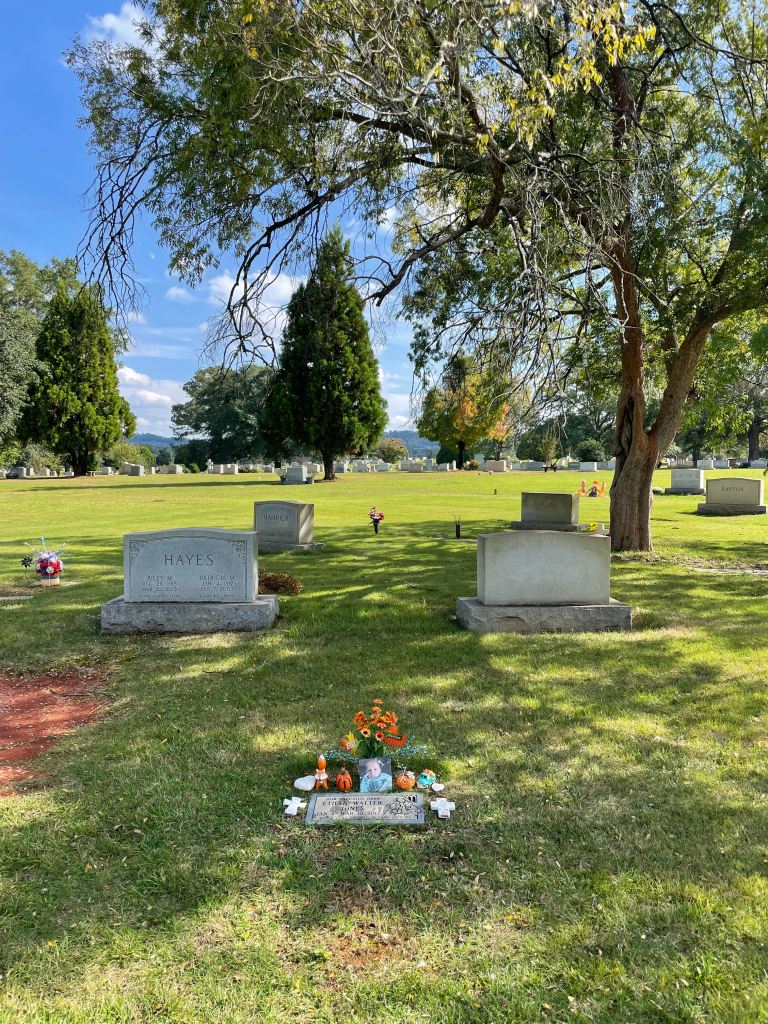
The fake cemetery in the yard down the street may have headstones with funny inscriptions, but my baby’s name is inscribed on a real marker in a real (and actually quite beautiful) cemetery where his real body lies waiting for the resurrection of the saints.  And on that day, their creepy, bony arms won’t shoot out of the ground like those tacky skeletons.  They will be raised imperishable, fully embodying all that God designed for us to be.   Until then, it is a struggle to believe that His promise of resurrection is true, especially in October.  All the decorations make it hard to follow the command found in Phillippians 4:8.

Finally, brothers, whatever is true, whatever is honorable, whatever is right, whatever is pure, whatever is lovely, whatever is admirable— if anything is excellent or praiseworthy— think on these things. 

Phillippians 4:8

I’m doing my best over here.  So can we just stick to pumpkins next year?  Please?

What is in a Name?

Ethan’s Dad: We are studying the book of Matthew in Bible Study Fellowship this year, and right near the beginning when Matthew is relating the angel’s revelation of Christ’s birth to Joseph, the angel commands Joseph to name Christ “Jesus, because He will save His people from their sins.” (Matthew 1:21). This signified God’s plan from the foundation of the world to enable humanity to spend eternity with God. Matthew then comments that Jesus’s birth also took place to fulfill a prophecy (from Isaiah 7:14) about the Messiah which said: “The virgin will conceive and give birth to a son, and they will call him Immanuel” (which means ‘God with us’).” (Matthew 1:23). This indicated that Christ would walk among us and experience our humanity in all its highs and lows.

This idea that Christ is both with us and saves us is a vital truth. A lot of times we tend toward either/or thinking: things are all one way or all another. We do this because it is easier than seeing nuance in the people who cross our path and in comprehending the issues that confront us in our lives. That is one of the many reasons this COVID thing has been so difficult; there are no clean answers to how we live with it. But Jesus is sufficient for our needs, and that is reflected even in His names.

The fact that Jesus came to save His people from their sins demonstrates that the here and now is not everything. The people who live as if it is misunderstand the purpose of this life, which is a staging ground for eternity. So much of what Christ talked about referred to His Kingdom, which is not of this world (John 18:36), and which must be comprehended through the lens of eternity. For example, when Jesus said “the meek will inherit the earth” (Matthew 5:5), He did not mean they would possess this earth; indeed, if anything, the truly humble are mocked for their refusal to “get while the getting is good.” No, Jesus meant that the humble will inherit a place of honor in eternity. The same is true for several statements in the Old Testament. Many Christians like to quote Jeremiah 29:11, which says in one translation: “‘I know the plans I have for you,’ says the Lord, ‘plans to prosper you and not to harm you; plans to give you a hope and a future.'” This verse is so popular that you see it on t-shirts, on coffee mugs, on bookmarks, and on Bible covers. There is an assumption among some Christians that this passage somehow means that God is going to make sure your life on this earth goes swimmingly. Some even use it to claim that God intends to make them rich. But if you read Jeremiah chapter 29 in its entirety, you discover that the Lord says this to the Israelites at the same time He is telling them that they will be in exile in a foreign land for 70 years. So, why would God make a promise like the one in verse 29 if most of the Israelites were going to be in captivity for the rest of their earthly lives? It seems obvious that a life of captivity in a foreign land was not a recipe for a prosperous life. But that is because God was not just talking about the immediate here and now – which in itself required patience for those who would live beyond the 70th year — but the future: God did indeed have a plan to prosper His people — for all eternity. And so on it goes for many of the promises in the Bible. Jesus said, “In this world you will have trouble, but take heart! I have overcome the world.” (John 16:33). In other words, our comfort for troubles in this world is knowing the Jesus has ultimately defeated sin and death, and we can look forward to that triumph.

But that does not mean this life is nothing, or an illusion, or not worth investing in. Jesus, Immanuel, came to be with us, in this life, on this earth. This part of life has significant meaning too. “By His will we live, move, and have our being.” (Revelation 4:11). We are purposefully here, living these lives to become more like Christ and to bring others to a saving knowledge of Him. I am reminding myself of that in writing it. Sometimes I want to fly away to Ethan, to leave behind the questions, the difficulties, and the drudgery that accompanies this existence. But “the earth is the Lord’s, and everything in it, the world and all who dwell in it.” (Psalm 24:1). So as much as salvation for eternity is a gift, this life is a gift as well. This is why Ethan’s life being cut so tragically short is so immensely hard to live with and to understand. Yet, the fact that Jesus is “God with us” proclaims that presence on this earth — no matter how short — is a treasure. Thus, Ethan’s conception, his birth — as crazy as it was — his short two-months of frail, struggling presence with us, mean more than just the bare facts of their happening. They mean God wants him, that Ethan is a part of the vast image of God we all reflect, that we are meant to be part of Ethan and he of us, and that Jesus was, and is, with Him too.

“Great are the works of the Lord, they are pondered by all who delight in them.
Splendid and majestic is His work, and His righteousness endures forever.
He has caused His wonderful acts to be remembered, the Lord is gracious and compassionate.” (Psalm 111:2-4).

I confess that sometimes I can get so wrapped up in Ethan’s death that I forget the loving kindness of his life. The name “Ethan” is Hebrew, and it means “strong,” “safe,” “solid,” and “firm.” We did not pick it because of its meaning, but I truly believe that Ethan was strong to stay with us as long as he did. I will always long for his presence and wonder why he could not have stayed with us. But because he was here, he was a splendid and majestic work, and he is remembered. And because Jesus is both “God with us” and the One who “saves His people from their sins,” that is not all there is to Ethan’s story. In Jesus’ arms he waits for us, where we will continue life in the Kingdom, together.

Springtime in Ethan’s Garden

Ethan’s Mom: Happy Eastertide – here we are on the “other side” of the event that changes everything, Jesus’ death and resurrection. As expected, March was difficult, but again, I was surprised by the different manifestation it took this year. For some reason, I found myself really struggling to respond to the acknowledgements of friends and family when that hasn’t been an issue before. Sometimes the bereaved struggle to find words just as much as those who seek to comfort them. So if you are reading this, know that I read every text/email/card multiple times, and they each brought comfort to my heart. My precious sister-in-law expressed a desire to “take a little patch of the weeds and tear them down” in reference to the figurative language from my last post. Truly, knowing that people remembered Ethan, prayed for us, reached out to us, and said his name did keep the weeds from completely taking over. Thank you.

Yesterday, God lifted my gaze away from the weeds and onto the beauty of the garden. Our BSF study notes stated this week, “…if God takes away what we treasure, we can trust that His loving care and faithfulness will go with us into life with the loss…If something you once held dear is gone, how has God met your deepest needs?” I had to think about that one for a few days. One of our deepest needs as Ethan’s parents is to know that his life mattered. Another is reassurance of God’s love and design for us, which includes the consummation of His redemptive plan at Christ’s return. Both of these needs were met in a sweet experience at our kids’ preschool this week.

After Ethan died, family and friends who wanted to make a donation in his memory contributed to the preschool our children have attended, which is also a ministry of our church. In fact, many of the teachers have come to feel like extended family as they have cared for at least one of our children each year for the last decade. In 2017, our middle two children were in the crawler and 3K classrooms, and the school did so much in taking care of them (and us!) in special ways during that very difficult spring. Two years later, they welcomed Ethan’s twin brother to school and acknowledged our pain of not dropping off two boys to their first day of 2K.

It took a while to decide on something to do with the fund that would be both meaningful and useful. But eventually, both the preschool director and I came up with the same idea – a garden. The money was used to buy materials to rehab a small section of landscaping on the playground into Ethan’s Garden. Two master gardeners from our church (one of whom planted our backyard Ethan’s Garden) prepared the soil and planted a Japanese maple tree and a row of Lenten roses along the back. In the summer of 2019, Ethan’s Garden was dedicated in a small ceremony attended by preschool staff, church family, and other friends and family. Ethan’s dad made a beautiful speech, and I led everyone in “A Liturgy for the Planting of Flowers” from Every Moment Holy Volume I. We then planted flowers while a friend sang “Hymn of Promise.” It was a beautiful and bittersweet ceremony.

Yesterday we planted petunias with the 3K class that our boys should be in together. The children experienced God’s creation as they dug holes, scooped dirt, and watered the new plants. As we smelled the fresh leaves, felt the moist soil, and observed the delicate roots, we talked with the children about how God satisfies the needs of each flower with sun, rain, and nutrients from the soil. Some asked about the caboose bird feeder in the center, and we told them it was a reminder of our son. I think it was a special experience for the children; it certainly was for me.

After the children went back inside, Ethan’s dad and I read the same liturgy from the garden’s dedication. These words brought tears to my eyes:

“[These flowers] are a warrant and a witness, each blossom shouting from the earth that death is a lie, that beauty and immortality are what we were made for. They are heralds of a restoration that will forever mend all sorrow and comfort all grief.”

After the darkness and doubts of the past several weeks, I needed the testimony of these delicate witnesses. Through them, God met my need for a reminder of his faithfulness.

The liturgy then moves on to a request for God’s blessings on the newly planted flowers and closes with this benediction:

“Let these flowers, O Lord, bear witness in their deepest natures to eternal things. Let our lives also, O Lord, do the same. Amen.”

As Ethan’s dad said at the garden’s dedication, “it is our hope and prayer that a tiny mental seed will be planted of God speaking to [the children] about life and growth and how death is not the end of the story: that God gives new life to all who believe in Jesus.” These flowering witnesses were planted in a garden created because of Ethan. His short life bears witness in its deepest nature to eternal things — on the playground, in our home, and in my heart. God used this small garden to show me that Ethan’s life mattered and matters still as God uses him to bear witness to His love, just like the flowers in a springtime garden.

Springtime by Chris Renzema

You’re the resurrection
That we’ve waited for
You buried the night
And came with the morning
You’re the King of Heaven
The praise is Yours
The longer the quiet
The louder the chorus

We will sing a new song
‘Cause death is dead and gone with the winter
We will sing a new song
Let “Hallelujah’s” flow like a river
We’re coming back to life
Reaching toward the light
Your love is like springtime

You’re the living water
God, we thirst for You
The dry and the barren
Will flower and bloom
You’re the sun that’s shining
You restore my soul
The deeper You call us
Oh, the deeper we’ll go

We will sing a new song
‘Cause death is dead and gone with the winter
We will sing a new song
Let “Hallelujah’s” flow like a river
We’re coming back to life
Reaching toward the light
Your love is like springtime

Come tend the soil
Come tend the soil of my soul
And like a garden
And like a garden I will grow
I will grow

We will sing a new song
‘Cause death is dead and gone with the winter
We will sing a new song
Let “Hallelujah’s” flow like a river
We’re coming back to life
Reaching toward the light
Your love is like springtime

The Struggle

Ethan’s Dad: It has been four years, but I continue to wrestle with it as I did right after it happened. The main differences are that the struggle is not there all the time and the questions are quieter and more subtle. I function fairly normally most of the time now. The fight sits in a pit deep within and emerges at various times — sometimes predictably, like in the week of all weeks in March, and sometimes unexpectedly, like when Ethan’s twin brother randomly does or says something that makes me wonder what Ethan would have said or done right next to him. It no longer pervasively cripples, but it does loom.

One recent example is when I (again) heard death generically described as a natural part of life. Mentally I understand why people say this: because people die every day, and everyone will experience loss in their lives. Certainly, with the pandemic that reality has hit home in a lot of places this past year. In a way, I suppose the statement is meant to be a comfort, so that you know everyone has a sense of what you have experienced. But there is a part of me that cannot help but take it as a gross trivialization of a genuine wrong. The fact is that not every parent loses a child, and not every parent only has two months with a child. My point is not to rank our pain above someone else’s, but to make people stop and think about what they are saying. All death is loss. All death is tragic. All death is wrong in the sense that it was not God’s original intent for His special creation called humanity. We know this and we feel it because the part of us that is not physical — our spirits — tell us so. The fact that Ethan was eventually going to die does not make his premature death any less tragic. We hold “celebrations of life” for people who live long and make lasting impressions on those around them. Ethan never had that chance. We can be thankful we got the opportunity to hold him — absolutely that was infinitely better than if he had not survived the first ambulance ride — but there is nothing wrong with mourning the fact that we did not get to see him (and Ethan did not get to experience) crawling, or walking, or talking, or laughing, or jumping on the trampoline, or reading a book, or giving us a hug, or . . . . the list is as long as a regular life. Death in this present world is a natural part of life, but a child’s death is not in the natural order of things. And, in any event, just because something is “natural” does not make it right. That is the very reason Christ calls us to be new creations and why He is coming back to bring a new Heaven and a new earth where there will be no more death, or mourning, or crying, or pain. The old will pass away and He will make all things new. (Revelation 21:4-5). Until that day, I will struggle with this loss.

Some might say that struggle is wrong. That I am failing to find peace in Christ. That I am arrogantly challenging God and His ways, which are perfect and irreproachable. But I don’t think God really sees it that way. Recently in BSF we studied the story where Jacob wrestles a “Man” from night until daybreak. The Bible records it this way:

“Jacob was left alone, and a man wrestled with him until daybreak. When the man saw that he could not defeat him, he struck Jacob’s hip socket as they wrestled and dislocated his hip. Then he said to Jacob, ‘Let me go, for it is daybreak.’ But Jacob said, ‘I will not let you go unless you bless me.’ ‘What is your name?’ the man asked.

“‘Jacob,’ he replied. ‘Your name will no longer be Jacob,’ he said. ‘It will be Israel because you have struggled with God and with men and have prevailed.’ Then Jacob asked him, ‘Please tell me your name.’ But he answered, ‘Why do you ask my name?’ And he blessed him there. Jacob then named the place Peniel, ‘For I have seen God face to face,” he said, ‘yet my life has been spared.’ The sun shone on him as he passed by Penuel — limping because of his hip.” (Genesis 32:24-31, CSB).

I have to confess that I have always found this story to be a strange one. It raises a lot of questions. Chief among them is: Who is this “man” that Jacob wrestled? There are several clues suggesting that the “man” is God in human form; indeed, it very well might be Jesus before the Incarnation. First, the “man” is able to dislocate Jacob’s hip just by touch. Second, Jacob seeks a blessing from the “man.” There would be no reason for Jacob to do that unless he believed the “man” was of divine origin. Third, the “man” renames Jacob. In ancient times, naming something indicated dominion over it.

You might wonder: “If it is God, who is all-knowing, how come He had to ask Jacob his name? But God does this all the time, that is, ask a question He already knows the answer to. He did the same in the Garden of Eden when He asked Adam and Eve where they were after they ate the fruit, and when He asked them what they had done. God did the same with Cain when He asked Cain where his brother Abel was after Cain had killed him. God does not ask such questions to gain information, but rather to test the respondent’s heart. Here, God wanted to see if Jacob would respond differently than he had when Isaac had asked who he was when Jacob and his mother were conspiring to trick Isaac into giving Jacob the blessing Isaac meant for Jacob’s brother, Esau. There Jacob had lied about who he was; but to the “man” he was honest about being Jacob, which means “the deceiver.” In essence, he was confessing who he had been to God.

A fourth clue as to the identity of the “man” is that when Jacob asks for His name, the “man” responds with incredulity at the question. This reaction is either because the “man” believed Jacob should have already known who He was, or because no name is adequate to describe God. It is reminiscent of when Moses asked God at the burning bush who he should tell the Egyptians sent him to them. God responds: “I am who I am.” (Exodus 3:14). That response may seem tautological, but that is the point. There is nothing that describes God except God because He is incomparable.

Fifth, the “man” does bless Jacob. God is the only one who truly can shower people with blessings because everything good comes from Him. (James 1:17). The sixth clue would seem to be a giveaway: the “man’s” translation of Jacob’s new name, Israel, is that Jacob “struggled with God and with men and has prevailed.” This would seem to indicate that the “man” is simultaneously God and man. Finally, after the “man” leaves, Jacob names the place where this event occurred and says that he has “seen the face of God” and yet his life had been spared. This is a big statement because even Moses only saw God’s “backside” because God said no one could see Him in his glory and live. Of course, seeing this human representation of God was different than seeing God the Father, but it was still clearly awe-inspiring for Jacob.

Okay, so if the “man” was God, why in the world was Jacob wrestling Him? After all, that seems like a losing proposition — wrestling the most powerful being in existence. Yet, then we see another curveball because the text says “the man saw he could not defeat [Jacob],” and then that Jacob “prevailed.” How is it remotely possible that Jacob could prevail over God? And again, why are they wrestling at all, alone in the middle of nowhere?

This is where the reasons this story is in the Bible start to be revealed. The answer to the first question is, of course, that God let Jacob win, though not without providing him with a reminder of his own weakness (the hip which produced a limp). Why would God let Jacob win? Because it is only through God’s seeming defeat that the true blessing could come. For you see (this observation comes courtesy of St. Augustine), we have here a picture of the Cross: the place where man and evil seemingly prevailed over Jesus, bringing about His death, but only because He (and God the Father) willingly submitted to it. He did this because it was only through the death of the perfect, spotless, Lamb of God that sin’s penalty could be paid, and that we could be given the blessing of new (and eternal) life. The “man” lets Jacob win, and only after that does He give Jacob his new name, Israel, and give him the blessing. And what was that blessing? Seeing God and (in a sense) being granted new life. In the end, this is also our blessing when we trust in Jesus.

But what was essential for all of that was the struggle, the wrestling that lasts the night and then gives way with the dawn of morning. Jacob starts alone in the night, no doubt wondering whether God is really with him, whether God really loves him and will keep His promises to Him. This is the true beginning of the struggle. Then the “man” appears and the fight ensues. As the fight goes on, no doubt Jacob’s inner struggle intensified: needing to will himself to go on as he grew weaker, reproving himself for mistakes that may give the “man” an upper hand, coming to realize that he was not at all worthy to be engaging in a match with this “man” in the first place. Then comes Jacob’s “victory,” which solely comes by grace from the “man,” which is demonstrated by the injury inflicted solely by the “man’s” touch. The blessing follows only after Jacob realizes who the “man” really is: he sees God and lives. But Jacob does not (and perhaps could not) experience this revelation without the struggle and hurt, the effects of which he would bear for the rest of his earthly days.

Jacob had to come to a place where he understood that he could no longer be who he was: the deceiver relying on his own wits to thrive. Instead, he needed to rely on the Truth — God — in order to receive the blessing that would last for eternity. The only reason Jacob “wins” this struggle is because the Lord is involved in it. If Jacob had only been wrestling with himself, he would have lost from despair — as anyone who has experienced bouts of depression can attest. Thus, struggles of belief do not lead anywhere if they do not actively involve God. God does not despise being tested or challenged if the one posing the challenge is genuine and honest. When Satan tempted Jesus by telling Him to throw Himself off the Temple because God’s angels will rescue Him, and Jesus says, “It is written: Do not put the Lord your God to the test,” Jesus refers to frivolous testing, challenges that mock God, as Satan proposed, rather than genuine questioning that comes from a seeking heart.

So, when I struggle with Ethan’s death, with God allowing such an evil to transpire, I do not think God despises it, blames me for it, or turns His back on me because of it. I think He expects it, hopes for it, and engages with it. The last thing He would want me to do is ignore it or assume He could have done nothing about it (and in doing so deny that God exists). The question is whether I am getting somewhere in the struggle. If it is a perpetual stalemate, then nothing comes of it, the dark of night always remains with no ray of sunshine peeking through the gloom. But if I am “winning,” even ever so slowly, by His grace, then I am coming closer to seeing God for who He truly is. That “sight” might not be the benevolent uncle or Santa Claus that people often like to imagine God being, but something more complex, scary, and mysterious. But if it is closer to Him, then the expectation of who He is needs to be shattered to make the vision clearer.

This is why our understanding of God and the incarnation of Jesus changes (or should change) over time. As children, we are taught about the God who created, who promised with a rainbow, who parted the sea, and who protected in a Lion’s den. These stories reflect the timeless character of God, but as we grow we ponder the presence of the Tree of Knowledge, the children who died in the flood, the Christians in the Roman coliseums who were torn apart by lions. Likewise, early in our walk, we are taught about Jesus the teacher, the healer, the good shepherd who cares for His sheep. These ideas are not wrong: they absolutely need to be a foundation for what follows, and we must be reminded of them throughout our lives. But they are not the whole story. For there is also Jesus the turner of tables in the Temple, Jesus the stern rebuker of the Pharisees, Jesus the questioner of Peter and confronter of Saul, Jesus the washer of feet, Jesus the anguished in the Garden, Jesus the transfigured on the mountain, and more.

In its essence, “the struggle” means coming to a better understanding of Christ’s death and resurrection: “seeing God” for who He really is more clearly on this side of Heaven. To be honest, that is what this wondering about Ethan’s loss produces in me. Resolution does not fully come because on this side I cannot see it all — but I yearn to, and do, see more. I would be lying if I said that the view is entirely easy on the eyes of my heart, but if my heart is closer to His, then that is something. It does not replace Ethan, but He knows that, because He knows our sorrow:

“You keep track of all my sorrows.
You have collected all my tears in your bottle.
You have recorded each one in your book.”(Psalm 56:8, NLT).

“He was despised and rejected—
a man of sorrows, acquainted with deepest grief.
We turned our backs on him and looked the other way.
He was despised, and we did not care.” (Isaiah 53:3, NLT).

And one day there will be a restoration:

“It will happen in a moment, in the blink of an eye, when the last trumpet is blown. For when the trumpet sounds, those who have died will be raised to live forever. And we who are living will also be transformed.

“For our dying bodies must be transformed into bodies that will never die; our mortal bodies must be transformed into immortal bodies. Then, when our dying bodies have been transformed into bodies that will never die, this Scripture will be fulfilled:

“Death is swallowed up in victory.
“‘O death, where is your victory?
“‘O death, where is your sting?’” (
1 Corinthians 15:52-55, NLT)

On that day, the struggle will cease because I will see Jesus clearly, I will see Ethan again, and there will be rest for my soul.

A Story for Our Time

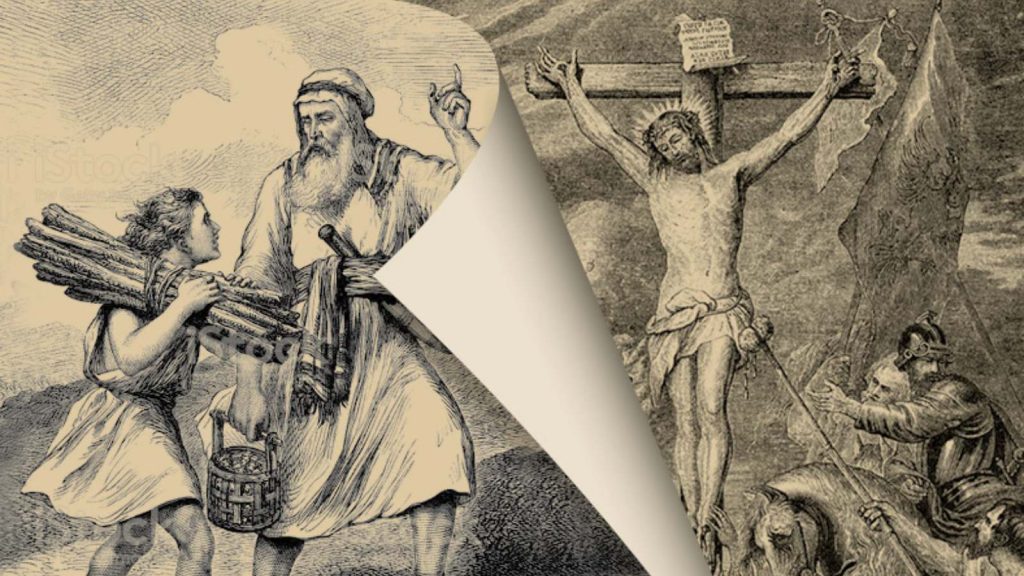
Ethan’s Dad: As my last post noted, we recently celebrated the twins’ fourth birthday. In our Bible Study Fellowship classes, the lesson for Ethan’s Mom and I that week of Ethan’s birthday was Abraham’s sacrifice of his son Isaac (Genesis 22:1-14). People who believe or live as though there is no spiritual aspect to life would ascribe that kind of occurrence to a mere coincidence, but if you believe that God exists, that He loves you, and that He is active in your life, then it is not so easy to dismiss this scheduling alignment.

So why would God have us study that particular story on that particular week? From a certain point of view, it seems cruel to have to ponder a story about God asking Abraham to sacrifice his son on the same week we remember the coming into the world of the the son we lost. And I don’t want what I am going to relate here to obscure the reality that engaging with the lesson was painful. To be sure, there are key differences between Abraham’s experience and ours: God did not ask us to give up Ethan, like He commanded Abraham to sacrifice Isaac, and our son was actually taken, without warning or explanation, while Abraham ultimately received the grace of not having to go through with the horrible deed and thus retained his son. Perhaps most importantly, the Genesis text expressly states that God was testing Abraham (22:1). As I have related in this blog before, I steadfastly believe that Ethan’s death was not a “test” from God: death is evil; it is not part of God’s original plan for us, and ascribing a tragedy like that to some sort of spiritual maturation process co-signs Ethan to being nothing more than a pawn in other people’s lives, which is absolutely wrong.

Even though we can mentally recognize those differences, the story still evokes strong emotions because of our experience. We understand what is being asked of Abraham in a tangible way few others can. Likewise, we have a deeper sense of what it actually meant for God to sacrifice, and be separated from, His Son Jesus on the Cross. (Though no human can adequately grasp the level of that sacrifice because Jesus physically endured an almost unimaginably grotesque death, He spiritually bore the entire sin of the world for all-time, and He and the Father had never before experienced the separation this sacrifice required). But if you asked us, we would say in a heartbeat that this deeper sense of understanding the magnitude of the loss at issue is not worth it. Indeed, there have been numerous times in the wake of that most horrendous of days that we have questioned whether this whole way of setting things up makes sense or was worth it. Why would God create a world where He knew so much pain was going to be inflicted on people He says He loves?

But then you have to remember Genesis 3:15 (“And I will put enmity between you and the woman, and between your offspring and hers; he will crush your head, and you will strike his heel.”) which tells us that God also set up this world in such a way that His Son (and therefore also Himself) was going to hang on a tree by nails in order to save us. So we can’t say that God is ducking any of the pain or that this is some kind of cruel joke or game He is playing because no rational person would set up such a wrenching game. In other words, God could identify with Abraham, and He can identify with us, just as we can with them.

And that truth got me thinking that perhaps the reason God had us do this particular lesson on this particular week was to identify with Abraham all the way through the story — not just in the sense of loss — but in order to affirm to us that Ethan was a precious gift to us, just as Isaac was to Abraham. For just as Isaac’s conception and birth were miracles, it also was a miracle that Ethan was born safely in that ambulance four years ago. As his only child, Abraham undoubtedly had spent a tremendous amount of time with Isaac before God gave this test to Abraham. We spent two priceless, brief months with Ethan, caring for him more intensely than any other baby we have had, up until the very moment he left us. But there is more to the parallel. Abraham was able to obey God’s command because Isaac’s life was a testimony to the facts that God always keeps His promises and that God does impossible things. According to Hebrews 11:19, Abraham in fact was clinging to the belief that Isaac would be raised from the dead, even though he had no concrete experience of such an event. But Abraham did know that God had demonstrated the power to create life from Sarah’s “dead” womb, and so Abraham firmly believed (because otherwise how could he ever have taken even the first step toward that mountain?) that even Isaac’s death could not hinder God from keeping His promises about Isaac and his offspring.

It is true that God endured the sacrifice of His Son while knowing that that Jesus was going to be raised from the dead, while Abraham had to rely on faith in carrying out God’s command to sacrifice Isaac. But that is precisely the point: we must come to understand that faith in God is as certain as actually knowing how it all ends. God commended and blessed Abraham, He preserved Isaac in the flesh, and He saved Abraham for eternity precisely because of Abraham’s indomitable faith in what was true: that God is a promise-keeper who does the impossible, including resurrection. Thus, to God knowing the answer is not as important as having faith in Him that there will be an answer.

Yes, this story of Abraham and Isaac is about how obedience to God may involve great sacrifice — though not more than God already has sacrificed for our salvation. But it is just as much about sustaining faith in God’s power of resurrection. So perhaps God was reassuring us on that particular week that His gift of Ethan to us was not in vain; we, like Abraham, can believe with confidence that we will see Ethan again because God ensured exactly that with none other than His own Son, who lives and is with Ethan at this very moment. Praise the Lord for His comforting truth in the midst of great sorrow!

The Futility of Going Back to the Future

Ethan’s Dad: Have you ever noticed how much people are obsessed with time? The common observation is that ours is a fast-food culture, which means we want/demand everything to happen as instantly as possible. But the obsession doesn’t stop there. Countless stories, television shows, and movies revel in imagining that we could manipulate time — whether that entails traveling backward to remedy tragedies and mistakes or jumping forward to discover what awaits us, and they posit questions about the consequences of moving either way on the timeline. We long for this power over time even though there is no realistic indication that we could obtain it.

But that does not stop people from thinking about the possibility of time-travel. In this vein, I recently read a news story about the paradox of time-travel. The paradox of time-travel is that if a person was to travel back in time in order to fix something that went wrong in history — like trying to prevent Adam and Eve from eating the fruit that caused the fall of humanity into sin — fixing that problem would mean that the problem would no longer exist when that person returned to his or her own time, so there would be no motivation to go back in time in the first place. Put another way, things happen the way they happen, and if they unfolded another way than was intended we could never know it because we are creatures of the time we are born in. However, a prolific young scientist in Australia claims to have demonstrated through mathematics that the paradox of time-travel does not exist. The young man says that if you were to go back in time and fix a problem, events would conspire in such a way that the problem would occur anyway. In the example I just referenced, if you stop Adam and Eve from eating the fruit, someone else would still disobey God, and we would still have sin. So, the motivation for going back to fix the problem would still exist for the time-traveler, and thus there is no paradox. Of course, if the Australian mathematician is correct, the lack of a paradox also means that even if humans could go back in time, they could only change a particular variable of time, not what ultimately happens in the timeline. In other words, there is an inevitability to the unfolding of events even though human agency makes deliberate choices about how to do things.

You might think this is a strange topic to explore in this blog. But to me this theory sounds an awful lot like God’s planning of time in this world. We know choice exists because without it love would not be real. However, we also know from the Bible that God has had a plan from before the beginning of time as to how humanity’s arc, and God’s salvation, would unfold. One of the verses I recite every time I visit Ethan’s grave is a paraphrase of Titus 1:1-2: “The faith of those chosen of God and the knowledge of truth are a faith and knowledge that rest in the hope of eternal life which God, who does not lie, promised before the beginning of time.” The prophet Isaiah proclaims: “O Lord, You are my God; I will exalt you and praise your name, for in perfect faithfulness You have done marvelous things, things planned long ago.” (Isaiah 25:1). Ecclesiastes 3:11 (my all-time favorite verse) informs: “[God] has made everything beautiful in its time; He has also set eternity in the hearts of men. Yet they cannot fathom what He has done from beginning to end.” These (and many other) Bible verses point to God setting up time as an unfolding story and yet planning for eternity even before He started the clock of history. People often wonder how these two things can be simultaneously true. But if time operates in such a way that we are able to make deliberate choices and yet the grand sweep of history unfolds only one way, i.e., we cannot manipulate the timeline (because we are not God), then it seems to me that we have at least a partial answer to the mystery. God has designed our timeline in such a way that our billions of variable choices impact us, but they do not affect the destination of history, which culminates with salvation through Christ for all who believe.

Pondering such a model of existence is both mind-boggling and awe-inspiring. The question that often arises from such pondering about time and eternity is: why would God set all of this in motion if He knew about all of the atrocities that would subsequently transpire? Or, as Fyodor Dostoevsky famously asked in “The Grand Inquisitor” chapter of The Brothers Karamazov: How can God say that all of this is worth the suffering of even one starving child? The consequences of the abhorrent evil Adam and Eve brought into this world are enormous, some would say, incalculable.

I think the answer to The Brothers K question lies in coming to appreciate that there is no reason that we should exist at all apart from God’s grace. God was here before all of the creation we see and that we are still discovering: Absolutely nothing required Him to make all of this and all of us in the first place. He never had to say “Let there be light.” He could have left Earth formless and void. Nothing mandated that He create creatures in His image. Yes, there is a whole lot about this world that is evil and dark and relentlessly unforgiving; viruses are part of that, as are the unexplained deaths of infant children, and seemingly a million other cruel things. But before all of that there was God. And by His own choice, first there was light, and then there was the gift of life. And all of that was immeasurably good. Moreover, beyond the irreplaceable gift of existence is the fact that God accounted from the beginning for humanity’s going astray, and His solution to that immense problem entailed sacrificing His own Son. If we stop and think about all of that first, before all else, it should produce a profound sense of gratitude and thankfulness. As the Psalmist said: “It is good to proclaim your unfailing love in the morning, and your faithfulness in the evening.” (Psalm 92:2). Such an attitude of thankfulness as a starting point can change our perspective of what we see before us. It does not erase evil, but it reminds us that the good, that life itself, is not a brutal fact of necessity, but is truly a gift from God.

I always lament (and forever will) that Ethan did not get to live more of this life, but I am thankful that He lived at all, and I should remember that the same is true for me and everyone else. As the Psalmist also reminds us, “For with You is the fountain of life; in Your light we see light.” (Psalm 36:9). The light of life is sparked by thankfulness to the God who gave us everything. Can we honestly say that never existing would have been better than the evil that plagues the world, especially given what God foreshadowed in the Garden of Eden and brought about through Jesus? The Lord declares: “I make known the end from the beginning, from ancient times, what is still to come. I say, ‘My purpose will stand, and I will do all that I please.'” (Isaiah 46:10). That end is this:

“The Lord God will swallow up death forever.
He will wipe away the tears from all faces;
He will remove the disgrace of His people from this whole earth.
For the Lord has spoken.

And in that day it will be said: ‘This is our God;
We have waited for Him and He has saved us.
This is our Lord;
Come let us be glad and rejoice in His salvation.'”

(Isaiah 25:8-9).

The inexpressible hope of this end to time-bound life is why God’s answer to Job in chapters 38-41 of that difficult work is not as heartless as it can seem from our perspective of sympathizing with Job’s immense suffering.

“Then the Lord spoke to Job out of the storm. He said:

“Who is this that obscures my plans
with words without knowledge?
Brace yourself like a man;
I will question you,
and you shall answer me.

“Where were you when I laid the earth’s foundation?
Tell me, if you understand.
Who marked off its dimensions? Surely you know!
Who stretched a measuring line across it?
On what were its footings set,
or who laid its cornerstone—
while the morning stars sang together
and all the angels shouted for joy?

“Who shut up the sea behind doors
when it burst forth from the womb,
when I made the clouds its garment
and wrapped it in thick darkness,
when I fixed limits for it
and set its doors and bars in place,
when I said, ‘This far you may come and no farther;
here is where your proud waves halt’?

“Have you ever given orders to the morning,
or shown the dawn its place,
that it might take the earth by the edges
and shake the wicked out of it?
The earth takes shape like clay under a seal;
its features stand out like those of a garment.
The wicked are denied their light,
and their upraised arm is broken.

“Have you journeyed to the springs of the sea
or walked in the recesses of the deep?
Have the gates of death been shown to you?
Have you seen the gates of the deepest darkness?
Have you comprehended the vast expanses of the earth?
Tell me, if you know all this.

“What is the way to the abode of light?
And where does darkness reside?
Can you take them to their places?
Do you know the paths to their dwellings?
Surely you know, for you were already born!
You have lived so many years!

“….

“Do you known the laws of the heavens?
Can you set up God’s dominion over the earth?

“….

“Who endowed the heart with wisdom
or gave understanding to the mind?

“….

“Would you discredit my justice?
Would you condemn me to justify yourself?

“….

“Then Job replied to the Lord:

“‘I know that you can do all things;
no purpose of yours can be thwarted.
You asked, “Who is this that obscures my plans without knowledge?”
Surely I spoke of things I did not understand,
things too wonderful for me to know.

“‘You said, “Listen now, and I will speak;
I will question you,
and you shall answer me.”
My ears had heard of you
but now my eyes have seen you.
Therefore I despise myself
and repent in dust and ashes.'”

Job 38:1-20, 33, 36; 40:9; 42:1-6.

God was not saying to Job that He did not care about Job’s suffering; after all, He was very careful to curtail Satan’s desire to destroy Job. But God was saying that He has existed from before the beginning of time and that He created this world with His own rules and intentions. For some reason, God did not (fully) reveal the end of history to Job, and, as with Job, He does not reveal all of the reasons for the shattering events of our earthly lives. Yet, for us to question God’s ways without accounting for the entire picture is to approach sophistry. The Lord does not despise heartfelt questions: God did not stop Job from asking his questions over and over again, and the Psalms are full of questions to God for why He allows things to occur the way they do. But God desires that we not assume a position of authority as if we have the knowledge and power only He possesses.

Accepting that we cannot fully comprehend why events unfold as they do, and that we cannot actually alter God’s plan, can bring some peace in the turbulence of life. For one thing, from these truths it follows that just because we cannot fathom a reason for an occurrence does not mean that there is no reason for it (a mistake often made by atheists). For another, it means that no matter how terribly we screw up, we cannot throw God for a loop because events will inevitably culminate with Jesus’s return, God’s victory over sin and death, and eternal life in glory with Him for those who believe. We must always keep this end in mind as we traverse our story in time because there will be life events we desperately wish we could do over.

For instance, it is only natural that I wonder about that March night and morning in 2017: that maybe if I had done just one thing differently Ethan would still be alive. But I cannot go back because, for whatever reason, this is how the story unfolded, and I am a part of this time, not outside of it like God. Moreover, as his mother and I know by now (though a part of each of us will always struggle to admit it), nothing we did caused Ethan to die. For a combination of reasons, unknown to us and to the medical world, his little body could not hold on anymore. He spent one last night and early morning close to us, and then he left and was welcomed into the arms of Jesus. And as painful as Ethan’s absence always will be during the remainder of our time here on earth, we must always remember that this catastrophic event is not the end of story. God, at the end of time, will, in a sense, undo time’s scars.

From His Word, we can see that God’s love overcomes this wretched evil and that the evil ultimately will be wiped away. This means that there is something in this time-bound life that is vital to our lives in eternity. Part of the importance is obviously God’s demonstration of His love for us, which had to physically unfold in order to be truly appreciated.  I have been saying that God is outside of time, but perhaps even more wonderous than that is the fact that God actually chose to enter our time in order to ensure its glorious ending.  God not only set time in motion; He marked its defining moment with His own presence, and then sacrifice.

But I suspect that part of the importance of living this life is the idea Andrew Peterson suggests in his song Don’t You Want to Thank Someone for This

“And when the world is new again
And the children of the King
Are ancient in their youth again
Maybe it’s a better thing
A better thing

“To be more than merely innocent
But to be broken then redeemed by love
Maybe this old world is bent
But it’s waking up
And I’m waking up”

There is some way that experiencing this life, both in its immense joys and wrenching sorrows, heightens our lives in eternity in a way that would not have been true if all of this had not occurred. We cannot know exactly how that is; our charge is to trust that this is true because of what we do know: that God so loves us that He gave His only Son to die for us, that Jesus rose again, and that one day we will spend eternity with Him. Those are the timeless truths for our time-bound lives.