A Tale of Two Sisters

Lenten Roses in Ethan’s Garden

Ethan’s Mom: Over the past year or two, I came to realize how many times we take stories from the Bible and make them about the people in the stories.  Be courageous like David standing up to Goliath, be obedient like Mary when the angel visits her, etc., etc.  In both the Old and New Testaments, we take the focus off of God and put it on the people.  Despite that in almost every case, a few chapters after Abraham, Noah, Moses, or David show great faith in God, the Bible will relate how these same men fail miserably in their ability to be the moral role models we make them into.  

Meredith Anne Miller, the author of the book “Woven,” has really opened my eyes to the extent in which we do this when we teach kids the Bible.  She advocates for a different approach, which she calls “God centered storytelling” – read a passage/story, make a list of things you notice God being or doing, teach the story focusing on one of those things, and end by asking the kids what else they notice about God.  She suggests this helps kids grow to trust God and lets the humans in the Bible be, well, human.  

One example of how I have internalized the “human centered storytelling” approach is in the story of Mary and Martha.  Growing up in and around church, I have heard many sermons and even read books about Lazarus’s two sisters.  In most situations, Mary is lifted up as an example to live by and Martha is the cautionary tale of being too worried about earthly things.  Let me give you a quick summary:

Mary and Martha are sisters.  One day Jesus and his crew came to their house.  Martha focused on welcoming them into their home and feeding them.  She was busy trying to make the house look good and generally give off a good impression so that she could be praised by Jesus for being the hostess with the mostess.  Mary, on the other hand, was focused on listening to Jesus.  She busted into the room with all the men, sat right at Jesus’s feet, and drank up all the wisdom from his teaching.  Martha gets mad, asks Jesus to fuss at her sister for being lazy and leaving her with all the stuff, and Jesus rebukes her.  Mary is the hero of the story because she chose the better thing.  Boo on you Martha for being worried about the stuff that doesn’t matter.  Be like Mary.  She’s awesome.  

A while later, Lazarus dies.  The sisters send word for Jesus to come.  Jesus stays where he is instead of coming to heal him.  When he shows up, Martha runs up to him and gives him a piece of her mind.  What were you doing Jesus?  If you had not taken your sweet time, you could have healed my brother.  Jesus starts talking theology to calm her down.  Mary comes out, asks Jesus where he’s been.  But this time, Jesus cries with her.  They go to the tomb.  Martha tells Jesus not to open the tomb because Lazarus smells.  Martha, we all know this, why do you have to point it out?  So uncouth.  Jesus says “Lazarus come out!” and happy ending.

Finally, Mary is also known to pour perfume on Jesus’s feet and anoint him with her hair.  Like her actions in the first part of the story, this is very brave and insightful of her.  Also, it is noted that Martha is serving the disciples when this happens.  Be like Mary.  Once again implied – don’t be like Martha.

OK, so that was a little tongue-in-cheek, but truly it’s not far off from my understanding of these two women.  I have always identified more with Martha than Mary.  I can say I am going to finish my BSF lesson or journal, but before I sit down, I’ll just need to put the clothes in the dryer or start dinner or run the vacuum.  One thing leads to another and suddenly it’s time to head to carpool or it’s past my bedtime.  I know I should be more like Mary, but somehow I default to Martha-mode every time.   And because Mary is the hero of the story as I have told it to myself, I am tempted to believe that Jesus loves the Marys and tolerates the Marthas – Marthas like me.  

But through the study, lectures, and notes from our BSF lesson on John 11 last week, I am starting to see how Martha is more than a cautionary tale; in fact, I realized that her siblings are not the only ones that Jesus loves.  Jesus loves Martha, too.

My teaching leader pointed out that the sisters send a message to Jesus that is simple and to the point:  Lord, the one you love is sick.  They don’t add any details or give any instructions.  Mary and Martha appear to trust that Jesus will help the one he loves.  The BSF notes also pointed out something I had never heard before.  The notes suggest that based on the timing of the message, Lazarus may have died that same day or even before Jesus received the message.  I have always kind of assumed that because the Bible says Jesus stays where he was two more days that he is intentionally waiting to come until Lazarus dies, which just seems kind of mean.  Either way, he receives the message and makes plans to head to Bethany in God’s timing, not in the sister’s suggestion.   

I thought there was something beautiful about being able to send for Jesus without needing a plan first.  We know that Martha is portrayed as the one working hard and taking care of things, but she doesn’t have to orchestrate this part of the crisis – she and Mary just tell Jesus the facts.  Nor do the sisters remind Jesus of why he should care.  Martha doesn’t give any reasons, like “Lord the one who opened his home to you or the one who donated to your ministry or the one who told all his friends that you are the Messiah…”  The only qualification is “the one you love.”  What if we did the same?  What if we came to Jesus, confident in our identity as his beloved, and just put the situation at his feet?  “Lord, the one you love is sick..or sad…or hurt…or lonely…”  Just sending that “simple” message to Jesus shifts the weight off of our shoulders and onto His.  In this situation, Martha and Mary both seem to get it right.

My brother-in-law and the BSF notes also drew out a different perspective on Jesus’s interactions with each woman after he arrives in Bethany.  First, Martha is the one who gets up and runs to Jesus first.  Mary stays put.  Maybe she was too sad to move, maybe she was the one who was angry with Jesus – we aren’t privy to the reason.  But Martha gets to Jesus first and says, “Lord, if you had been here my brother would not have died.”  I have always read that as an angry accusation.  As a person who has been hurt and confused by Jesus’ inaction when someone I love died, I don’t blame her for asking, even in anger.  But the notes suggest that “this if/only statement should not be seen as a rebuke of her Lord.  Martha expressed deep sorrow with confidence that Jesus could have prevented her brother’s death.”  Martha knows that Jesus could have intervened and does not question that he would have, had he only made it in time.  

But Jesus doesn’t leave Martha swimming in regrets and “if onlys.”  He starts right where she is and then engages her intellectually.  He knows how to talk to Martha and how to help her in this moment of despair.  He reveals himself as the resurrection and the life and guides her from “if only” to “I know” to “I believe.”   The BSF notes go on to explain:  “Our faith often stumbles when we lament the past or enumerate what did not happen…Like Martha, we can mourn the past and feel paralyzed in the present, even when we cognitively believe God’s promises for the future…What promise is God calling you to believe, not just to provide distant future hope but to find strength for today?”  

Once Martha is strengthened by belief, she goes to tell Mary that Jesus is asking for her.  When Mary comes out, we find Jesus engaging her emotionally, not intellectually.  As my brother-in-law pointed out in his lecture, Jesus doesn’t come at Mary with words of comfort, only his presence and compassion.  It is at this point in the story we get verse 35, famous for its brevity and profound in its meaning. “Jesus wept.”  He could not hold back the tears, despite the miracle that was moments away.  

Studying this passage and focusing on Jesus throughout the story was a very timely exercise.  Right now, we are in the ten weeks of the year that hold the most heartache.  There are always days during January, February, and March when I don’t operate at full capacity. In fact, today is one of them.  I don’t know why.  Nothing in particular is going on, just a cloudy day in February.  I have tried to go about my business today, but I keep finding myself staring off into space and wondering how the world can be so full of heartache.   

Looking back at Martha and Jesus’s first interaction helps me to know that Jesus loves me, even on the days when the weight of missing Ethan keeps me from “getting things done.”  He is troubled when his followers are grieving, including me.  The story of Lazarus shows that “the things that make us sad move Jesus’s heart” (BSF notes).  I can just say, “Lord the one you love is sad today” – no explanation or qualifications required – and, amazingly, the God of the universe is moved by my sorrow and meets me in it.  

And when the “if onlys” increase in frequency and intensity as we approach March 10th, I can remember how Jesus gently led Martha back to what she knew and ultimately what she believed about him.  Jesus is the resurrection and the life.  In 1 Thessalonians 4, Paul tell us what this statement means for those who are are “asleep” like Lazarus and for those who mourn them:  

Brothers and sisters, we do not want you to be uninformed about those who sleep in death, so that you do not grieve like the rest of mankind, who have no hope. For we believe that Jesus died and rose again, and so we believe that God will bring with Jesus those who have fallen asleep in him. According to the Lord’s word, we tell you that we who are still alive, who are left until the coming of the Lord, will certainly not precede those who have fallen asleep.  For the Lord himself will come down from heaven, with a loud command, with the voice of the archangel and with the trumpet call of God, and the dead in Christ will rise first. After that, we who are still alive and are left will be caught up together with them in the clouds to meet the Lord in the air. And so we will be with the Lord forever.

1 Thessalonians 4:13-17

The final time we see Martha in the book of John is in chapter 12.  John briefly mentions that she was at her house six days before Passover, serving Jesus, Lazarus, and the disciples.  While the men are reclining at the table, Mary pours out her expensive perfume and annoints Jesus’s feet.  There is not a rebuke for Martha this time.  Judas is the one to try and get Mary into trouble with Jesus, who defends her actions again.  I have to think that Martha’s heart was different during this dinner.   I think my heart is different now, too.  Martha and I have come into a deeper realization of who Jesus is through our experiences with grief.  The following song is one that I have listened to on repeat the last few years.  I wonder if it might have resonated with Martha as well.  Martha, the one Jesus loves after all.

Braver Still
I never saw it coming
There was no way to prepare
The world kept spinning 'round me
And left me standing there
And it's okay to grieve
A life that could not be
I'm trying to believe
In something better
Even if the dreams I had turned into dust
There's no wreckage that's too broken to rebuild
The world is just as scary as I thought it was
But Your love makes me braver still
Your love makes me braver
I spent my whole life running
Trying to find a place to rest
Why did it take a wound like this
To let You hold me to Your chest?
Now I can hear You breathe
You're singing over me
You're making me believe
In something better
Even if the dreams I had turned into dust
There's no wreckage that's too broken to rebuild
The world is just as scary as I thought it was
But Your love makes me braver still
Your love makes me braver
There is a valley
Where shadows are covering everything I hold dear
There in the darkness
I hear You whispering "I am here"
Even if the dreams I had turned into dust
There's no wreckage that's too broken to rebuild
The world is just as scary as I thought it was
But Your love makes me braver still
Your love makes me braver still
Your love makes me braver

-JJ Heller

When Knowing is not the Answer

Ethan’s Dad:

HERE’S A STORY ABOUT UNCERTAINTY. In the early 20th Century, technology kept improving and the instruments kept improving and the instruments used for scientific measurements kept growing more precise. So did the clocks, to the extent that train schedules could finally be synchronized across Europe. That different trains in different places could leave their stations at the same time — well, that was very important to the patent office in Bern, Switzerland. But it was also very curious to a clerk who worked there.

‘Albert Einstein said, we used to think we knew what ‘at the same time’ meant,’ says Hans Halvorson, a professor of philosophy at Princeton. ‘It meant “simultaneous.” And the whole relativity revolution was Einstein saying, “Wait, when we have really precise measurements, what we thought of as being the same time breaks down.” We don’t really know what it means to say something happened in New Jersey at the same time as something happened in Sydney, Australia.’

It turns out to be the driving force of the breakthroughs that define modern physics. ‘What happened,’ Halvorson says, ‘was that experimental techniques kept getting better and better so they could pin down things more and more. But what they were finding was that as one thing was pinned down more and more precisely, it was making other questions harder and harder to answer.’

This seeming paradox — more knowledge leading to less certainty — pertains more to quantum physics than it does to relativity. But according to Halvorson, the underlying philosophical questions have never been settled, ‘because there are people who very much hope that this is a temporary thing and we’ll eventually figure out how to beat it and others who think it’s telling us something about how we’re embedded in our reality. We have to figure out what it is about human beings that makes us think we can without limit make our knowledge more precise. Because that turns out not to be true.’

Tom Junod: How the Dez Bryant no-catch call changed the NFL Forever

Why am I starting a post by quoting from a sports article that was all about the vagaries of instant replay in the NFL? Because it unexpectedly contained an exposition about the human thirst for knowledge and, conversely, how that thirst seems cursed because it is never satisfied. To be sure, the philosophy professor quoted in the article does not say humanity is cursed; he describes it in terms of a scientific conundrum because “educated” people are not supposed to invoke primordial ideas like a “curse.” After all, we have evolved beyond such thinking, haven’t we? That was what the scientific revolution was all about as far as the post-modern world is concerned: ridding the world of religious superstitions.

Unless, of course, the “curse” is describing something inherent in the human condition. In the very first book of the Bible, Genesis, there is a story about how the first humans, Adam and Eve — who were special creations made by God in his image and likeness — destroyed their relationship with their Maker. (See Genesis 3). It is a story that, even in our ever-increasing religiously pluralistic society, nearly everyone knows. God told Adam and Eve that they could eat from any tree in the Garden of Eden except the Tree of Knowledge of Good and Evil. With some encouragement from Satan, who was disguised in the form of snake, Adam and Eve disobeyed God’s command and ate fruit from the Tree of Knowledge. Satan had told Eve that when she ate the fruit “your eyes will be opened and you will be like God, knowing good and evil.” (Genesis 3:5, NIV). That was partially true: Adam and Eve did obtain knowledge they were previously unaware of, but they did not become “like God” because they did not become all-knowing — far from it. Of course, it was not the fruit that imparted knowledge; it was the act of disobedience, which deprived them of innocence and opened the door to forsaking the good that God intended for them.

It turned out that knowledge of evil was not a good thing. The knowledge Adam and Eve gained caused them to feel guilty, to cast blame rather than assume responsibility, to lie and thus become less trusting of each other, and to feel scared of God rather than feel enveloped by His love for them. Just as menacing, they passed this knowledge on to their offspring, and that knowledge led to anger and jealousy by one brother toward the other, who then conceived the idea of murder as a solution to the problem. (See Genesis 4). People have lived with the terrible consequences of this knowledge ever since.

Thus, one of the lessons of that story from the beginning of human history is that more knowledge is not necessarily the panacea we like to believe that it is. We like to believe that inevitably the more we know, the better off we are; that the answers to our problems are just around the next bend, if only we can see a little further ahead in order to gain more information; that if we seek knowledge, it will reward us with ever-increasing benefits. But deep within ourselves, or at least the more years we spend on this earth, we start to doubt this belief about knowledge.

I write all of that because for a while now I have been pondering how certain situations in my life have been characterized by a lack of knowledge. As Ethan’s Mom wrote in a recent post, I had an accident a little over six months ago that was caused by falling off a ladder. I sustained a severe concussion, I had to go the emergency room (which brings painful memories in itself — especially on this day), and apparently I had multiple seizures while I was unconscious, which was a completely new phenomenon for me. The concussion initially caused some unpleasant after-effects such as sensitivity to noise, extreme tiredness, and some confusion. The fact of the seizures meant I was put on preventative medication and was not permitted to drive at all for six months. On top of all of that, a neurologist showed me an MRI scan that seemed to indicate that there are some potential problems in my brain.

So, throughout this entire period after the accident I have been wondering why it even happened. I do not remember the fall itself, but I know it is likely that the ladder became unstable and I simply lost my balance. I then had the misfortune of hitting the back of my head on something very hard. But that is just the physical explanation for the accident. What I really want to know is why did I fall, on that particular day just before my birthday; why did I have to sustain a severe concussion? Why did I have seizures that prevented me from being able to drive members of my family anywhere for six months? Why did there need to be all those physical scans performed on my body that raised the specter of several things being wrong with me, including with the one instrument I use the most: my brain?

It has been more than six months and I still do not know the answers to those questions. It has felt like a metaphorical parallel to the “dream” I had of me falling backwards off a ladder into nothing but darkness: no ground, nothing visible, just a pit of darkness. There is nothing. No explanation. No clarity. No ah ha moment revealing a purpose for this drastic event that came out of nowhere.

Of course, that scenario has happened to me before, in the worst way imaginable, six years ago today. That event of March 10th, 2017, is one I could never forget. And when it happened, all I felt was agony, darkness, and confusion. It has been six years since Ethan slipped away, and there has been no genuine clarity, no ah ha moment, no revelation of why God allowed that to happen. Oh, our knowledge has increased. We know that Ethan’s heart condition was a factor in his death. We know he was weaker than the doctors thought. We know that something the night before was off with him even more than usual. But those are just bare physical facts. They are not real answers to why our precious boy would be robbed of his life and why we would be robbed of his presence for the rest of our earthly lives. I have no such answers despite immeasurable amounts of time spent pondering, praying, and wondering about it all.

It is not because of insufficient effort that I lack the knowledge. It is not because of a lack of reading or learning or listening that I do not have an answer beyond the fact that some tragedies occur because creation is torn and shattered by a scourge of evil. And because of that, I have been wondering if the notion that having that knowledge will make it better is simply not true. Maybe I do not have the answer because it is best I don’t.

So, maybe those philosophers who say that it is inherent in our existence that further knowledge breeds more uncertainty are right. Perhaps the fact that things become less clear the more we know does speak to the human condition. Every time we look further into space we find there is more there than we thought and less we understand about it than we theorized. The further we probe into the smallest particles of existence, the less predictable the behavior of matter seems to be and the less certain we are of how that unseen world operates. As Bono sings in the opening of U-2’s City of Blinding Lights “The more you see, the less you know, the less you find out as you go, I knew much more then, than I do now.” What if that uncertainty itself is purposeful?

To go back to Genesis 3, I believe it is possible that the reason God commanded Adam and Eve not to desire knowledge for its own sake (not to eat from the tree of knowledge of good and evil) was because knowledge is a false god. It tempts you into believing that all you need is to discover the right answer and everything will be okay when the reality is that further probing often just produces futility because there is always another permutation out there. I am not saying that exploration and discovery and learning are bad or pointless. I am talking about treating knowledge as an end, rather than as a means to the right end — as if the answers to life’s fundamental questions lie in obtaining more knowledge, or that if we can just be precise enough, work hard enough, study enough, the answer will reveal itself. I think God was trying to tell us that is not true: In essence, He was saying: “Do not seek knowledge, seek Me. I am the answer you are looking for because you are dependent upon Me.” Adam and Eve were tempted to “be like God.” (Genesis 3:5). In contrast, Paul tells us that Jesus, even though He was God, “did not count equality with God a thing to be grasped, but emptied himself, by taking the form of a servant, being born in the likeness of men.” (Philippians 2:6-7, ESV). We do not need to be God; we need to be with God.

I ask why Ethan died because it is natural for me to pose the question. I know God does not condemn the inquiry. He expects it. But what He does not want me to do is to assume there is an answer that I should be able to find out or understand this side of Heaven. We look for answers because it is inherent in our nature to seek knowledge. We want to solve the problem. But what if we are not meant to know the answer, or even, what if there is no good answer beyond that evil exists and wreaks havoc upon this world? What if we are supposed to sit in that void of uncertainty where knowledge is forsaken because we are meant to be dependent upon the Lord?

That thought is why I despise the saying “don’t waste your suffering.” I certainly believe that God’s purpose in the grand scheme of our lives is to bring us closer to Him — to make us more like Jesus — and that suffering can move us in that direction. But not everything that happens to us occurs for that purpose. When a phrase like “don’t waste your suffering” is glibly thrown around — especially to those who are in the midst of tragedy — it not so subtly implies that there is some “higher purpose” for every kind of suffering a person endures, that we should be striving to ascertain that purpose, and that, if we do not discover that purpose, perhaps we are just not listening to God closely enough. However, God tells us:

‘For my thoughts are not your thoughts,
neither are your ways my ways,’ declares the Lord.
‘For as the heavens are higher than the earth,
so are my ways higher than your ways
and my thoughts than your thoughts.’

(Isaiah 55:8-9, ESV). Given that disparity, we do not — and dare I say cannot — know all of the answers for why some things happen as they do, and we put ourselves in God’s place, as Adam and Eve sought to do, when we persistently assume and seek such answers.

In fact, Ethan’s Mom pointed out to me earlier this week that the whole concept of “don’t waste your suffering” is a very American way of viewing this issue. It assumes that pain and suffering are some sort of self-help program that we are supposed to be availing ourselves of in order to improve our character. We Americans particularly view ourselves as problem-solvers. Every question has an answer if we just put our minds to it. There is nothing we cannot accomplish if we just keep trying. But that attitude is the exact opposite of what our spiritual lives are supposed to reflect. We are supposed to comes to grips with our constant need for dependence on God. We do not save ourselves: Jesus does. Isn’t that void of knowledge the place where faith resides?

And even if such mysteries bring us to that place of dependence because of unimaginable loss, it does not mean that God intended for that loss to happen. Just because we learn something does not mean that is why it occurs because correlation does not necessarily equal causation. We can thank God for blessings that come out of tragedies while still lamenting the awfulness of the events themselves. Being thankful in our troubles does not mean we must forget about them. After all, the Psalms of lament are just as much a part of Scripture as the Psalms of praise.

We always want this neat little bow on everything, to somehow make it “happily ever after” in the here and now even though God clearly says in both Isaiah (25:8-9) and Revelation (21:1-5) that such happiness will not come until the end of this age. It is the materialist, not the Christian, who desperately strives for and clings to happiness now because for him there is nothing else.

So, to me the proper spiritual response to real, heart-rending pain is not “don’t waste your suffering”; it is “don’t despair in your suffering” because God grieves about it with you and His Son experienced it, and precisely because of that, one day it will be made right. Hold fast in dependence upon Him until then. Do not buy the lie that all is lost because you do not see the good in your suffering. Because sometimes there is no good in an evil thing, which is why we need the One who not only redeems situations while we are here, but who also will restore situations when we are all at last with Him for eternity.

Later in that same U-2 song I referenced earlier, Bono sings: “And I miss you when you’re not around, I’m getting ready to leave the ground.” Every day, and especially on this day, I miss you not being around, Ethan. And through Jesus’ sanctifying work, I am “getting ready to leave the ground” of this physical world where, thankfully, I will see Ethan again. “Amen! Come, Lord Jesus!” (Revelation 22:20).

The Struggle

Ethan’s Dad: It has been four years, but I continue to wrestle with it as I did right after it happened. The main differences are that the struggle is not there all the time and the questions are quieter and more subtle. I function fairly normally most of the time now. The fight sits in a pit deep within and emerges at various times — sometimes predictably, like in the week of all weeks in March, and sometimes unexpectedly, like when Ethan’s twin brother randomly does or says something that makes me wonder what Ethan would have said or done right next to him. It no longer pervasively cripples, but it does loom.

One recent example is when I (again) heard death generically described as a natural part of life. Mentally I understand why people say this: because people die every day, and everyone will experience loss in their lives. Certainly, with the pandemic that reality has hit home in a lot of places this past year. In a way, I suppose the statement is meant to be a comfort, so that you know everyone has a sense of what you have experienced. But there is a part of me that cannot help but take it as a gross trivialization of a genuine wrong. The fact is that not every parent loses a child, and not every parent only has two months with a child. My point is not to rank our pain above someone else’s, but to make people stop and think about what they are saying. All death is loss. All death is tragic. All death is wrong in the sense that it was not God’s original intent for His special creation called humanity. We know this and we feel it because the part of us that is not physical — our spirits — tell us so. The fact that Ethan was eventually going to die does not make his premature death any less tragic. We hold “celebrations of life” for people who live long and make lasting impressions on those around them. Ethan never had that chance. We can be thankful we got the opportunity to hold him — absolutely that was infinitely better than if he had not survived the first ambulance ride — but there is nothing wrong with mourning the fact that we did not get to see him (and Ethan did not get to experience) crawling, or walking, or talking, or laughing, or jumping on the trampoline, or reading a book, or giving us a hug, or . . . . the list is as long as a regular life. Death in this present world is a natural part of life, but a child’s death is not in the natural order of things. And, in any event, just because something is “natural” does not make it right. That is the very reason Christ calls us to be new creations and why He is coming back to bring a new Heaven and a new earth where there will be no more death, or mourning, or crying, or pain. The old will pass away and He will make all things new. (Revelation 21:4-5). Until that day, I will struggle with this loss.

Some might say that struggle is wrong. That I am failing to find peace in Christ. That I am arrogantly challenging God and His ways, which are perfect and irreproachable. But I don’t think God really sees it that way. Recently in BSF we studied the story where Jacob wrestles a “Man” from night until daybreak. The Bible records it this way:

“Jacob was left alone, and a man wrestled with him until daybreak. When the man saw that he could not defeat him, he struck Jacob’s hip socket as they wrestled and dislocated his hip. Then he said to Jacob, ‘Let me go, for it is daybreak.’ But Jacob said, ‘I will not let you go unless you bless me.’ ‘What is your name?’ the man asked.

“‘Jacob,’ he replied. ‘Your name will no longer be Jacob,’ he said. ‘It will be Israel because you have struggled with God and with men and have prevailed.’ Then Jacob asked him, ‘Please tell me your name.’ But he answered, ‘Why do you ask my name?’ And he blessed him there. Jacob then named the place Peniel, ‘For I have seen God face to face,” he said, ‘yet my life has been spared.’ The sun shone on him as he passed by Penuel — limping because of his hip.” (Genesis 32:24-31, CSB).

I have to confess that I have always found this story to be a strange one. It raises a lot of questions. Chief among them is: Who is this “man” that Jacob wrestled? There are several clues suggesting that the “man” is God in human form; indeed, it very well might be Jesus before the Incarnation. First, the “man” is able to dislocate Jacob’s hip just by touch. Second, Jacob seeks a blessing from the “man.” There would be no reason for Jacob to do that unless he believed the “man” was of divine origin. Third, the “man” renames Jacob. In ancient times, naming something indicated dominion over it.

You might wonder: “If it is God, who is all-knowing, how come He had to ask Jacob his name? But God does this all the time, that is, ask a question He already knows the answer to. He did the same in the Garden of Eden when He asked Adam and Eve where they were after they ate the fruit, and when He asked them what they had done. God did the same with Cain when He asked Cain where his brother Abel was after Cain had killed him. God does not ask such questions to gain information, but rather to test the respondent’s heart. Here, God wanted to see if Jacob would respond differently than he had when Isaac had asked who he was when Jacob and his mother were conspiring to trick Isaac into giving Jacob the blessing Isaac meant for Jacob’s brother, Esau. There Jacob had lied about who he was; but to the “man” he was honest about being Jacob, which means “the deceiver.” In essence, he was confessing who he had been to God.

A fourth clue as to the identity of the “man” is that when Jacob asks for His name, the “man” responds with incredulity at the question. This reaction is either because the “man” believed Jacob should have already known who He was, or because no name is adequate to describe God. It is reminiscent of when Moses asked God at the burning bush who he should tell the Egyptians sent him to them. God responds: “I am who I am.” (Exodus 3:14). That response may seem tautological, but that is the point. There is nothing that describes God except God because He is incomparable.

Fifth, the “man” does bless Jacob. God is the only one who truly can shower people with blessings because everything good comes from Him. (James 1:17). The sixth clue would seem to be a giveaway: the “man’s” translation of Jacob’s new name, Israel, is that Jacob “struggled with God and with men and has prevailed.” This would seem to indicate that the “man” is simultaneously God and man. Finally, after the “man” leaves, Jacob names the place where this event occurred and says that he has “seen the face of God” and yet his life had been spared. This is a big statement because even Moses only saw God’s “backside” because God said no one could see Him in his glory and live. Of course, seeing this human representation of God was different than seeing God the Father, but it was still clearly awe-inspiring for Jacob.

Okay, so if the “man” was God, why in the world was Jacob wrestling Him? After all, that seems like a losing proposition — wrestling the most powerful being in existence. Yet, then we see another curveball because the text says “the man saw he could not defeat [Jacob],” and then that Jacob “prevailed.” How is it remotely possible that Jacob could prevail over God? And again, why are they wrestling at all, alone in the middle of nowhere?

This is where the reasons this story is in the Bible start to be revealed. The answer to the first question is, of course, that God let Jacob win, though not without providing him with a reminder of his own weakness (the hip which produced a limp). Why would God let Jacob win? Because it is only through God’s seeming defeat that the true blessing could come. For you see (this observation comes courtesy of St. Augustine), we have here a picture of the Cross: the place where man and evil seemingly prevailed over Jesus, bringing about His death, but only because He (and God the Father) willingly submitted to it. He did this because it was only through the death of the perfect, spotless, Lamb of God that sin’s penalty could be paid, and that we could be given the blessing of new (and eternal) life. The “man” lets Jacob win, and only after that does He give Jacob his new name, Israel, and give him the blessing. And what was that blessing? Seeing God and (in a sense) being granted new life. In the end, this is also our blessing when we trust in Jesus.

But what was essential for all of that was the struggle, the wrestling that lasts the night and then gives way with the dawn of morning. Jacob starts alone in the night, no doubt wondering whether God is really with him, whether God really loves him and will keep His promises to Him. This is the true beginning of the struggle. Then the “man” appears and the fight ensues. As the fight goes on, no doubt Jacob’s inner struggle intensified: needing to will himself to go on as he grew weaker, reproving himself for mistakes that may give the “man” an upper hand, coming to realize that he was not at all worthy to be engaging in a match with this “man” in the first place. Then comes Jacob’s “victory,” which solely comes by grace from the “man,” which is demonstrated by the injury inflicted solely by the “man’s” touch. The blessing follows only after Jacob realizes who the “man” really is: he sees God and lives. But Jacob does not (and perhaps could not) experience this revelation without the struggle and hurt, the effects of which he would bear for the rest of his earthly days.

Jacob had to come to a place where he understood that he could no longer be who he was: the deceiver relying on his own wits to thrive. Instead, he needed to rely on the Truth — God — in order to receive the blessing that would last for eternity. The only reason Jacob “wins” this struggle is because the Lord is involved in it. If Jacob had only been wrestling with himself, he would have lost from despair — as anyone who has experienced bouts of depression can attest. Thus, struggles of belief do not lead anywhere if they do not actively involve God. God does not despise being tested or challenged if the one posing the challenge is genuine and honest. When Satan tempted Jesus by telling Him to throw Himself off the Temple because God’s angels will rescue Him, and Jesus says, “It is written: Do not put the Lord your God to the test,” Jesus refers to frivolous testing, challenges that mock God, as Satan proposed, rather than genuine questioning that comes from a seeking heart.

So, when I struggle with Ethan’s death, with God allowing such an evil to transpire, I do not think God despises it, blames me for it, or turns His back on me because of it. I think He expects it, hopes for it, and engages with it. The last thing He would want me to do is ignore it or assume He could have done nothing about it (and in doing so deny that God exists). The question is whether I am getting somewhere in the struggle. If it is a perpetual stalemate, then nothing comes of it, the dark of night always remains with no ray of sunshine peeking through the gloom. But if I am “winning,” even ever so slowly, by His grace, then I am coming closer to seeing God for who He truly is. That “sight” might not be the benevolent uncle or Santa Claus that people often like to imagine God being, but something more complex, scary, and mysterious. But if it is closer to Him, then the expectation of who He is needs to be shattered to make the vision clearer.

This is why our understanding of God and the incarnation of Jesus changes (or should change) over time. As children, we are taught about the God who created, who promised with a rainbow, who parted the sea, and who protected in a Lion’s den. These stories reflect the timeless character of God, but as we grow we ponder the presence of the Tree of Knowledge, the children who died in the flood, the Christians in the Roman coliseums who were torn apart by lions. Likewise, early in our walk, we are taught about Jesus the teacher, the healer, the good shepherd who cares for His sheep. These ideas are not wrong: they absolutely need to be a foundation for what follows, and we must be reminded of them throughout our lives. But they are not the whole story. For there is also Jesus the turner of tables in the Temple, Jesus the stern rebuker of the Pharisees, Jesus the questioner of Peter and confronter of Saul, Jesus the washer of feet, Jesus the anguished in the Garden, Jesus the transfigured on the mountain, and more.

In its essence, “the struggle” means coming to a better understanding of Christ’s death and resurrection: “seeing God” for who He really is more clearly on this side of Heaven. To be honest, that is what this wondering about Ethan’s loss produces in me. Resolution does not fully come because on this side I cannot see it all — but I yearn to, and do, see more. I would be lying if I said that the view is entirely easy on the eyes of my heart, but if my heart is closer to His, then that is something. It does not replace Ethan, but He knows that, because He knows our sorrow:

“You keep track of all my sorrows.
You have collected all my tears in your bottle.
You have recorded each one in your book.”(Psalm 56:8, NLT).

“He was despised and rejected—
a man of sorrows, acquainted with deepest grief.
We turned our backs on him and looked the other way.
He was despised, and we did not care.” (Isaiah 53:3, NLT).

And one day there will be a restoration:

“It will happen in a moment, in the blink of an eye, when the last trumpet is blown. For when the trumpet sounds, those who have died will be raised to live forever. And we who are living will also be transformed.

“For our dying bodies must be transformed into bodies that will never die; our mortal bodies must be transformed into immortal bodies. Then, when our dying bodies have been transformed into bodies that will never die, this Scripture will be fulfilled:

“Death is swallowed up in victory.
“‘O death, where is your victory?
“‘O death, where is your sting?’” (
1 Corinthians 15:52-55, NLT)

On that day, the struggle will cease because I will see Jesus clearly, I will see Ethan again, and there will be rest for my soul.

A Story for Our Time

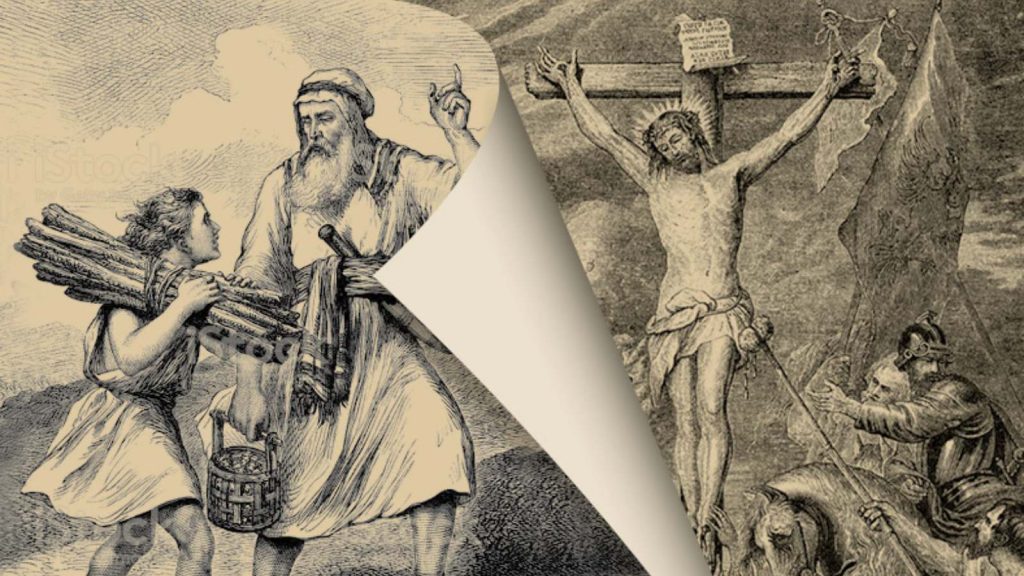
Ethan’s Dad: As my last post noted, we recently celebrated the twins’ fourth birthday. In our Bible Study Fellowship classes, the lesson for Ethan’s Mom and I that week of Ethan’s birthday was Abraham’s sacrifice of his son Isaac (Genesis 22:1-14). People who believe or live as though there is no spiritual aspect to life would ascribe that kind of occurrence to a mere coincidence, but if you believe that God exists, that He loves you, and that He is active in your life, then it is not so easy to dismiss this scheduling alignment.

So why would God have us study that particular story on that particular week? From a certain point of view, it seems cruel to have to ponder a story about God asking Abraham to sacrifice his son on the same week we remember the coming into the world of the the son we lost. And I don’t want what I am going to relate here to obscure the reality that engaging with the lesson was painful. To be sure, there are key differences between Abraham’s experience and ours: God did not ask us to give up Ethan, like He commanded Abraham to sacrifice Isaac, and our son was actually taken, without warning or explanation, while Abraham ultimately received the grace of not having to go through with the horrible deed and thus retained his son. Perhaps most importantly, the Genesis text expressly states that God was testing Abraham (22:1). As I have related in this blog before, I steadfastly believe that Ethan’s death was not a “test” from God: death is evil; it is not part of God’s original plan for us, and ascribing a tragedy like that to some sort of spiritual maturation process co-signs Ethan to being nothing more than a pawn in other people’s lives, which is absolutely wrong.

Even though we can mentally recognize those differences, the story still evokes strong emotions because of our experience. We understand what is being asked of Abraham in a tangible way few others can. Likewise, we have a deeper sense of what it actually meant for God to sacrifice, and be separated from, His Son Jesus on the Cross. (Though no human can adequately grasp the level of that sacrifice because Jesus physically endured an almost unimaginably grotesque death, He spiritually bore the entire sin of the world for all-time, and He and the Father had never before experienced the separation this sacrifice required). But if you asked us, we would say in a heartbeat that this deeper sense of understanding the magnitude of the loss at issue is not worth it. Indeed, there have been numerous times in the wake of that most horrendous of days that we have questioned whether this whole way of setting things up makes sense or was worth it. Why would God create a world where He knew so much pain was going to be inflicted on people He says He loves?

But then you have to remember Genesis 3:15 (“And I will put enmity between you and the woman, and between your offspring and hers; he will crush your head, and you will strike his heel.”) which tells us that God also set up this world in such a way that His Son (and therefore also Himself) was going to hang on a tree by nails in order to save us. So we can’t say that God is ducking any of the pain or that this is some kind of cruel joke or game He is playing because no rational person would set up such a wrenching game. In other words, God could identify with Abraham, and He can identify with us, just as we can with them.

And that truth got me thinking that perhaps the reason God had us do this particular lesson on this particular week was to identify with Abraham all the way through the story — not just in the sense of loss — but in order to affirm to us that Ethan was a precious gift to us, just as Isaac was to Abraham. For just as Isaac’s conception and birth were miracles, it also was a miracle that Ethan was born safely in that ambulance four years ago. As his only child, Abraham undoubtedly had spent a tremendous amount of time with Isaac before God gave this test to Abraham. We spent two priceless, brief months with Ethan, caring for him more intensely than any other baby we have had, up until the very moment he left us. But there is more to the parallel. Abraham was able to obey God’s command because Isaac’s life was a testimony to the facts that God always keeps His promises and that God does impossible things. According to Hebrews 11:19, Abraham in fact was clinging to the belief that Isaac would be raised from the dead, even though he had no concrete experience of such an event. But Abraham did know that God had demonstrated the power to create life from Sarah’s “dead” womb, and so Abraham firmly believed (because otherwise how could he ever have taken even the first step toward that mountain?) that even Isaac’s death could not hinder God from keeping His promises about Isaac and his offspring.

It is true that God endured the sacrifice of His Son while knowing that that Jesus was going to be raised from the dead, while Abraham had to rely on faith in carrying out God’s command to sacrifice Isaac. But that is precisely the point: we must come to understand that faith in God is as certain as actually knowing how it all ends. God commended and blessed Abraham, He preserved Isaac in the flesh, and He saved Abraham for eternity precisely because of Abraham’s indomitable faith in what was true: that God is a promise-keeper who does the impossible, including resurrection. Thus, to God knowing the answer is not as important as having faith in Him that there will be an answer.

Yes, this story of Abraham and Isaac is about how obedience to God may involve great sacrifice — though not more than God already has sacrificed for our salvation. But it is just as much about sustaining faith in God’s power of resurrection. So perhaps God was reassuring us on that particular week that His gift of Ethan to us was not in vain; we, like Abraham, can believe with confidence that we will see Ethan again because God ensured exactly that with none other than His own Son, who lives and is with Ethan at this very moment. Praise the Lord for His comforting truth in the midst of great sorrow!

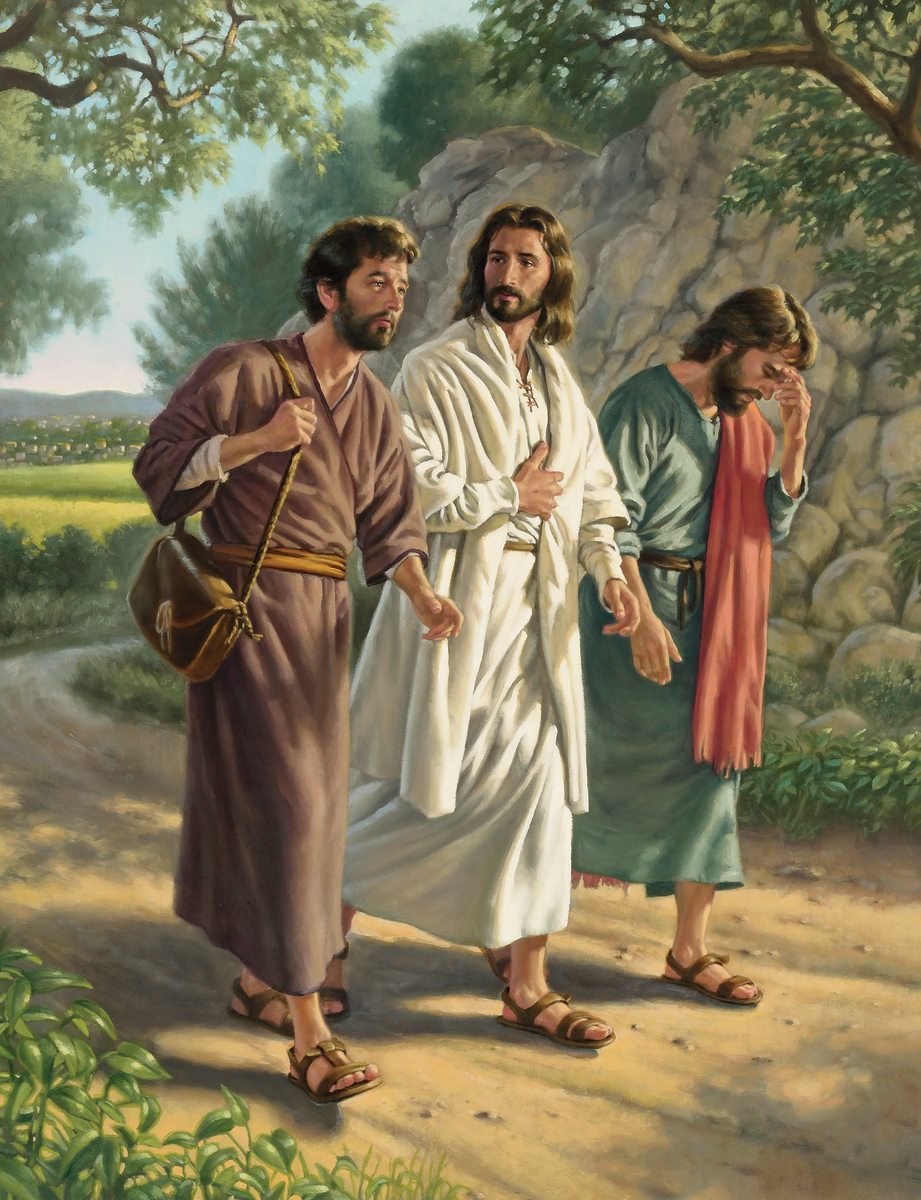
On the Road to Emmaus

Road to Emmaus

Several weeks ago a pastor at our church gave a sermon based on the story of the Road to Emmaus. For anyone who might be unfamiliar with it, the story can be found in Luke 24:13-35, and it is about who two followers of Jesus encountered when they were walking to a village about seven miles from Jerusalem on the day Jesus rose from the dead — before that news had widely spread. There are many fascinating aspects to the story, but this time when I was reading it one particular fact struck me in a way it had not done before. The story begins like this:

“That same day two of Jesus’ followers were walking to the village of Emmaus, seven miles from Jerusalem. As they walked along they were talking about everything that had happened. As they talked and discussed these things, Jesus himself suddenly came and began walking with them. But God kept them from recognizing him.

“Jesus asked them, ‘What are you discussing so intently as you walk along?’

“They stopped short, sadness written across their faces. Then one of them, Cleopas, replied, ‘You must be the only person in Jerusalem who hasn’t heard about all the things that have happened there the last few days.’

“‘What things?’ Jesus asked.

“‘The things that happened to Jesus, the man from Nazareth,’ they said. ‘He was a prophet who did powerful miracles, and he was a mighty teacher in the eyes of God and all the people. But our leading priests and other religious leaders handed him over to be condemned to death, and they crucified him. We had hoped he was the Messiah who had come to rescue Israel. This all happened three days ago.

“‘Then some women from our group of his followers were at his tomb early this morning, and they came back with an amazing report. They said his body was missing, and they had seen angels who told them Jesus is alive! Some of our men ran out to see, and sure enough, his body was gone, just as the women had said.

“Then Jesus said to them, ‘You foolish people! You find it so hard to believe all that the prophets wrote in the Scriptures. Wasn’t it clearly predicted that the Messiah would have to suffer all these things before entering his glory?’ Then Jesus took them through the writings of Moses and all the prophets, explaining from all the Scriptures the things concerning himself.”

What struck me was the line: “But God kept them from recognizing him.” (Luke 24:16). The immediate question that comes to mind is why? Why did God prevent these followers from recognizing Jesus the moment He appeared to them? As the story relates, the men were clearly distraught by the events of the crucifixion. As I attempted to convey in my last post, His followers’ whole worlds were turned upside down when Jesus was killed. These men tell Jesus that they had “hoped he was the Messiah,” and then those hopes were seemingly dashed by Jesus’ sudden and gruesome demise, which they probably witnessed. So, why in the world would God prevent these grieving men from recognizing Jesus standing in the flesh before them?

Of course, you start to get some sense of the answer as the story unfolds. First, the men honestly told Jesus what they believed: they thought Jesus was a great prophet and teacher, but they were unconvinced that He was the Messiah. Jesus then explained the Scriptures (what we today call the Old Testament) to them as they were meant to be understood, with Jesus at their center. His teaching was so powerful that the men literally begged Him to stay with them longer even though they still didn’t actually know who He was.

“By this time they were nearing Emmaus and the end of their journey. Jesus acted as if he were going on, but they begged him, ‘Stay the night with us, since it is getting late.’ So he went home with them. As they sat down to eat, he took the bread and blessed it. Then he broke it and gave it to them. Suddenly, their eyes were opened, and they recognized him. And at that moment he disappeared!

“They said to each other, ‘Didn’t our hearts burn within us as he talked with us on the road and explained the Scriptures to us?’ And within the hour they were on their way back to Jerusalem. There they found the eleven disciples and the others who had gathered with them, who said, ‘The Lord has really risen! He appeared to Peter.'”

After the encounter, the men didn’t sit around or go to bed; they got right back on the road back to Jerusalem to tell the Disciples what had happened to them. They were practically bursting with the news. These men, who had been followers, were now true believers in Jesus as the Savior of the world because now they had to tell people about Him.

Thus, by the end of the story, it becomes clear that God kept the men from initially recognizing Jesus for their own good. Their belief needed the uncertainty, and, dare I say, the pain, that came from not understanding what had happened to Jesus. It needed those prompting questions from a seeming stranger to bring their honest doubts to the surface. The men also clearly needed guidance from Jesus to traverse this spiritual journey from anxiety to exuberance about Jesus, but they did not really know that was their need. In short, in order for the men to experience a progression from factual knowledge about the Bible and Jesus to genuine understanding and faith in who Jesus really is, the men had to be kept in the dark for a little while. Timing was crucial to a correct understanding of the answers they sought.

So, you might be thinking: “That’s all very interesting with regard to how people come to a saving knowledge of Jesus, but why are you writing about it in this blog that is dedicated to Ethan?” And the answer is that I think God can be telling us more than one thing through the stories He has preserved for us in the Bible. I have no doubt that the story of the men on the Road to Emmaus is about a journey toward faith in Jesus. But it also can have something to say about how God raises His children.

No one knows us better than God because He made us. “For you created my inmost being; you knit me together in my mother’s womb.” (Psalm 139:13). He knows what we need, and, just as important, when we need it. So, when this story says, “God kept them from recognizing Jesus,” it suggests that there are times that God purposefully does not reveal to us the answer to a question we ask — even when we desperately want an answer for good an understandable reasons — because the timing is not right for us to receive that answer. For reasons we cannot fathom at the time, we must walk through a period of pain, uncertainty, inquisition, and spiritual guidance from the Lord before we are prepared to fully grasp the import of the answer.

If you think about it, we do the same with our own children. Children ask questions all the time that we know the answers to, but for a variety of reasons we do not provide them with an immediate direct answer. In many cases, we do not reveal the answer because the child is not ready to understand the answer. It is better for the child that the answer waits for a more appropriate time. This can be true for something as simple as a birthday surprise or as profound as how they came to be. In fact, there are even times when we will tell them the true answer because it is unavoidable, but they will not come to grasp the full import of that answer until many years later. I know this last one to be true from telling our other children when we came home from the hospital on March 10, 2017, that Ethan was not coming home. Our other children are still too young to really understand what his absence means.

The question I always ask God is Why? Why would You let our Ethan die so young, before we could see all he was meant to be? Why would You perform this miraculous work of creating so precious a creature inside his mother — together with his brother Noah — and then let that “wonderful work” die in our arms? (Psalm 139:14). Why would You allow this harrowing experience of twins being born in the back of an ambulance in an ice storm, only to then watch one of them expire after being raced to a hospital in another ambulance? Why would You have him be born with a hole in his heart, so that each of his days before a necessary (but supposedly common) surgery were a painful struggle for him, only to have him leave us before he could have that operation? Why? Why? Why?

Aside from the cold reality that evil really does exist in this world, God has not given me an answer. And to be honest, I believe that I am going to live the rest of my life — however long it is — without receiving an answer. I know that sounds depressing. And again, to be honest, there are a lot of times that the silence that surrounds that pleading question is just that: depressing, forlorn, dark — much like I imagine those men on that Road felt two days after Jesus had cried out from the Cross “My God, my God, why have You forsaken me?” before He breathed His last. (Matthew 27:46).

But it is also good to remember that this does not mean there isn’t an answer. The answer to Jesus’ question from the Cross came the moment He took His first breath in that tomb Sunday morning. The answer to those men’s questions was standing right in front of them even though they did not yet know it. It is a mistake to be believe that just because you do not receive an immediate answer to a heartfelt question that no answer exists -– or that you will never receive it. Sometimes the when is just as important as the what.

And I believe that there is a reason I have to wait for the answer to my question. I am well aware in saying this that it means God is purposefully allowing me to travel this road of uncertainty, doubt, and yes, even pain before I receive the answer. That is not an easy thing to accept, but the truth is often not easy; it is, however, necessary. And, by the way, that does not mean it is easy for God to make me wait, just as it is sometimes hard for me to keep an answer from my own children. God knows that I ache, and grieve, and wonder, and I believe that it rends His heart to watch me go through this experience. (Psalm 56:8).  But if sometimes what is best is not what is easiest, then that is as true for God as it is for us. So, in His infinite wisdom, He keeps the knowledge from me even though it pains Him to do so.

But please do not misunderstand: I am not saying that God thought Ethan needed to die in order for me to experience some kind of spiritual progression in my life. Some well-meaning Christians, in a round about way, say things like this to fellow believers who have suffered excruciating losses in an attempt to offer meaning for a senseless event. It isn’t true. What these people do not realize is that what they are really saying is that the loved one the fellow believer lost was just a pawn for God’s work in that believer’s life. That is an insult, not a comfort. How could this be if Ethan, like all of the other precious ones who are tragically lost through no fault of their own, is “fearfully and wonderfully made?” (Psalm 139:14). Pardon me for the bluntness, but this idea that all things occur for your own betterment is an extraordinarily selfish view of life. There is a distinct and important difference between understanding that God can produce good from the ash of tragic circumstances and saying that tragic circumstances are for our good. The former is Biblical truth; the latter is nothing less than the denial of the existence of evil.

What I am saying is that for some reason, I am not ready for the full answer to this question of Why. I think it is likely that at least part of the reason is simply that my finite existence is incapable of understanding it. Regardless, what is important for me to grasp is that sometimes God does not give us an immediate answer, not because it doesn’t exist or because we don’t deserve one, but rather because it is absolutely necessary for us to wait in order for the answer to have the meaning it is intended to have. And so I must wait. But I do not wait as one with no hope:

“It is wrong to say that the Almighty does not listen, to say the Almighty is not concerned. You say you cannot see him, but He will bring justice if you will only wait.” (Job 35:13-14).

One day I will have an answer, but it will be better than just a mystery revealed; it will include setting this wrong aright again.

“Yes, the Sovereign Lord is coming in power. He will rule with a powerful arm…. He will carry His lambs in His arms, holding them close to His heart.” (Isaiah 40:10-11).

I will not just get to see why; like the men on that Road, I will get to see Who is the answer. And I will see Him holding Ethan in His arms . . . waiting for me.

A Perpetual Saturday

Ethan’s Dad: I never really gave much thought to that Saturday. It wasn’t that I was flippant about it or that I purposefully ignored it. It was just that, in the Christian tradition I grew up in (and I think most others), all of the focus is placed on Good Friday and Easter Sunday. In many ways this is perfectly understandable.

Good Friday is the cataclysmic crisis point in which everything comes crashing down, the unthinkable occurs, and abject evil appears to win. For Christians that day is the definition of the ultimate sacrifice by the only One capable of making it for our sins.

In the starkest of contrasts, Easter Sunday is the glorious climax, the triumph, the grandest of all happy endings. It is the impossible of resurrection from the dead occurring, and yet it was simultaneously inevitable if Jesus was who He said He was because death could not hold onto the Author of life. For Christians that day means a new and ultimately eternal life with God.

So it is little wonder that Saturday is overlooked or even forgotten as it bridges these two profound and all-important days. But you don’t traverse a chasm without a bridge, so it is a required part of the journey, and — I have come to realize — it is more precarious than at first it might seem to be.

Can you imagine for a moment what that day must have been like for Mary, the Disciples, and others close to Jesus? Jesus had completely changed their lives: shown them miraculous signs reminiscent of wonders spoken about by ancestors of old, opened the doors of love beyond their previous comprehension, given them a brand-new purpose for life, and offered a hope unlike any they had ever known before. He had promised them an eternity with Him.

And then it all came to a sudden and sickening end in the span of one dark day. It must have been extremely confusing for them to watch Jesus be arrested, let alone witness Him beaten, then offered to the crowds, and then crucified like a common criminal. Everything they had known, believed, and hoped was instantly shattered beyond all recognition the moment Jesus breathed His last on that cross. It had to seem almost surreal, like it had to be a nightmare that they would surely awake from at any minute.

But when Saturday dawned, the darkness was still there, and it was, if anything, more oppressive. The sheer intensity of the trauma from the previous day was replaced by the stark void of the loss. Jesus really was not there. His leadership, assurance, and love were gone. More immediately, His presence was missing. And somehow they had to go on.

Remember that they did not know what would happen on Sunday. Jesus had tried to tell them, of course, but they just couldn’t understand it. Honestly, in a way you can’t blame them. It was all unlike anything that had ever happened before. Granted, as I have said, they had witnessed Jesus precipitate several miraculous events on a smaller scale: feeding thousands with almost no food, calming raging seas and walking on water, raising Lazarus after he had been in a tomb for 4 days. But this time they had watched Him die. And not just any death, but the most gruesome devised by the Roman Empire. It had to feel devastating, bewildering, hopeless. Surely they just wanted to crawl into a shell and never come out.

So they waited . . . and wondered. What was there left to do? How do you hold onto faith when everything you believed is turned upside down? How do you maintain hope when you watch it breathe it’s final breath? How do you continue to love when what illuminates that love is buried in a tomb? The questions are endless and the answers are elusive; they feel out there, yet not accessible. That Saturday they lived in a kind of netherworld — not really dead, but not capable of fully living either.

“So they took His body down
The man who said He was the resurrection and the life
Was lifeless on the ground now
The sky was red His blood along the blade of night

“And as the Sabbath fell they shrouded Him in linen
They dressed Him like a wound
The rich man and the women
They laid Him in the tomb

“….

“So they laid their hopes away
They buried all their dreams
About the Kingdom He proclaimed
And they sealed them in the grave
As a holy silence fell on all Jerusalem”

-Andrew Peterson (God Rested)

If you haven’t already guessed it, the reason for this rumination (other than the fact that it is Easter weekend) is because for my wife and I it feels as if we are living every day in something like that Saturday. You see, on one level, the day of a tragic event is the hardest because the vividness of its devastation haunts you over and over again. But in another sense, the day after is almost harder. At the time, the day of the event seems surreal, like it can’t be happening, like you are watching it from the outside as it unfolds. But the day after the horror, the reality hits you because the frantic energy of the moment is no longer there, and a person you love gone. The stark realization of permanent absence desolates your soul and you can hardly breathe, let alone dare to believe that one day the chasm of that loss will disappear and you will be reunited again.

An irreplaceable presence, our Ethan, is missing from our lives every day. It is an absence we did not ask for or expect. And that absence stretches on, with each new day bringing an ache and unsettledness that never quite subsides. When we say we are “Walking in the Shadowlands,” this is, in large part, what we mean.

An undeniable fact about that Saturday long ago is that God knew what it would be like for those close to Jesus after He was crucified.  God knew about the pain, confusion, and uncertainty, and yet He did not break through the silence to give them reassurance. He let then wait until Sunday to see the answer for themselves. I think it is worth asking: Why did God allow them to endure that Saturday?

The most immediate answer is that He knew everything would be made right again on Sunday. But what if it was more than that? Suppose that the waiting, with all of its attendant anguish, bewilderment, and doubt, was a necessary part of the process for the revelation of the Resurrection.  Would the Disciples have fully grasped the implications of the Resurrection without experiencing what life would be without Jesus’ presence?

Of course, Christians today know how the whole story unfolded, so it is harder to grasp what the loss of Jesus must have felt like on that Saturday.  But we do experience personal losses, sometimes profound ones.  And sometimes, when there is a loss that is wretchingly dear, God asks us to wait the rest of our earthly lives — to trust Him in the midst of the daggers of pain and whirlwinds of questions — until we come to the end of that seemingly perpetual Saturday and see that the loss will be made whole.

For me, then, there is a strange comfort in the fact that dark Saturdays are not alien to Christianity; they are, in fact, apparently somehow integral to it.  It does not lessen Ethan’s loss for me, but it does show me that God knows what I am feeling, and the fact that He has let me experience it is not proof that He is not there, as some would tell you.  Instead, the loss of that precious boy, and the restless unease that accompanies it, imparts a little more understanding of what life would mean without Jesus, without His death, burial, and resurrection.  So, I will keep walking in the shadows and looking forward to dawning of that Sunday when

“the Lord Himself will descend from heaven with a shout, with the voice of the archangel and with the trumpet of God, and the dead in Christ will rise first. Then we who are alive and remain will be caught up together with them in the clouds to meet the Lord in the air, and so we shall always be with the Lord.” (1 Thessalonians 4:16-17).


Weep Until You Have No Strength to Weep

Ethan’s Mom: This week was pretty weird in our BSF study of People of the Promised Land. The assigned chapters in 1 Samuel included Saul meeting with a medium (1 Sam. 28:3-25) (that is a whole other post for a different day, and probably not one written by me) and the study questions included one about experiencing the silence of God (also a tender subject with my husband and I). Ethan’s dad had an intense conversation in his small group for that portion of his discussion last night, speaking up about how the silence cannot always be explained by unrepentant sin driving a wedge between you and God. My group did not take that direction in answering that question, but I had my own moment of “is this really how we are going to answer this question?” a little later on in our discussion.

Here’s the background (1 Sam. 30): David and his men were between a rock and a hard place – they had been living in Philistia, hiding from Saul and deceiving the Philistine king Achish into thinking they were allies against Israel. For a minute, it seems David is going to be conscripted into fighting against Israel, but God mercifully provides away out of the bed that David has made before he has to lie in it. His men return to their home base at Ziklag to find that an enemy clan has burned it to the ground and kidnapped the wives and children of all the soldiers, including David. Verse 4 says, “So David and his men wept aloud until they had no strength left to weep.” That verse is what I wrote down to answer the first question on that section: “Describe the scene at Ziklag. How did David and his men respond?”

No one immediately jumped to field that question, and my group leader tried rephrasing it. “What was the first thing David does when he returns to this scene?” she asks. I replied, “wept until he had no strength to weep.” She seemed a little surprised and said, “Well, yes, but… what was next? What did he do? In verse 6?” Someone else provided the answer she was looking for, that David found strength in the Lord. She follows up with “Then in verse 9?” Someone else answers, “David inquired of God.”

First of all, if someone “does something next” that is not, by definition, the thing that he does first. But I was taken aback by more than mere semantics. Glossing over the fact that David’s initial reaction was to weep until he had no strength left to weep totally discounts his grief over losing his family. Yes, they were kidnapped and eventually rescued, but initially David didn’t know their fate. For all he knows, he will never see his family again, and he is leading hundreds of men who will never see their families again.

Let’s allow them to weep before we are demanding that they find strength in God, shall we?

I firmly believe after my experience, watching my husband grieve, and reading several books/memoirs by fellow mourners, that the tears must come first, then the strength in the Lord, and then the inquiring of God.

In the lecture that followed, the teaching leader made a statement that struck me as she was summarizing the divergent paths of Saul and David. “No one drifts toward God.” While we do not earn God’s mercy or grace towards us, faith does require a conscious choice to seek God. This has never before been so clear to me. Sometimes I feel like not only am I not drifting to Him, I am fighting against a strong current of pain and doubt as I struggle to swim towards Him. But in those initial months of shock, confusion, and disbelief, I could do nothing but be tossed by the waves. I could not even ask why or articulate to God that I was angry or sad or anything.  It was a terrible place to be, but I couldn’t just sit up and say, “let me go and find strength in God.”

Choosing to trust God and find strength in him requires more effort than I had for quite some time.  But eventually, I could.  I think I am just now maybe beginning to move to the inquiring of God stage — to trust that He will not only keep me from drowning in a pit of despair (finding strength in Him) but also guide me into an abundant life as I inquire of Him what to do next (wow, that was even just hard to type, I am definitely just beginning to move into that stage!)

So I want to encourage you, whoever you are, that if you are faced with a devastating loss, it is OK to weep until you have no strength left to weep.  Don’t let anyone rush you through this — the time frame that is right for you is known only by you and the Lord.  You do not have to find strength in God or have stalwart trust that He has a plan for you in the midst of this tragedy.  There will come a time when you will have to look to someone or something for strength to resume your life, and at that point, you will have to make a conscious choice to find your strength in God.  He will strengthen you and eventually you will then be able to inquire of God — looking for redemption in the midst of your tragedy and discerning “what is His good, pleasant, and perfect will” (Rom. 12:2) for your life, including your life after loss.

Tough Chicks

pieta-1499.jpg!Large

Ethan’s Mom: Last week before church started I was visiting with a friend who should be celebrating her first Christmas as a grandmother. Her daughter, whom I remember being in the youth group when we first joined our church, was due in October with a baby girl but is now in “the club” after her daughter was stillborn this summer. Although our stories have some pretty significant differences, we are both believers and mommies to babies in heaven, which makes Christmastime more important and more painful than you might realize. At the end of our chat, my friend looked at me and said “You both are really tough chicks.” I chuckled at first but then said, “You know what? We are.”

One theme that has popped up again in Bible Study Fellowship this year as we are studying the People of the Promised Land is that people play a role in God’s plan for their lives. God promised them the land, but they had to go take it. They had to take the first step into the Jordan River, blow their trumpets outside the walls of Jericho, and show up for battle when they were completely outnumbered. Last year when we studied Romans, we learned that salvation is the same way. It is not by our own will or volition we are saved, but there is some kind of mystery of how God enables us to receive His salvation through faith — not the absence of doubt but the presence of faithfulness. I remember one of the teaching leaders illustrations was about a man who walked (or maybe rode a bike?) on a tight wire across Niagara Falls. He asked the crowd if they believed he could carry someone across with him, and the crowd went wild with cheers… until he asked for a volunteer. No one came forward to show their faith in his ability by the action of volunteering.

There are days I literally have no idea how I made it through, and I know there was something supernatural going on. But even on those days, I have to choose to get out of the bed. To be honest, nearly two years later, the days where that is a sacrificial choice are fewer but not gone. Just today I had two conversations (with my friend and my husband) that basically ended in us shaking our heads as we said “It’s just really, really hard.” Sometimes there is just nothing else to say.

I didn’t sign up for this. It is my honor to be Ethan’s mom, but it is a really, really hard job.

Which brings me to the actual point of this blog post — there is a woman, really a girl, who signed up for the toughest mothering gig ever. When the angel showed up to tell Mary, “You will conceive and give birth to a son and you will call his name JESUS,” she didn’t try to find out exactly what would be involved before saying yes. She had one (understandable I’d say) logistical question but quickly came to “I am the Lord’s slave, may it be done to me according to your word.”

I can remember in 2016 sitting in the Christmas Eve service, 34 weeks pregnant with the twins, thinking how amazing Mary was for traveling to Bethlehem. At that moment, if Greg had told me we needed to take a trip to his homeland of Ohio, I would have pointed at my huge belly and declared that “we” would not be making this trip with him. Even still, nine hours in the car cannot be compared to a few days on a donkey. Mary is a rock star, I thought.

Two weeks later, there was an ice storm in Birmingham, and I went into labor with no way to get to the hospital. A fire-rescue truck came to our aid and attempted to get me to the only accessible hospital, which I had never even seen before much less planned to go to for delivery. There was no room for my husband in the back with me, so he watched  their births as best he could through the small window up front. There was no one to hold my hand, no technology to monitor the babies, no nurses to coach me through the contractions, and no mom standing nearby with a camera and moral support.

After we got to the hospital and they asked me a million registration and medical history questions, one of the nurses asked if she could call my mom for me. YES! If there is ever a time when a daughter wants her mom, it is when she herself becomes a mom (or becomes a mom again).

Back to Mary — she makes this crazy trip on a donkey. I have always wondered whether or not she expected to make it back before the baby was born. It is not inconceivable that the difficult trip contributed to premature labor and the baby took everyone a bit by surprise. Either way, whether she knew she would be away for the birth or not, she was. No mom or familiar midwife to coach her through her very first delivery. No familiar and safe home in which to welcome her baby.  She was probably in the last place she would have thought she would deliver the Son of God.

This is a far cry from the typical nativity scene played out in churches and yard displays. We just went to the live nativity at our church, and I think ours is typical of most of these programs. Mary and Joseph walk straight to the stable. At best, Mary looks about 6 months pregnant and is moving pretty well. Lights go out. Lights come up. Mary and Joseph sit beaming at a baby doll either in Mary’s arms or the manger. Shepherds and Wisemen arrive, and everyone just looks goo goo eyed at the baby. Curtain.

Now, don’t misunderstand me — I am not advocating that we all bring our children to watch an actress screaming in pain with bloody rags around the stable. I just think maybe we should all realize that was part of Mary and Joseph’s experience as much as the goo goo eyes.

Yes, Joseph found that kind innkeeper. But how many doors did he knock on first? How close were the contractions when they finally found the stable? Did Joseph deliver Jesus and if so, how did he know what to do? Did Mary think “oh how charming this little manger is, full of nice clean hay” or did she cringe as she put Jesus down in the feeding trough because her arms were too tired to hold him another minute? When Mary said, “Let it be done to me as you have said” could she have imagined this? Did she think “this is not what I signed up for as the mother of the Messiah”? What an amazing honor, what a really, really hard job.

Andrew Peterson’s song, “Labor of Love,” conveys the real scene well:

“It was not a silent night
There was blood on the ground
You could hear a woman cry
In the alleyways that night
On the streets of David’s town

“And the stable was not clean
And the cobblestones were cold
And little Mary full of grace
With the tears upon her face
Had no mother’s hand to hold

“It was a labor of pain
It was a cold sky above
But for the girl on the ground in the dark
With every beat of her beautiful heart
It was a labor of love

“Noble Joseph by her side
Callused hands and weary eyes
There were no midwives to be found
On the streets of David’s town
In the middle of the night

“So he held her and he prayed
Shafts of moonlight on his face
But the baby in her womb
He was the maker of the moon
He was the Author of the faith
That could make the mountains move

It was a labor of pain
It was a cold sky above
But for the girl on the ground in the dark
With every beat of her beautiful heart
It was a labor of love

“For little Mary full of grace
With the tears upon her face
It was a labor of love.”

I was really upset for weeks about how the twins came into the world. Turns out, having twins (one breech) in the back of a moving ambulance in an ice storm is a walk in the park compared to burying one of them two months later. It didn’t get any easier for Mary either. When Simeon tells her “a sword will pierce your soul,” he is not kidding. She gets to see the miracles, but she is there at the foot of the cross, watching her baby cry out in terrible pain. She watches him die.

At the retreat I went to in September, the counselor handed out small cards with a picture of Michelangelo’s Pieta on them. I had never seen this sculpture before. Mary is holding the body of Jesus after his crucifixion. She has one hand cradling him and the other open and pointed up, as if she is both holding on and letting go at the same time. According to Catholic tradition, Mary was the first person to hold Jesus and the last. That was her holy and sacred duty and privilege as his mother. Mary, blessed among women, is my new #1 hero in the faith. She isn’t just a smiling, well-coiffed new mother in a charming, rustic stable. She is the toughest of all tough chicks.

If you are reading this as a mother of a baby in heaven, hear me say this — you are a tough chick. God has promised to see you through to heaven where He will wipe all the tears from your eyes and reunite you with your sweet baby. Keep choosing to fight the darkness, and know you are winning the battle even if all you can do is take your next breath. If you can’t take it day by day, back up to hour by hour, or even minute by minute. I am praying for you as I write this, and I think you have a special place near to the heart of the Mary as well. After all, she is in “the club” too. But most of all, you are seen and known by the God who was faithful to strengthen Mary for her very unique mission and is able to strengthen you for yours.

When Love Refrains: What Else the Story of Lazarus Tells us about God

Lazarus 1Ethan’s Dad: My wife has mentioned in this space before that sitting in church can be a trying experience for us. We never know when a song, a prayer, or a statement made in Sunday School banter might open the floodgates of sadness that reside within us from losing Ethan. Of course, this is also true in everyday encounters, but we have found that the likelihood of it occurring is magnified in church because mortality and miracles are topics of discussion in church much more often than in everyday life.

One of those occasions occurred this past Sunday when our pastor was giving a sermon titled “Who is Jesus.” It was part of a series he has been doing in which he has listed three descriptions of Jesus in each sermon and expounded upon them. The first of those descriptions this past Sunday was that Jesus is “the resurrection and the life.” This is a description Jesus gave about himself that is recorded in the book of John, chapter 11, that tells the story of Jesus raising Lazarus from the dead.  In one part of the story, Jesus has a captivating conversation with Martha, the brother of Lazarus.  Just after Martha informed Jesus that Lazarus has died, Jesus said:

“Your brother will rise again.”

“Martha answered, ‘I know he will rise again in the resurrection at the last day.’

“Jesus said to her, ‘I am the resurrection and the life. He would believes in me will live, even though he dies, and whoever lives and believes in me will never die. Do you believe this?’

“‘Yes, Lord,’ she told him, ‘I believe that you are the Christ, the son of God, who was to come into the world.’” (John 11:23-27)

Our pastor was, of course, right that Jesus’s pronouncement about himself in this passage is foundational to the Christian life because it revealed to Martha (and all who would later read those words) who Jesus was in the grandest eternal sense and what they must do to inherit eternal life, which was simply to believe in who He really was. My problem was not with the pastor’s reference to this exchange or to the story of Lazarus in general. My issue was with the pastor’s use of something Martha said right before this part of their conversation.

When Martha first heard that Jesus had arrived in Bethany — the town where she, her sister Mary, and Lazarus had lived — she said to him, “Lord, if only you had been here, my brother would not have died.” (v. 21). To fully understand this comment, you have to know that several days earlier Martha and Mary had sent Jesus a message informing Him that Lazarus was sick, and they no doubt had expected Jesus to come quickly to Lazarus’s aid.  Instead, Jesus arrived in Bethany four days after Lazarus had died.  Jesus’s delay piled confusion on top of the crushing grief Martha was feeling because of her brother’s death.

Our pastor chose to focus on those two little words near the beginning of Martha’s statement: “if only.” The pastor did a riff on how we all have “if only” times in our lives, i.e, times when we believe that things could have been different if only God had acted or if only we had made a different choice. He made some statement about how, in thinking this way, we are often more focused on temporal things while God is concerned with eternal matters. Again, that is a true statement in itself (to a degree). And I believe the pastor’s point was that whatever those “if only” moments might be in our lives, Jesus is the ultimate answer to them because He is the resurrection and the life.

Now, as I have said, I had no theological problem with any of this in the abstract. My issue was that as soon as the pastor started talking about “if only” moments, my mind (and my wife’s) immediately veered to March 10, 2017, and that horrific period when we literally screamed for God to save our precious Ethan. We begged; we pleaded; we cried oceans of tears. . . . And nothing happened.

So, here is the thing about Martha’s statement that the pastor chose to gloss over: she was right. If Jesus had been there before Lazarus had died, He could have saved Lazarus from death. Indeed, in all likelihood Martha had seen Jesus do it before for total strangers. All she was wondering was: why didn’t Jesus come earlier and save His friend Lazarus? And is that really such a bad thing to wonder about?

I don’t think so. For one thing, Jesus did not rebuke Martha in any way for her implied question. In fact, if she had not wondered about it, I think it would mean that Martha did not really believe that Jesus was who He said He was. But we know this isn’t true because Martha gave not one, but two great statements of faith. Right after Martha made her “if only” statement, she said: “But I know that even now God will give you whatever you ask.” (v. 22). And then when Jesus asks her if she believes that He is the resurrection and the life, Martha responds unequivocally: “Yes, Lord, I believe that you are the Christ, the Son of God who was to come into the world.” (v. 27).

As one who has been where Martha was, in the throes somber grief, I have to say that this is a wonderful testimony on her part. The Holy Spirit must have encouraged her, but it is truly admirable that Martha did not let her deep sorrow swallow her faith in Jesus at that moment. The sincerity of Martha’s faith practically explodes off the page because of the palpably desperate moment in which she expresses those statements. It is not unlike that moment when a thief hanging on a cross, in the midst of excruciating agony, expressed his faith in Jesus even as Jesus was on a cross right beside him (Luke 23:40-43), or when Stephen asked the Lord to forgive his executioners as they stone him and he proclaimed that he saw Jesus standing at God’s right hand in heaven. (Acts 7:54-60).  To proclaim Jesus as Lord when doubt has enveloped the heart and darkness is one’s sole companion: those are the testimonies that speak most to me because I know first-hand how difficult it becomes in that lonely place to cling to this truth.

But as commendable as Martha’s faith is, do not lose sight of the fact that, at the same time, she questioned Jesus’s timing. For faith and questions are not incompatible; they are, in a sense, inseparable. We do not continue to learn about who Jesus is if we do not keep wondering about why things must be the way they are. For Jesus is “the author and perfecter of our faith,” (Hebrews 12:2), where “perfect” really means “finish” or “complete.” Our faith must mature, and it only does so when we probe and ask Jesus to show us who He is, just as Martha did. And I think the answer she received stretched beyond her imagination, because how could one really conceive that Jesus was going to call Lazarus forth out of that tomb, and that Lazarus would actually walk out of it as if nothing at all had happened to him?

So as I sat there in the pew now only half listening to the rest of the sermon, I kept poring over this story about Lazarus, a story like the widow of Zarephath, which inevitably causes a believer who loses someone close to him or her to wonder, just as Martha did: Why didn’t you save him, Lord? And I am not afraid to confess that I did not receive an answer. But what I did see was something I had never noticed before in all my years of being told about and then reading this story. It was this: Doing this was really hard for Jesus.

I don’t mean the raising of Lazarus from the dead. Indeed, the remarkable thing is that that was the easy part for Jesus. For Jesus, raising Lazarus was no different than restoring a blind man’s sight or causing a lame man to walk or walking on water. Certainly, it seemed different to everyone else, but for the One “through whom all things were created, things in heaven and on earth, visible and invisible,” resurrection is not difficult. (Colossians 1:16; see also John 1:3).

No, what was really difficult for Jesus was not saving Lazarus before he died. Go back to when Martha and Mary first sent their message to Jesus telling Him that Lazarus was sick. John 11:3 says: “So the sisters sent word to Jesus, ‘Lord, the one you love is sick.’” Martha and Mary knew Jesus would understand that they were talking about Lazarus, which tells us that Jesus and Lazarus must have been extremely close friends. Jesus responded to this message by saying: “This sickness will not end in death. No, it is for God’s glory so that God’s Son may be glorified through it.” (v. 4). This response, though somewhat cryptic at this point in the story, tells us that something bigger was going on than anyone could really understand.

But then John decides to give the reader an interesting side note.

“Jesus loved Martha and her sister and Lazarus. Yet, when He heard that Lazarus was sick, he stayed where He was two more days.” (vv. 5-6).

This note drives home the point that Jesus loved all three of these people very much, and yet He did not do what everyone would think He would do and rush to see Lazarus, Martha, and Mary. No, instead, Jesus essentially decided to kill time with his Disciples while Martha and Mary watched their brother suffer and die. Despite appearances, this isn’t callousness; it is the exact opposite: it is unfathomable love. John is telling us that Jesus really wanted to rush to Lazarus’s side, but that for the sake of something greater, He had to wait.

This point is reinforced again when Jesus said to his Disciples: “Lazarus is dead, and for your sake I am glad I was not there, so that you may believe.” (vv. 14-15). Jesus says He is glad for their sakes, not His own, because if this was just about His personal feelings, He would not have allowed Lazarus to die. Jesus was also acknowledging here that if He had been there, He would have healed Lazarus rather than letting him die. Think about it: where in the Gospels is there a time when Jesus refused an in-person request for healing? He certainly would not have refused to heal if He was standing before his dear friends watching Lazarus suffer. So, Jesus did not go right away because He knew what had to happen — Lazarus dying — and that it would not have happened if He had gone to them sooner.

John decides to make very sure the reader does not miss how difficult this was for Jesus by noting that when Jesus saw Mary and her friends weeping near Lazarus’s tomb, “He was deeply moved in spirit and troubled,” (v. 33). And then he observes that “Jesus wept” when He saw Lazarus’s tomb. (v. 35). The word “troubled” that is used in verse 33 is the same root word Jesus later used in the Garden of Gesthsemane to describe His spirit in its agony before the crucifixion. And yet again, just before Jesus raises Lazarus, John notes that “Jesus, once more deeply moved, came to the tomb.” (v. 38).

John (God, really) is practically begging his readers recognize that Lazarus’s death precipitated intense pain for Jesus. Jesus understood that allowing Lazarus to die had caused great pain and grief for people He loved very much. Jesus weeps for the real anguish that is present even though He is about to remove the reason for it by raising Lazarus from the dead.

In the same way, I believe that God weeps for us in our sorrow for Ethan’s loss. God knows that Ethan is with Him and that He will raise Ethan again for us to see one day, but He also knows that there is real and genuine suffering caused right now by Ethan’s absence. He knows that torment because Jesus lived it. The fact that Jesus is the resurrection and the life gives us incredible hope for eternity, but it does not erase our reality of agonizing loss in the here and now. God does not ask us to ignore or diminish that reality because He has shared it.

So God wants us to know that He truly understands our pain and grief. But in this incarnation story, God tells us more than just that He felt as we feel. He tells us that there are times when, in His love, He refrains from acting to save even though it deeply wounds Him to stay His healing hand. In the immediate sense it is not what He wants: God does not enjoy seeing our suffering, and it hurts Him even beyond what we can imagine because He knows that He can help us. But sometimes God chooses “to stay away from Bethany for a couple of days” even as He hears our cries. I do not pretend to know why He makes this choice at some times while at others He rushes to save one in need.

Certainly the answer comes easier in the Lazarus story, for Jesus delayed coming so that He could demonstrate that His power extends even over death itself. Further, Jesus’s raising of Lazarus started to bring the conspiracy against Jesus to a head because the miracle caused a great many more people to believe in Him, and, in turn, the religious leaders resolved that Jesus must be stopped at all cost. So His raising of Lazarus became a part of the chain of events that led to the crucifixion, which caused His death, which precipitates His resurrection, and leads to our redemption.

God’s choice to refrain from acting in our circumstances does not portend such heady consequences — at least so far as I can see. I believe that at least in part the answer to why He sometimes stays His healing hand lies in the fact that this world is corrupted by evil, and in many cases God must let the consequences of that evil play out; otherwise, love and choice do not exist. And part of the answer lies in how suffering occasions examples like Martha who proclaim their belief in Jesus even as they drown in sorrow, and by so doing they embolden others to believe likewise. But those are only partial answers. Right now we know in part, but there will be a time when we will know in full. (See 1 Corinthians 13:12).

Yet, as much as I wonder about a complete answer to the why question, even a full answer would not bring Ethan back. Consequently, for me what is more important is the knowledge that God’s failure to act does not equate to a failure to care. God can simultaneously allow and yet participate in our suffering. In fact, this also happens when people sin. Sin hurts the sinner and often those around him or her. But it also grieves God to see His children participate in evil. Thus, whether the suffering is caused by the world’s brokenness or by human rebellion, God permits pain knowing that it will cause Him intense pain as well, all because of His greater purposes.

In the story of Lazarus Jesus tells us that greater purpose is “God’s glory,” (v. 4) and our eternal lives (v. 25). The stories of our earthly lives take places within that context, and so ultimately we can take lasting comfort in the assurance that the tragedies which befall us — tragedies seen by a God who hurts with us as we experience them — will one day be made right again. One day He will call Ethan forth and we will see him again because Jesus truly is the resurrection and the life.

Some Lessons from the Book of Ruth

Ethan’s Mom: Confession – two weeks ago when I saw that our next Bible Study Fellowship unit was on Ruth, I was not super excited. Great, I thought. This is just a love story where everything works out for everyone, nothing like my life. Turns out, I had a lot to learn from this not-so-easy love story. So much, in fact, that not only was it the focus of BSF, it was also a focal point of a book I was reading with a small group of intergenerational ladies at church. It seems God really wanted me to pay attention to these folks, and I think I can see why.

For starters, let’s all take a moment to acknowledge that Naomi is not just a supporting actress in this drama. There is so much that Ruth’s mother-in-law and their relationship can teach us. I had not really paid close attention to her before, but then again, I had never identified with her grief before March 2017. First, she went to a foreign land with her husband and sons. Then her husband dies, and years later both boys marry and then they die as well. I think in order to familiarize modern readers with the cultural challenges that Naomi faced, the message that comes through most loudly is that Naomi was in a pickle because she had no income or that she was in despair because she was going to go hungry. No doubt the financial woes and uncertainty were a huge stresser, but that is not the whole story. She is grieving the loss of THREE people in her immediate family. The only three people in her immediate family. For the sake of argument, let’s assume she and Elimelech had an arranged marriage and maybe his death didn’t break her heart. Maybe she was so mad at him for moving the family to Moab that she felt like she lost her meal ticket but not her happiness. You can’t tell me, though, that she wasn’t torn to pieces over losing her sons. One of the sweetest relationships that has developed since our loss is my friendship with an older lady at church whose adult son died unexpectedly. The loss of an adult child may be different in some ways than losing an infant, but there is deep, unrelenting grief in both situations. That makes me feel like I can identify with Naomi in a way I never really identified with Ruth.

For instance, it may sound a little melodramatic when Naomi arrives back in Israel and demands that people call her “Mara, for the Almighty has dealt very bitterly with me.” (Rule 1:20).  Here she is, rolling back into her old neighborhood, seeing people she hasn’t seen in more than 10 years. There was no post office, much less Instagram. I’m thinking no one knows what has befallen her. She is likely telling the story over and over as she sees more and more people who inquire after her family or want to be introduced to this foreign woman she has with her. She is likely finding out that some of her old friends have bucket loads of grandchildren and are totally set for life. She has made a long, arduous journey with plenty of time to reflect on her situation and wishes that her husband or sons were travelling with her. I don’t blame her a bit for saying “I went away full, and the Lord has brought me back empty.” This is not a suck-it-up-buttercup kind of a moment; this is understandable anguish.

Do you know what is missing after this little pity party? A rebuke. Thanks to my husband for pointing that out to me. Naomi may not be theologically on target, but she’s being honest. This says to me that God can handle honest, even bitter honest, maybe even especially bitter honest. The important thing is not what she said when overwhelmed with sorrow when her arrival caused a “stirring” among the women in her old neighborhood. The important thing is that she had made the decision in Ruth 1:7 to “set out on the road that would take (her) back to the land of Judah.” She made the decision to move towards God in the midst of her fear and depression. It didn’t erase her pain immediately, but she was moving, one step at a time, toward the one who could bring redemption to her terrible circumstances.

Redemption. It’s a huge theme in the book of Ruth. It’s a huge theme in our lives walking in the shadowlands. Aside from the foreshadowing of Jesus as our kinsman-redeemer and all the beauty that entails, the story has moments where the tragic circumstances of Naomi and Ruth are redeemed by Boaz’s actions.

If there is one thing that parents whose babies have died want, it is for their loss to be redeemed in some way. There are bereaved mothers who have launched non-profits, written books, organized fundraisers or remembrance walks, etc., etc. We desperately want something good to come out of this because ultimately that gives us a way to share our little one’s life and legacy with others.

Side note: This is NOT the same as finding a reason for the tragedy – do not tell me that Ethan died so that this or that would happen. He is not just a pawn in God’s big chess game, and all the promises in the Bible that I can claim apply to him, too. That’s a whole other post, one that is probably better suited for my husband to analyze in this space.

Anyway, I have struggled with this thought since a few months after Ethan’s death. I have had ideas on how I can honor his memory, but nothing seems big or important enough to qualify as redemption, except things that seem impossible. I felt like God was saying to me through the study of Ruth that it is not up to me to do the redeeming. That’s His job.

Ruth has left her homeland and her family of origin after losing her husband. She lost so much. There is no reason to believe that she and Naomi were walking up the incline to Bethlehem talking about how great they were going to have it once they arrived. I’m quite sure they weren’t discussing how they might fit into the lineage of the Messiah. They were just doing what they felt was right in going back to the Promised Land and to the one true God. When they arrive, Ruth says she will go out and work for their food, and that’s just what she did. She went out and gleaned in Boaz’s field. Nothing glamorous, but she worked so hard on the task at hand that Boaz took notice of her work ethic and her devotion to Naomi.

God took her day-in-and-day-out obedience in the most mundane task, and out of that He brought redemption to Ruth’s life, Naomi’s life, the nation of Israel, and ultimately all humanity. I felt like He was pressing upon my heart that He wants my day-in-day-out obedience in the mundane tasks of mothering my four children on earth, loving my husband, and pouring into relationships with friends and family. Out of that work I have set before me, He will set into motion a plan to bring redemption in this lifetime to our loss, our pain, and our grief.

The story ends with Ruth and Boaz’s son, Obed, sitting in Naomi’s lap. Don’t you know that woman loved her grandson something fierce? I just imagine them having the sweetest relationship. She and Ruth must have just stared into his squishy baby face and delighted in counting his fingers and toes. They must have marveled at their miracle baby as he learned to talk and walk. That would have been such a blessing on its own, but then we find out that Obed has a son named Jesse. Jesse has a son named David, who becomes the king of Israel and a man after God’s own heart. From David, the lineage goes straight down to Jesus. There is so much more redemption coming than Ruth or Naomi could ever have imagined, and they don’t even see it in their lifetimes. Even the possibility that God can do more with our situation than we could plan, even more than we can imagine, gives me such hope. Now I am going to bed in preparation for another day of gleaning tomorrow, and I will rest in the freedom that the rest of our story is in much better hands than mine.